Travel Guide› Suzhou› Zhouzhuang Ancient Town
Suzhou

Zhouzhuang Ancient Town 周庄古镇

Zhouzhuang Ancient Town
Address
No. 43 Quanfu Road, Zhouzhuang Town, Kunshan City, Suzhou, Jiangsu Province, China
Zhouzhuang Ancient Town

Section One: Overview

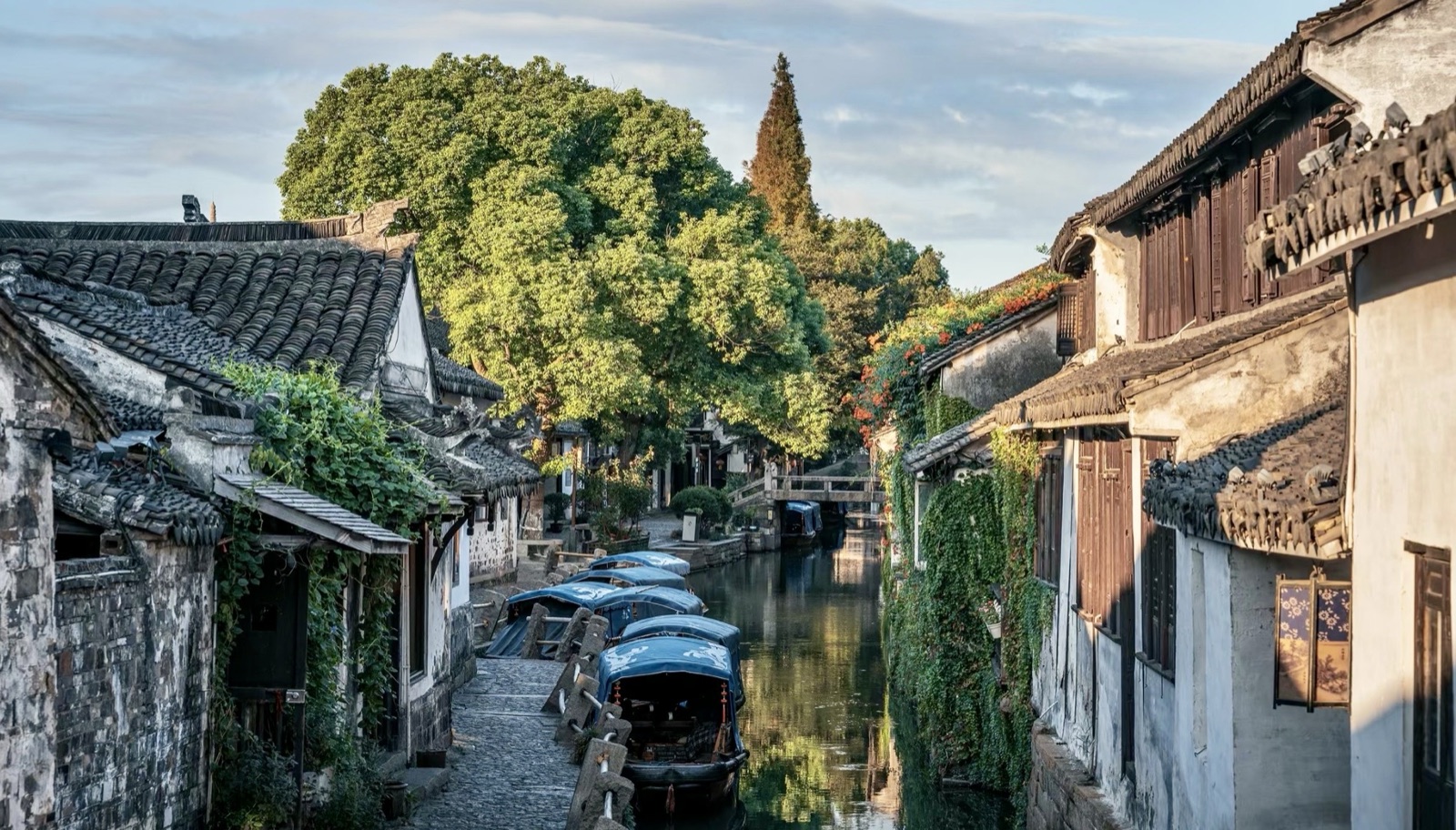
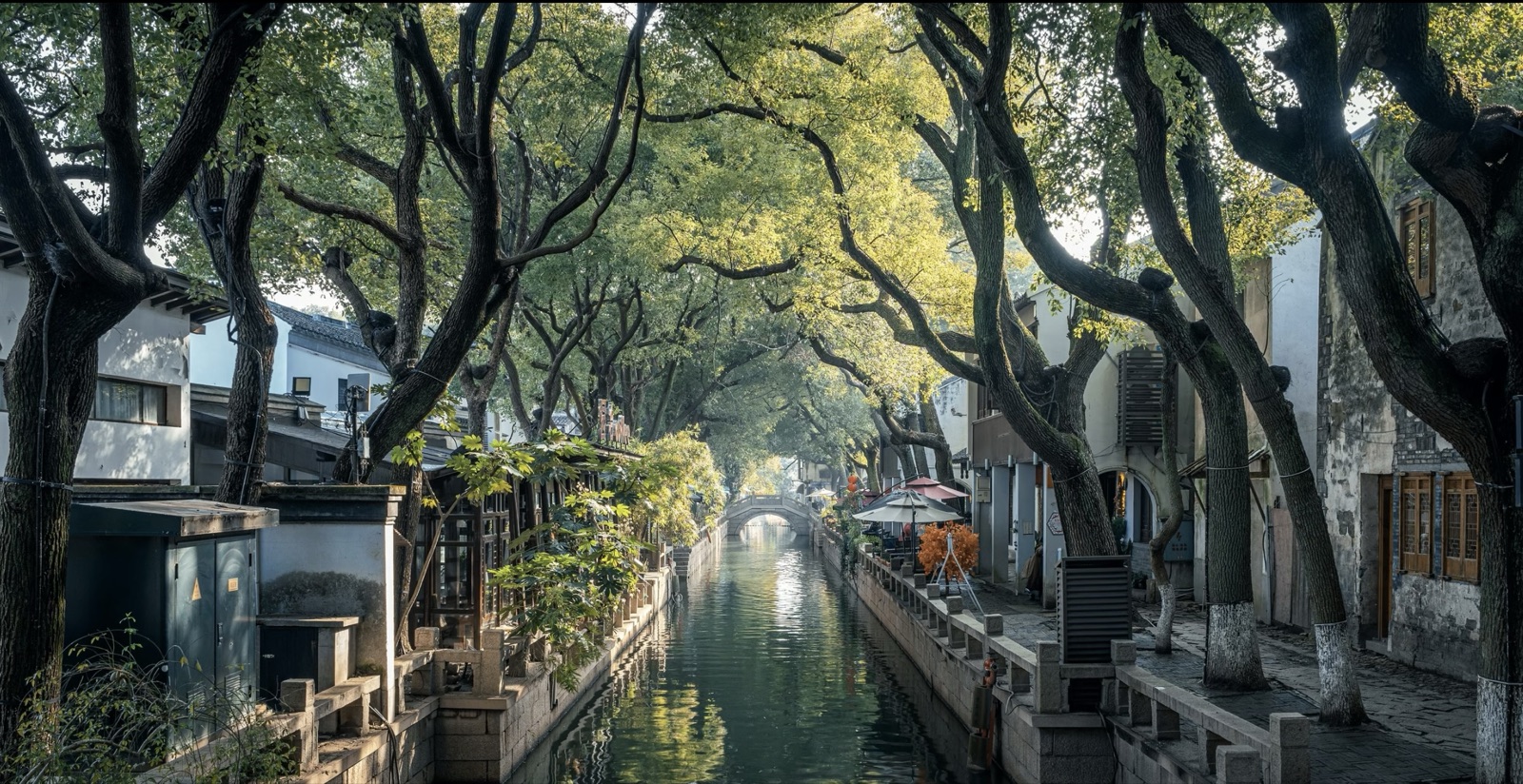
Zhouzhuang Ancient Town is located in Kunshan, Suzhou, Jiangsu Province, in the heart of the Taihu Lake basin and Jiangnan's waterway network. Founded in 1086, the first year of the Yuanyou reign of the Northern Song dynasty, the town has a history of more than 900 years. It is one of China's first nationally designated Historic and Cultural Towns and one of the country's first 5A-rated national scenic areas, known as "China's Number One Water Town." Surrounded on all sides by water, the town is built around a grid-shaped canal system, with fourteen well-preserved ancient bridges from the Yuan, Ming, and Qing dynasties serving as its connective tissue. Together, they preserve in full the authentic Jiangnan waterway landscape of "little bridges, flowing water, and homes" as it stood in the Ming and Qing periods. Zhouzhuang gained international renown in 1984 when artist Chen Yifei painted his oil work Hometown Memories using the Twin Bridges as his subject, and the town became a defining image of Chinese water-town culture on the world stage. In 2003, Zhouzhuang was placed on China's Tentative List for UNESCO World Heritage status. With the Twin Bridges, Shen's Residence, and Zhang's Residence as its centerpiece attractions, the town brings together vernacular architecture, historic canal bridges, folk customs, and religious heritage — making it an invaluable living specimen for the study of Jiangnan urban history, traditional water-town culture, and Ming-Qing architectural art. The town stretches nearly one kilometer east to west and about 500 meters north to south, with a total built area of over 20,000 square meters. Its historic landmarks — the Ancient Stage, Twin Bridges, Shen's Residence, Zhang's Residence, Fu'an Bridge, Milou Pavilion, Zhouzhuang Museum, Strange House, Zhenfeng Bridge, and Quanfu Temple — together form a complete living scroll of Jiangnan waterway life.

Section Two: Attractions

  1. Ancient Stage
  2. Twin Bridges
  3. Shen's Residence
  4. Zhang's Residence
  5. Fu'an Bridge
  6. Milou Pavilion
  7. Zhouzhuang Museum
  8. Strange House
  9. Zhenfeng Bridge
  10. Quanfu Temple

Section Three: Attraction Introductions

Ancient Stage

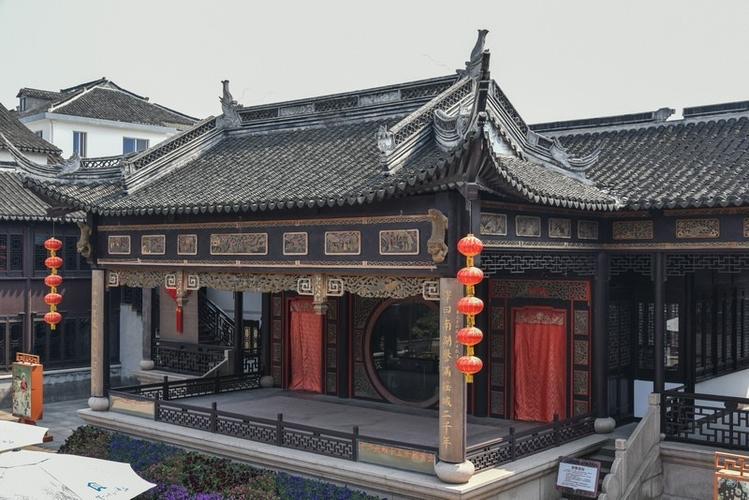
The Ancient Stage stands at the northern entrance to Zhouzhuang and is the first landmark visitors encounter upon entering the town. Originally built during the Qianlong reign of the Qing dynasty, it has been restored several times and now presents the classic form of a traditional Kunqu opera stage with sweeping upturned eaves and richly painted beams. Facing north toward an open plaza, the stage is fronted by a reflecting pool whose still surface mirrors the performances above — a variation on the classical "waterside pavilion stage" design. Daily scheduled performances of Kunqu and Xi opera make it one of Zhouzhuang's most important windows onto intangible cultural heritage. The architecture itself is a work of art: the bracket clusters, architrave beams, and decorative corner brackets are all carved with operatic figures, narrative scenes, and auspicious motifs in a style typical of Qing-dynasty Jiangnan stage construction. The Ancient Stage is not only a performance venue but also a symbol of Zhouzhuang's tradition of welcoming guests through the art of opera.

Twin Bridges

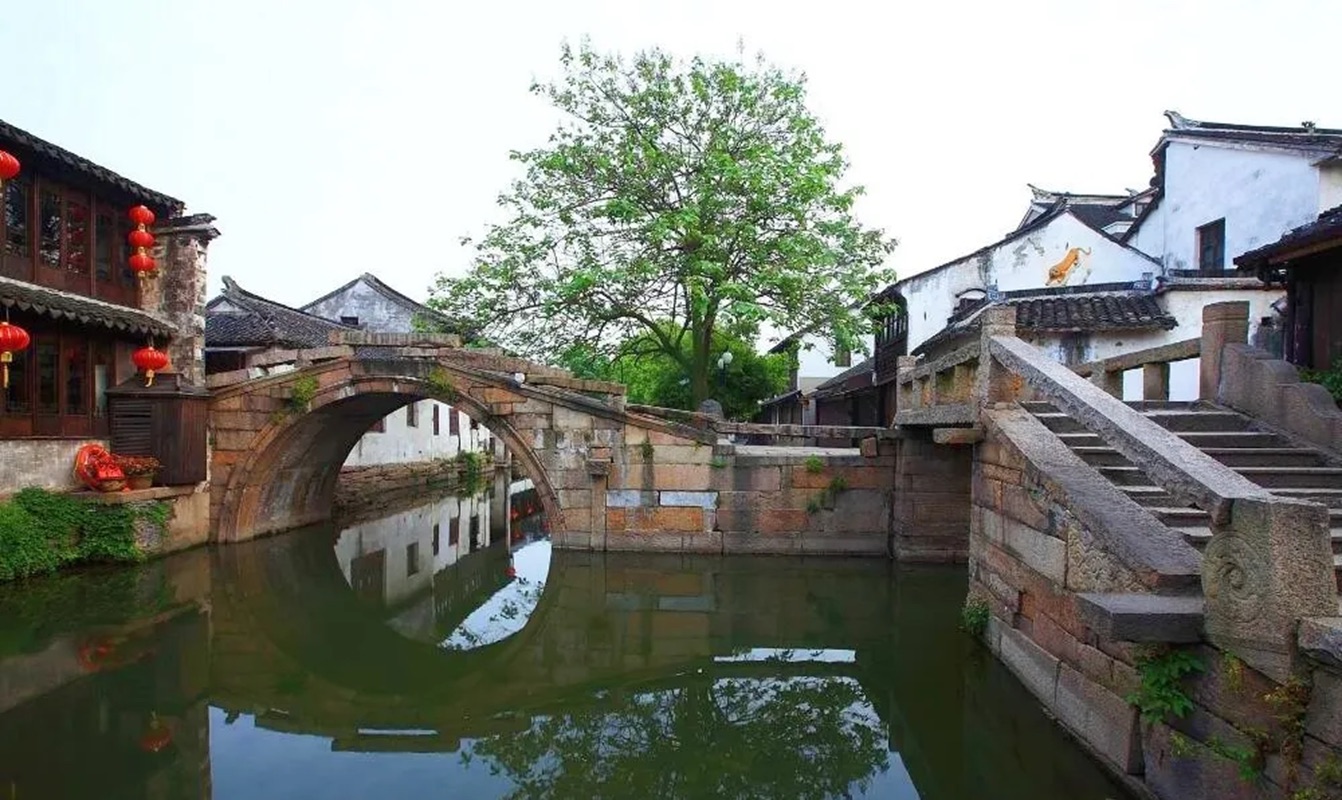
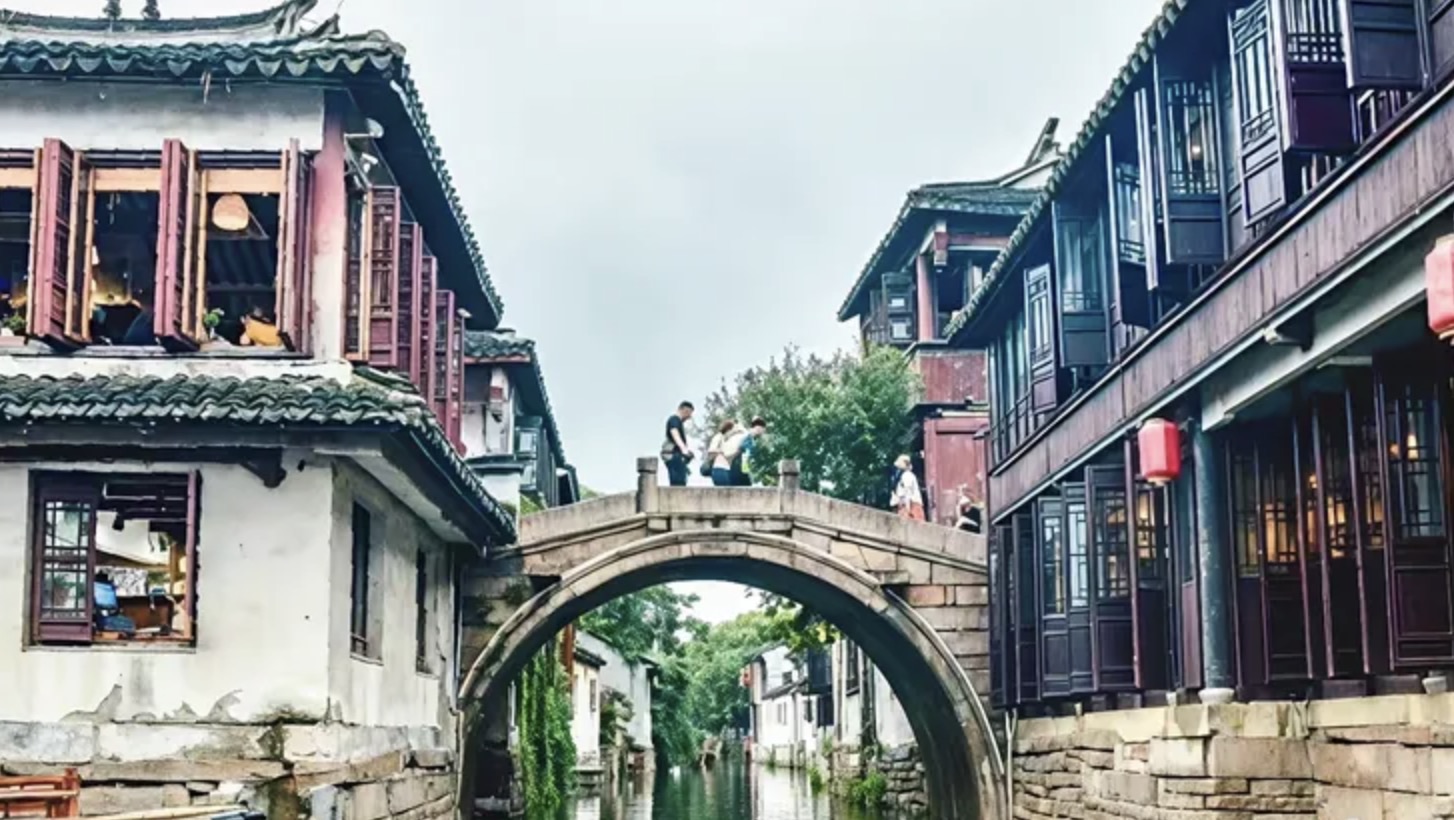
The Twin Bridges sit at the heart of Zhouzhuang and consist of two stone arch bridges joined at a right angle: Shide Bridge, with a round arch, and Yong'an Bridge, with a square arch. The two bridges connect end to end — one round, one square, forming an image locals affectionately call the "key bridge," the round arch resembling the head of a key and the square arch its shaft. In 1984, Chinese-American painter Chen Yifei created his oil painting Hometown Memories with the Twin Bridges as his subject. The work was acquired by oil magnate Armand Hammer, who presented it to Deng Xiaoping during his 1985 visit to China. The bridges became world-famous overnight, and Zhouzhuang transformed from a quiet Jiangnan town into "China's Number One Water Town." Shide Bridge is 16 meters long; Yong'an Bridge is 13 meters long. Water flows through both arches — the round and the square — and when the river is still, the bridge openings and their reflections combine to form a perfect geometric pattern of circle and square. The Twin Bridges are Zhouzhuang's most iconic water-town symbol and the most photographed spot in the entire town. Standing at the bridgehead, visitors look out on a quintessential Jiangnan scene: riverside homes, overhanging eaves, and trailing willows brushing the water.

Shen's Residence

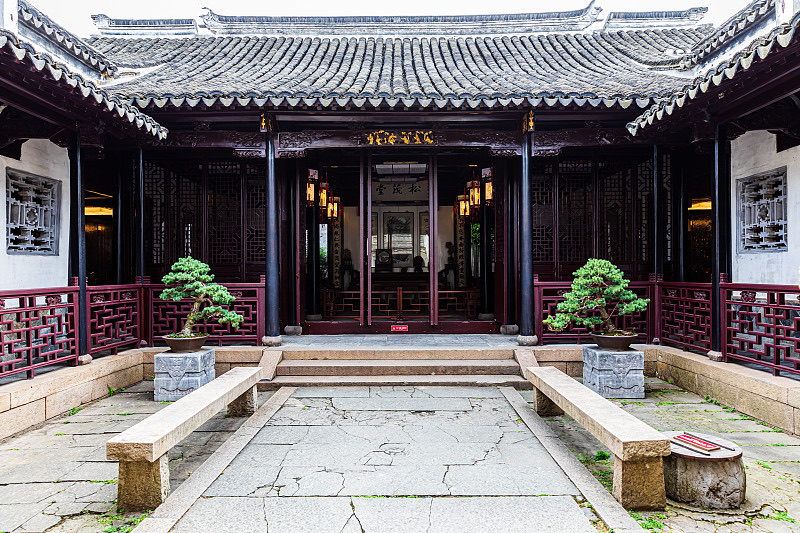
Shen's Residence stands southeast of Fu'an Bridge. Built in 1742, the seventh year of the Qianlong reign of the Qing dynasty, it was constructed by Shen Benren, a descendant of the fabulously wealthy Ming-dynasty merchant Shen Wansan. It is the largest and best-preserved Ming-Qing residential complex in Zhouzhuang. Oriented east-west, the compound covers over 2,000 square meters and unfolds through seven courtyards and five gate towers along a central axis: a watergate entrance, a front hall, a main hall, an upper main hall, a smaller upper hall, and a rear hall, with side passages and wing rooms on either side. The arrangement is strict and hierarchically ordered. The main hall, Songmao Hall, is five bays wide; its beams and columns are nanmu timber — one of China's most prized hardwoods — elaborately carved throughout, representing the finest tradition of Jiangnan residential craftsmanship. Shen's Residence showcases not only the architectural logic of a prosperous Ming-Qing merchant household but also carries, through the legend of Shen Wansan's wealth, the collective imagination of China's Jiangnan commercial culture. The rear hall houses displays on Shen Wansan's life and Zhouzhuang folk artifacts, making it an essential stop for anyone interested in the town's history.

Zhang's Residence

Zhang's Residence stands on North Market Street and was built during the Zhengtong reign of the Ming dynasty — more than 560 years ago. It was originally constructed by descendants of Xu Kui, the younger brother of Xu Da, a founding general of the Ming dynasty. It later passed to the Zhang family, and the name Zhang's Residence has stuck ever since. The compound covers over 1,800 square meters, extends through six courtyards, and contains more than seventy rooms across its halls and upper floors. Its most celebrated feature is captured in the phrase "sedan chairs enter through the front gate; boats pass right through the house." Between the front hall and the rear courtyard, a canal flows directly through the property, with a private riverside landing where boats could dock inside the compound itself. This "house-and-waterway-as-one" arrangement is the classic expression of the Jiangnan water-town residential form. The rear courtyard garden, known as Zhujing — "Chopstick Creek" — is small but exquisitely composed: Taihu Lake rockery, winding pools, and garden pavilions integrate seamlessly with the halls and buildings. Zhang's Residence, in its Ming-dynasty architectural vocabulary, stands in instructive contrast to the Qing-dynasty Shen's Residence and is an invaluable specimen for studying how Zhouzhuang's architecture evolved over the centuries. In early spring, a magnolia tree in the garden bursts into bloom — one of the most poetic sights the residence has to offer.

Fu'an Bridge

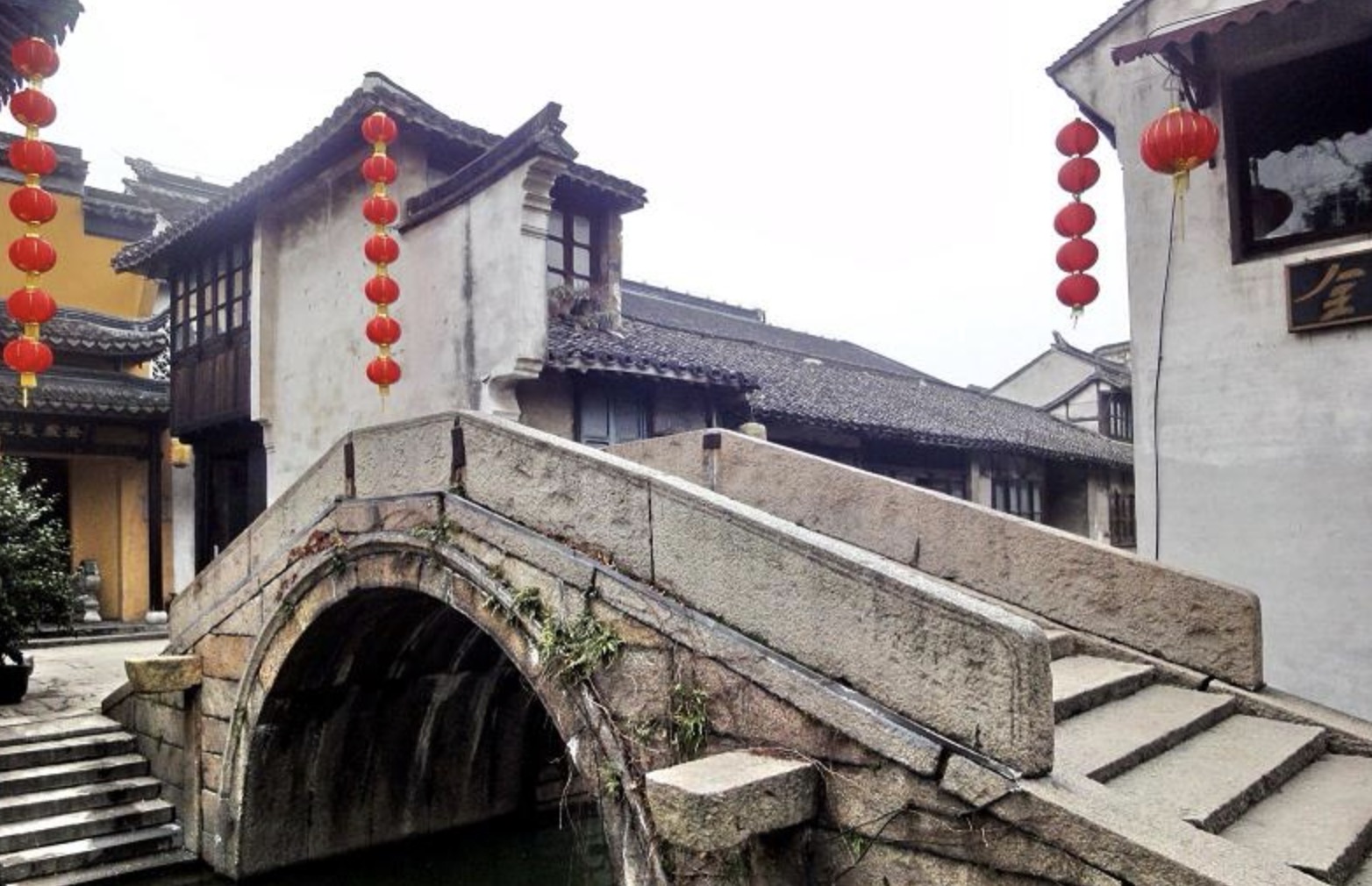
Fu'an Bridge spans the North-South Market River on Central Market Street. Built in 1355, the fifteenth year of the Zhizheng reign of the Yuan dynasty, it is one of the oldest surviving bridges in Zhouzhuang. A single-arch stone bridge, it is 17.4 meters long and 3.8 meters wide, with a body of granite and arches built using the transverse parallel construction method — solid and enduring. On both sides of the bridge, five-bay bridge houses have been built with upturned eaves, their structure fully integrated with the bridge itself. This "bridge topped by buildings" arrangement is extremely rare among Jiangnan water-town bridges. The ground floors of the bridge houses serve as shops; the upper floors as riverside residences. Pedestrians walk through the bridge, traders do business from within it, and residents look out over the water from their upstairs windows — a "bridge-and-market-as-one" configuration that stands as living evidence of Zhouzhuang's commercial vitality in the Ming dynasty. The name Fu'an means "seek peace after gaining wealth." Legend holds that the bridge was rebuilt at the expense of Shen Wansan, who was urged by others that after acquiring great fortune, one should do good works — build bridges, pave roads, accumulate virtue — and so find lasting security. The name reflects a core value of Jiangnan merchant culture.

Milou Pavilion

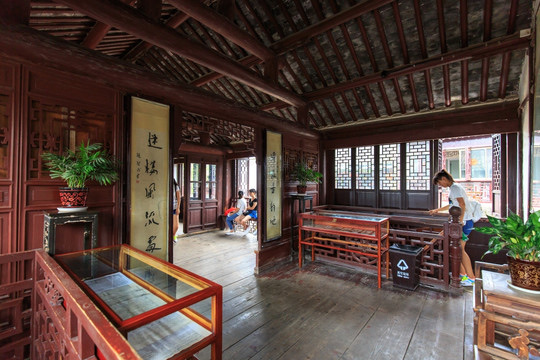
Milou Pavilion stands beside Zhenfeng Bridge. Originally called Deji Tavern, it was a two-story riverside wine house built in the late Qing dynasty — over a hundred years old. Despite its modest appearance, this little building is a significant landmark in the history of modern Chinese literature. Around 1920, in the wake of the New Culture Movement, a group of revolutionary poets gathered around Suzhou and Shanghai and founded a literary society called the Southern Society. These poets championed literature as a tool to awaken the public and resist feudal autocracy. The society's leading figures — Liu Yazi, Ye Cucang, Chen Qubing, Su Manshu, and others — loved to gather in wine houses to drink and compose poetry. In 1920, Liu Yazi and Ye Cucang came to Zhouzhuang, climbed to this second-floor riverside room, pushed open the windows, and found Zhenfeng Bridge right before them: boats drifting on the water, willows trailing along the banks, the classic Jiangnan scene. A few cups of warm rice wine later, the poems came pouring out. Liu Yazi wrote "Night of Revelry at Milou"; Ye Cucang wrote of a hundred years' sorrows surrendered to drink and wandering. They called the place Milou — "the pavilion that bewitches" — because three things had ensnared them: the wine was superb, the scenery was intoxicating, and the poetry they wrote here was the most captivating of all. The pavilion's interior still preserves the setting of those literary gatherings, with photographs, calligraphy, and manuscript poetry from Liu Yazi and his contemporaries on the walls. Milou is proof that Zhouzhuang was never merely a commercial town — it was a place of literary spirit and of wine-and-poetry Jiangnan culture.

Zhouzhuang Museum

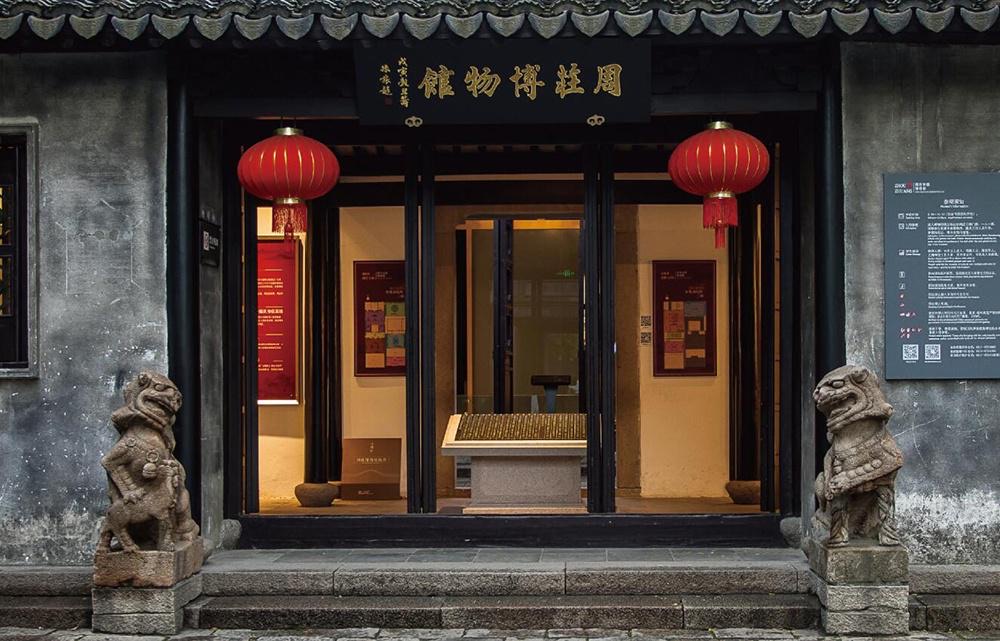
The Zhouzhuang Museum is housed in the Zhu Family Residence on Hougang Street — the former home of Zhu Zhirun, a prosperous merchant of the late Qing and early Republican era, arranged in the classic Jiangnan four-courtyard residential style. The museum makes full use of the original architectural spaces, with galleries devoted to Zhouzhuang's historical development, water-town life implements, folk customs, and traditional crafts, offering a systematic look at the town's evolution from the Northern Song dynasty to the present. The collection of over a thousand artifacts includes Song-dynasty pottery shards, Ming-Qing furniture, agricultural tools, boat fittings, fishermen's clothing, and silkworm-raising equipment. The exhibits most distinctively Zhouzhuang in character are the water-town production tools — oars, rudders, fishing nets, water-chestnut tubs — and folk artifacts such as Wansan pork hock molds and Grandma's Tea sets. The Zhouzhuang Museum is the best single place to trace the town's journey from fishing village to market town, from subsistence farming to long-distance commerce, and to understand the four cultural threads — bridges, water, people, and trade — that run through nine centuries of Zhouzhuang's history.

Strange House

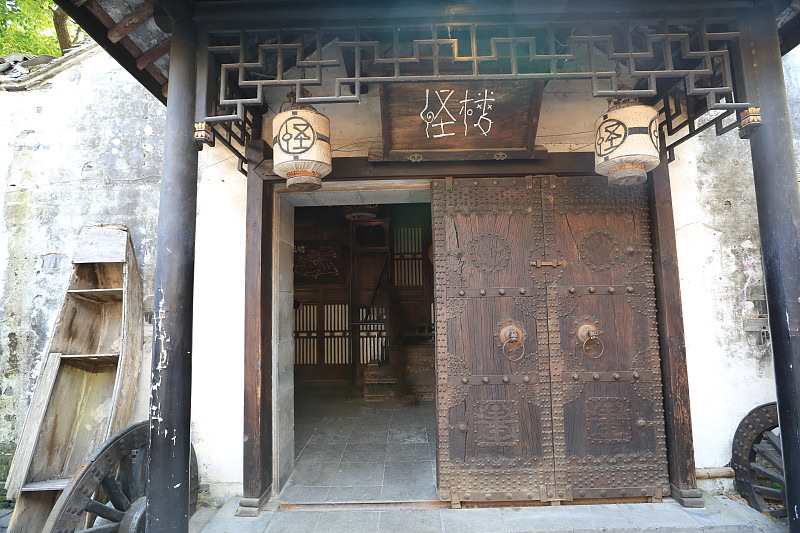
Strange House is a 3D illusion interactive experience center created inside a renovated Qing-dynasty residence on Quangong Road. It blends the traditional Jiangnan vernacular interior with modern optical illusion technology, housing dozens of interactive experience spaces including an upside-down room, a tilted room, a mirror maze, and an invisibility room. In the upside-down room, visitors can "stand" on the ceiling. In the mirror maze, endless reflections surround them from all directions, making it easy to lose all sense of orientation. In the invisibility room, parts of the body appear to vanish entirely against a special transparent screen. Strange House is the modern entertainment offering that Zhouzhuang has developed for younger visitors and families alongside the town's traditional waterway experiences. Its existence also reflects the town's active exploration of how to integrate cultural tourism and experiential innovation while preserving its historic character. No background knowledge is required to enjoy it — just a sense of humor and a willingness to be surprised.

Zhenfeng Bridge

Zhenfeng Bridge crosses the Hougang River on Hougang Street. Built during the Zhizheng reign of the Yuan dynasty, it is, along with Fu'an Bridge, one of the oldest Yuan-dynasty stone arch bridges in Zhouzhuang — over 600 years old. The bridge is 12.2 meters long and 2.8 meters wide, a single-arch stone bridge with a gracefully curved span and a sturdy, time-worn appearance. The name Zhenfeng carries the memory of the town's oldest recorded name: before the Northern Song dynasty, this settlement was called Zhenfengli, meaning "steadfast and abundant." When the Song official Zhou endowed land for a temple here, the grateful community renamed the place Zhouzhuang, but the name Zhenfeng survived in this bridge. The area around Zhenfeng Bridge — home to Milou Pavilion and Zhenfeng Cultural Street — is one of the quieter corners of Zhouzhuang, where commercial activity gives way to the more everyday rhythms of longtime residents. The river here widens into a gentle bend; the water moves slowly, and on still days the surface holds clear reflections of the well-preserved Ming-Qing buildings on both banks. Zhenfeng Bridge is one of the classic vantage points for photographing Zhouzhuang's water reflections.

Quanfu Temple

Quanfu Temple stands on the banks of South Lake at the southern edge of Zhouzhuang. Founded in 1086 — the same year the town itself was established — it is the oldest religious building in Zhouzhuang, with a history of more than 930 years. Legend holds that it was here that the Song official Zhou donated his land to build a temple, and that the people, in gratitude, named the place Zhouzhuang. The temple covers about 40,000 square meters and unfolds along its central axis through the main gate, the Hall of the Heavenly Kings, the Grand Hall, and the Sutra Repository, with bell and drum towers, side halls, and guest quarters on either side. The Buddha statue in the Grand Hall stands more than 10 meters tall, making it one of the larger indoor Buddhist figures in the Jiangnan region. Quanfu Temple backs onto South Lake and faces the ancient town; in front of the temple gates stands a thousand-year-old ginkgo tree, adding a layer of serene antiquity to the whole precinct. The temple is not only Zhouzhuang's Buddhist center but the very site from which the town's name originated. On the first and fifteenth day of each lunar month, and on major Buddhist festivals, the temple draws large numbers of worshippers — it is the essential place to experience Zhouzhuang's folk beliefs and religious culture.

Practical info Opening hours · Ticket · Getting there
Opening hours
  • Scenic area: 08:00–21:00
  • Ticket sales: 08:00–17:00
  • Opening hours of individual attractions vary; check on-site notices
  • Night tours are subject to official announcements
Ticket
  • Day ticket: CNY 100 per person
  • Night ticket: subject to on-site announcement
  • Half-price ticket: CNY 50 per person (minors aged 6–18, full-time undergraduate students and below, seniors aged 60–69 with valid ID)
  • Free admission: children under 6 or under 1.4m, seniors aged 70+, active servicemen, and people with disabilities (valid ID required)
  • Note: Tickets are valid on the day of purchase and allow multiple entries within ticket-selling hours. Prices are subject to on-site announcement
Getting there
  • High-speed/regular train: Take a high-speed train to Kunshan South Station and transfer by bus or taxi to Zhouzhuang, about 40 minutes; or take a regular train to Kunshan Station and transfer to bus 133 or tourist line 7
  • Bus: Take a bus from Suzhou North Bus Station or Kunshan Bus Station to Zhouzhuang; from Kunshan city center, take bus 130, 133, or tourist line 7 to Zhouzhuang Bus Station
  • Driving: Navigate to “Zhouzhuang Ancient Town Scenic Area.” From Shanghai or Suzhou, take the S58 highway and exit at Zhouzhuang; several parking lots are available nearby
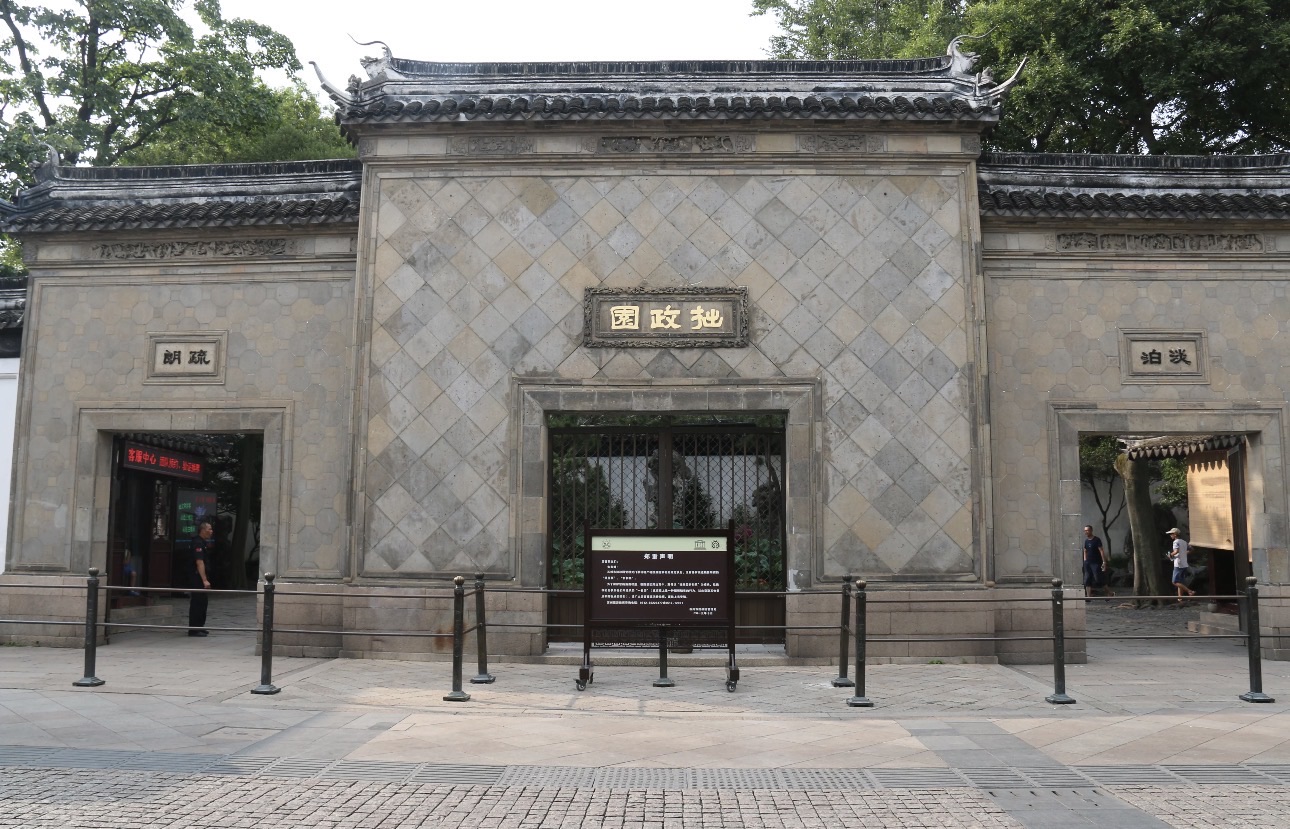
  • Taxi/ride-hailing: Set destination to “No. 43 Quanfu Road, Zhouzhuang Ancient Town” or “Zhouzhuang Ancient Archway”

Inside Zhouzhuang Ancient Town

10 stops, in walking order — read top to bottom, no clicking needed.

1 Ancient Stage of 10

Ancient Stage

古戏台

The Ancient Stage is located near the entrance of Zhouzhuang and is a classic example of a traditional Jiangnan theatrical stage. First built during the Qing Dynasty and later restored, it retains its original timber-frame structure. The stage faces north, with its back to the water. The front stage features a gable-and-hip roof with upturned flying eaves, while the backstage dressing area is separated from the front by a wooden screen. The stone-pillar foundation raises the stage about one meter above ground, allowing viewing from all four sides. Wood carvings adorn the beams, brackets, and lintels — depicting opera scenes and auspicious motifs with exquisite craftsmanship, making this stage an important artifact for the study of Jiangnan folk carving art. In centuries past, opera troupes were invited to perform Kunqu, Yueju, and Xiju during festivals, with townsfolk gathering at the water's edge to watch — a cherished memory of Zhouzhuang's cultural life. Today, the stage still hosts regular performances of Kunqu and other traditional operas, open to all visitors at no additional charge.

On-site narration · read it where you stand

Welcome, everyone. We are standing at the northern entrance to Zhouzhuang Ancient Town, and the building directly in front of you is the Ancient Stage. The Ancient Stage was first built during the Qianlong reign of the Qing dynasty, more than two hundred years ago, and it is the first landmark you encounter after entering Zhouzhuang.

Take a look at how it is designed. The stage faces north toward the plaza behind you. A reflecting pool in front of the stage catches the performance in its still surface — this is a variation on the classical "waterside pavilion stage." The builders understood that a water reflection doubles the visual pleasure for the audience. The stage itself is a riot of traditional ornament: sweeping upturned eaves, painted beams, and elaborately carved bracket clusters, architrave beams, and decorative corner brackets — all depicting operatic figures, narrative scenes, and auspicious motifs. It is a textbook example of Qing-dynasty Jiangnan stage architecture.

Every day, the Ancient Stage hosts scheduled performances of Kunqu opera and Xi opera. Kunqu is one of China's oldest theatrical forms, with a history of more than 600 years. In 2001, UNESCO inscribed it as a Masterpiece of the Oral and Intangible Heritage of Humanity. Its singing style is silky and fluid — people call it the "water-ground melody" — because it flows like water. Xi opera is a local form unique to the Jiangnan region, originating around Changzhou and Wuxi, with a bright and fluid vocal style full of water-town character. The daily program includes excerpts from classics such as The Peony Pavilion, The Palace of Eternal Youth, and The Pearl Pagoda, each running roughly 15 to 20 minutes. If the timing works out, sit down for a piece — it is the most direct way to feel the culture of Jiangnan.

The Ancient Stage is not only a performance venue; it is a symbol of Zhouzhuang's tradition of welcoming guests through the art of opera. In ancient China, the stage was the center of community life — festivals, weddings, funerals, harvest celebrations all brought the whole village or town together in front of a stage. The plaza you see here was once Zhouzhuang's "public living room." Although today's performances are primarily for visitors, the spirit of gathering people through theater has never left. Look at the couplet on either side of the stage: "Ancient and modern fill the eye and ear; heaven and earth open the heart and mind." The upper line says the stories on the stage span all of history; the lower line says the audience comes to understand the universe of human experience through them. Together, they capture the essential purpose of Chinese opera: through invented stories, help people understand real life.

The Ancient Stage also has a remarkable acoustic design. The stage faces an open plaza with a reflecting pool; the water surface reflects sound back toward the audience. At the same time, the building behind the stage and the walls on either side help concentrate the sound. Even without any amplification, a person standing in the plaza can hear the singing clearly. This is a clever application of ancient Chinese architectural acoustics — using the natural environment to enhance sound rather than relying on mechanical equipment. No electricity needed, just ingenuity.

Look at the roof decoration. At each end of the main ridge is a dragon-shaped ornament called a chiwen. According to legend, the chiwen is one of the dragon's offspring and loves to swallow fire, so placing it on the rooftop was believed to protect against fire. Along the ridge, there are also ridge animals — dragon, phoenix, lion, sea horse, celestial horse — whose number and sequence followed strict hierarchical rules. The stage may not be a palace, but as a public building it adheres to traditional conventions. You could call it Zhouzhuang's "cultural palace."

The Ancient Stage is the best spot to photograph Zhouzhuang's cultural landmarks. Stand in the plaza facing the stage and use a symmetrical composition to capture the full frontal view. In the early morning, sunlight comes in from the east and the upturned eaves are outlined in gold against the backlight — very photogenic. At dusk, the lanterns on the stage come alive, and the red light contrasts beautifully against the dark tiles and white walls, making it an excellent moment for night photography. If there is a performance, consider shooting from the audience's vantage point to capture the costumes, long sleeves, and stage movements of the performers — images full of cultural depth.

That covers the Ancient Stage. Please follow me south along the stone-paved lane in front of the stage. In a few minutes we will reach Zhouzhuang's most celebrated attraction — the Twin Bridges.

Twin Bridges

双桥

The Twin Bridges — Shide Bridge and Yong'an Bridge — are so named because they intersect at right angles, one arched and one straight, together resembling an ancient Chinese key. Hence they are also called "Key Bridge" (钥匙桥). Shide Bridge is a stone arch bridge built during the Wanli era of the Ming Dynasty (1573–1620); Yong'an Bridge, a stone beam bridge, dates from the same period. The two bridges span the confluence of Yinzi Stream and the North-South River. Water murmurs below; whitewashed houses with dark-tiled roofs line the banks, their reflections creating a natural ink-wash painting. In 1984, the renowned painter Chen Yifei created the oil painting "Memory of Hometown" featuring the Twin Bridges. Recommended by Armand Hammer, the painting was selected by the United Nations for a first-day cover — launching Zhouzhuang onto the world stage and making the Twin Bridges the most recognizable cultural symbol of Jiangnan water towns. At dawn, when mist rises from the river, or at dusk, when golden light floods the scene, the Twin Bridges reveal their most breathtaking beauty — an unmissable subject for photographers.

On-site narration · read it where you stand

Walking south from the Ancient Stage along the stone-paved lane for about three to five minutes brings us to Zhouzhuang's most famous landmark — the Twin Bridges. Please stop here for a moment and take in the two bridges in front of you. Do you notice that they are connected to each other, and that one has a round arch while the other has a square arch?

The round bridge is called Shide Bridge; the square bridge is called Yong'an Bridge. Both were first built in the Ming dynasty, more than 400 years ago. Shide Bridge has a circular arch opening; Yong'an Bridge has a rectangular one. The two bridges join at a right angle, one running horizontally and the other vertically, one round and one square. Locals describe them as a "key bridge" — the round one looks like the head of a key, the square one like its shaft. A very Chinese way of seeing things.

The reason these two humble Jiangnan bridges became world-famous comes down to one painter and one painting. In 1984, Chinese-American artist Chen Yifei came to Zhouzhuang and was captivated by the distinctive form of the Twin Bridges. Standing at the water's edge, he saw the round arch of Shide Bridge, the square arch of Yong'an Bridge, and their reflections shimmering on the surface below, and painted the scene in an oil work he called Hometown Memories. The painting was later acquired by American oil magnate Armand Hammer, who presented it to Deng Xiaoping during his 1985 visit to China. From that moment, the bridges were known around the world, and Zhouzhuang was transformed from an obscure Jiangnan town into "China's Number One Water Town." A stone beside the Twin Bridges is now inscribed with the words "Twin Bridges" and marks the spot where Chen Yifei stood to paint — have a look as you pass by.

Please walk up to the bridgehead and look down into the water. You will see that the round arch of Shide Bridge and the square arch of Yong'an Bridge together form a striking geometric pattern on the river surface: a circle and a square, side by side, one higher, one lower. When the water is still, the arches and their reflections combine into a perfect set — a complete circle, a complete square. This "circle and square" composition is a visual expression of a classic Chinese philosophical idea: that the sky is round and the earth is square. The Temple of Heaven in Beijing has a circular roof; the Temple of Earth has a square platform. The Twin Bridges have given that ancient idea a form in stone and water — and that deeper resonance is part of why they are so beautiful.

The Twin Bridges are also the busiest photography spot in Zhouzhuang. Visitors with cameras and phones line the bridge from morning to evening. But the best times to photograph them are two: early morning, between six and seven-thirty, and evening, between five and six-thirty. In the early morning, the bridges are nearly empty, sunlight angles in from the east and bathes the stonework and the riverside homes in soft gold, and a faint mist drifts over the water, blurring the reflections in the arches like an ink-wash painting. In the evening, the setting sun comes in from the west and silhouettes the stone arches against a warm, backlit sky, while the white walls and dark roof tiles of both banks glow in amber tones. Both windows are favorites of photographers and painters. If you visit during the day, stand in the center of Yong'an Bridge — the square bridge — and face Shide Bridge — the round one — to shoot. This angle captures both bridges in one frame with the most balanced composition. Looking up from river level through one arch and framing the buildings on the far bank is another unusual angle worth trying.

That covers the Twin Bridges. Please follow me south for another two minutes or so, and we will arrive at Zhouzhuang's most magnificent private residence — Shen's Residence.

Shen Hall

沈厅

Shen Hall is the largest private residence in Zhouzhuang, built in 1742 (the seventh year of the Qianlong reign) by Shen Benren, a descendant of the legendary "richest man in Jiangnan" — Shen Wansan. Covering over 2,000 square meters with more than 100 rooms, the complex faces west and comprises seven courtyards with five gateways along a central axis — front hall, main hall, rear hall, and more — flanked by side chambers and connecting corridors in a rigorously ordered layout. The main hall, "Songmao Hall," spans five bays with massive beams and columns. Its nanmu-wood carved floor-to-ceiling latticed windows are works of art, and the brick carvings on the gateways — depicting scenes from "Dream of the Red Chamber" and "Romance of the Western Chamber" — are masterpieces of Jiangnan residential brick sculpture. The layout reflects the classic merchant-family pattern of "shop in front, residence in the middle, garden behind," offering a vital window into the rise and fall of Ming-Qing commercial dynasties. Today, the hall houses an exhibition on Shen Wansan's life, telling the dramatic story of this legendary merchant.

On-site narration · read it where you stand

Welcome to Shen's Residence, the largest and grandest Ming-Qing private compound in Zhouzhuang Ancient Town. Please look up at the name plaque above the main gate. Shen's Residence was built in 1742, the seventh year of the Qianlong reign of the Qing dynasty — more than 280 years ago. It was constructed by Shen Benren, a descendant of Shen Wansan, the greatest private fortune in late-Yuan and early-Ming dynasty China, and it carries his family name.

Before we go any further, let me tell you about Shen Wansan, because without understanding him it is hard to grasp the scale and significance of what we are about to see. Shen Wansan was the wealthiest man in Jiangnan in the transition from the Yuan to the Ming dynasty. How vast was his fortune? Legend says his landholdings spread across Suzhou, Songjiang, and Huzhou — a wealth said to rival the imperial treasury. When the founding emperor of the Ming dynasty, Zhu Yuanzhang, established his capital at Nanjing and needed to build the city walls, Shen Wansan single-handedly financed one-third of the construction, and even offered to pay the wages of the entire army. The emperor accepted the money but was deeply unsettled: a merchant richer than the Son of Heaven? That could not stand. Shen Wansan was eventually charged on various grounds, exiled to Yunnan, and died far from home. But the family's commercial instincts survived. Generations later, in the Qianlong reign of the Qing dynasty, Shen Benren rebuilt this residence as the family seat in Zhouzhuang.

Shen's Residence covers more than 2,000 square meters, faces west, and extends through seven courtyards and five gate towers. Along its central axis, from front to back: a watergate entrance, a front hall, a main hall, an upper main hall, a smaller upper hall, and a rear hall, with side passages and wing rooms on either side. A seven-courtyard layout was extraordinarily rare even among the wealthiest merchant households of Jiangnan. Most prosperous families made do with three or four courtyards. The scale of Shen's Residence tells us two things: first, the Shen family was still enormously wealthy by the Qing dynasty; second, they had acquired the status through the imperial examination system, because only those who held official rank were permitted to build a residence of this grade and configuration.

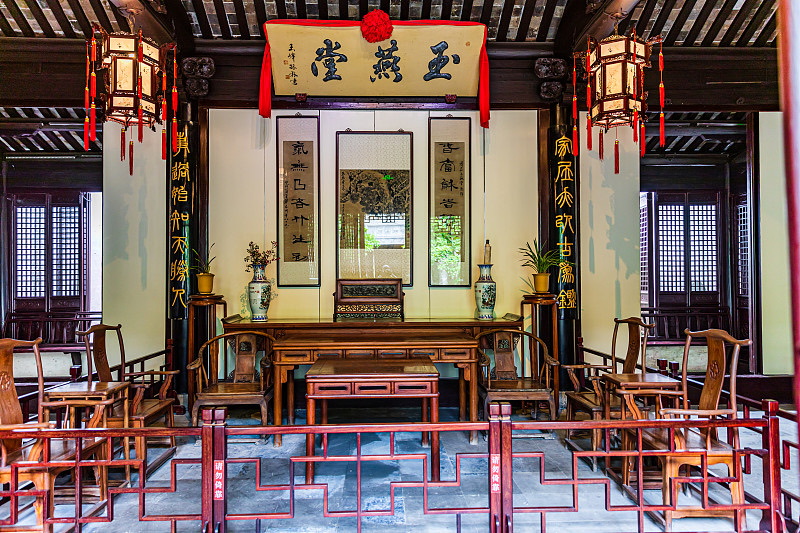
Please step into the main hall and look up. This hall is called Songmao Hall — a name drawn from the Book of Songs, meaning "flourishing like a pine tree." It is five bays wide and built entirely of nanmu timber, one of China's most precious hardwoods. Nanmu is dense, finely grained, naturally fragrant, and resistant to insects. Using nanmu for the structural beams and columns was a statement of extraordinary wealth. The carvings on the beams are equally exceptional — scrolling vegetation, geometric key-fret patterns, cloud forms — all fine examples of Qing-dynasty Jiangnan woodcarving. The name Songmao Hall carries the family's wish for prosperity lasting across generations, as enduring as a pine.

Shen's Residence also has a distinctive watergate entrance. On the east side of the front hall, a door opens directly onto the river, with stone steps leading down to the water. Boats could tie up here. This was the standard configuration for a prosperous Jiangnan merchant's home: a land gate in front for people, a water gate at the back for boats. Trade, transport, and the reception of guests all moved by water. This reflects the defining character of Jiangnan life: waterways were roads, and boats were vehicles. Look out through the watergate at the river now, and imagine it two hundred years ago — Shen family boats departing from these steps, sailing to Suzhou, Shanghai, and Hangzhou, carrying Jiangnan silk, cotton, and tea to buyers across the country, and returning with goods from distant places. Shen's Residence was not just a home; it was the headquarters of a commercial empire.

The rear hall now houses an exhibition on Shen Wansan's life, Zhouzhuang folk artifacts, and the family's commercial history. If the story of Shen Wansan interests you, spend a little time in there. The display includes a portrait of Shen Wansan — its authenticity is impossible to verify, but it presents him as a shrewd yet understated merchant. The exhibition also covers the traditional trades that were once part of the Shen family's commercial reach: weaving, brewing, boat-building, and bamboo crafts.

Photography tips: Songmao Hall is an excellent place to photograph the interior space of a Jiangnan residence. Stand inside the hall facing the main gate and use a symmetrical composition to capture the full arrangement of the central table, chairs, hanging scroll, and matching couplets. The stone steps and riverside landing at the watergate are also a classic shot, combining person, boat, water, and house in one frame. Early morning and evening are the best times to photograph Shen's Residence — light enters the watergate at a low angle and falls across the nanmu beams in warm gold tones.

That covers Shen's Residence. Please follow me north, through a few lanes, and in three to five minutes we will arrive at Zhouzhuang's other celebrated historic compound — Zhang's Residence.

Zhang Hall

张厅

Zhang Hall, originally named "Yuyan Hall," was built during the Zhengtong era of the Ming Dynasty (1436–1449) by descendants of Xu Mengqing, brother of the Prince of Zhongshan, Xu Da. It later passed to the Zhang family, hence its current name. The residence faces west, with six courtyards, over 1,000 square meters of floor area, and more than 70 rooms. Its most distinctive feature is that the Mingjing River — a canal running through the town — flows directly through the courtyard, complete with a private mooring where boats could dock. This spatial arrangement, in which "sedans enter through the front gate and boats pass through the house," is one of the most representative layouts of Jiangnan water-town residences. Inside, nanmu-wood columns and intricately carved window lattices remain well preserved. The rear courtyard contains a miniature water garden with banana palms and bamboo — combining the dignity of an official's mansion with the warmth and vitality of a riverside home. Visiting Zhang Hall is the best way to understand the centuries-old wisdom of "living by the water."

On-site narration · read it where you stand

Welcome to Zhang's Residence on North Market Street. Zhang's Residence was built during the Zhengtong reign of the Ming dynasty — more than 560 years ago, making it over two hundred years older than Shen's Residence. It was originally constructed by descendants of Xu Kui, the younger brother of Ming dynasty founding general Xu Da. The property eventually passed to the Zhang family, and the name Zhang's Residence has been with it ever since.

Zhang's Residence is most famous for the phrase: "Sedan chairs enter through the front gate; boats pass right through the house." What does that mean exactly? Please follow me through the main gate, past the front hall, and walk toward the back. You will find that between the front hall and the rear section of the compound, a canal flows directly through the property — not beside the house, but through it. The canal has private stone landings on both sides, exclusively for the Zhang family. Boats could sail in from the outer market river, dock inside the compound, load and unload goods, and take on or drop off guests. The main gate at the front, meanwhile, was for sedan chairs, horses, and foot traffic. So: the front gate for sedan chairs, the canal for boats — that is the meaning of the phrase.

This is the most distinctive residential form in the Jiangnan waterway landscape. In Jiangnan, water is everywhere and boats are the primary means of transport. For a household of substance, having a private riverside landing meant both convenience and status. Only a large enough house and a wealthy enough family could accommodate a canal inside their own compound. The canal at Zhang's Residence is not wide, but it carries living water — it flows in through one end of the compound and out through the other, and the house is simply a node along its path. Shen's Residence has a similar watergate arrangement, but Zhang's Residence goes a step further with a canal that flows entirely through the house — the ultimate expression of the Jiangnan "house-and-waterway-as-one" ideal.

Zhang's Residence covers over 1,800 square meters, extends through six courtyards, and contains more than seventy rooms across its halls and upper floors. Step into the main hall and you will notice immediately that its character differs from Shen's Residence. Songmao Hall at Shen's Residence is richly ornate; Zhang's Residence is quieter and more restrained. The difference comes from the period each was built in. Ming-dynasty architecture favored simplicity, sobriety, and honest materials; Qing-dynasty architecture leaned toward ornament, elaboration, and finish. The beams and columns here carry no heavy carving — the wood's own grain and color are left to speak. The posts are broad and powerful, the framework clean and direct. You might say Shen's Residence is a meticulously adorned beauty; Zhang's Residence is a natural, understated one.

Please continue to the rear courtyard and the garden. This garden is called Zhujing — "Chopstick Creek." It gets its name from the slender canal running through it, shaped like a chopstick inserted into the ground. Zhujing is small but composed with great precision: rockery, a winding pool, a pavilion, and plantings — nothing is missing. Look at the rockery stones: they are Taihu Lake rocks, and they meet the four classical standards of fine garden stone — lean, wrinkled, perforated, and translucent. Taihu Lake rocks are formed on the lakebed over millions of years, shaped by the constant action of the waves. Lean means slender and uncluttered; wrinkled means surface texture with a sense of age; perforated means hollows inside that let wind and light pass through; translucent means open enough that you can see through from one side to the other. The Taihu rocks in Zhujing are modest in size but high in quality — fine examples of Jiangnan garden craft.

In the garden there is also a magnolia tree that blooms every spring. Chinese literati have always loved the magnolia because it flowers before its leaves appear: after the bare branches of winter, the blossoms open first — a whole tree of white flowers — and only then do the leaves slowly unfurl. Ancient poets interpreted this habit as a kind of noble restraint: the magnolia does not compete with other flowers for attention. If you are here in March, do not miss this tree in bloom. The whole garden fills with white, and the effect is genuinely poetic.

The contrast between Zhang's Residence and Shen's Residence is telling: Shen's Residence belonged to merchants and pursued grandeur; Zhang's Residence belonged to officials and pursued refinement. The seven courtyards of Shen's Residence show commercial ambition; the six courtyards of Zhang's Residence reflect the cultivated restraint of the official class. One is in the south, one in the north; one is Ming, one is Qing; one is mercantile, one is bureaucratic. Together, they show two distinct sides of Zhouzhuang's architectural history. If you have time, I encourage you to walk through both compounds and sit quietly to compare them. Architecture is history frozen in place — every beam, every window lattice, every stone tells a different story.

Photography tips: The private canal landing inside Zhang's Residence is the best spot to capture the "boat passing through the house" arrangement. Stand on the stone steps of the landing and shoot toward the interior canal — you can bring the steps, the stone embankment, the water, and the rear hall into a single frame. This "house-and-water-as-one" composition is virtually impossible to find outside of Jiangnan. The Taihu rocks and the magnolia blossoms in Zhujing Garden are also spring highlights. Use a wide-angle lens for the garden overview; switch to a close-up lens to capture the texture of the Taihu rock surfaces and the detail of the magnolia petals.

That covers Zhang's Residence. Please follow me south, through Central Market Street, and in about two minutes we will reach one of Zhouzhuang's oldest bridges — Fu'an Bridge.

Fu'an Bridge

富安桥

First built during the Zhizheng era of the Yuan Dynasty (1341–1368), Fu'an Bridge was funded by Shen Wansi, the younger brother of the legendary merchant Shen Wansan. After multiple restorations, it is one of the oldest surviving stone arch bridges in Zhouzhuang. The bridge spans the North-South River in a single arch, about 17 meters long, with a gently arched deck paved in granite slabs. Its most distinctive feature is the four corner buildings — "bridge towers" — that rise from the bridge's four corners, creating the rare architectural form of "bridge and building as one." The bridge deck remains a thoroughfare, while the towers house shops and teahouses — a design that fuses transportation and commerce, exceedingly rare among Jiangnan water-town bridges. The towers' upturned eaves reflect in the water; from a distance, they look like pavilions floating on the river. Legend has it that Shen Wansan ran a small stall near the bridge before his fortune was made, and "Fu'an" (literally "wealth and peace") commemorates his rise. Standing on the bridge, one sees the staggered riverside dwellings along both banks, with awning boats gliding slowly beneath the arch — a quintessential water-town tableau.

On-site narration · read it where you stand

Welcome to Fu'an Bridge. Fu'an Bridge spans the North-South Market River and is one of the oldest surviving bridges in Zhouzhuang. It was first built in 1355, the fifteenth year of the Zhizheng reign of the Yuan dynasty — more than 670 years ago. It is a single-arch stone bridge, 17.4 meters long and 3.8 meters wide, built from granite using a transverse parallel arch method that makes it exceptionally strong.

What makes Fu'an Bridge truly remarkable is that it is a bridge with buildings on top. Please look on either side: five-bay bridge houses have been built directly on the bridge, with upturned eaves and red columns under dark roof tiles, the buildings and bridge forming one seamless structure. You walk beneath overhanging eaves to cross the bridge, and if you step into the bridge houses, you are actually standing on top of the bridge. This "bridge-topped-by-buildings" arrangement is extremely rare among Jiangnan water-town bridges. The ground floors of the bridge houses are shops; the upper floors are residences. In earlier times, the families living in the bridge houses could open a window and look down at the boats on the river, or step outside and be on the opposite bank in moments. A single bridge serving simultaneously as infrastructure, commercial space, and residential space — this "bridge-and-market-as-one" configuration is living evidence of Zhouzhuang's commercial vitality during the Ming dynasty.

The name Fu'an means "seek peace after gaining wealth." Legend has it that the bridge was rebuilt at the expense of Shen Wansan. After accumulating his vast fortune, someone advised him: you are too rich — better to do good works, build bridges and pave roads, earn merit and find security. Shen Wansan agreed, funded the reconstruction, and named the bridge Fu'an. The idea embedded in that name is that wealth, to last, must be paired with restraint and giving back. Fu'an Bridge is a small piece of the larger story of Jiangnan merchant culture.

Please walk to the center of the bridge and look south or north. You will see the North-South Market River converging below you, with boats passing up and down, and ancient buildings lining both banks in close succession. Fu'an Bridge stands exactly at the center of this junction. Looking down from the bridge, the grid-shaped canal network of Zhouzhuang opens up below you. The north-south and east-west market rivers divide the town into sections like a chessboard, and the fourteen ancient bridges are the crossing points. Fu'an Bridge is the most important of them all — it connects not only the two banks of this river but also the east-west waterway, making it the town's traffic hub.

There are many details worth looking at on the bridge itself. Notice the small stone lions on the balustrades — each one is slightly different, some open-mouthed, some closed, some turned left, some turned right. These are the work of Yuan-dynasty craftsmen and are more than 600 years old. Despite centuries of rain and river water, they are still standing guard on the bridge, watching over each generation of Zhouzhuang. The stone slabs on the bridge surface have been worn smooth by countless footsteps, and if you look closely you will find grooves of varying depth — marks left over years by wheelbarrows, sedan chair poles, and horses' hooves. These traces are the bridge's growth rings.

Standing on Fu'an Bridge, you can also see Shen's Residence just to the southeast. The two were neighbors: the Shen family walked out of their gate, crossed Fu'an Bridge, and were on Central Market Street, from which the canal led straight to the wharf. Fu'an Bridge was the daily route for Shen family merchants — every morning out, every evening home. The bridge has witnessed the rise and fall of the Shen family and the whole arc of Zhouzhuang's growth from small fishing village to commercial center.

Photography tips: Fu'an Bridge is the best place to photograph Zhouzhuang's "bridge-and-market" arrangement. Stand on the south bank of the river and use a medium telephoto lens to capture the full face of the bridge and its buildings, bringing bridge, houses, river, and the residences on both banks into one frame. Looking down from an upper window of the bridge house gives a bird's-eye view of the river below — a distinctive angle. At dusk, when the lanterns on the bridge houses are lit and their reflections flicker on the water, this is the best moment to photograph Zhouzhuang at night. With a slow shutter speed, passing boats leave light trails that make the scene look almost dreamlike.

That covers Fu'an Bridge. Please continue north along Central Market Street for three or four minutes, and we will arrive at the most literary corner of Zhouzhuang — Milou Pavilion.

Milou (Labyrinth Tower)

迷楼

Milou was originally a small riverside tavern called "Deji Wine House," built in the late Qing or early Republican era — a modest two-story building by the water. In 1920, poets of the Southern Society (南社), including Liu Yazi, Ye Chucang, and Wang Dajue, gathered here to drink and compose poetry. Ye Chucang later published his poems from this gathering as the collection "Milou Ji" (Labyrinth Tower Collection), and the tavern became widely known — henceforth called "Milou." The character "迷" (lost/bewitched) conveys both the intoxication of wine and the poets' bewilderment and lament over the turbulent times. The interior is small, with a steep, narrow wooden staircase; the second floor has windows overlooking the canal. Today, Milou displays reproductions of the Southern Society poets' biographies and handwritten works, recreating the spiritual world of early Republican-era Jiangnan literati who expressed their patriotism and sorrow through wine and verse. Though not the largest attraction in Zhouzhuang, its literary depth makes it a must-visit for lovers of literature and history.

On-site narration · read it where you stand

Welcome to Milou Pavilion, here beside Zhenfeng Bridge. Milou was originally called Deji Tavern — a two-story riverside wine house built in the late Qing dynasty, more than a hundred years old. Modest as it looks from outside, this little building is a significant landmark in the history of modern Chinese literature.

The story of Milou begins with a group of poets, more than a hundred years ago. Around 1920, in the wake of the New Culture Movement and the May Fourth Movement, a cohort of revolutionary poets gathered around Suzhou and Shanghai and founded a literary society called the Southern Society. These poets championed literature as a tool to awaken the public and resist feudal autocracy. One of the society's leading figures was Liu Yazi — a celebrated poet who wrote prolifically against the Qing dynasty's rule and in praise of revolution, earning recognition as a pioneer of the "poetry revolution." Among the other core members were Ye Cucang, Chen Qubing, and Su Manshu.

These poets of the Southern Society shared one great pleasure: gathering in wine houses to drink and compose. In 1920, Liu Yazi and Ye Cucang came to Zhouzhuang and climbed to the second floor of this riverside wine house. They pushed open the windows and found Zhenfeng Bridge right before their eyes: small boats drifting on the water, willows trailing along the banks, the quintessential Jiangnan scene spread out beneath them. A few cups of warm rice wine later, the poems arrived. Liu Yazi wrote "Night of Revelry at Milou": "In this little upstairs room we drank the night away, surrendering a matchless spring evening to the wine. Through wine-blurred eyes I gazed at the dark hills; deep in Milou's pavilion, I poured out my heart." Ye Cucang wrote: "One drunk in this fragrant house and all things fade; a hundred years pass like a bubble on the stream. How many sorrows does the south hold? Left to the wandering poet to turn into verse."

Both poems contain the words Milou — "the bewitching pavilion." Why did they call it that? Because this little house had bewitched them with three things: the wine was exceptional — Zhouzhuang's rice wine is mellow and smooth, impossible to stop drinking; the scenery was intoxicating — open the window and there was Zhenfeng Bridge, the water flowing below, the distant hills soft against the sky, the willows near the banks like smoke, all of it heartbreakingly beautiful; and most of all, the poetry was bewitching — when wine and scenery combined, inspiration surged and the urge to write could not be held back. So they named the place Milou: come here, and you will be bewitched, and you will not want to leave.

Milou still preserves the atmosphere of those literary gatherings. Walk into the ground floor and you will see the old wooden counter, wine jars, tables and chairs, and photographs of Liu Yazi, Ye Cucang, and their contemporaries on the walls, alongside manuscript poems in their own hand. Go up to the second floor and you are in the room where the poets met. The riverside windows are still in their original configuration — you can push them open, just as Liu Yazi did, and look out at Zhenfeng Bridge and the water. The walls of the second floor are hung with calligraphy and manuscripts from the Southern Society poets, some originals, some reproductions. If you have any interest in modern Chinese literature, linger here a while and read through these lines. They carry the passion and romanticism of Chinese intellectuals a hundred years ago.

Small as it is, Milou represents another side of Zhouzhuang's character entirely. We have just seen Shen's Residence and Zhang's Residence — homes of merchants and officials, showcasing wealth and power. Milou shows us the literary tradition. Zhouzhuang was not only a gathering place for traders; it was a place where poets and scholars lingered and found inspiration. In Jiangnan society, the identities of merchant and intellectual often overlapped: many merchants were also poets, many poets were also businesspeople. After making money, they did not seek excess — they sought refinement: garden-building, art collecting, poetry, calligraphy, tea, and conversation. Milou is a small but perfect emblem of that Jiangnan "commerce-and-culture-as-one" sensibility.

Photography tips: Milou is the best place to photograph Zhouzhuang's "literary wine-house" atmosphere. Sit by the riverside window on the second floor, with Zhenfeng Bridge and the water as your backdrop, and take a "looking out through the window" photograph. This composition has both the depth of an interior space and the openness of the waterway outside — and tells a story all on its own. The old counter, the wine jars, and the manuscript poems on the ground floor are also excellent subjects for detail shots. Shoot in natural light without flash; only then will you preserve the weathered, unhurried feeling that defines Milou.

That covers Milou Pavilion. Please follow me west along Hougang Street for three or four minutes, and we will arrive at the Zhouzhuang Museum.

Zhouzhuang Museum

周庄博物馆

Zhouzhuang Museum is located within the historic Zhu family residence — a comprehensive museum dedicated to the local history and culture of Zhouzhuang. The building itself is a typical Jiangnan residence with a Qing Dynasty layout: whitewashed walls, dark tiles, courtyards, and sky-wells. Multiple exhibition halls cover the town's founding, commercial development, folk customs, and notable figures. The collection includes precious Ming and Qing-era contracts, land deeds, merchant account books, ancient coins, and folk implements — with the richest materials relating to Shen Wansan and traditional water-town daily life. Models, photographs, and multimedia displays vividly illustrate how Zhouzhuang grew "from water into a town, and from commerce into prosperity." Visiting the museum is the ideal starting point for understanding Zhouzhuang: build a historical framework here first, then explore the town's sights — and the experience will be transformed.

On-site narration · read it where you stand

Welcome to the Zhouzhuang Museum. The museum is housed in a Qing-dynasty residence on Hougang Street — the Zhu Family Residence. It was built by Zhu Zhirun, a prosperous Zhouzhuang merchant of the late Qing and early Republican era, and follows the classic Jiangnan four-courtyard residential arrangement: appropriately scaled, well-ordered in layout, and very well suited to its new purpose as a museum.

The museum uses the original rooms and courtyards to house multiple galleries, offering a systematic look at Zhouzhuang's development over more than 900 years, from the founding of the town in the Northern Song dynasty to the present. Follow me into the first gallery: "Zhouzhuang: A Historical Overview." Through text, photographs, maps, and scale models, this gallery traces the town's transformation from dynasty to dynasty. You will see that Zhouzhuang began as a small fishing settlement called Zhenfengli. It acquired its present name after a Song-dynasty official named Zhou donated his land to build a temple here. In the Yuan and Ming periods, the town's position along the waterway routes between Suzhou, Shanghai, and Hangzhou brought it commercial prosperity — especially after the rise of the Shen Wansan family in the Ming dynasty, which made Zhouzhuang an important trading hub in Jiangnan. By the Qing dynasty, the water transport network had been further developed, giving the town its defining form: a grid-shaped canal system threaded together by fourteen ancient bridges.

Please step into the second gallery: "Implements of Water-Town Life." This is the most distinctive part of the museum, and everything on display was actually used in the daily lives of Zhouzhuang's residents. You will see all kinds of boat implements — long sculling oars, shorter punting poles, fishing nets, mooring ropes. There are fishermen's bamboo hats and straw rain capes, and also the specialized tools of water-town farming: water chestnut tubs for harvesting from the water, silkworm trays for raising silkworms, and weaving looms. These objects may look simple, but each one carries a story of practical ingenuity. Take the water chestnut tub: it looks like a plain wooden bucket, but its shape and size are designed specifically for the harvester to crouch inside, floating on the surface, and reach out to pick the water chestnuts growing beneath the water. Without that tub, it simply cannot be done. The silkworm tray has a bamboo-woven base to allow airflow — exactly what silkworm larvae need to thrive. These details are the living memory of the agricultural society of a Jiangnan water town.

The third gallery, "Folk Customs and Festivals," covers Zhouzhuang's traditional rituals and seasonal celebrations: dragon lantern parades at the Lunar New Year, riddle-guessing at the Lantern Festival, floating lanterns on the river at the Qingming Festival, dragon boat racing at Dragon Boat Festival, and moon-gazing at the Mid-Autumn Festival. The most charming exhibit here is the "Grandma's Tea" display. Grandma's Tea is not a type of tea leaf — it describes a way of drinking tea unique to Zhouzhuang. In the old days, the town's elderly women had a daily custom: each afternoon, three or five of them would gather by the river on stone benches, or in front of their own doorways, brew a pot of tea, and set out homemade salted vegetables, toasted pumpkin seeds, and dried radish to go with it, spending the afternoon chatting over their cups. This informal gathering was called "Grandma's Tea," and it was the primary social life of older women in Zhouzhuang. The gallery recreates the scene with a teapot, teacups, tea snacks, and wax figures of the grandmothers mid-conversation — very vivid.

The fourth gallery, "Traditional Crafts," covers Zhouzhuang's historic trades and folk arts: weaving, rice wine brewing, boat-building, bamboo work, embroidery, and clay sculpting. The most representative is the boat-building tradition. Zhouzhuang's boats were once built entirely by hand, with carpenters using axes, chisels, and saws to shape raw timber into hulls. The town produced many types of vessels — cargo-carrying black-awning boats, passenger boats, water chestnut tubs, fishing boats — each with its own form, dimensions, and structure reflecting the boat-builder's specialized knowledge. The gallery includes a scale model of a black-awning boat that you can examine in detail: a flat bottom suited to shallow inland waterways; an arched canopy of woven bamboo and oiled cloth to keep out wind and rain; and a large stern oar worked by the boatman to propel the vessel forward.

The museum's most important value lies in the cultural DNA it reveals. What is Zhouzhuang's cultural DNA? Four words: bridges, water, people, and trade. Bridges were the town's mode of connection, water was its environment, people were its creators, and trade was its economic lifeblood. These four elements together form the nine-hundred-year logic of Zhouzhuang's history. If you want to truly understand Zhouzhuang, I strongly recommend spending half an hour here walking through all the galleries. When you step back out onto the streets and look at the bridges, the water, and the buildings again, you will see everything with new understanding.

Photography tips: Flash photography is not allowed in the galleries, but photography without flash is permitted. Use a high ISO setting to photograph the artifacts and scene recreations indoors. The black-awning boat model and the Grandma's Tea tableau are the most distinctively local subjects. The Zhu Family Residence itself — its courtyard, colonnaded walkways, and carved wooden windows and doors — also makes excellent architectural photography material. A wide-angle lens works well for the interior spaces; switch to a close-up lens for artifact details.

That covers the Zhouzhuang Museum. Please follow me west along Quangong Road for about two minutes, and we will reach a very different kind of experience — Strange House.

Guailou (Strange Tower)

怪楼

Guailou is a distinctive attraction within Zhouzhuang themed around optical illusions and interactive experiences. Standing three stories tall, its exterior already differs subtly from the surrounding traditional buildings, hinting at the novelty within. Multiple themed rooms inside use principles of optics, geometry, and perspective to create astonishing visual effects: one room has a sloping floor with level walls, producing a sensation of weightlessness; another uses mirrors and lighting to simulate infinite space; yet another employs 3D murals that make visitors feel they have stepped into a painting. Each space encourages hands-on experience and creative photography, making it tremendous fun. Guailou injects a splash of modern artistic vibrancy into this thousand-year-old town, where tradition and creativity collide to delightful effect. It is especially popular with younger visitors and families — a lighthearted counterpoint to the town's historical sights.

On-site narration · read it where you stand

Welcome to Strange House. Strange House is a 3D illusion interactive experience center created inside a renovated Qing-dynasty residence — a blend of traditional Jiangnan vernacular architecture and modern optical illusion technology, and a genuinely entertaining place to spend some time.

From the outside, Strange House looks like an ordinary Jiangnan old home — white walls, dark roof tiles, wooden doors and windows, indistinguishable from the buildings around it. But once you step inside, you find yourself in an entirely different world. The interior contains dozens of interactive experience spaces, each one exploiting some aspect of human visual perception to produce an impossible effect. Let me describe a few of the best.

First, the Upside-Down Room. In this room, all the furniture — bed, table, chairs, cabinet, lamp — is attached to the ceiling, hanging directly above your head. Standing on the floor, you have the odd sensation that it is you who are hanging upside down. Take a photograph and the people in the picture will appear to be standing on the ceiling with the furniture at their feet. Many visitors end up shooting a whole series of "anti-gravity" images here, and the results are always entertaining.

Second, the Tilted Room. The floor in this room is sloped, but the walls and furniture appear level. The moment you walk in, you feel dizzy and your body leans involuntarily to one side. Even knowing perfectly well that the floor is tilted, your brain cannot override your body's balance response. This room exploits a conflict between the vestibular system and the visual system to generate a powerful sensation of weightlessness. Many visitors end up grabbing the wall just to walk through it, which makes for good laughs.

Third, the Mirror Maze. This room is composed of countless mirrors. Step inside and you see infinite reflections of yourself closing in from every direction. Walk left and there you are on the left; walk right and there you are on the right. The entire space seems to extend without limit in every direction, and it is very easy to lose all sense of where you are. The design principle is the "infinite mirror" effect — two parallel mirrors face each other and generate an endless series of reflections. Strange House combines this with a maze layout, creating a space that is simultaneously beautiful and completely disorienting.

Fourth, the Invisibility Room. A special transparent screen in this room lets you "hide" part of your body behind it. From the camera's perspective, that part of the body vanishes entirely. Tuck your head behind the screen and the photograph shows only your body and limbs — a headless figure. Hide your lower half and only your upper body is visible, apparently floating in mid-air. The effect works through light refraction and projection technology, and it never fails to astonish.

Strange House reflects Zhouzhuang's exploration of how to integrate cultural tourism with experiential innovation. Zhouzhuang is a water town with more than 900 years of history. Its core appeal is traditional culture — ancient bridges, historic residences, historic streets, ancient canals. But for younger visitors and families, traditional culture alone can sometimes feel like it lacks immediate fun. So Zhouzhuang has been trying, alongside the preservation of its historic character, to introduce modern, interactive, entertaining experiences. Strange House is a good example: it takes an old Jiangnan residence and transforms it into a contemporary magic space, giving visitors something new and playful alongside the deeper cultural encounters the rest of the town offers.

One practical note: Strange House is an old building that has been renovated, and the interior staircases are fairly steep and the floors can be slippery. Please take care with your safety throughout, and parents should keep a close eye on children. Some of the rooms may cause dizziness or discomfort — if you are prone to motion sickness or find it easy to feel unsteady, pace yourself and skip any experience that does not feel comfortable.

Photography tips: Strange House is perfect for creative photography. The Upside-Down Room gives you anti-gravity shots; the Mirror Maze lets you multiply yourself endlessly; the Invisibility Room lets you make parts of yourself disappear. Images like these tend to perform very well on social media. Try as many angles and poses as possible, let your imagination run, and see what you come up with.

That covers Strange House. Please continue north along Quangong Road, through a few lanes, and in about three to five minutes we will arrive at Zhenfeng Bridge.

Zhenfeng Bridge

贞丰桥

Zhenfeng Bridge is a single-arch stone bridge spanning the Zhongshi River. Its date of original construction is unknown; the current structure dates from a Qing Dynasty rebuilding. "Zhenfeng" derives from Zhouzhuang's ancient name — "Zhenfeng Li." During the Yuanyou era of the Song Dynasty (1086), a local official named Zhou Digonglang established a manor here and donated farmland to Quanfu Temple. The grateful residents renamed the place "Zhouzhuang" in his honor. The name "Zhenfeng Bridge" is a living fossil of this thousand-year-old renaming. The bridge is modest in length, with an elegant arch, plain stone railings, and stone steps at both ends. Riverside houses rise directly from the water; willows dip their branches toward the river; an occasional sculling boat drifts past with a rhythmic creak of the oar, complementing the ancient bridge's quiet charm. Fewer tourists gather here than at the Twin Bridges or Fu'an Bridge, making Zhenfeng Bridge a serene spot to sit, slow down, and savor the unhurried rhythms of water-town life. A teahouse once stood by the bridge, and it is said that Southern Society poets gathered here to compose verse, adding a literary luster to its stones.

On-site narration · read it where you stand

Welcome to Zhenfeng Bridge on Hougang Street. Zhenfeng Bridge was built during the Zhizheng reign of the Yuan dynasty and is, alongside Fu'an Bridge, one of the oldest Yuan-dynasty stone arch bridges in Zhouzhuang — more than 600 years old. The bridge is 12.2 meters long and 2.8 meters wide, a single-arch stone bridge with a gracefully curved span and a sturdy, time-worn character.

The name Zhenfeng carries the oldest recorded name of this place. Before the Northern Song dynasty, this settlement was called Zhenfengli — "zhen" meaning steadfast and firm, "feng" meaning abundant — expressing the people's wish for the land to be solid and plentiful. When a Song-dynasty official surnamed Zhou donated land to build a temple here, the community renamed the place Zhouzhuang in his honor. But the name Zhenfeng was not lost — it lived on in this bridge, becoming a fixed coordinate of the town's historical memory.

The area around Zhenfeng Bridge is one of the quietest corners of Zhouzhuang, where commercial bustle gives way to the everyday rhythms of longtime residents. Unlike the liveliness near the Twin Bridges and Shen's Residence, this stretch feels slower and more domestic. Stand on the bridge and you will see people along both banks going about their day: someone washing vegetables at the water's edge, someone sitting in the sun by their doorway, someone draping laundry over the stone landing. These are not performances staged for visitors — they are the actual daily life of Zhouzhuang. If you want photographs that feel genuinely lived-in rather than tourist-postcard perfect, this is the best place to find them.

Just beside Zhenfeng Bridge is Milou Pavilion, the literary wine house we visited earlier. The view from Milou's second-floor window looks directly onto this bridge. When Liu Yazi wrote his poems here, what he saw must have looked much like this: an ancient stone bridge crossing a calm river, willows swaying on both banks, white-walled, dark-roofed houses overlapping one after another. That image of "little bridge, flowing water, people's homes" is China's most classic mental picture of Jiangnan — and it is the essential reason Zhouzhuang became known as "China's Number One Water Town."

The river at Zhenfeng Bridge opens into a relatively wide bend. Please walk to one side of the bridge and look out over the water. The bend makes the current slow and the surface stay calm, holding clear reflections of the well-preserved Ming-Qing buildings on both banks. River bends like this were common in Jiangnan water towns: where the current slows, the water runs clearer and the riverbank erodes less, providing stable ground for building. Residential communities naturally clustered at bends in the waterway. The Zhenfeng Bridge bend is one of the earliest settled areas of Zhouzhuang.

The stone balustrades of Zhenfeng Bridge are also worth a look. Unlike the carved stone lions on Fu'an Bridge, the railings here are simple rectangular stone slabs with no ornamentation. That plainness is actually characteristic of Yuan-dynasty building: under Mongol rule, architecture tended toward strength and simplicity rather than the refined decoration of the Ming and Qing periods that followed. The railings may not be decorative, but they have a quality of weight and solidity — each slab thick, each joint firm — that gives the whole bridge a presence like bedrock. That sturdiness is the Yuan bridge's signature.

Zhenfeng Bridge is one of the classic spots for photographing water reflections in Zhouzhuang. The gentle bend keeps the surface still, so reflections stay sharp. Stand at one end of the bridge, face the opposite bank, and you can bring the bridge, the buildings on both sides, the sky, and their reflections together in a single frame. Early morning and dusk, when the sun is low and the light is soft, the water surface takes on shades of blue-purple or warm gold, and the reflection merges with the real scene into something that looks like a natural ink-wash painting. Use a medium telephoto lens to compress the space, draw the bridge and the buildings on both banks closer together, and achieve a tighter, more composed frame.

That covers Zhenfeng Bridge. Please follow me south along Hougang Street, through the southern end of the ancient town, about a ten-minute walk, to the religious landmark at the southern tip of Zhouzhuang — Quanfu Temple.

Quanfu Temple

全福讲寺

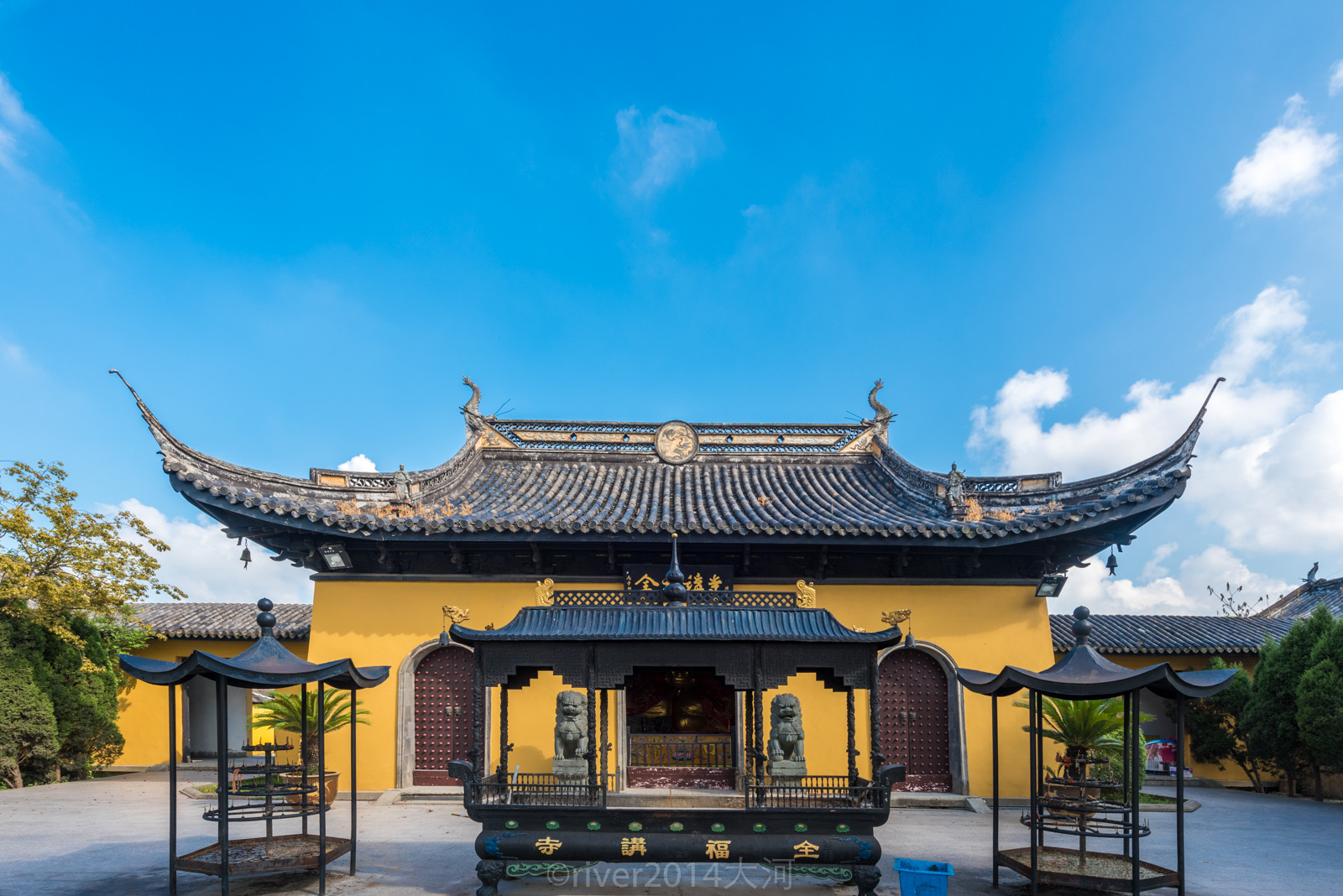
Quanfu Temple stands on the shore of Lake Bianxian, south of Zhouzhuang Old Town. Founded in 1086 during the Song Dynasty's Yuanyou era — built on land donated by Zhou Digonglang — it is the oldest Buddhist temple in Zhouzhuang. The temple rises directly from the lake, with its main halls standing at the water's edge. From a distance, the halls and pavilions appear to float upon the water, earning it the name "Buddhist Kingdom on Water" (水中佛国). The complex faces south, with a gate, main hall, and scripture repository along its central axis. The architecture is grand and solemn — golden walls, dark tiles, layered flying eaves — striking against the blue water and sky. The temple once housed a Song Dynasty bronze bell whose peal carried for miles; "Quanfu Dawn Bell" was one of the historic Eight Scenes of Zhouzhuang. Destroyed and rebuilt multiple times, the current structures are modern reconstructions that nonetheless preserve the layout and dignity of a traditional Buddhist monastery. At dawn, the temple bell rings across the misty lake, its sound blending with the water's shimmer to instill a deep tranquility. From the upper floors of the scripture repository, one looks out over the vast expanse of Lake Bianxian, with Zhouzhuang's water-town panorama spread below — one of the few elevated vantage points in the town.

On-site narration · read it where you stand

Ladies and gentlemen, we have now arrived at the southernmost attraction in Zhouzhuang Ancient Town — Quanfu Temple. Quanfu Temple stands on the shore of South Lake and was first built in 1086 CE, during the first year of the Yuanyou era of the Northern Song dynasty. With a history of more than 930 years, it is the oldest and largest religious structure in Zhouzhuang. What's more, this temple is directly tied to how Zhouzhuang got its name — legend has it that a Song-dynasty official named Zhou Digong donated land here to build the temple, and local people named the place "Zhouzhuang" in his honor.

Quanfu Temple covers roughly 40,000 square meters. Along its central axis stand the Mountain Gate, the Hall of Heavenly Kings, the Grand Hall of the Great Sage, and the Scripture Pavilion, flanked by a bell tower, a drum tower, side halls, and a reception hall. The scale is grand and the architecture solemn. Let's walk through the Mountain Gate and look first at the Hall of Heavenly Kings. At the center of the hall stands a statue of Maitreya Buddha — smiling broadly, with a large round belly. He is the Buddhist symbol of joy and tolerance. On either side of Maitreya stand the Four Heavenly Kings: Guardian of the East, Guardian of the South, Guardian of the West, and Guardian of the North. They hold respectively a pipa lute, a sword, a dragon and serpent, and a canopy, symbolizing favorable winds and rain. In Chinese Buddhist temples, the Four Heavenly Kings are divine guardians of the dharma and the temple, and are also figures that ordinary people pray to for safety and peace.

Pass through the Hall of Heavenly Kings and you reach the main hall of Quanfu Temple — the Grand Hall of the Great Sage. "Great Sage" is an honorific title for Shakyamuni Buddha, meaning "the great hero," because the Buddha conquered all worldly suffering and evil through wisdom and compassion. The statue of Shakyamuni inside the hall stands over 10 meters tall, making it one of the larger indoor Buddha statues in the Jiangnan region. Please look up — the Buddha is seated on a lotus throne, his expression serene, his eyes gently downcast, his hands forming the meditation mudra. Behind the statue is the halo — a massive flame-shaped aureole carved with flying apsaras, lotus flowers, and auspicious clouds. Along the walls on either side stand the Eighteen Arhats, each in a distinctive pose, remarkably lifelike. The entire hall feels solemn and still, and visitors naturally slow their steps and lower their voices.

Please take a moment to look at the architectural structure of the Grand Hall. The roof is a double-eaved hip-and-gable form, one of the highest-ranking roof styles in traditional Chinese architecture, second only to the full hip roof. Inside, the beams are heavy and powerful, the bracket sets layer upon layer, and the painted decoration is dominated by gold, red, and green — brilliantly ornate. But unlike most temples, the paintwork here incorporates many Jiangnan elements: alongside the traditional dragons, phoenixes, and cloud patterns, the beams and lintels are also decorated with lotus flowers, water lilies, and willow branches — plants of the watertown. This is a hallmark of Buddhist architecture in Jiangnan: it follows the conventions of Buddhist building while absorbing local aesthetics and culture.

Behind the Grand Hall stands the Scripture Pavilion, which houses Buddhist scriptures and historical documents of the temple. The Scripture Pavilion is generally not open to the public, but its exterior is well worth admiring. It is typically the tallest and most refined building in a temple complex, because it holds the heart of the dharma — the scriptures. The Scripture Pavilion at Quanfu Temple is a two-story structure with upswept eaves and a striking presence. Looking south from the upper floor, you can see the broad surface of South Lake — an open expanse of water to the south of Zhouzhuang, where sky and water seem to merge. In the middle of the lake sits a small island with buildings on it: this is the "Autumn Moon over South Lake" scenic spot belonging to Quanfu Temple. On Mid-Autumn Night, with the full moon overhead and the lake as still as a mirror, you can look down from the heights of Quanfu Temple and see the moon's reflection shimmering below. This is the famous Zhouzhuang view known as "Autumn Moon over South Lake."

In front of Quanfu Temple grows a thousand-year-old ginkgo tree believed to be more than a thousand years old. The ginkgo is a species native to China and known as a "living fossil," having existed on Earth for more than 200 million years. Its fan-shaped leaves turn golden yellow in autumn, a magnificent sight. This ancient ginkgo is the guardian treasure of Quanfu Temple — it has witnessed the rise and fall of the temple and the transformations of Zhouzhuang across the centuries. In spring, it puts out tender green leaves; in summer, it casts dense shade; in autumn, the whole tree blazes gold; in winter, its bare branches stand spare and powerful. Every season brings a different scene. If you visit in autumn, be sure to photograph the ginkgo — its golden leaves against the temple's red walls and dark roof tiles make for a stunning contrast.

Quanfu Temple is the southern landmark of Zhouzhuang Ancient Town. Looking north from the Mountain Gate, you can take in the full panorama of the ancient town — white-walled, dark-roofed houses, a web of waterways, fourteen ancient bridges, and the Twin Bridges and Shen House in the distance. And from any high point in the town looking south, you can see the silhouette of Quanfu Temple's towers and roof ridges. The temple is not only a religious center but a visual anchor for the ancient town — like a lighthouse standing at the southern end, watching over this nine-hundred-year-old watertown.

Quanfu Temple also serves as the center of folk religious life in Zhouzhuang. On the first and fifteenth of each lunar month, and on major Buddhist holidays such as Buddha's Birthday, Guanyin's Birthday, and the Ghost Festival, Quanfu Temple holds dharma ceremonies that draw large numbers of devotees and visitors. On these days the temple fills with incense smoke, the bells ring out, monks chant the sutras, and worshippers offer their prayers — a deeply solemn atmosphere. If your visit to Zhouzhuang falls on one of these occasions, step inside Quanfu Temple and experience the living tradition of Jiangnan Buddhist culture. Even if you are not a Buddhist, that sense of stillness, reverence, and quiet devotion will bring a kind of peace to the mind.

Photography tips: Quanfu Temple is the best spot in Zhouzhuang for capturing religious architecture in a natural setting. Try standing in the plaza in front of the Grand Hall and shooting back toward the Mountain Gate, so the rooflines of the Mountain Gate, the Hall of Heavenly Kings, and the Grand Hall recede in layers into the distance — a classic deep-perspective composition. From the upper floor of the Scripture Pavilion, shooting south over South Lake combines the temple buildings with the water view for a compelling contrast of the human-made and the natural. Autumn is the best season to photograph Quanfu Temple — the golden leaves of the ancient ginkgo against the temple's red walls create a vivid burst of color. If you visit during a dharma ceremony, you may photograph monks chanting and worshippers offering incense, but please be respectful of religious customs: avoid using flash, and do not disturb the proceedings.

That brings us to the end of our tour of Zhouzhuang Ancient Town. Starting from the Ancient Stage in the north, we have walked through the Twin Bridges, Shen House, Zhang House, Fuan Bridge, Mi Lou, Zhouzhuang Museum, Guai Lou, Zhenfeng Bridge, and finally arrived here at Quanfu Temple in the south. Along the way, we have seen Zhouzhuang's theatrical culture, its watertown identity, its merchant legends, its literati traditions, its layers of history, and its folk faith — and we have seen a town that works to preserve its heritage while embracing change. Nine hundred years of Zhouzhuang history is a condensed story of Jiangnan society: a stage for merchants, a page of poetry for scholars, and the everyday life of ordinary people.

If you have time, I strongly recommend spending a night in Zhouzhuang. Daytime Zhouzhuang is lively, but at night it becomes very quiet. After nine in the evening, most visitors have gone, and the streets of the ancient town are left with only rows of red lanterns and the occasional passing security patrol. You can sit by the Twin Bridges and listen to the water lapping against the stones, or look up at the handful of stars in the night sky. Or you can board a hand-rowed boat and glide slowly along the waterways in the moonlight while the boatman rows and sings Jiangnan folk tunes. That experience is nothing like the daytime — it is the most poetic and intimate side of Zhouzhuang.

Zhouzhuang's food is also worth a mention. Wansan Braised Pork Knuckle is a must — a dish of red-braised pork knuckle said to have been a signature dish that the merchant Shen Wansan served to honored guests. It is glossy and deep red, the meat tender enough to fall apart, melting on the tongue with a flavor that is sweet and savory. Also worth trying are Apo Tea, green rice dumplings, sock-sole pastries, and Sanwei sweet rice balls — all local Zhouzhuang specialties. If you spot a stall in the ancient town selling Wansan Pork Knuckle, try one, and pick up a few more to take home as gifts for friends.

Thank you all for your company today. I hope you have had a wonderful time in Zhouzhuang. Wishing you safe travels ahead — and we hope to see you again in China, in Jiangnan, and in this nine-hundred-year-old watertown.

Goodbye!

Prefer to be shown around?

A local guide walks these 10 stops with you and answers what the page cannot.

Browse tours ↗