Travel Guide› Chengdu› Wuhou Shrine
Chengdu · Temple & shrine

Wuhou Shrine 武侯祠

Wuhou Shrine
Opening hours
9:00 AM – 6:00 PM (last entry 5:00 PM)
Allow
2–3 hours
Ticket
¥50 (~$7)
Getting there
Line 3 · Gaoshengqiao
Address
231 Wuhou Ci Street, Wuhou District, Chengdu

Overview

Wuhou Shrine sits at 231 Wuhouci Street, Wuhou District, Chengdu, Sichuan Province, covering an area of 150,000 square meters. It is the only temple in China jointly dedicated to both a ruler and his minister, and the world's most influential museum of Three Kingdoms heritage — earning it the title "Sacred Ground of the Three Kingdoms." The site traces its origins to the first year of the Zhangwu reign of Shu Han (221 AD), when Huiling Mausoleum and the Temple of Han Zhaolie were built to enshrine Liu Bei, the founding emperor of Shu Han. Around the Northern and Southern Dynasties period, a separate shrine honoring Zhuge Liang was relocated to stand beside Huiling, bringing the three structures together. In 1390, the twenty-third year of the Hongwu reign of the Ming dynasty, Zhu Chun, Prince Xian of Shu, unified Huiling, the Temple of Han Zhaolie, and Wuhou Shrine into a single complex under the principle that "ruler and minister should be as one." Over time, the entire site came to be known simply as Wuhou Shrine — a name the public has used ever since.

The complex is divided into a cultural heritage preservation zone — comprising four sections: Huiling Mausoleum, the Temple of Han Zhaolie, Wuhou Shrine, and Sanyi Temple — and a garden zone. The principal buildings are arranged along a south-to-north central axis: the Main Gate, the Second Gate, the Hall of Liu Bei, the Connecting Hall, the Hall of Zhuge Liang, and Sanyi Temple, each leading into the next in a sequence of commanding grandeur. The shrine houses 50 gilded statues of Shu Han heroes including Liu Bei, Zhuge Liang, Guan Yu, Zhang Fei, and Zhao Yun, along with more than a hundred steles, plaques, and inscribed couplets spanning the dynasties — the most prized of which is the Tang dynasty "Stele of Three Perfections." Ancient cypresses tower overhead, red walls line the paths, and bamboo shadows dapple the grounds. The site was designated in 1961 among the first batch of National Key Cultural Relics Protection Units, and in 2008 was recognized as a first-tier national museum.

Site-by-Site Guide

Main Gate (Temple of Han Zhaolie)

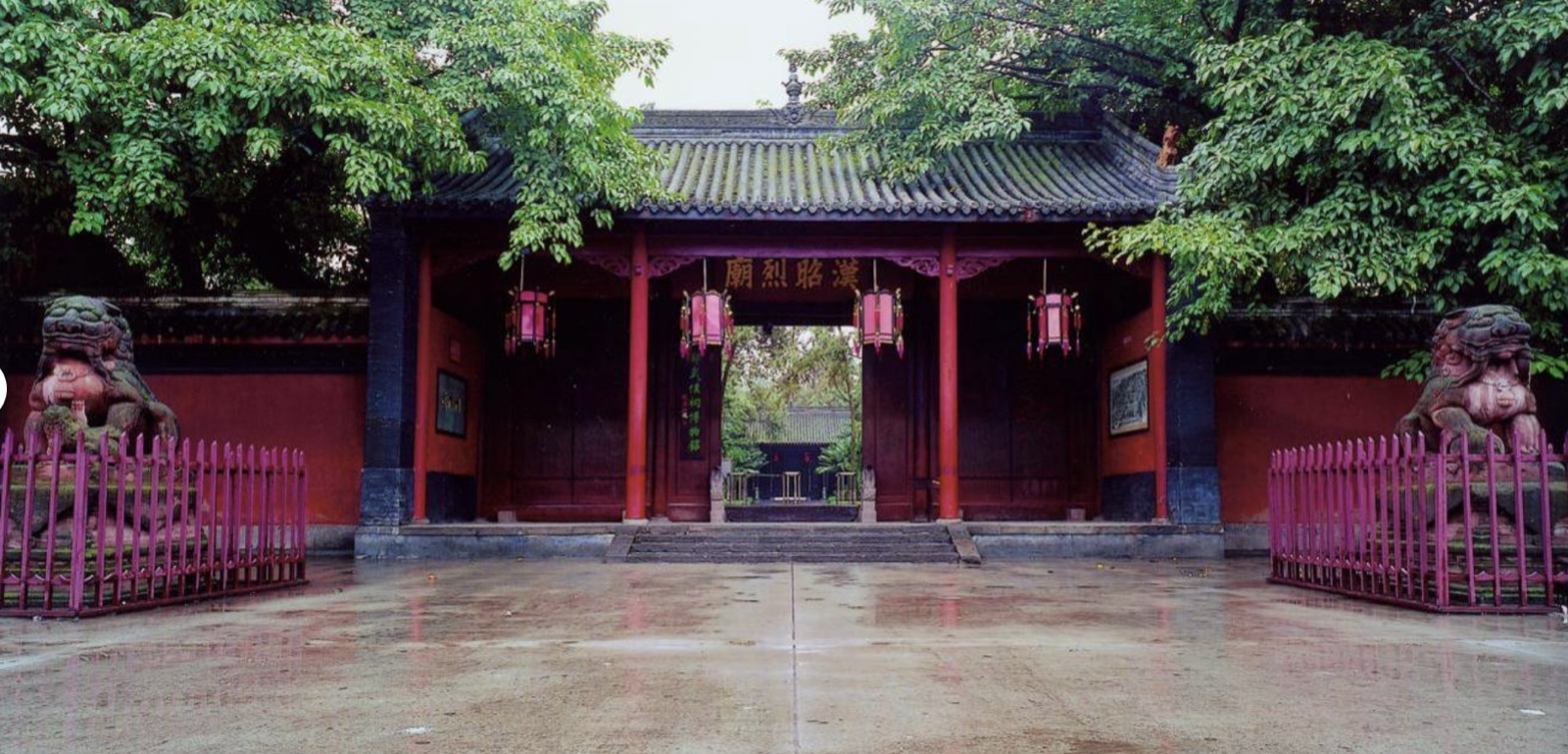
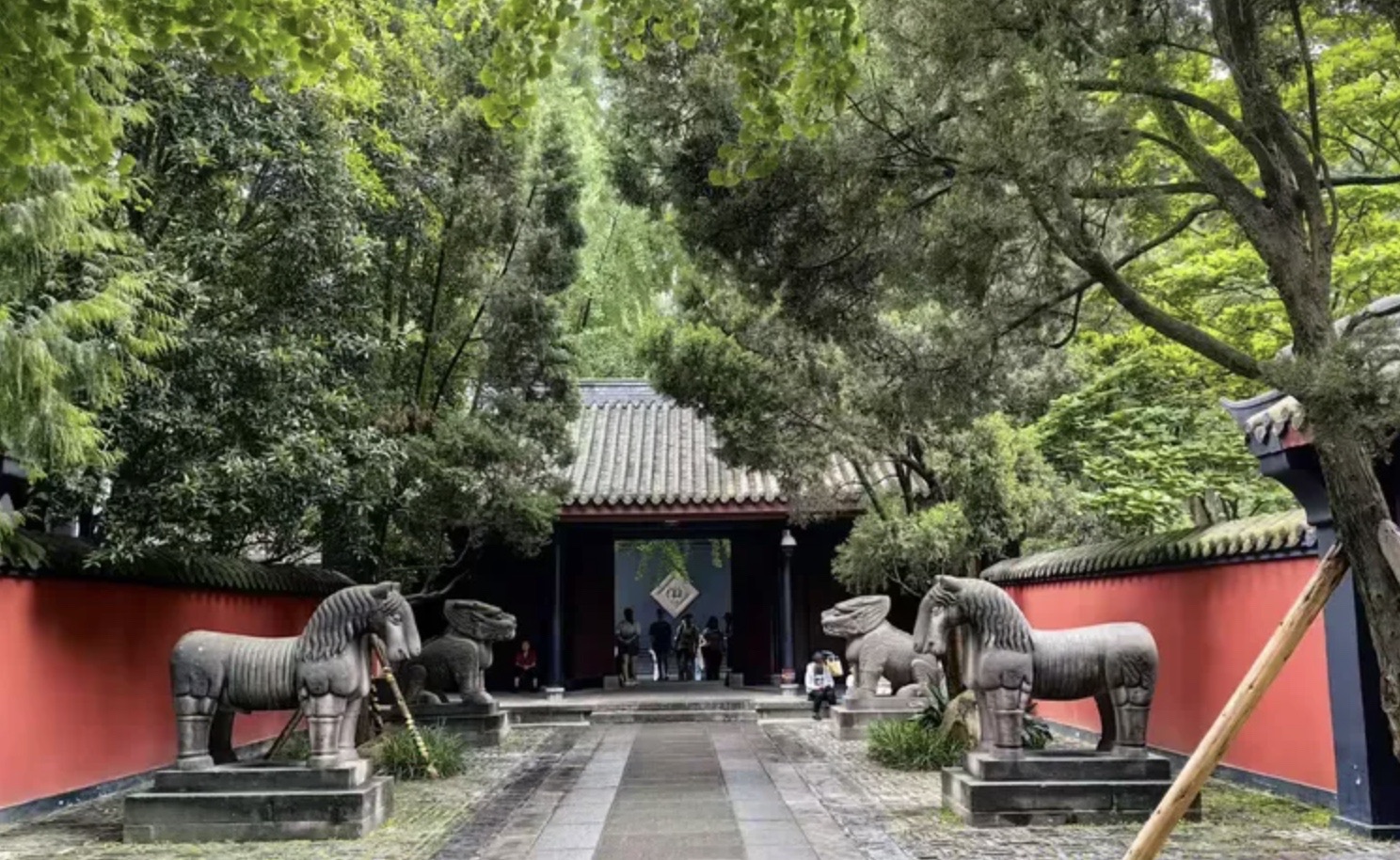
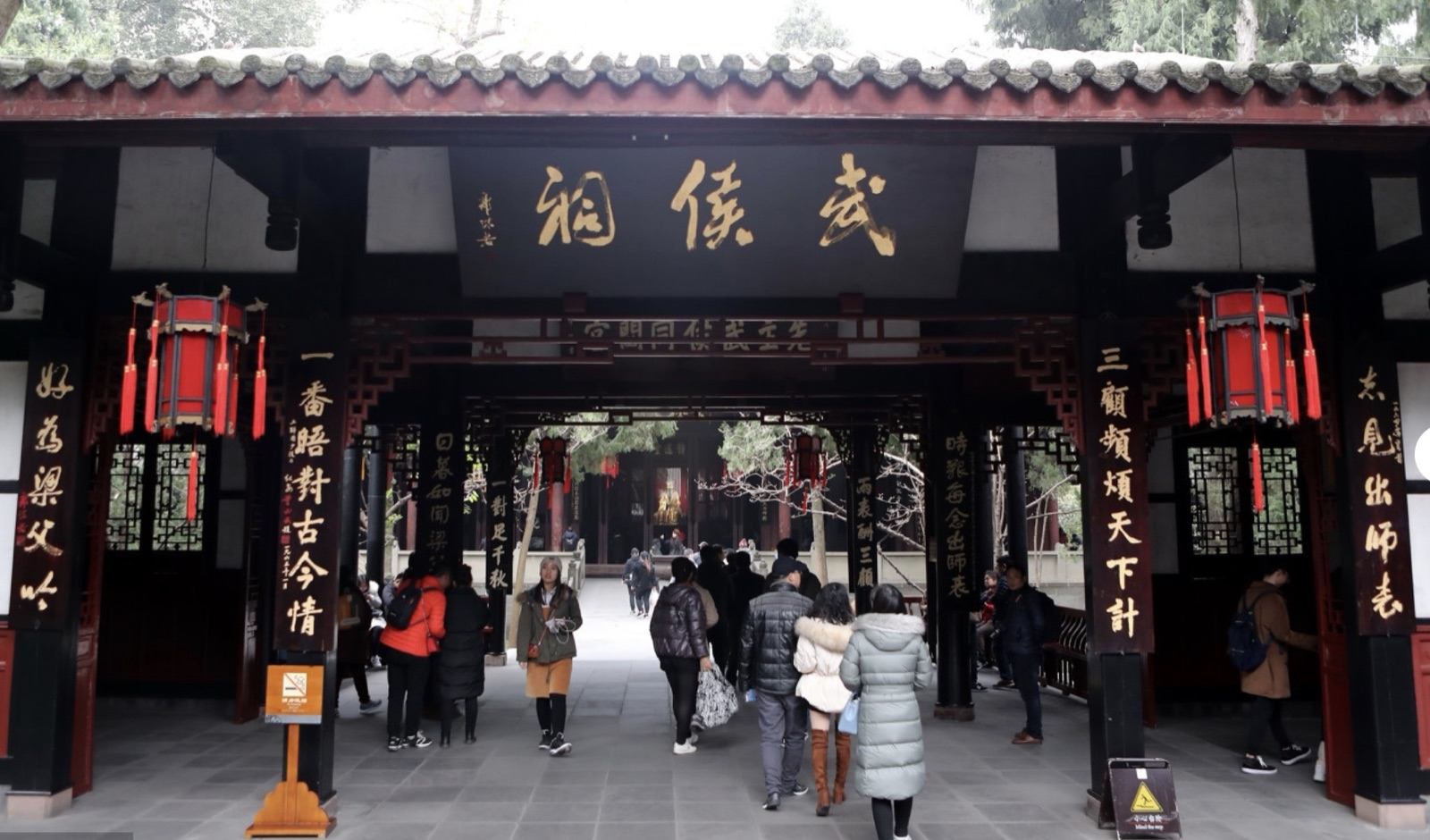
The Main Gate features a flush gable roof divided by a central column into inner and outer bays. A vermilion plaque hangs at the center of the gate, bearing four gilded characters reading "Temple of Han Zhaolie." Two Ming dynasty stone lions flank the entrance, and a spirit wall stands just outside the central axis, framed on either side by ancient banyan trees. A celebrated couplet composed by modern calligrapher Liu Mengkang is displayed at the gate: "Three visits for counsel on the fate of the realm; one meeting that moved heaven and earth across all time."

Although the gate plaque reads "Temple of Han Zhaolie" — a temple honoring Liu Bei, the Emperor Zhaolie of Shu Han — people have called the entire complex "Wuhou Shrine" for centuries. The reason is simple: Zhuge Liang carried far greater weight in the hearts of ordinary people than the emperor himself. This gap between official name and popular name is perhaps the most intriguing cultural riddle the shrine holds.

The Tang Stele (Stele of Three Perfections)

The Tang Stele stands inside a pavilion between the Main Gate and the Second Gate. It measures 367 centimeters tall and 95 centimeters wide, and was erected in the fourth year of the Yuanhe reign of Emperor Xianzong of Tang (809 AD). The inscription was composed by Pei Du, a prime minister of the Tang dynasty, praising Zhuge Liang for embodying four virtues in equal measure: loyalty to his ruler, talent for founding a nation, integrity of character, and skill in governing the people. Pei Du likened him to the great statesmen of antiquity — Guan Zhong, Xiao He, and Zhang Liang. The calligraphy was executed by Liu Gongchuo, elder brother of the renowned calligrapher Liu Gongquan, in a style of upright authority. The carving was done by Lu Jian, a master craftsman of Shu, whose precise chisel work faithfully captured the spirit of the brushwork.

Because it unites three forms of perfection — literary composition, calligraphy, and stone carving — the stele has long been known as the "Stele of Three Perfections," and remains among the oldest and most treasured artifacts in the shrine.

The Ming Stele

The Ming Stele stands in a pavilion to the left of the Second Gate. It was composed by Zhang Shizhe, the Regional Inspector of Sichuan, in the twenty-sixth year of the Jiajing reign of the Ming dynasty (1547), and erected by the Chengdu prefect Ma Jiude together with his colleagues. The inscription documents in detail the history of Wuhou Shrine from the Shu Han period onward — its successive restorations and the layout of the shrine as it stood at the time — making it, in effect, a chronicle of the shrine's construction history carved in stone. The characters are orderly and measured, and the stele serves as a key primary source for studying the architectural development of Wuhou Shrine and the evolving tradition of venerating Zhuge Liang and Liu Bei across later dynasties.

Second Gate

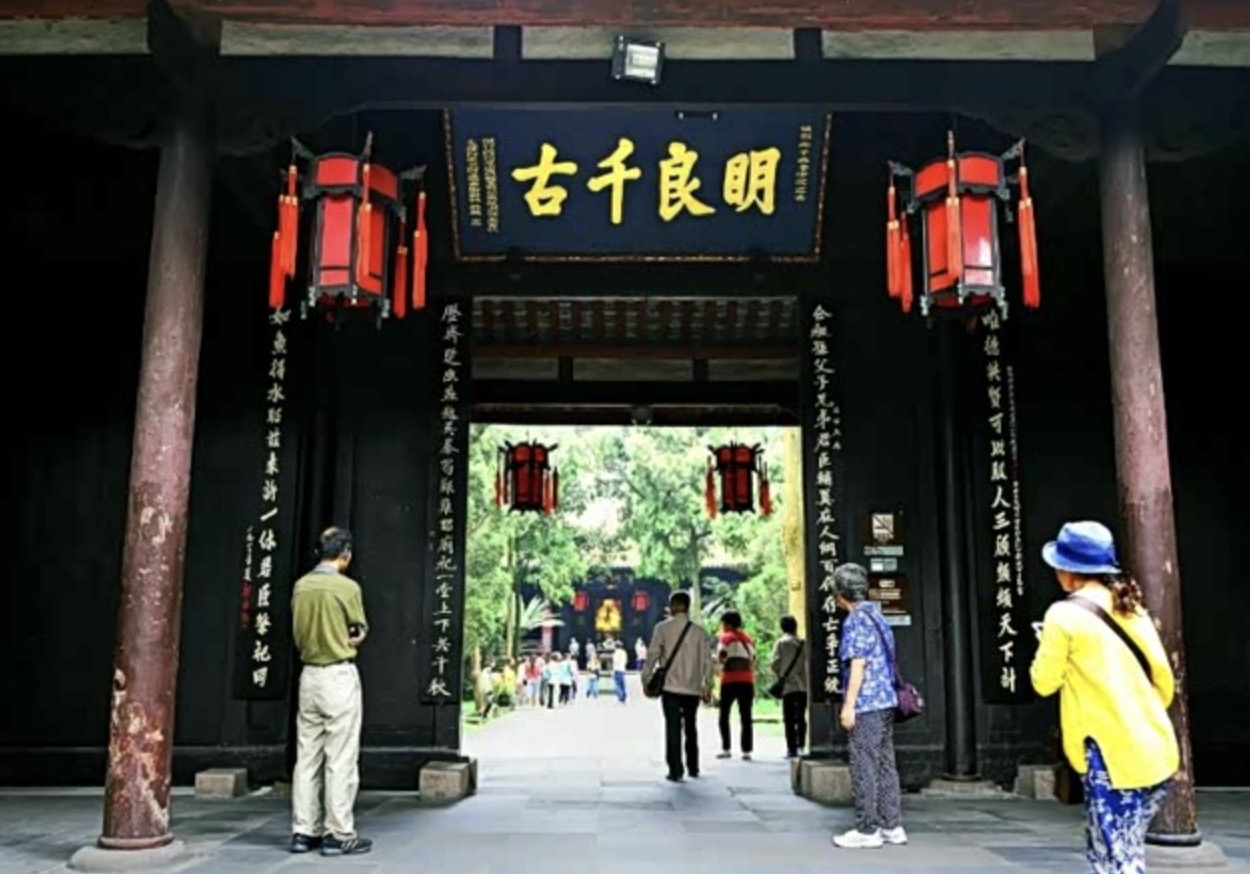
The Second Gate is a three-bay flush gable structure. Above the gate hangs a plaque bearing the four characters "Mingliang Qiangu," meaning "Enlightened ruler and able minister — a model for all ages." The plaque was installed during the Kangxi reign of the Qing dynasty by Wu Ying, the Military Governor of Sichuan, who held up the relationship between Liu Bei and Zhuge Liang as the ideal of ruler-minister bonds throughout history. Passing through the Second Gate marks entry into the inner ceremonial heart of Wuhou Shrine.

Civil and Military Corridors

On the east and west sides in front of the Hall of Liu Bei run two long corridors, together housing 28 statues of Shu Han civil officials and military commanders. The eastern corridor is the Civil Officials Corridor, led by Pang Tong — styled "Young Phoenix" — followed by Jian Yong, Qin Mi, Jiang Wan, Fei Yi, Dong Yun, and nine other strategists, each rendered with a distinct bearing and temperament. The western corridor is the Military Commanders Corridor, led by Zhao Yun of Changshan, followed by Ma Chao, Huang Zhong, Jiang Wei, and eleven other generals, all posed with martial dignity.

The costumes of all 28 statues draw on the theatrical dress conventions of the Qing dynasty. A stone stele recording each figure's biography stands before every statue. Ancient cypresses rise in front of the corridors, complementing the statues and lending the whole ensemble a deep sense of historical gravity.

Hall of Liu Bei

The Hall of Liu Bei is the principal structure on the central axis, positioned at the northern end of the first courtyard. Together with the Civil and Military Corridors on the east and west and the Second Gate to the south, it forms a complete four-sided courtyard. At the center of the hall stands a gilded seated statue of Liu Bei, three meters tall, wearing a nine-pendant crown and holding a jade tablet in both hands — the largest single statue in the entire shrine — attended by two figures, one bearing the imperial seal and the other the emperor's sword.

On the eastern wall of the hall, a woodblock carving of the "Longzhong Dialogue" by Zhuge Liang, rendered in the calligraphy of modern master Shen Yinmo, is inlaid into the wall. On the western wall, a stone carving of Zhuge Liang's "Memorial on the Dispatch of Troops," in the hand of Yue Fei, is set into the wall. Above the central doorway hangs the plaque "Ye Shao Gao Guang," meaning Liu Bei carried forward the imperial legacy of Han Gaozu Liu Bang and Emperor Guangwu Liu Xiu, establishing the foundation of Shu Han.

Connecting Hall

The Connecting Hall is the transitional structure between the Hall of Liu Bei and the Hall of Zhuge Liang, spanning three bays in width and one bay in depth. Numerous plaques and couplets hang inside, the most celebrated of which is the "Heart-Winning Couplet" composed by the Qing scholar Zhao Fan: "Win over hearts, and resistance dissolves on its own — for those who truly understand war throughout history were never lovers of it; fail to read the situation, and both leniency and severity will go wrong — those who govern Shu in the future must think deeply on this." Using Zhuge Liang's governance of Shu as its starting point, the couplet reflects on the art of warfare and the essence of statecraft. It has long been regarded as the finest couplet in Wuhou Shrine and continues to be quoted to this day.

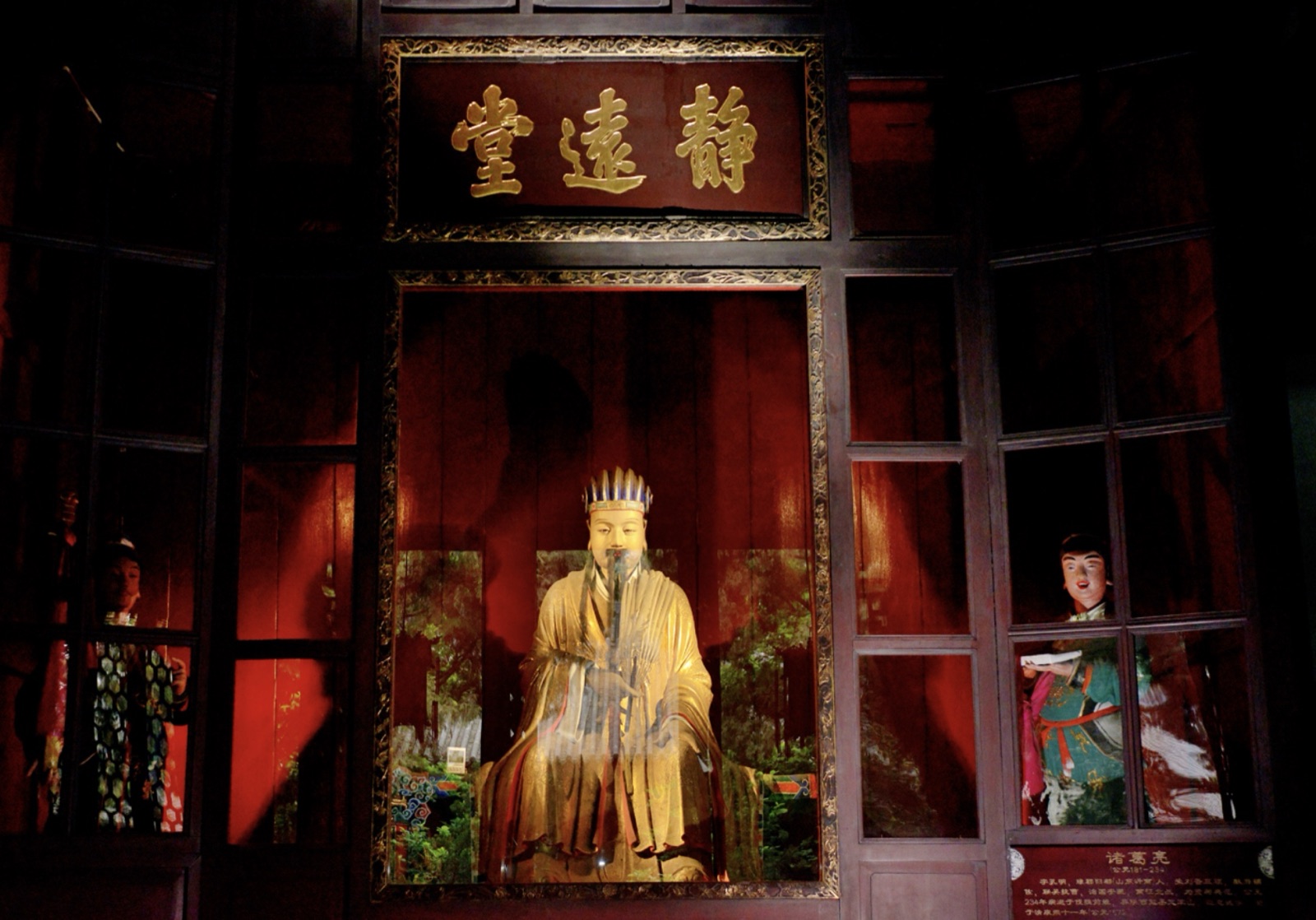
Hall of Zhuge Liang (Hall of Still and Far)

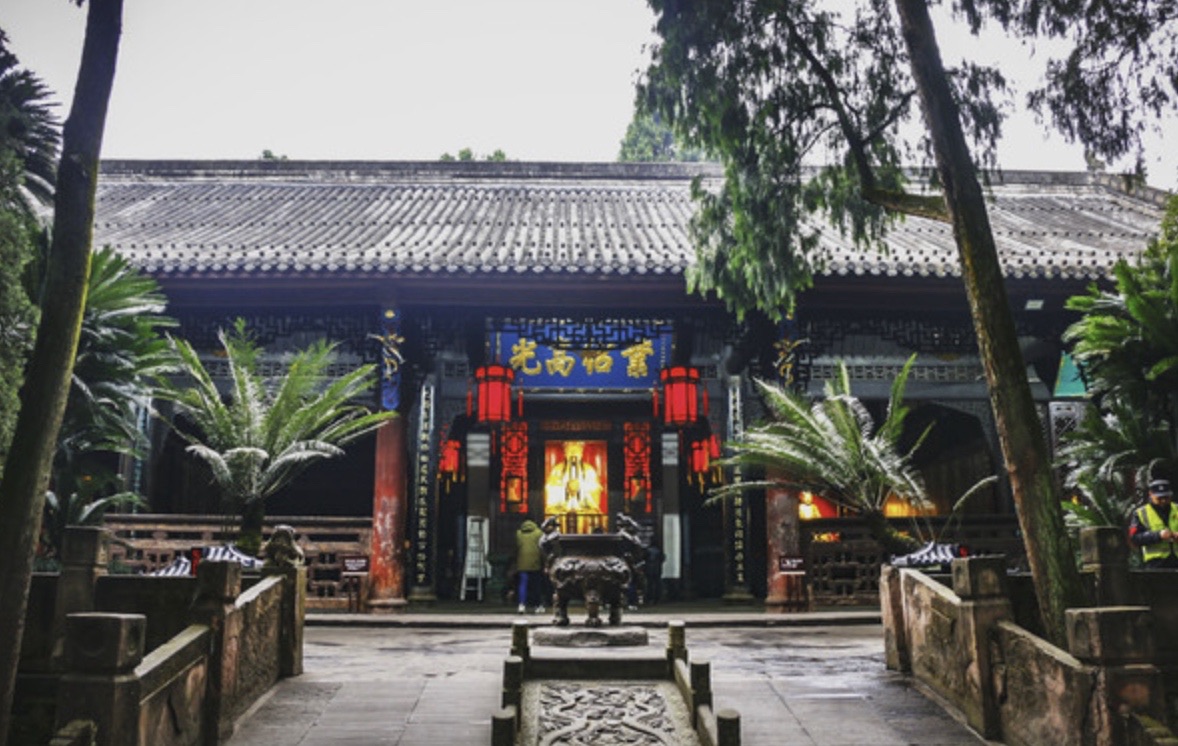
The Hall of Zhuge Liang lies north of the Connecting Hall, enclosed by six structures: the Connecting Hall, east and west side rooms, a bell tower, a drum tower, and the main hall of Kongming, with a combined floor area of 1,588 square meters. At the center of the hall stands a gilded seated statue of Zhuge Liang, depicted in his characteristic feathered fan and silk headband, his expression composed and serene. Flanking him on left and right are statues of his son Zhuge Zhan and his grandson Zhuge Shang — three generations of the family enshrined together in one hall.

Above the eaves at the front of the hall hangs the plaque "Ming Chui Yu Zhou," taken from a line by the poet Du Fu: "The great name of Zhuge Liang fills the universe." The hall's name, "Hall of Still and Far," comes from Zhuge Liang's "Letter of Admonition to His Son": "Without simplicity of desire, one cannot clarify one's ambitions; without stillness of mind, one cannot reach far." The full text of the letter is carved into the main roof beam above.

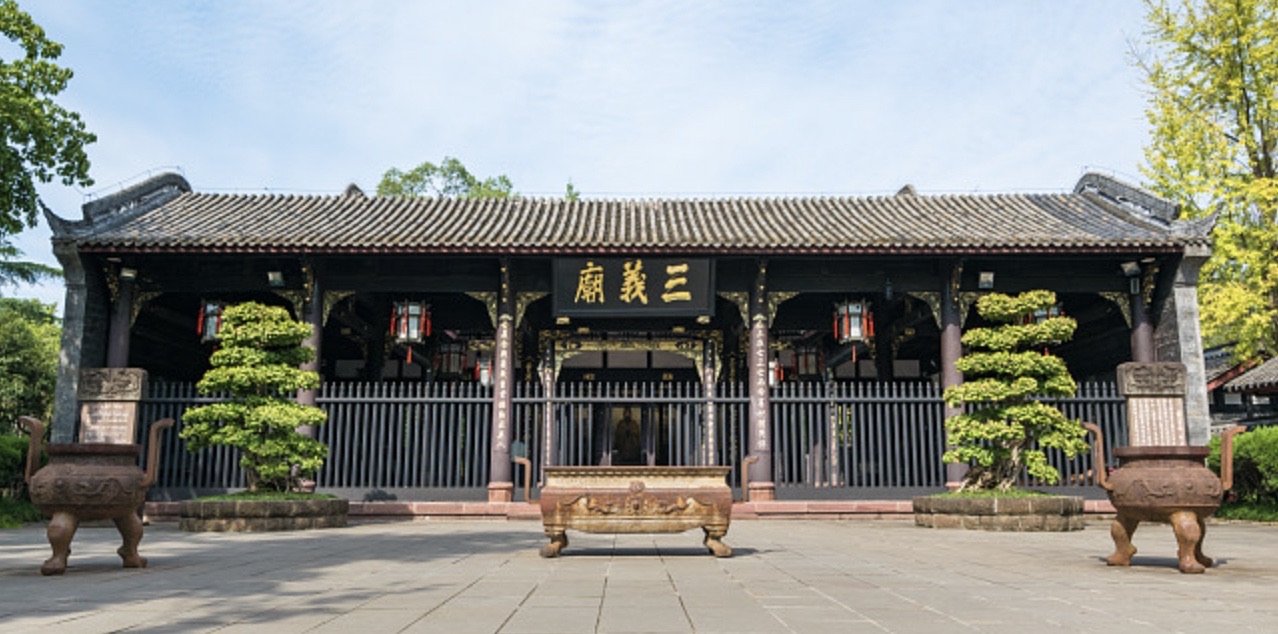
Sanyi Temple

Sanyi Temple stands north of the Hall of Zhuge Liang. Originally called Sanyi Shrine, it was first built in the early Kangxi reign of the Qing dynasty by Zheng Jiaolin, then Military Governor of Sichuan. The surviving structures and inscriptions date primarily from the Daoguang period (1821–1850). The building is of composite construction, covering 569 square meters across four courtyards and five halls. Inside, three statues depict Liu Bei, Guan Yu, and Zhang Fei as imagined in the novel Romance of the Three Kingdoms — rendered here younger and more vigorous than versions found elsewhere. The temple plaque reads "Yi Zhong Taoyuan," evoking the boundless loyalty of the oath the three men swore in a peach garden, and celebrating the spirit of faithfulness at the heart of the Three Kingdoms era.

Huiling Mausoleum

Huiling Mausoleum is the tomb of Liu Bei, Emperor Zhaolie of Shu Han, and the oldest surviving structure in the Wuhou Shrine complex, established in the first year of the Zhangwu reign of Shu Han (221 AD). The tomb structures are arranged along a south-to-north central axis: a spirit wall, a gate, a spirit path, a rear hall, and the burial mound itself. Above the gate hangs the plaque "Han Zhaolie Ling." Ancient cypresses line both sides of the spirit path. The burial mound rises approximately 12 meters, with a perimeter of about 180 meters, in a truncated-pyramid shape, its surface covered in dense vegetation.

According to the Records of the Three Kingdoms, Huiling is a joint burial tomb: Liu Bei's consorts, Lady Gan and Lady Wu, are also interred within. After eighteen hundred years, the mausoleum has never been looted, making it one of the best-preserved imperial tombs from the Three Kingdoms period in China.

Red Wall Passage

The Red Wall Passage is the corridor connecting the Hall of Zhuge Liang to Huiling Mausoleum — a deep, enclosed lane flanked by vermilion palace walls, stretching roughly one hundred meters. The walls are painted a rich red; behind them grow tall, slender bamboo, whose shadows fall across the surface, creating a shifting interplay of red and green, light and shade. The mood shifts with every hour and every season — in morning sun, in rain, in the last light of afternoon. The passage has become one of the most photographed spots in Wuhou Shrine, a signature image visitors associate with the entire site.

Kongming Garden

Kongming Garden occupies the western side of the shrine's garden zone. Originally a section of the shrine's ornamental grounds, it was later developed into a dedicated exhibition area focusing on the life and achievements of Zhuge Liang, displaying Three Kingdoms-era artifacts, weapons, farming tools, and scale models of his wooden oxen and gliding horses. Towering old trees shade the grounds, and covered walkways connect the exhibition rooms, weaving the story of Zhuge Liang's life — from the Longzhong Dialogue to his final campaign at Wuzhang Plains — through a setting of quiet garden beauty.

Jinli

Jinli runs immediately east of Wuhou Shrine. It is one of the oldest and most commercially vibrant streets in the historical record of western Shu, already celebrated throughout the country as far back as the Qin, Han, and Three Kingdoms periods. Restored and rebuilt, the street extends 550 meters and is modeled on the vernacular residential architecture of western Sichuan from the late Ming and early Qing dynasties. Stone-flagged lanes wind between shopfronts selling Shu embroidery, bamboo weaving, sugar paintings, and other intangible cultural heritage crafts. Jinli and Wuhou Shrine fall under the same administrative body, the Chengdu Wuhou Shrine Museum. Together — one lively, one contemplative — they form Chengdu's most representative Three Kingdoms cultural experience.

Inside Wuhou Shrine

10 stops, in walking order — read top to bottom, no clicking needed.

1 South Gate & Screen Wall (Chengdu Wuhou Shrine) of 10

South Gate & Screen Wall (Chengdu Wuhou Shrine)

南门与照壁(成都武侯祠)

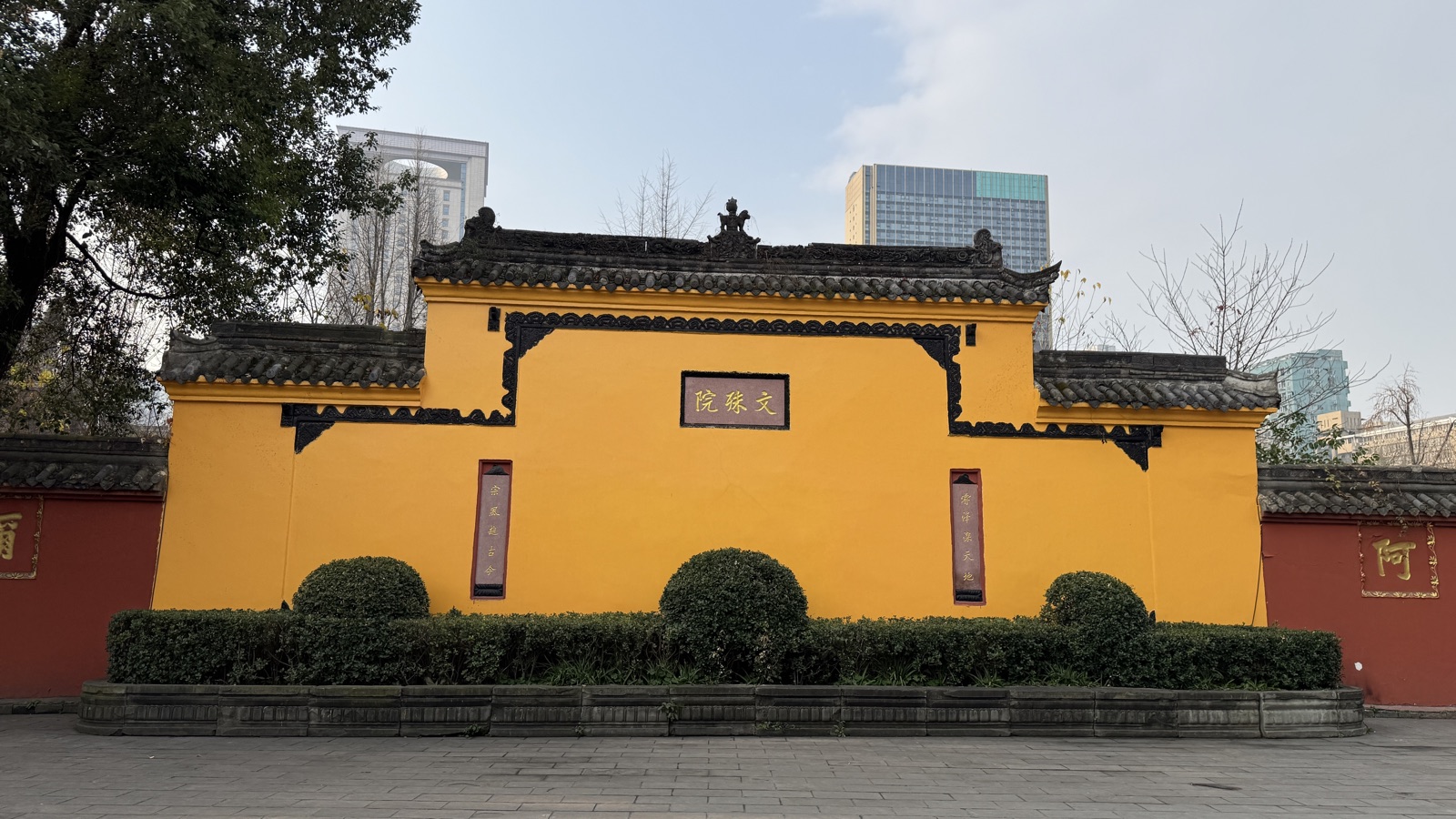
The vermilion screen wall outside the south gate bears the black-and-gold "Han Zhao Lie Miao" plaque—signaling that this is no ordinary Zhuge shrine, but a nationally unique co-enshrinement of sovereign and minister. The wall is ~18m long and ~6m tall, built of grey brick. The south plaza, shaded by green trees, often features Sichuan-opera face-changing performers and bronze statues. The "red wall with bamboo shadow" is one of Chengdu's most photogenic classical backdrops. During Spring Festival, the plaza hosts lantern shows and intangible-heritage markets.

On-site narration · read it where you stand

Welcome, everyone! It's great to have you here at the Wuhou Shrine Museum in Chengdu. Today I'll take you through the site in order — South Gate, Main Gate, Second Gate, Liu Bei Hall, the Passageway, Zhuge Liang Hall, Sanyi Temple, Huiling Mausoleum, and finally Jinli Street — so we can experience together this "Sacred Ground of the Three Kingdoms," where history, architecture, and garden art all come together.

Let's start with a quick overview of Wuhou Shrine. This is no ordinary place. Founded in 223 AD, it has stood for over 1,780 years and is the only shrine in China dedicated jointly to a ruler and his minister. You might wonder what "jointly dedicated" means — it means that both sovereign and subject are worshipped here under one roof: Liu Bei and Zhuge Liang, honored side by side. The grounds cover 150,000 square meters, making this the most influential Three Kingdoms heritage museum in the country, earning it the title "Sacred Ground of the Three Kingdoms." It was listed among the first batch of National Key Cultural Relics Protection Units in 1961, and in 2008 it was designated a National First-Class Museum.

A lot of people call this place Wuhou Shrine without a second thought, but its official name is actually the Han Zhaoli Temple. When it was first built, it served as a memorial temple for Liu Bei, the founding emperor of Shu Han, and was known as the Han Zhaoli Temple. Nearby stood a separate Wuhou Shrine dedicated to Zhuge Liang. Then, in the twenty-fourth year of the Hongwu reign of the Ming dynasty (1391), Zhu Chun, the Prince of Shu, decided that ruler and minister ought to share the same space, and had Zhuge Liang's statue moved into the Han Zhaoli Temple — creating the unique arrangement of one shrine honoring both lord and counselor. But the people didn't care much about official names. Because Zhuge Liang's achievements were so towering and the affection people held for him ran so deep, everyone kept calling the whole complex "Wuhou Shrine." During the Republic of China era, the poet Zou Lu captured it perfectly: "The gate plaque reads Han Zhaoli Temple, yet all the world calls it Wuhou Shrine. For reputation bows to merit and deed — the Premier's glory echoes down a hundred ages." That verse is a true reflection of how, in the hearts of Sichuan's people, Zhuge Liang's stature surpassed even that of Liu Bei.

Right now we're standing outside the South Gate — take a look at that tall spirit wall across the road. A spirit wall, or zhaobi, is a feature of traditional Chinese architecture: you never let the main gate open directly onto the street. A wall is placed in front to shield the interior, preserve privacy, and — as the saying goes — "gather the wind and hold the energy." On either side of this wall stands an old banyan tree, its canopy spread wide like an umbrella, framing the red wall in a scene that serves as Wuhou Shrine's very first impression.

Main Gate — Han Zhao Lie Miao (Chengdu Wuhou Shrine)

大门——汉昭烈庙(成都武侯祠)

The main gate bears the gold character "Han Zhao Lie Miao," calligraphied by Guo Moruo in 1955. The gate is a single-eave overhanging-gable building, vermilion doors with bronze beast-head knockers, flanked by two stone lions carved in the Kangxi era. The plaque is the key to understanding the shrine's unique layout: as minister, Zhuge Liang's shrine should be in front, but during the early Ming the order was reversed—Emperor Liu Bei's "Han Zhao Lie Miao" stands ahead, Zhuge's behind. The tour officially begins here.

On-site narration · read it where you stand

Coming through the South Gate, the first thing you see is the plaque above the entrance bearing four golden characters: Han Zhao Lie Miao — the Han Zhaoli Temple. Take a close look at that plaque — notice anything unusual about the character for "bright" or "ming"? On the left side, the normal form has the sun radical "ri," but on this plaque it's written with an extra horizontal stroke, making it look like "mu" — an eye — instead. Legend has it this was a slip of the brush by the Kangxi Emperor of the Qing dynasty. Later generations, however, decided they liked the "error" better than the correct version, reading it as a poetic idea: a truly enlightened ruler must see with sharper eyes than ordinary men. So it was passed down from one generation to the next and became one of Wuhou Shrine's most distinctive cultural signatures.

Admission is 50 yuan per person. Students and visitors over 60 receive half-price tickets at 25 yuan. The shrine is open from 9 a.m. to 6 p.m., with last entry at 5 p.m. You can buy tickets at the ticket windows or scan the QR code to purchase online through the Wuhou Shrine mini-program on WeChat or Alipay. During the Spring Festival temple fair, crowds can be very large — if you'd prefer a quieter visit, coming on a weekday right when the gates open is the way to go.

Look up at the two sides of the main gate. A pair of Ming dynasty stone lions flank the entrance on left and right, seated upright with heads raised high, radiating an air of quiet authority. The gate itself opens at the center, its vermilion doors studded with gold-painted nails — nine across and nine down, eighty-one in all. This was a specification reserved for imperial architecture during the Ming and Qing dynasties, befitting Liu Bei's status as the Emperor Zhaoli of Han.

Now let's step through the gate and enter Wuhou Shrine. When sunlight catches the plaque above these vermilion doors, it practically glows — especially in the soft light just after opening time in the morning. If you enjoy photography, keep that in mind and come back to find your angle before you leave.

Second Gate & Tang Stele — Three Absolutes Stele (Chengdu Wuhou Shrine)

二门与唐碑——三绝碑(成都武侯祠)

Crossing the main gate, the second gate bears Guo Moruo's 1944 "Wuhou Shrine" plaque, echoing the main gate's "Han Zhao Lie Miao" in the unique sovereign-minister protocol. Inside stands the "Three Absolutes Stele"—3.4m tall, 1.3m wide—composed by Prime Minister Pei Du, calligraphed by Liu Gongchuo, and carved by Lu Jian, 809 AD. The pavilion houses 20+ steles from Han to Qing dynasties, making it a one-stop showcase of 1,200 years of stone inscription. Visitors gain the key view of the central axis: Liu Bei's hall in front, Zhuge's hall behind.

On-site narration · read it where you stand

Passing through the Main Gate, we arrive at the Second Gate. Notice the six tall stone steles lining both sides of the path. The one on the far right, protected under a glass enclosure, is the famous Tang dynasty stele known as the "Stele of Three Perfections."

This stele stands over three meters tall. Its full title is Inscription on the Shrine of Zhuge Wuhou, Prime Minister of Shu. It was commissioned in the fourth year of the Yuanhe reign of Emperor Xianzong of Tang — that is, 809 AD — by Wu Yuanheng, the Military Governor of Jiannan Xichuan, after he visited the shrine with twenty-eight of his staff to pay their respects to Zhuge Liang. It has now stood for more than 1,200 years.

So why is it called the "Stele of Three Perfections"? Because it brings together three distinct forms of excellence — literary composition, calligraphy, and stone carving:

  • Perfection in Writing: The inscription was composed by Pei Du, one of the most celebrated prime ministers of the Tang dynasty. Pei Du was no ordinary figure — he was the great minister who helped restore central authority by putting down the warlord rebellions of the mid-Tang era. In this text, he praises Zhuge Liang for embodying "loyalty in service, talent in founding a state, integrity in conduct, and skill in governing the people," comparing him to the legendary ministers Guan Zhong, Xiao He, and Zhang Liang of antiquity. Through Zhuge Liang's example, he was also gently advising Emperor Xianzong to strengthen central power and bring the regional warlords to heel.

  • Perfection in Calligraphy: The text was written by Liu Gongchuo, the older brother of Liu Gongquan — the most celebrated master of regular script in the Tang dynasty. The saying "the sinew of Yan, the bone of Liu" refers to that Liu Gongquan. Liu Gongchuo's own calligraphy was equally accomplished and was said to be "no lesser than his younger brother's" — upright and vigorous, with a powerful, disciplined stroke.

  • Perfection in Carving: The stone was cut by Lu Jian, a master craftsman from Sichuan. His chisel work was precise enough to reproduce every nuance of Liu Gongchuo's brushwork — every stroke that began round like a silkworm's head and lifted at the end like a swallow's tail was faithfully rendered in stone.

You may find that the glass enclosure causes reflections when you try to photograph the stele. Try shifting slightly to one side, or use a polarizing filter to cut the glare — this will make the inscribed characters come through much more clearly. The best light for shooting this stele falls between 8 and 10 in the morning, when sunlight comes in from the side and brings out the depth and texture of the carving.

In the stele pavilion to the left of the Second Gate stands another important stone stele from the Ming dynasty — the Inscription on the Shrine of Zhuge Wuhou, in full, composed by Zhang Shizhe, the Governor of Sichuan, and erected in the twenty-sixth year of the Jiajing reign (1547). Its text traces the history of the shrine through the ages — something of an official record of how Wuhou Shrine came to be.

Near the Second Gate, another feature deserves attention — the ancient cypress trees of Wuhou Shrine. Dozens of old cypresses still grow within the grounds. Some are said to have roots going back nearly two thousand years, though the original trees are long gone and what stand here today are replacements planted by later generations. Even so, they carry the memory of the ancient cypresses that Du Fu immortalized in verse. What is especially remarkable is that some of these trees still bear traces of the propping method used by Qing dynasty craftsmen — wooden poles driven into the earth at an angle to support a leaning trunk and keep an aged tree from falling. It was a simple, ingenious solution. The bark is cracked and furrowed like an old person's face, yet in May the branches are full of fresh green leaves that rustle in the breeze. Standing beneath them, you can feel a stillness that reaches back a thousand years.

Liu Bei's Hall — Main Hall of Han Zhao Lie Miao (Chengdu Wuhou Shrine)

刘备殿——汉昭烈庙正殿(成都武侯祠)

Liu Bei's Hall is the 3rd bay of the central axis, ~12m high, hung with the plaque "Ye Shao Gao Guang." Centered is the gilded seated statue of Emperor Zhaolie Liu Bei—robed, holding the jade tablet, dignified—the shrine's principal deity. Flanking the emperor are Guan Yu's three generations (Guan Ping, Guan Xing, Zhang Zun) and Zhang Fei's three generations (Zhang Bao, Zhang Zun); the side walls display 14 Shu Han elite statues (Zhuge Liang, Pang Tong, Zhao Yun, Ma Chao, Huang Zhong). The stone balustrade is finely carved, and the hall houses historic plaques including Zhuge Liang's "Collection" plaque and Lu You's poetry stele. Liu Bei's birthday celebration is held on the 26th day of the 6th lunar month.

On-site narration · read it where you stand

Through the Second Gate, we arrive at the heart of Wuhou Shrine — Liu Bei Hall. This is the largest building in the complex, built with the traditional single-eave hip-and-gable roof — a form second only to the full hip roof in the hierarchy of classical Chinese architecture. The hall stretches seven bays wide and four bays deep, and the carved bracket arms along the front eaves are decorated with gilded mythical animals of exceptional craftsmanship.

Look up at the plaque above the Second Gate — four large characters reading "Ming Liang Qian Gu," written by Wu Ying, Military Commander of Sichuan during the Kangxi reign of the Qing dynasty. "Ming" refers to Liu Bei as an enlightened ruler; "Liang" refers to Zhuge Liang as an outstanding minister; "Qian Gu" means that this model of ruler and counselor will be remembered for eternity. Notice that the character "ming" here is also written with the eye radical rather than the sun radical — the same as on the Main Gate plaque, a writing style unique to Wuhou Shrine.

Step inside the hall and you'll find yourself facing the towering golden statue at the center — this is Liu Bei. It is the tallest statue in the entire shrine, standing three meters high and covered in gold leaf. He wears an imperial crown adorned with nine strings of hanging jade beads — the regalia of a Son of Heaven — and holds a jade ceremonial tablet in both hands, the implement carried by emperors during formal rites. The plaque before the statue reads "Emperor Zhaoli of Han" — "Han" being the dynastic name, "Zhaoli" his posthumous title. Flanking him are two attendants: one holding the imperial jade seal, the other a royal sword, symbolizing civil and military authority. Liu Bei rose from selling straw sandals on the street to ruling a third of the known world, founding the kingdom of Shu Han on the twin principles of benevolence and righteousness — one of the most unlikely origin stories in all of Chinese history.

Now turn to the side halls on the left and right:

The East Side Hall is dedicated to Guan Yu. Guan Yu's image — the red face, the long beard, the phoenix eyes, the crouching silkworm eyebrows, the Green Dragon Crescent Blade — is one that needs no introduction. In Chinese culture, Guan Yu is the embodiment of loyalty and righteousness, venerated as the God Guan and in Buddhist tradition as the Protector Bodhisattva. Enshrined alongside him are his sons Guan Ping and Guan Xing, and his subordinates Zhao Lei and Zhou Cang. Zhou Cang is actually a fictional character from the novel Romance of the Three Kingdoms, but his place in popular imagination was so deeply rooted that he too earned a spot in the hall.

The West Side Hall is dedicated to Zhang Fei. Zhang Fei's image — the dark face, the wide eyes, the swallow jaw and tiger whiskers — radiates the ferocity of a great warrior. The historical Zhang Fei was quite different from his fictional counterpart: he was skilled in calligraphy, showed deep respect to men of virtue, and was said to be especially fond of painting beautiful women. Enshrined with him are his son Zhang Bao and grandson Zhang Zun — Zhang Zun died fighting when Wei invaded and destroyed Shu Han, carrying on the family's tradition of loyal sacrifice.

Now step back outside and look toward the two long corridors stretching east and west in front of Liu Bei Hall — these are the celebrated Civil and Military Galleries.

In the fifth year of the Daoguang reign (1825), Liu Yuan, a prominent Sichuan scholar, oversaw a restoration of Wuhou Shrine and had fourteen clay statues of Shu Han civil officials placed in the East Gallery and fourteen military commanders in the West Gallery — twenty-eight in all. Each statue stands beside a stone tablet inscribed with a brief account of that person's life. The clothing on the figures draws from the costume traditions of Qing dynasty opera, which gives them a distinctive visual character.

The East Gallery is the Civil Officials' Gallery, led by Pang Tong, followed by Jian Yong, Lu Kai, Fu Rong, Fei Yi, Dong He, Deng Zhi, Chen Zhen, Jiang Wan, Dong Yun, Qin Mi, Yang Hong, Ma Liang, and Cheng Ji. Among these fourteen, you have a first-rate strategist known as the "Young Phoenix" (Pang Tong), ministers who steered the Shu Han court after Zhuge Liang's death (Jiang Wan and Fei Yi), and men who held the diplomatic and military fronts (Deng Zhi on a mission to Eastern Wu, Fei Yi holding Hanzhong). The most stirring figure is Fu Rong — at the Battle of Yiling, when Liu Bei's forces were routed, Fu Rong commanded the rearguard and fought until his last soldier fell. When Wu troops called on him to surrender, he said: "You dogs of Wu — since when does a Han general surrender?" Then he fought on until he died. Those words are carved on the tablet beside his statue, and every visitor who reads them feels a jolt to the chest.

The West Gallery is the Military Commanders' Gallery, led by Zhao Yun, followed by Sun Qian, Zhang Yi, Ma Chao, Wang Ping, Jiang Wei, Huang Zhong, Liao Hua, Xiang Chong, Fu Jian, Ma Zhong, Zhang Yi (a different one), Zhang Nan, and Feng Xi. Zhao Yun stands first not because he held the highest rank — in fact, his official position within Shu Han was never the most senior — but because his standing among ordinary people was extraordinary. His image as a warrior of total loyalty and unshakeable courage became part of the cultural DNA. Ma Chao was the scion of a legendary Western Liang military family; his fame as "the Magnificent Ma Chao" reached even Cao Cao's ears. Jiang Wei was Zhuge Liang's chosen successor and led nine campaigns against the north after Zhuge Liang's death, never abandoning the dream of restoring the Han dynasty.

Stand in the middle of the galleries and look back at Liu Bei Hall. These twenty-eight statues of civil and military officials, the images of Guan Yu and Zhang Fei in the side halls, and the central statue of Liu Bei together form a complete tableau of the Shu Han court — civil officials to the east, military commanders to the west, all standing guard around their sovereign at the center. This is not simply a shrine. It is an entire era, one that brimmed with heroes, frozen in space.

Connecting Hall — Chu Shi Biao Stone Carving (Chengdu Wuhou Shrine)

过厅——出师表石刻(成都武侯祠)

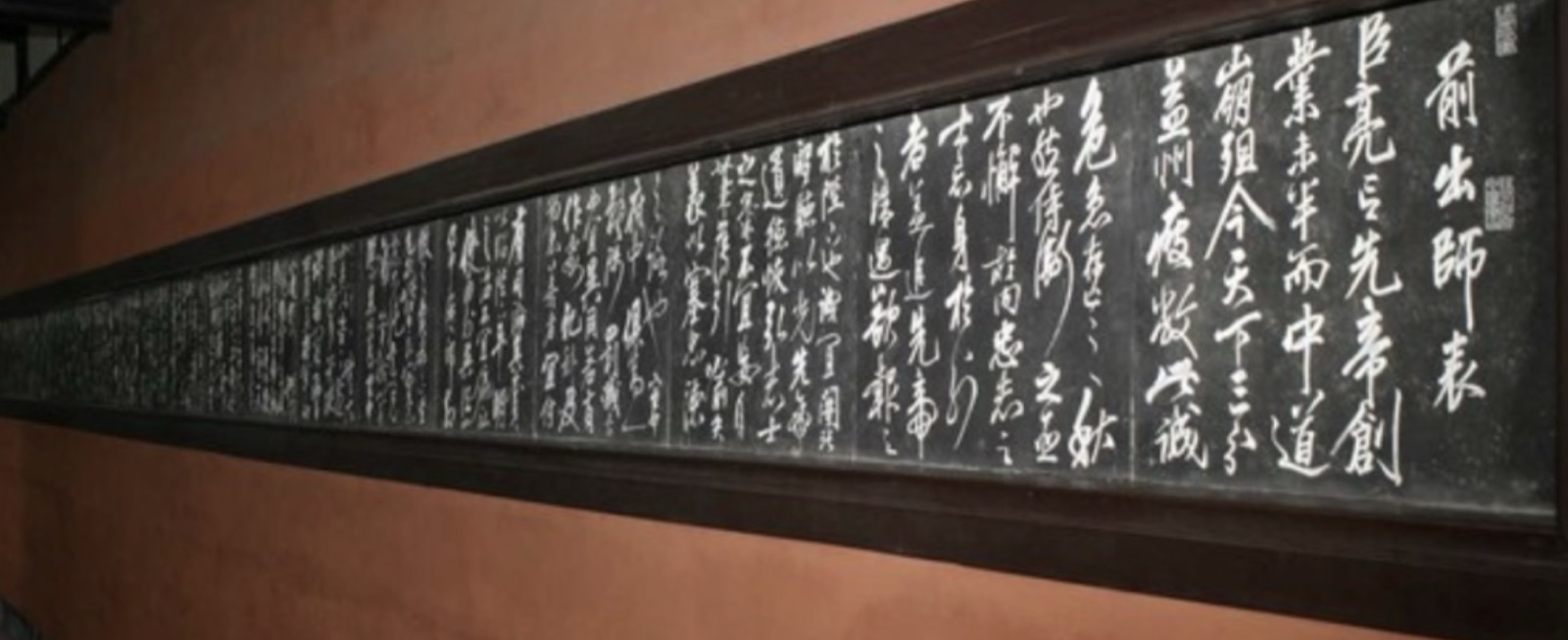
The connecting hall is the 4th bay on the central axis, functioning as a transition between Liu Bei's and Zhuge Liang's halls. Its south and north walls bear the "Chu Shi Biao" carvings—Yue Fei's calligraphy of the "Former" and "Latter Memorials." Yue Fei's running script is vigorous and powerful, bridging the two loyal figures 700 years apart. The carved plaques were re-engraved in the Guangxu era. The hall bears the "Jingyuan Tang" (Tranquility Hall) plaque, quoting Zhuge Liang's famous injunction: "Without tranquility, one cannot achieve far-reaching goals."

On-site narration · read it where you stand

Leaving Liu Bei Hall and continuing north along the central axis, the corridor we're passing through now is the Passageway. The space itself is modest, but the walls on either side are inlaid with one of the most important calligraphic treasures in the entire shrine — the stone carvings of the "Chu Shi Biao" (Memorial on Sending Forth the Army), handwritten by Yue Fei.

The two Memorials on Sending Forth the Army were written by Zhuge Liang in 227 and 228 AD, on the eve of his first and second northern campaigns, as formal addresses to the later ruler Liu Shan. They are among the most celebrated works of prose in Chinese literary history. The lines they contain are things almost every Chinese person can recite from memory: "I was a commoner, tilling the fields in Nanyang, simply trying to survive in an age of upheaval, asking nothing of the princes and lords." "I will give my utmost in faithful service until my dying breath."

But what makes these carvings truly remarkable is not just the text — it's the man who wrote it: Yue Fei. In the eighth year of the Shaoxing reign of the Southern Song dynasty (1138), Yue Fei was marching his army through Nanyang in Henan Province and stopped to spend the night at the local Zhuge Liang shrine. He walked through the halls where Zhuge Liang's memory still lingered, and something inside him broke open. Two heroes, separated by nine hundred years: Zhuge Liang, who spent his life in campaigns northward, his ambitions unfulfilled; Yue Fei, who fought his whole life to drive back the Jurchen invaders, only to be recalled by twelve imperial edicts. That night, by lamplight, two souls collided across the centuries. Yue Fei took up his brush and in a single session wrote out both memorials — his running script bold and urgent, the force of each stroke coiled like compressed energy. It is said that when he reached the lines "the campaign failed before the general could prevail — it has left heroes weeping ever since," Yue Fei wept aloud.

The set of carvings comprises thirty-seven stone panels, each approximately 63 centimeters long and 52 centimeters wide, mounted on the walls on both sides of the passageway. The characters range from about 10 centimeters square for the larger ones down to 3 centimeters for the smaller. As you walk through, take time to look at each panel — the sweeping energy in the calligraphy is like a cavalry charge. It will make you imagine a general on the night before riding out to the front, sitting by candlelight, pouring every ounce of suppressed feeling and unresolved longing into his brush.

On the opposite wall of the passageway are stone carvings of the "Longzhong Dialogue." This was Zhuge Liang's famous strategic assessment, delivered to Liu Bei before Zhuge Liang had even left his retreat at Longzhong. The core argument: first take Jing Province as a base, then seize Yi Province to establish a three-way balance of power, then ally with Eastern Wu against Cao Cao, and when the time is right, launch a two-pronged campaign northward. History unfolded almost exactly according to this blueprint. Zhuge Liang was barely in his twenties when he had already seen the entire board.

Zhuge Liang's Hall — Jingyuan Tang (Chengdu Wuhou Shrine)

诸葛亮殿——静远堂(成都武侯祠)

Zhuge Liang's Hall, the 13m-high endpoint of the central axis, bears the Qing prince's "Eternal Fame" plaque. Inside, three generations of the Zhuge family are enshrined as gilded statues. Above Zhuge Liang's image is the "Yi-Zhou Sage" plaque—equating him to the legendary minister Yi Yin. The veranda displays the famous "Gongxin Couplet" by Zhao Fan (late Qing), essential for understanding Sichuan governance philosophy. The hall also houses the "Three Absolutes" original text, a Ming bronze drum, and Qing-era epigraphy exhibits.

On-site narration · read it where you stand

Through the Passageway, we enter the rear section of Wuhou Shrine — Zhuge Liang Hall. Architecturally, this hall is noticeably smaller than Liu Bei Hall — only five bays wide, about half the floor area. But that very modesty is an expression of Zhuge Liang's own character: "I will give my utmost in faithful service until my dying breath." In life he was a minister; in death, he remains one.

Stone steps lead up to the hall entrance, lined with plain stone railings whose columns are carved with a variety of stone creatures. The eight carved bracket arms along the front eaves are exquisitely detailed. In front of the hall stands a Ming dynasty bronze incense burner with a four-legged phoenix design, its rim cast with a pair of treasure-holding child figures, lively and full of spirit. At the two rear corners of the hall are a bell tower and a drum tower — the classic pairing of "morning bell and evening drum" found in traditional Chinese temples.

Step inside and you'll see the plaque hanging above the main shrine — three characters reading "Jing Yuan Tang": Hall of Stillness and Far Sight. The name is drawn from a line in Zhuge Liang's famous Letter of Counsel to His Son: "Without simplicity of desire, one cannot clarify one's ambitions; without stillness, one cannot reach far." This is more than a hall name. It is a portrait of the man himself.

In the central shrine sits the gilded clay statue of Zhuge Liang, sculpted in the eleventh year of the Kangxi reign (1672). He holds a feather fan, wears a silk headband, and is draped in a crane-feather cloak — the image that every Chinese person carries in their mind when they think of Zhuge Liang. His expression is composed and refined, his gaze quiet and penetrating. He is at once a military commander of consummate strategic skill and a statesman who carried the weight of the world on his shoulders. Flanking him stand two young attendants — one holding a book of military strategy, the other a sword. In Zhuge Liang, the civil and the martial, the plan and the decision, were never two separate things.

The two figures enshrined to Zhuge Liang's left and right are his son Zhuge Zhan and his grandson Zhuge Shang. In 263 AD, when the Wei general Deng Ai made his audacious crossing of Yinping to strike directly at Chengdu, Zhuge Zhan and his nineteen-year-old son Zhuge Shang led their forces out to meet the enemy at Mianzhu. Both died in battle. Three generations of the Zhuge family gave their lives in loyal service — this is the most quietly heartbreaking group of statues in the entire shrine.

Look at the display in front of Zhuge Liang's statue — three bronze drums, known as the "Drums of Zhuge Liang." They are said to have been used during his southern campaigns against Meng Huo: turned upside down during the day, they served as cooking pots for the marching army; beaten at night in camp, their resonant sound carried for miles as an alert. The surface of each drum features a sunburst at the center, surrounded by crouching frogs — a classic motif in the bronze drum tradition of China's southwestern ethnic peoples. These three drums represent the lasting devotion of the peoples of the southwest to Zhuge Liang. He chose persuasion over force in subduing the south, giving rise to the legendary story of capturing and releasing Meng Huo seven times — and so the peoples of the south have remembered him, generation after generation.

Now look up at the couplet hanging on the front columns of the hall. This is the most famous inscribed couplet at Wuhou Shrine — the "Gongxin Couplet," composed by Zhao Fan in the twenty-eighth year of the Guangxu reign (1902):

Upper line: Win over the heart, and resistance dissolves of itself — the great commanders of history were never men who loved war

Lower line: Fail to read the situation, and both leniency and strictness become errors — those who govern Shu in later times must think deeply

This couplet rewards a closer reading, line by line.

The upper line says: "Win over the heart" — conquer your opponent's mind, earn their genuine allegiance, and opposition crumbles on its own. During his southern campaign, Zhuge Liang took to heart the counsel of Ma Su: "To subdue the heart is superior; to subdue the city is inferior. Winning the psychological battle is superior; winning the military battle is inferior." He captured and released Meng Huo seven times, until Meng Huo said with full conviction: "The people of the south will rebel no more." Hence the line: "The great commanders of history were never men who loved war" — true mastery of warfare means never needing to fight.

The lower line is a warning to those who come after: "Fail to read the situation" — if you don't carefully analyze the conditions you're working in, then it doesn't matter whether your policies are lenient or strict, you will get them wrong. "Those who govern Shu in later times must think deeply" — anyone who takes on the governance of Sichuan must weigh Zhuge Liang's approach carefully, and never act with haste.

When Zhao Fan wrote this couplet, Sichuan was passing through a period of political turbulence. He used Zhuge Liang's example to offer a gentle remonstrance to the then-Governor of Sichuan, hoping the authorities would govern as Zhuge Liang did — by reading the times and winning loyalty through virtue. The reason this couplet was quoted repeatedly by leaders like Mao Zedong and Deng Xiaoping is that it transcends the praise of any individual and rises to the level of a general principle of statecraft.

Sanyi Temple (Chengdu Wuhou Shrine)

三义庙(成都武侯祠)

Sanyi Temple, originally built in 1672 and relocated in 1998, now forms an independent courtyard at the southern end of the heritage zone. It enshrines the three sworn brothers: Liu Bei in the center, Guan Yu left, Zhang Fei right. The east/west wings display woodblock prints of Romance of the Three Kingdoms, replica weapons, and Guan Yu cultural exhibits. The temple complements the central axis's "sovereign-minister" theme with a "brotherly loyalty" focus. Guan Yu's birthday (24th day of 6th lunar month) features ceremonies and Sichuan-opera performances.

On-site narration · read it where you stand

Leaving Zhuge Liang Hall and walking east, we come to Sanyi Temple — the Temple of the Three Oaths. This building was not originally located here. It was first constructed in the early Kangxi reign of the Qing dynasty at Tidu Street in Chengdu, commissioned by Zheng Jiaolin, the Military Commander of Sichuan. It was destroyed by fire in the forty-ninth year of the Qianlong reign (1784) and rebuilt the following year. In 1998, when urban development required the original site to be cleared, the entire temple was dismantled and relocated here within the grounds of Wuhou Shrine.

Why move Sanyi Temple into Wuhou Shrine? Because the story of Liu Bei, Guan Yu, and Zhang Fei is inseparable from Zhuge Liang's own story — the Oath of the Peach Garden was the founding moment of Shu Han, and the Longzhong strategy was its blueprint. By bringing the Temple of the Three Oaths inside Wuhou Shrine, the full picture of the Three Kingdoms era finally comes together in one place.

Inside the hall, the three central statues are Liu Bei, Guan Yu, and Zhang Fei, modeled after their descriptions in Romance of the Three Kingdoms. Liu Bei sits at the center, projecting the air of a generous and benevolent lord; Guan Yu is on the left, his red face and long beard and phoenix eyes emanating an authority that commands instant respect; Zhang Fei is on the right, leopard-headed and wide-eyed, every inch the ferocious warrior. The incense before these three burns thick and constant. In Chinese popular belief, the brotherhood oath of Liu, Guan, and Zhang is the supreme symbol of loyalty among friends — merchants venerate them as the God of Wealth in his martial form, sworn brotherhoods invoke them as founding ancestors, and friends sealing a bond still echo the old vow: "We do not ask to be born on the same day, month, and year — only to die on the same day, month, and year."

Guihe Tower, Qin Pavilion & Garden Area (Chengdu Wuhou Shrine)

桂荷楼、琴亭与园林区(成都武侯祠)

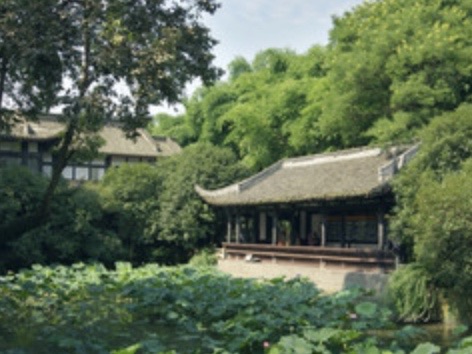
The garden area west of the main axis centers on the Guihe Pond, with the Qing-era civilian-style Guihe Tower, the hexagonal Qin Pavilion (named for Zhuge Liang's "Empty City Strategy"), and several smaller structures—Tingli Pavilion, Bicao Xuan, a boat pavilion, and a bonsai garden. The garden employs the "borrowed scenery" technique, pulling distant views of Zhuge Liang's Hall, Hui Ling Tomb, and the city wall into the pond's reflections. Autumn brings osmanthus and lotus together, while winter features red plum blossoms and stone lanterns. The garden is also home to calligraphy steles of "Chu Shi Biao" and "Jie Zi Shu."

On-site narration · read it where you stand

Walking south from Sanyi Temple, we enter the garden area of Wuhou Shrine. This section was originally part of the South Suburbs Park and was incorporated into the shrine grounds in 2003. Let's start with Guihe Tower — a two-story pavilion built on a platform in the middle of a pond, surrounded by osmanthus trees and lotus plants. In summer, when the lotus blooms, the water is covered in green leaves and red flowers, and Guihe Tower reflects in the still surface — this is the quietest and most beautiful corner of Wuhou Shrine. In autumn, the sweet osmanthus fills the air, and sitting beneath the pavilion with the scent of flowers around you and the soft sound of wind moving through the lotus leaves, you feel time itself slow to a stop.

Just east of Guihe Tower is Qin Pavilion — the Pavilion of the Zither, and it is well worth a pause. According to tradition, Zhuge Liang was a skilled player of the guqin. Two of the most celebrated scenes in Romance of the Three Kingdoms both involve the instrument. The first is the "Empty City Stratagem" — Zhuge Liang sat alone on the city wall, burning incense and playing his zither without a tremor in the music, and his unruffled calm caused Sima Yi to withdraw his army of a hundred and fifty thousand, convinced it must be a trap. The second comes after Liu Bei's three visits to the thatched cottage — when Zhuge Liang finally agreed to leave, he sat at his instrument one last time before departing. The music he played was said to be vast and mournful, a farewell to the life of the hermit and a premonition of the long road ahead. Qin Pavilion was built by later generations to honor Zhuge Liang's musicianship and the character it expressed — open on all four sides, the wind moving freely through it, as though you might still catch a note from eighteen hundred years ago.

The garden also holds Tingli Pavilion — the Pavilion for Listening to the Oriole. The name comes from a poem Du Fu wrote about Zhuge Liang: "Green grass fills the stone steps with spring's own color; through the leaves, the oriole sings its beautiful, useless song." Standing before Tingli Pavilion, watching the moss-covered steps half-hidden in grass and listening to the orioles calling in the trees, you understand something of what Du Fu felt when he wrote those lines — the scene is lovely, but the hero is gone, and all the beauty of spring cannot fill the hollow that history left behind.

Hui Ling — Joint Burial Tomb of Emperor Zhaolie Liu Bei and Empresses Gan & Wu

惠陵——蜀汉昭烈帝刘备与甘、吴二皇后合葬陵

Hui Ling is located at the northwest of the heritage zone, distributed in a "reverse pinwheel" layout with Han Zhao Lie Miao and Wuhou Shrine. The burial mound is ~12m high, 180m in circumference, ~3,000 sqm. Liu Bei was entombed here after his death at Baidi City in 223 AD—the tomb has never been looted in 1,780 years, protected by both the people's loyalty and the Ming-Qing tomb guardians. The 1953 excavation of the tomb passage revealed gold, jade, swords, and horse-and-chariot artifacts. The mound, tomb passage, que-fang, and corner towers form a complete imperial-tomb architectural group.

On-site narration · read it where you stand

Rounding through the garden, we arrive at the most solemn place in all of Wuhou Shrine — Huiling, the mausoleum of Liu Bei. This is where the entire complex began. After Liu Bei proclaimed himself emperor in 221 AD, construction of his tomb started immediately. In the third year of Zhangwu (223), Liu Bei died at Baidicheng after entrusting his son to Zhuge Liang's care. Zhuge Liang personally escorted the coffin back to Chengdu, and "in the eighth month of autumn, Emperor Zhaoli was interred at Huiling."

Huiling follows the standard layout of traditional Chinese imperial tombs: arranged along a north-south central axis, the sequence runs from spirit wall to gate to spirit road to main hall to gate tower to the burial mound itself. Standing before the gate and looking up, you see the plaque inscribed "Mausoleum of Emperor Han Zhaoli" — Zhaoli being Liu Bei's posthumous imperial title. Inside the gate, ancient pines and cypresses rise tall on both sides of the spirit road, creating an atmosphere of austere dignity.

Inside the main hall, four large characters hang overhead: "Qian Qiu Lin Ran" — "Through a Thousand Autumns, His Integrity Endures." Beyond the hall is the gate tower, and set into its center face is a stone stele bearing seven characters in standard script: "Tomb of Emperor Zhaoli of Han." Behind the stele rises the burial mound — a circular earthen tumulus twelve meters high with a circumference of 180 meters, covered in dense grass and trees. For eighteen hundred years, the figure buried here has lain in silence: a man who went from selling straw sandals to founding an empire, now resting alongside the two empresses who accompanied him through his life — Consort Gan and Consort Wu. Historical records confirm that Huiling is a joint burial of three.

Running along the outer face of the grey brick wall that encircles Huiling is one of Wuhou Shrine's most beloved spots for photography — the Red Wall Passage. Between two tall walls of deep crimson, a narrow path winds forward, and overhead a dense canopy of bamboo forms a long green archway. Dappled bamboo shadows shift and dance across the red walls; every angle you turn to is a picture. This red wall passage connects Huiling to Zhuge Liang Hall — walking its length means moving from the tomb to the shrine, from Liu Bei to Zhuge Liang. In terms of how the whole space tells its story, this passage is the emotional resolution — walk through the Red Wall Passage, and you have walked the full depth of a bond between ruler and minister that lasted a thousand years.

Jinli Folk Street & Waterside Pavilion (Chengdu Wuhou Shrine · Folk Area)

锦里与水榭(成都武侯祠·民俗区)

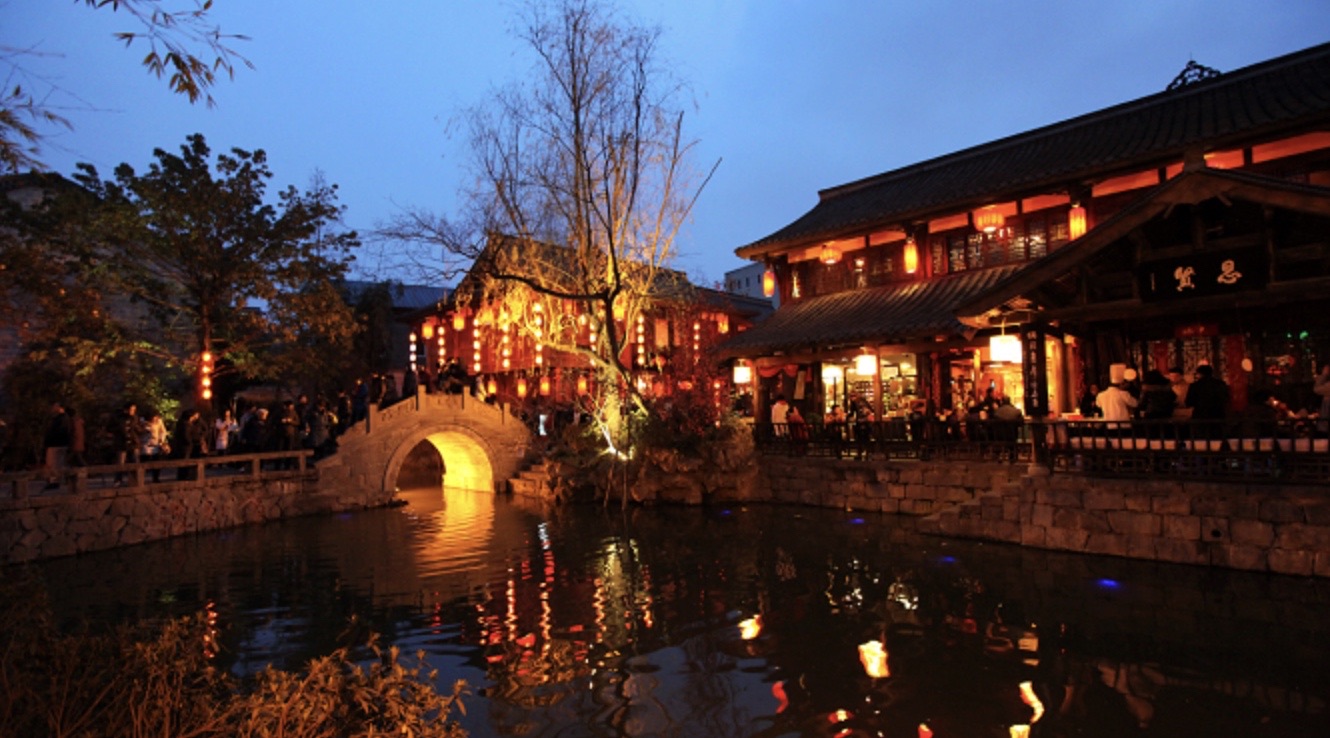
Jinli Folk Area, opened in 2004, is Chengdu's first "Three Kingdoms + western Sichuan folk" themed block, ~550m long, in western Sichuan folk-house style: grey-tile white-wall houses, bluestone paths, wooden archways, and overhanging eaves along the Jinli watercourse. Three highlights: ①Snacks—over 100 Sichuan-style eateries (San Da Pao, Bo Bo Ji, etc.); ②Intangible heritage—12 western Sichuan crafts (Shu embroidery, lacquerware, silver filigree, etc.); ③Performances—three daily Sichuan-opera shows. The waterside pavilion, a riverside teahouse, offers a perfect view of Jinli and the shrine's red wall at night. Year-round red lanterns and Three Kingdoms flags decorate the street, with over 100,000 daily visitors during Spring Festival.

On-site narration · read it where you stand

Coming out of Hui Mausoleum, you'll find Jinli right to the south. During the Three Kingdoms period, Jinli was the most bustling commercial district in Chengdu — the beating heart of the Shu brocade trade. What stands here today is a reconstructed heritage street built close to the original site: cobblestone lanes, red lanterns, carved wooden doors and latticed windows, all hosting an eclectic mix of coffee shops, Sichuan opera face-changing performances, handcrafted sugar art, and boutique souvenirs. If you'd like to bring home something Three Kingdoms-themed — Zhuge Liang's feather fan, a statue of Guan Yu, a embroidered Shu brocade pouch — Jinli is the place to find it. And the street food alone is worth the stop: Sandapao glutinous rice balls, egg waffles, sugar-fried dough bites, bobo chicken skewers... If you've spent a whole morning touring Wuhou Shrine on an empty stomach, Jinli will pull you straight back into the warmth and bustle of everyday life.

And with that, our tour of Wuhou Shrine comes to a close. Let's trace the path we've walked today: the south gate spirit wall, the main gate of Han Zhaolie Temple, the second gate with the Stele of Three Excellences and the ancient cypresses, the Liu Bei Hall with its civil and military corridors, the connecting hall with the Memorial to the Southern Campaign and the Longzhong Discourse, the Zhuge Liang Hall with its Jingyuan Hall plaque, the Gong Xin couplet, and the Zhuge drum, then the Three Righteous Brothers Temple, the garden with Guihe Tower, Qin Pavilion, and Tingli Pavilion, the red-walled passage to Hui Mausoleum, and finally Jinli.

To close, I'd like to draw on the spirit of the Gong Xin couplet. The reason Zhuge Liang has been revered in China for over a thousand years is not simply his brilliance — it's his character. He was a man who gave his whole heart to his country and its people. As he wrote himself: "I will serve with every ounce of my being, until my last breath." And he did exactly that. Eighteen hundred years later, visitors from every corner of the world still stand before his statue and feel the weight of those words — that is the true power of Zhuge Liang's "winning of hearts."

Thank you all, and may the rest of your journey be wonderful!

Prefer to be shown around?

A local guide walks these 10 stops with you and answers what the page cannot.

Chengdu tours ↗