Travel Guide› Chengdu› Sichuan Museum
Chengdu · Museum

Sichuan Museum 四川博物院

Sichuan Museum
Address
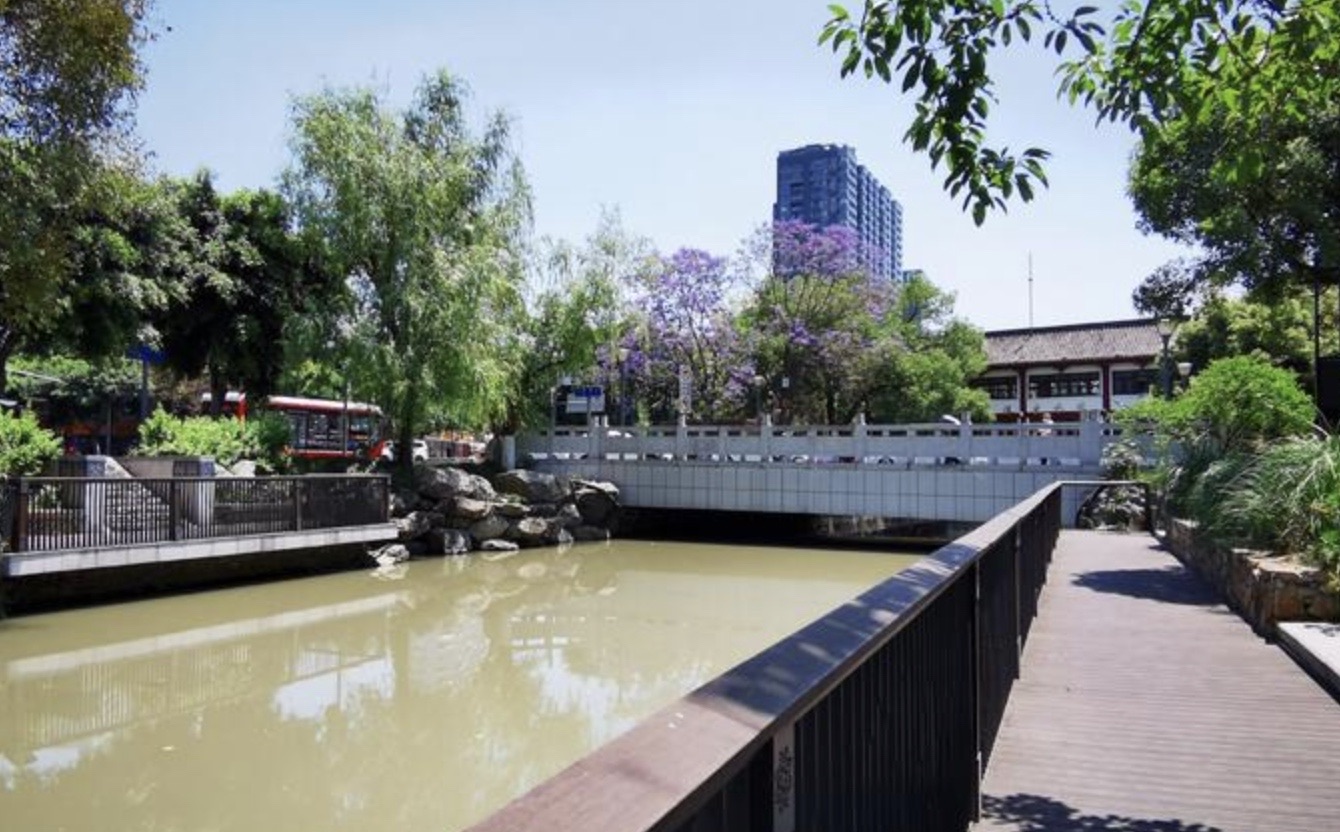
No. 251 Huanhua South Road, Qingyang District, Chengdu, Sichuan Province (by Huanhua Stream, adjacent to Du Fu Thatched Cottage) - North Gate: No. 5 Qinghua Road - Southeast Gate: No. 251 Huanhua South Road

Sichuan Museum: Visitor's Route and Gallery Guide

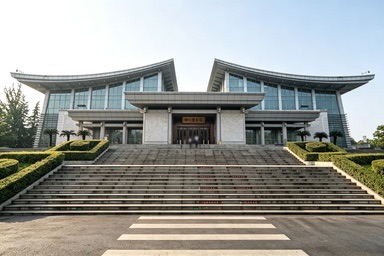
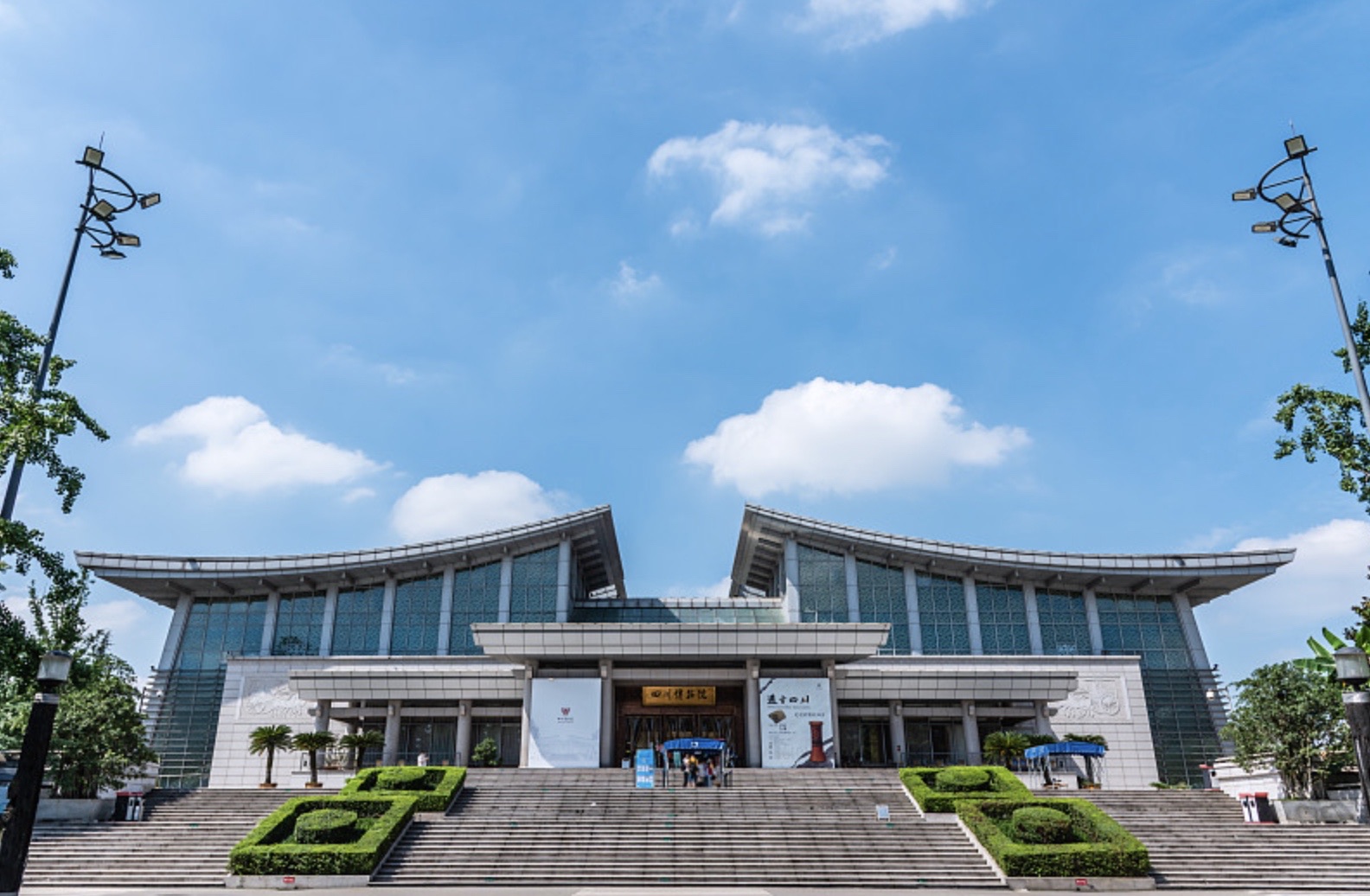
The Sichuan Museum is located at 251 Huanhua South Road, Qingyang District, Chengdu, set within the scenic Huanhua Stream Historical and Cultural Scenic Area, right next to Du Fu Thatched Cottage. As the largest comprehensive museum in southwest China and a National First-Class Museum, it holds a collection of more than 350,000 artifacts, over 70,000 of which are classified as precious cultural relics. Together they trace Sichuan's history from prehistoric times through the Ming and Qing dynasties. The building's architectural style draws on elements of western Sichuan vernacular architecture — steeply pitched roofs, the traditional chuandou timber-frame structure, and small grey roof tiles — giving it a dignified yet approachable presence that feels rooted in the local landscape.

Recommended Route: The museum's exhibition floors span three levels. The suggested order is Second Floor — Third Floor — First Floor, following the chronological arc of Sichuan's history and giving you a coherent sense of how its culture evolved over time.

Second Floor: Ancient Sichuan — Prehistoric Gallery

The Prehistoric Gallery occupies the second floor and forms the first chapter of the Sichuan General History Exhibition. Through more than 340 artifacts, it traces the story of early human life in the Sichuan Basin and the gradual emergence of civilization.

The exhibition follows the arc from the Paleolithic through the Neolithic, showing how people in this region moved from basic survival to the earliest stirrings of culture. Key highlights include a Neolithic painted pottery jar and a jade pendant carved in the shape of a human face. The pottery jar resembles a bamboo tube, narrowing slightly at the waist, with a rolled rim and flat base; its body is painted with parallel bands and rope patterns in black, reflecting the character of early Yangtze River basin ceramic traditions. The jade pendant speaks to the craft skills and spiritual beliefs of prehistoric Sichuan.

The gallery also displays representative early artifacts such as stone tools, pottery, and jade objects, illustrating how Sichuan's earliest inhabitants adapted to a complex geographic environment and created a rich and distinctive prehistoric culture. Through these objects, you can reach back to the very first threads of Sichuan civilization and feel the ingenuity of the people who built it.

Second Floor: Ancient Sichuan — Pre-Qin Period Gallery

The Pre-Qin Period Gallery is also on the second floor and forms the second chapter of the Sichuan General History Exhibition. Close to 200 artifacts document the development of the Ba and Shu region during the pre-Qin era.

The focus is the bronze culture, ritual systems, and social life of the Ba-Shu civilization during the Shang, Zhou, and Warring States periods. Headline pieces include a Western Zhou bronze lei vessel with elephant-head handles and kui-dragon patterns, a Warring States bronze hu vessel with water-and-land battle scenes, and Sanxingdui bronze objects. The bronze lei's shoulder is decorated with elephant heads in three tiers of relief alongside beast-face motifs on the body — compelling evidence of cultural exchange between ancient Shu and the Zhou ritual tradition of the Central Plains. The battle-scene hu vessel has been called the "Warring States Qingming Shanghe Tu," its body inlaid with red copper wire in four bands of imagery depicting military, everyday, and agricultural life in the Ba-Shu region.

The gallery also displays weapons, ritual vessels, and daily objects — bronze swords, spears, ge halberds — as well as the unique writing and symbols native to the Ba-Shu culture. These objects reveal not only the distinctive character of Ba-Shu civilization but also the deep connections it maintained with the Central Plains, Chu, and other regional cultures.

Second Floor: Zhang Daqian Painting and Calligraphy Gallery

The Zhang Daqian Painting and Calligraphy Gallery on the second floor is dedicated to the life's work of one of the twentieth century's greatest Chinese painters. The Sichuan Museum holds an exceptionally large collection of Zhang Daqian's paintings, particularly his copies of Dunhuang murals — 183 panels in total — making it the single richest repository of his work in the world.

The gallery is divided into three sections: Zhang Daqian's Dunhuang copies, his freehand ink paintings, and his personal seals. Must-see pieces include "Copy of an Early Tang Bejeweled Bodhisattva" and "Copy of the Votive Portrait of Lady Wang of Taiyuan, Wife of the Prefect." The former reveals Zhang's deep study of Dunhuang art; the drapery technique — known in Chinese art history as "Cao's style: drapery like emerging from water" — echoes the approach of the Northern Qi painter Cao Zhongda, in which robes cling closely to the body as if wet.

The gallery also displays Zhang Daqian's earlier works: figure paintings, bird-and-flower compositions, and landscape paintings, as well as the many seals he used throughout his career. These objects trace Zhang's journey from deep immersion in tradition to bold artistic innovation, and show how he wove Ba-Shu culture together with the art of Dunhuang to forge a style entirely his own.

Third Floor: Ancient Sichuan — Jin through Five Dynasties Period Gallery

The Jin through Five Dynasties Period Gallery on the third floor is the fourth chapter of the Sichuan General History Exhibition. More than 280 artifacts capture the cultural sparks that flew from the collision of different peoples and dynasties across centuries of political change.

The gallery is divided into two sections: the Jin and Northern and Southern Dynasties period, and the Sui, Tang, and Five Dynasties period. Key exhibits include a Southern Qi Yongming-era Amitabha Buddha stone stele, a Tang dynasty seven-string qin inscribed "Shijian Qiao Bing," and a jade belt from the Former Shu ruler Wang Jian's tomb. The Amitabha stele is one of the earliest surviving Southern Dynasties Buddhist relief steles with a confirmed date in Sichuan, displaying the characteristic "slender figure with delicate drapery" style of Southern Dynasties Buddhist art. The "Shijian Qiao Bing" qin is one of only around twenty surviving Tang dynasty instruments and has been exhibited in Singapore, a testament to the musical achievements of the Tang golden age.

The gallery also displays ceramics, gold and silver objects, and paintings from the Tang and Song periods — Tang sancai ware, the stone scripture fragments of the Later Shu — reflecting the economic prosperity and cultural vitality of Sichuan during this era. Through these objects, you can follow the spread of Buddhism through Sichuan and witness the extraordinary cultural mixing that took place here across the centuries.

Third Floor: Sichuan Ethnic Minorities Gallery

The Sichuan Ethnic Minorities Gallery on the third floor presents the cultures and lifeways of Sichuan's fourteen indigenous ethnic groups. The museum has selected more than 200 objects for display, organized into four sections: Yi mountain communities, Qiang village life, Tibetan plateau culture, and Miao embroidered villages.

Key exhibits include Yi ethnic costume, a Tibetan gilt-bronze ritual mask, and a Qiang sheepskin drum. The Yi costumes represent the tradition of the Liangshan Yi Autonomous Prefecture: both men and women wear right-front lapel robes, and men grow a single lock of long hair on the front of their heads — called the "hero's knot" — while women's dress varies according to whether they are unmarried or married. The Tibetan gilt-bronze mask reflects the role of religious belief and ritual ceremony in Tibetan life.

The gallery also displays Miao silver ornaments, Tujia brocade, and the everyday tools and utensils of various ethnic communities. These objects speak to the distinctive artistic traditions and practical wisdom of each of Sichuan's peoples, and to the broader tapestry of unity within diversity that defines Chinese civilization.

Third Floor: Arts and Crafts Gallery

The Arts and Crafts Gallery on the third floor showcases the finest examples of decorative arts in the Sichuan Museum's collection, spanning from the Shang dynasty through the early Republic period.

Key exhibits include a Qing dynasty Gesar thangka, a Tang dynasty celadon warrior figurine, and a Qing dynasty ivory-carved screen depicting scenes from Dream of the Red Chamber. The Gesar thangka is a visual telling of the Tibetan epic of King Gesar. The gallery also presents jade objects, gold and silver pieces, bamboo and ivory carvings, lacquerware, shadow puppets, snuff bottles, and embroidery from across the Shang-to-Republican era — including a carved jade hook and a Shu embroidery double-sided vase with cats and dogs on opposing faces.

These objects are not only visually striking — in their shapes, colors, and ornamentation — but most were objects of everyday use, embodying the old craftsman's art of making beauty inseparable from life. The Arts and Crafts Gallery offers a vivid introduction to the depth and sophistication of Ba-Shu craftsmanship across the centuries.

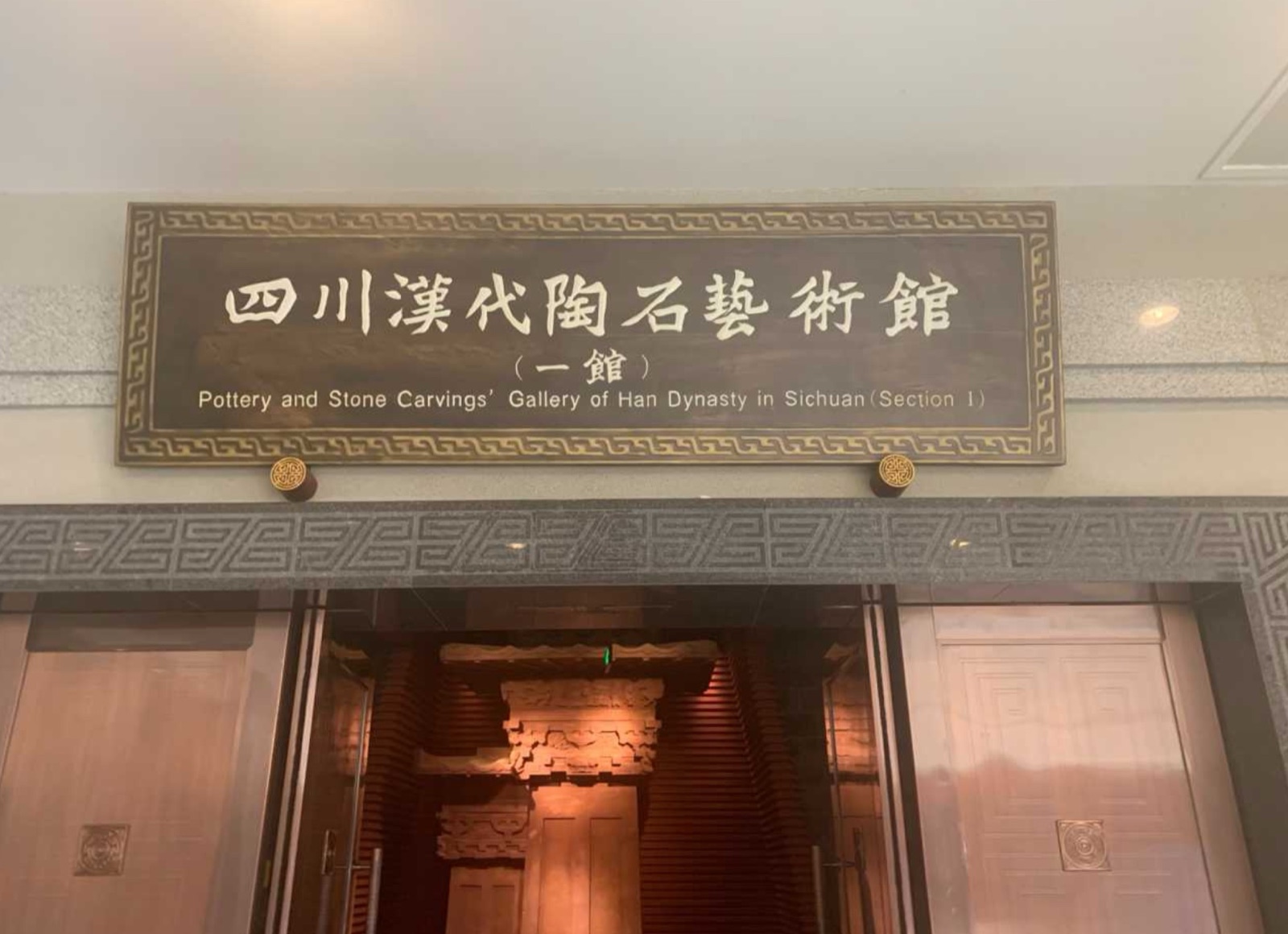
First Floor: Sichuan Han Dynasty Ceramic and Stone Art Gallery

The Han Dynasty Ceramic and Stone Art Gallery on the first floor is one of the museum's major permanent exhibitions. The painted stone reliefs, pictorial bricks, and ceramic sculpture on display are products of the Han custom of lavish burial — objects made to accompany the dead — and they carry a distinctly regional flavor and strong sense of their era.

Must-see pieces include the Eastern Han pottery storyteller figurine and the pictorial brick "Salt Well." The storyteller figurine has been called the ancestor of Chinese comic performance: fully intact, it shows a figure with a topknot, eyes half-closed, mouth twisted open with tongue protruding, both arms raised, left hand holding a small drum, right hand gripping a mallet — a vivid snapshot of the humor and easy-going spirit of Han-era Sichuan. The "Salt Well" brick depicts the production of well salt in Shu from a bird's-eye perspective and has been described as the world's earliest "industrial process diagram," documenting the sophisticated manufacturing technology of Han-period Sichuan.

The gallery also displays Han pottery figures, pictorial stones, and bronzes — including a pottery Fang Xiangshi exorcist figurine and a bronze money tree. Together these objects bring Han-dynasty Sichuan social life and artistic achievement to life, and illuminate the beliefs and values that shaped how people then thought about life and death.

First Floor: Wanfo Temple Stone Sculpture Gallery

The Wanfo Temple Stone Sculpture Gallery on the first floor is another of the museum's permanent exhibitions. It displays Buddhist stone carvings unearthed at the site of Wanfo Temple in Chengdu, objects that have been coming to light since 1882. The total number recovered exceeds 200, and the majority are now held by the Sichuan Museum.

The Wanfo Temple sculptures are among the most important surviving examples of Southern Dynasties and Sichuan Buddhist stone carving. The gallery's key works include a standing image of Shakyamuni dated to the fourth year of the Liang Putong reign and a Tang dynasty Bodhisattva head. The Liang Putong stele bears an explicit date, making it a fixed point for understanding the spread of Southern Dynasties Buddhist art; the figure embodies the ideal of self-sacrifice through faith. The Tang Bodhisattva head is sometimes called the "Beauty of the East," representing the apex of Tang Buddhist sculptural achievement.

The sculptures cover a wide range of subjects — Buddhas, Bodhisattvas, votive steles, and votive niches — and the stylistic hallmarks of the Southern Dynasties aesthetic: slender figures with long elegant robes and broad flowing sashes. Beyond their considerable artistic value, these objects are indispensable primary sources for the study of how Buddhism spread and took root in Sichuan.

Inside Sichuan Museum

13 stops, in walking order — read top to bottom, no clicking needed.

1 Main Entrance & Lobby (Chengdu Museum) of 13

Main Entrance & Lobby (Chengdu Museum)

正门与大厅(成都博物院)

The main entrance and lobby deliver the Chengdu Museum's first impression. Designed by master architect Xu Shanggui under the "gold-inlaid-jade" concept, the facade merges Han-dynasty pictorial-brick motifs with a modern glass curtain wall. Two Han-style stone beasts (Shiyi & Bixie) flank the entry. The atrium's central relief, "Hua Chong Jin Guan Cheng – A Historical Journey through Chengdu," unfolds Chengdu's urban evolution from Sanxingdui–Jinsha through Qin-Han, Tang-Song, and Ming-Qing. Dougong brackets, caisson ceilings, and Shu-brocade patterns abstract the western-Sichuan sloped roofline—turning the architecture itself into the museum's first exhibit. Here visitors collect audio guides, store luggage, and scan in to begin their tour.

On-site narration · read it where you stand

Welcome, everyone! I'm thrilled to have you here at Sichuan Museum. Today I'll be guiding you through the largest comprehensive museum in Southwest China — floor by floor, gallery by gallery. We'll start on the first floor with the Han Dynasty Ceramic and Stone Art Gallery, then move up to the second floor for the prehistoric and ancient Sichuan exhibits, followed by the Ba-Shu Bronze Gallery, the Ceramics Gallery, the Zhang Daqian Painting and Calligraphy Gallery, and the Calligraphy and Painting Gallery. On the third floor, we'll wrap up with the Tibetan Buddhist Artifacts Gallery, the Wanfo Temple Stone Sculpture Gallery, the Sichuan Ethnic Minority Artifacts Gallery, and the Arts and Crafts Gallery. Together we'll take in the full sweep of Ba-Shu culture, from the ancient past right through to modern times.

Let me start with a quick overview of the museum itself. Sichuan Museum was founded in 1941, giving it more than eighty years of history. In 2009 the new building opened at its current location in Chengdu's Huanhuaxi Historic and Cultural Scenic Area. The campus covers 88 mu (roughly 14 acres), the main building exceeds 32,000 square meters in floor area, and the museum houses 14 exhibition halls. Its collection tops 350,000 artifacts, including over 70,000 classified as precious cultural relics and 1,399 designated as National Grade-One Cultural Relics. It is, without question, the leading museum in Southwest China.

Admission to Sichuan Museum is free, but you need to book in advance through the official WeChat public account and collect your ticket at the entrance using your ID or valid travel document. Daily capacity is limited to 4,000 visitors. One important note: tickets are issued in two windows each day — 9:00 to 12:00 in the morning, and 13:00 to 15:30 in the afternoon. No tickets are distributed between noon and 1 p.m., so plan your arrival accordingly. Opening hours are Tuesday through Sunday, 9 a.m. to 5 p.m. Last entry is at 4 p.m. The museum is closed on Mondays, except on national public holidays.

Getting here is straightforward. You can take city buses Route 19, 35, 58, 82, 151, 165, 170, or 309, among others. If you're driving, simply navigate to No. 251 Huanhua South Road, Qingyang District — there is a paid parking lot on site. One thing to keep in mind: only the Qinghua Road entrance is open to visitors. The Huanhua South Road entrance is for staff only, so make sure you come to the right gate.

The museum's layout follows a logic that moves from broad to specialized, and from earliest to latest. The first floor hosts a dedicated exhibition on Han dynasty ceramic and stone art. The second floor traces history from prehistory through the Three Kingdoms period, alongside themed galleries on bronze, ceramics, and painting. The third floor covers Buddhist art, ethnic minority cultures, and traditional crafts. We recommend following the route 1F → 2F → 3F; allow two to three hours for the full visit. The museum offers paid audio guide devices supporting six languages — Chinese, English, French, Japanese, Korean, and more — available at the service desk. Alright, let's get started on the first floor!

Sichuan Han Dynasty Ceramic & Stone Art Gallery (Chengdu Museum, 1F)

四川汉代陶石艺术馆(成都博物院一楼)

Located on the museum's 1F core, this is China's only gallery dedicated to Sichuan Han-dynasty pictorial bricks and carved stones. Hundreds of masterpieces from Pengshan, Xinjin, Pixian, and Xindu are organized into four zones: manor-farming and archery-harvest, markets and salt-wells, mythic auspiciousness, and chariots-banquets. The iconic "Archery and Harvest" brick captures a hunter, startled wild geese, and rippling rice fields; the "Salt Well" brick documents the deep-well brine extraction at Linqiong (home of Zhuo Wenjun), the world's earliest visual record of salt production. Smiling storytellers, drummers, and qin-players in the pottery zone are evidence of Han-era Sichuan's cheerful, secular folk spirit. Multimedia stations let visitors zoom into brick details and hear expert commentary.

On-site narration · read it where you stand

We're now stepping into the Sichuan Han Dynasty Ceramic and Stone Art Gallery on the first floor. You might wonder — why does Sichuan Museum place Han dynasty ceramic and stone art here on the ground floor, in the very first position? Because within the museum's collection, Han dynasty ceramic and stone art is the most distinctive and nationally unrivaled category Sichuan has to offer — the first key to understanding Sichuan's history.

The Han dynasty — both Western and Eastern Han — was a golden age of expansion for China. Sichuan at that time was known as "Tianfu zhi Guo," the Land of Abundance. The phrase first appeared in Zhuge Liang's famous strategic address to Liu Bei, where he described Sichuan as having "a thousand li of fertile plains — land as rich as the granary of heaven." It was precisely this material prosperity that allowed Sichuan's Han dynasty art to develop its own distinctive character. This gallery displays over 200 Han dynasty ceramic and stone works, falling into two broad categories: pottery figurines and pictorial bricks (or stones).

Please look to my right — this group of ceramic figurines. The most famous among them is the Eastern Han Ceramic Storyteller-Entertainer Figurine, one of the museum's prized treasures. Take a good look: one leg is kicked up, one hand holds a drumstick, the other cradles a small drum, his mouth is thrown wide open, and that grin stretches almost to his ears. His whole body leans back and to the right, as if he's about to topple over from laughing too hard. A craftsman two thousand years ago managed to freeze the exact peak moment of a street performer's act. This is no lofty deity — this is a flesh-and-blood ordinary person. The storyteller-entertainer figurines reflect the entertainment culture of Han dynasty Sichuan: the folk performing arts of the Shu region were tremendously vibrant at that time — much like the storytellers and "jingianban" performers you can still find in Chengdu teahouses today. That streak of humor and wit has never broken across two thousand years.

Now let's look at the pictorial brick section. The Han dynasty had no cameras; pictorial bricks were their photographs. Sichuan has yielded the richest collection of Han dynasty pictorial bricks in the country, covering virtually every aspect of life: farming, fishing and hunting, salt-making, weaving, banqueting, song and dance, horse-drawn carriages. The most remarkable piece is the "Salt Production Pictorial Brick." The scene shows tall well-derricks, workers using windlasses to haul brine up from underground, furnaces beside them boiling the salt, and hunters in the distant forest. This single brick tells us that over two thousand years ago, Sichuan already had a mature well-salt extraction industry — the deep history of salt production in Zigong traces its roots right back to the Han dynasty. Think of the pictorial bricks as documentaries of Han dynasty Sichuan — no words, but every image tells a story.

There are also large stone carvings on display: stone coffins, stone memorial towers called "que," and stone animals. The stone que towers in front of Han tombs were symbols of power — only senior officials had the right to erect them. Sichuan preserves the largest number of Han dynasty stone que in the country and is sometimes called "the homeland of Han que." The most common stone animals are Tianlu and Bixie — mythical creatures resembling winged lions, placed before tombs to guard the souls of the departed.

Photography tip: the display cases for the figurines and pictorial bricks use ultra-clear bulletproof glass with excellent light transmission, but some glare is unavoidable. Please turn off your flash and try shooting at a slight angle — you'll capture the details of the artifacts much more clearly. Flash photography is prohibited in every gallery throughout the museum; please keep that in mind.

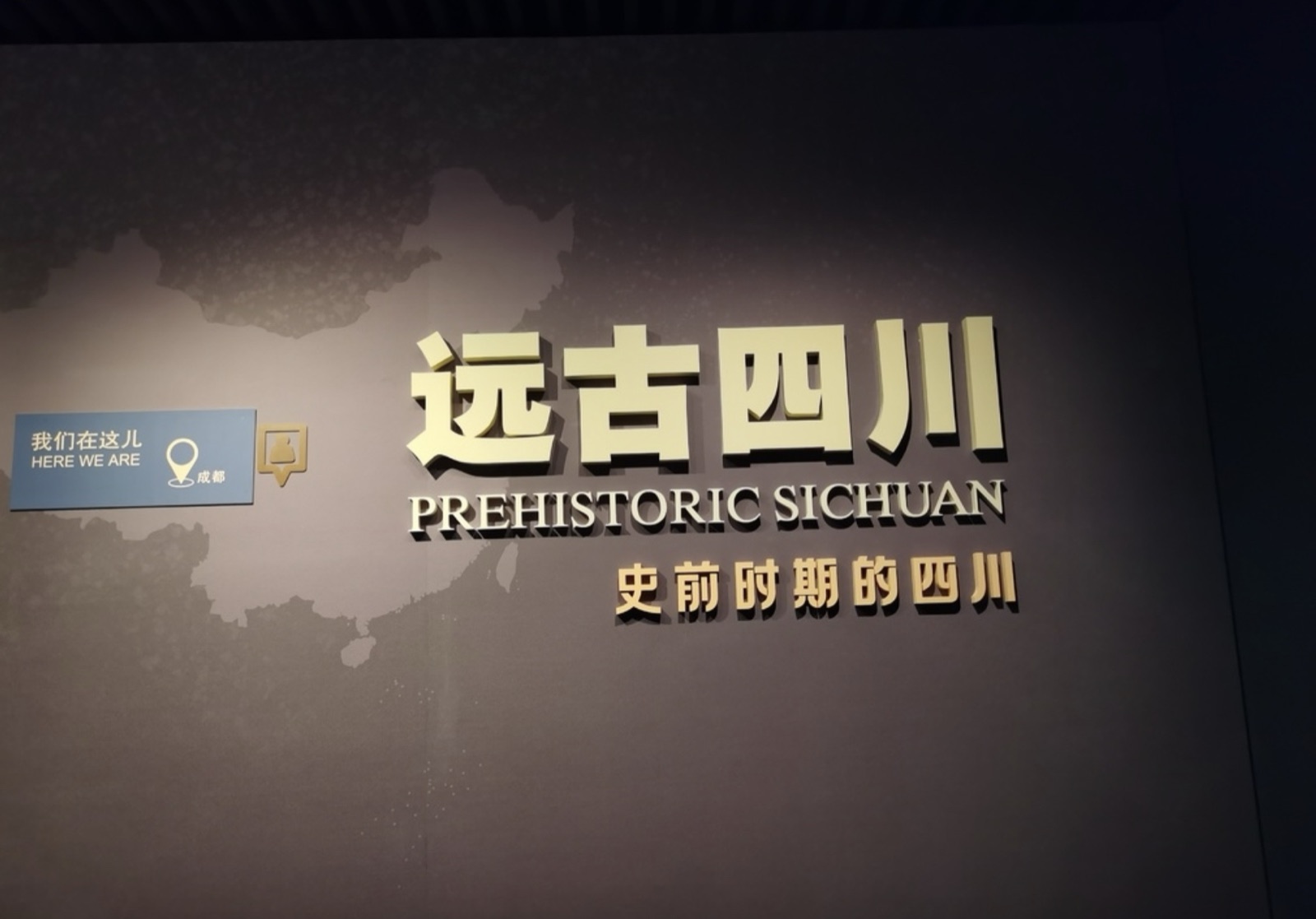
Ancient Sichuan – Prehistoric Era Hall (Chengdu Museum, 2F)

远古四川·史前时期展厅(成都博物院二楼)

This hall is the prologue of the "Hua Chong Jin Guan Cheng" chronological exhibition. The trail begins with the 2.04-million-year-old Wushan Man tooth fossil, moves through Ziyang Man (Palaeolithic), Gaoshan Ancient City, the Baodun culture, and culminates in the Sanxingdui–Jinsha sites—revealing how the Chengdu Plain nurtured China's earliest, largest, and most imaginative ancient Shu civilization. Highlights include a section model of Baodun's city wall (~2700 BCE), 4,500-year-old paddy-field remains, and replicas of face-painted pottery pots, bird-head ladle handles, and jade yazhang ritual blades. Immersive projections let visitors "enter" ancient Shu sacrificial grounds, understanding Sanxingdui–Jinsha not as alien imports but as the indigenous pinnacle of Sichuan's own civilizational arc.

On-site narration · read it where you stand

Coming up from the first floor, we now enter the gallery with the longest timeline in the museum — Prehistoric Sichuan. This hall tells the story of Sichuan from the Old Stone Age through the New Stone Age, spanning more than two million years. "Prehistoric" might sound dry at first, but Sichuan's prehistoric archaeology is genuinely fascinating — it directly answers the fundamental question of where the people of Sichuan came from.

What did the earliest Sichuan people look like? The answer may surprise you. A fossilized skull discovered in Ziyang, Sichuan, known as "Ziyang Man," dates back roughly 30,000 to 40,000 years. It belonged to a late-period Homo sapiens from the Upper Paleolithic — the same era as the famous Upper Cave humans found at Zhoukoudian near Beijing. This tells us that anatomically modern humans were already living and multiplying in the Sichuan Basin thirty or forty thousand years ago.

By the Neolithic period, a rich variety of prehistoric cultures had taken root across Sichuan. The most significant is the Baodun Culture on the Chengdu Plain, dated to roughly 4,500–4,000 years ago — an ancestral Shu civilization that predates Sanxingdui. Look at the large ceramic vessels and stone tools in the display cases: Baodun Culture settlements already had distinct functional zones — walls, residential areas, burial grounds — indicating a society that had begun to stratify and was transitioning from tribal organization toward early statehood. The Baodun site is the earliest and largest prehistoric urban settlement found on the Chengdu Plain to date, and has been called "the first city along the upper Yangtze." Without Baodun Culture as its foundation, the Sanxingdui civilization that followed could never have emerged.

The gallery also places artifacts from the western Sichuan plateau and the eastern Sichuan gorge regions side by side, showing how different geographical environments gave rise to different cultural types. The objects here may not be as visually striking as what you'll see in the galleries ahead, but this hall provides the essential conceptual framework for understanding the origins of Sichuan's civilization as a whole. We recommend spending ten to fifteen minutes browsing here, with a focus on the Baodun Culture ceramics and the Ziyang Man fossil.

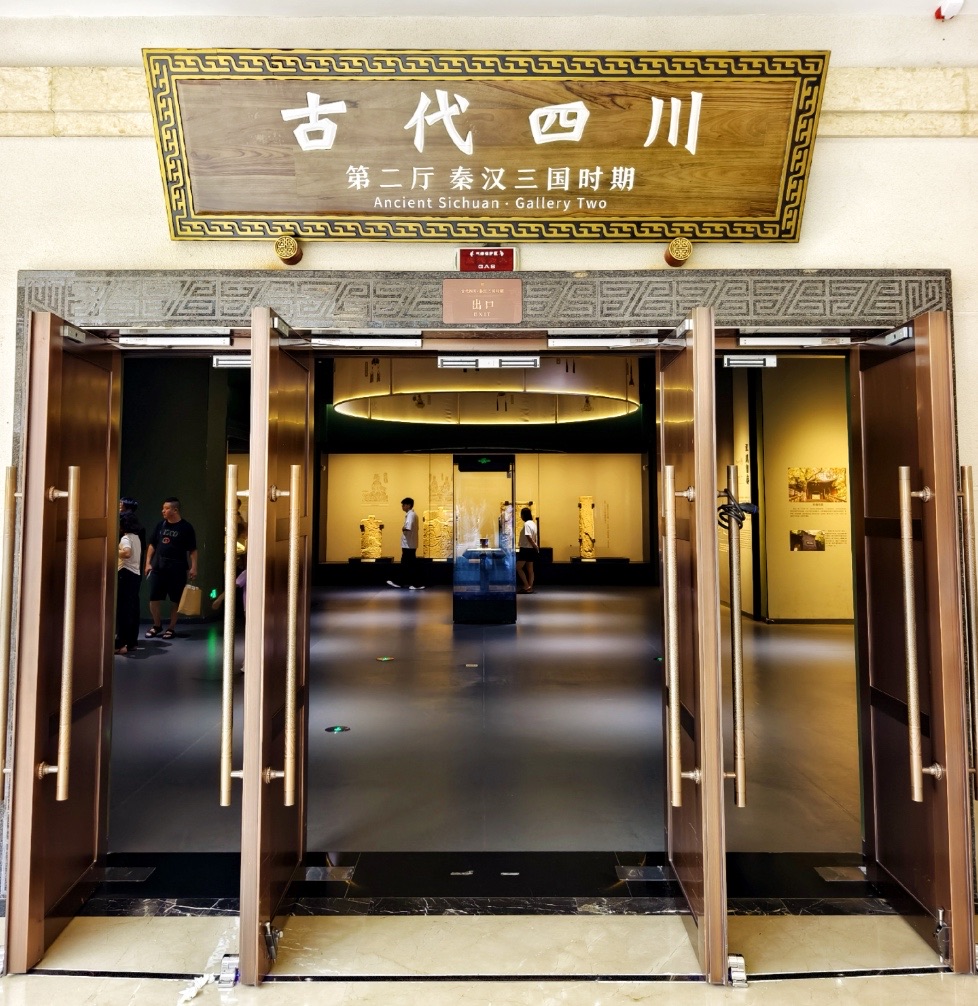
Ancient Sichuan – Pre-Qin to Qin-Han-Three Kingdoms Hall (Chengdu Museum, 2F)

古代四川·先秦至秦汉三国展厅(成都博物院二楼)

This hall is Chapter 2 of the "Hua Chong Jin Guan Cheng" chronological exhibition. The narrative moves from the legendary Twelve Shu Kings (Cancong, Du Yu, Kaiming) to the Qin conquest of Ba and Shu (316 BCE), the "colonization of Shu" policies, Li Bing's construction of Dujiangyan (256 BCE), Wen Weng's schools, and Han-era artifacts—the Li Bing stone statue, storyteller figurines, and cliff-tomb models. A Dujiangyan sand-table with dynamic water projection reveals the engineering genius of Yuzui, Feishayan, and Baopingkou. The finale explores Three Kingdoms Shu—Shu brocade, Zhuge crossbow, and the zhi-bai coin—showing how the "Land of Abundance" moved from periphery to center stage in the Han–Three Kingdoms era. Allow at least 40 minutes for the dense exhibits.

On-site narration · read it where you stand

Passing through the prehistoric gallery, we enter the Ancient Sichuan chronological exhibition — this hall traces a continuous thread from the pre-Qin era through the Qin, Han, and Three Kingdoms periods, serving as the historical backbone of the second floor.

Let's begin with the pre-Qin section. This period covers the rise and fall of the Sanxingdui and Jinsha civilizations. The cases here hold bronze heads, jade zhang blades, gold foil, and other artifacts excavated from the Sanxingdui site. While the most spectacular Sanxingdui pieces are at the Sanxingdui Museum in Guanghan, the objects held here at Sichuan Museum are equally precious. Notice the eyes on these bronze heads — they protrude in a diamond shape, the ears are large, and the mouth is rendered with sharp, angular lines. This is completely unlike the bronze human figures produced in the Central Plains during the Shang and Zhou periods. It reflects the ancient Shu civilization's distinct aesthetic sensibility — and to this day it remains one of archaeology's most compelling mysteries.

Now for the Qin, Han, and Three Kingdoms section — the most captivating part of the entire second floor. In 316 BCE, the Qin state conquered the ancient kingdom of Shu, formally incorporating Sichuan into the territory governed by a Central Plains dynasty. The Qin official Li Bing and his son then built the Dujiangyan irrigation system. Dujiangyan works not by damming the river but through three interconnected structures: a "fish-mouth" water-divider splits the flow, an "overflow weir" manages floods and flushes sediment, and a "bottle-neck inlet" channels irrigation water onto the Chengdu Plain — all without a single dam, and all still functioning after more than two thousand years. The gallery has a model of Dujiangyan and related artifacts, letting you see clearly how the system works. It was Dujiangyan that truly made the Chengdu Plain what it became: a land where "water and drought follow human command, and famine is unknown" — the Land of Abundance.

Han dynasty Sichuan reached its first great cultural and economic peak. Look at the Han storyteller-entertainer figurines in the cases here — if the one downstairs left you wanting more, there are additional examples — as well as bronze mirrors, lacquerware, and iron agricultural tools. By the Han dynasty, Sichuan was already a highly developed agrarian society.

The Three Kingdoms period is the most widely known chapter of Sichuan's history. Liu Bei established the Shu Han kingdom in Chengdu. His prime minister Zhuge Liang crossed the Lu River in midsummer and pushed deep into hostile territory, launching six northern campaigns from the Qishan mountains in an effort to restore the Han dynasty. The gallery holds Shu Han period artifacts — bronze crossbow triggers, coins, ceramics — few in number but each carrying the breath of that heroic age. Among them is an Eastern Han bronze chariot and horses, beautifully crafted with a horse in a proud, spirited stance — a true-to-life portrait of how high-ranking Han officials traveled.

Ba-Shu Bronze Ware Gallery (Chengdu Museum, 2F)

巴蜀青铜器馆(成都博物院二楼)

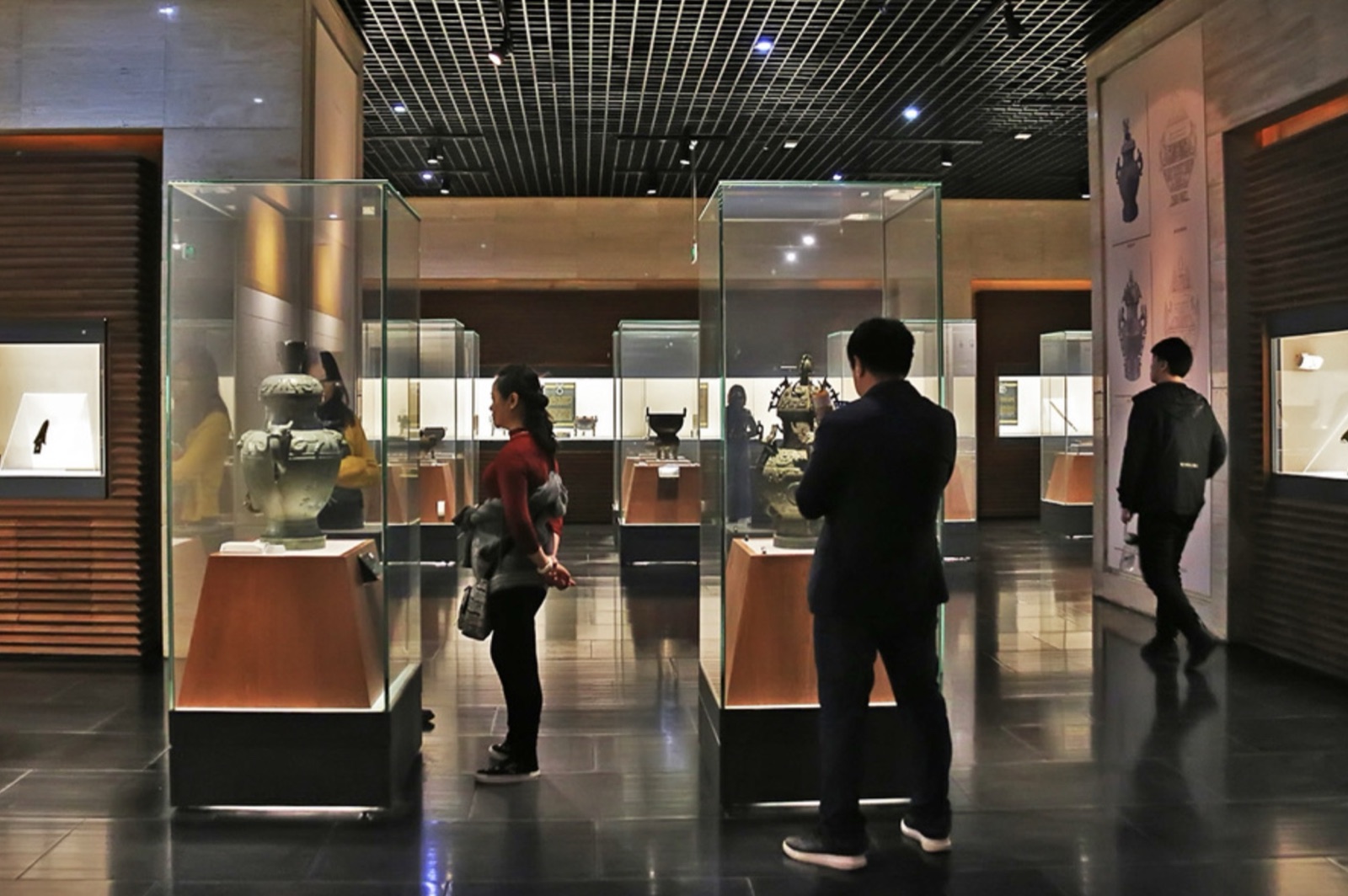
This is one of the most academically rich galleries in the museum. The collection focuses on late Warring States to early Western Han Ba-Shu bronzes, organized into ritual, weapon, musical, daily-use, and coin categories. The headline piece—the "Inlaid Bronze Pot with Banquet, Music, Water and Land Battle Scenes"—stands ~40 cm tall and uses metal inlay to depict five scenes (mulberry-picking, archery, feasting, water battle, land battle) with nearly 200 miniature figures, hailed as "the earliest bronze War and Peace." Tiger-pattern ge-daggers, willow-leaf swords, and boat-coffin bronze plaques reflect Ba-Shu's tiger worship and fishing-hunting culture. Multimedia stations let visitors rotate 3D models, zoom inlay details, and compare the lineage differences between Ba-Shu and Central Plains bronzes.

On-site narration · read it where you stand

Leaving the Ancient Sichuan gallery, we now enter the Ba-Shu Bronze Gallery — one of the most important themed galleries in the museum.

What sets Ba-Shu bronzes apart from Central Plains bronzes? Central Plains bronzes were primarily ritual vessels — ding cauldrons, gui food containers, zun wine vessels — emphasizing hierarchy and order, rich in inscriptions and solemn in decoration. Ba-Shu bronzes, by contrast, include a much higher proportion of weapons, tools, and everyday objects alongside the ritual pieces. Their forms are stranger and more inventive, charged with imagination.

The gallery's crown jewel — and one of the most important artifacts in the entire museum — is the Warring States Period Bronze Jar with Water and Land Battle Scenes. Please come to the central freestanding case. This bronze jar stands about 30 centimeters tall and was excavated in 1965 at Baihuatan Middle School in Chengdu. What makes it priceless is the decoration on its surface: the entire body is divided into three horizontal bands of imagery, created using an inlay technique in which metal wire is set into the bronze surface to form pictures, depicting a complete panorama of Warring States society — from mulberry-picking and hunting to feasting, naval combat, and land warfare. The top band shows mulberry harvesting and banqueting; the middle band shows archery and hunting; the bottom band shows a river battle and a siege. You can make out soldiers rowing forward, warriors climbing siege ladders, and archers drawing their bows. This is nothing less than a Warring States documentary film engraved in bronze.

Only two bronze jars of this type exist in China — one is a transmitted heirloom held by the Palace Museum in Beijing; the other is this piece, the only one ever recovered through scientific archaeological excavation. Its scholarly value is therefore irreplaceable. Thanks to this jar, we know what Warring States warfare actually looked like — the shape of the boats, the weapons the soldiers carried — more vividly than any written text could convey.

The gallery also holds another heavyweight: the Western Zhou Period Bronze Lei Wine Vessel with Elephant-Head Handles and Kui Dragon Motifs. A lei is a large vessel for storing wine. This one has two elephant-head handles on its shoulders — trunks curled, eyes wide — with a bearing that is majestic and commanding. The body is covered in kui dragon patterns and spiral motifs, cast with extraordinary technical mastery. The kui dragon was one of the most common decorative motifs on Shang and Zhou bronzes — the kui is a one-legged mythical dragon symbolizing power and authority. This lei is a masterwork representing Ba-Shu bronze casting at its peak during the Western Zhou period.

The gallery also displays a variety of Ba-Shu bronze weapons — willow-leaf swords, triangular-bladed ge halberds, and Ba-Shu seals. The symbols on the Ba-Shu seals — known as "Ba-Shu pictographic script" — have never been fully deciphered, leaving an enormous historical mystery, much like the undeciphered scripts of the ancient Maya.

Photography tip: bronze artifacts are very sensitive to light, and this gallery is kept relatively dim to protect the collection. Please do not use flash under any circumstances. Raising your ISO setting will actually produce better results and bring out the texture of the bronze more beautifully.

Ceramics Gallery (Chengdu Museum, 2F)

陶瓷馆(成都博物院二楼)

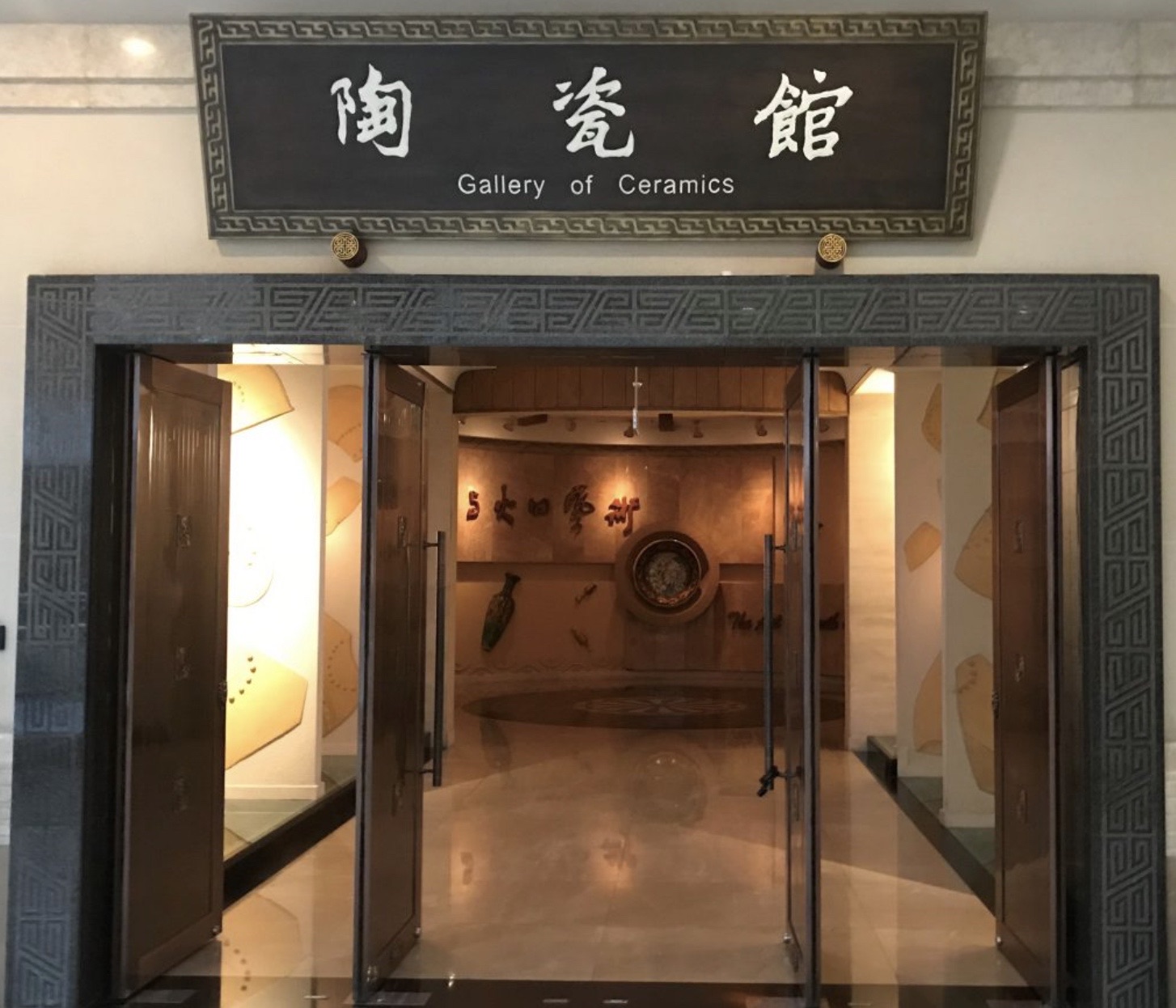
Located on 2F East Wing, the gallery chronologically presents ~400 representative pieces: Han green-glazed pottery, Tang Qingyao tri-colors, Song-Yuan Jingdezhen bluish-white porcelain, Ming-Qing blue-and-white and wucai, and late-Qing/Republic qianjiang enamels. The Qionglai (Qingyao) kiln takes center stage—China's largest southwestern folk kiln system, whose oil-saving lamps, stamped stem-cups, and flambé-glaze bowls were praised by Lu You's "Laoxue'an Notes." A multimedia reconstruction of the Shifangtang kiln site lets visitors follow clay-purifying, throwing, glazing, firing, and unloading steps. The finale showcases "export porcelain" from Chengdu customs and the Ya'an Tea-Horse Road, revealing Chengdu's role as a tea-horse corridor and Southern Silk Road hub in East-West ceramic trade.

On-site narration · read it where you stand

Right next to the bronze gallery is the Ceramics Gallery, which traces Sichuan's complete ceramic history from Neolithic painted pottery through to Ming and Qing dynasty porcelain.

Sichuan ceramics may not carry the fame of the imperial kilns at Jingdezhen, but they followed their own distinct path. Start by looking at the Daxi Culture painted pottery from the Neolithic period — these pieces are five to six thousand years old, decorated in red and black with wave patterns and grid patterns. Rudimentary, yes, but already showing a conscious desire to adorn.

Han dynasty ceramic figurines are one of Sichuan's defining contributions to the history of ceramics. We've already marveled at the storyteller-entertainer figurines downstairs and in the Ancient Sichuan gallery. Here in the Ceramics Gallery there are even more types: kitchen figurines (a cook in the middle of chopping), mirror-holding figurines (a maidservant holding a bronze mirror), labor figurines (a farmer shouldering farm tools)... Sichuan's Han dynasty figurine art stands in a class of its own within Chinese ceramic history. The reason: Sichuan's clay is fine-grained and fired at high temperatures, and the Ba-Shu people's innate sense of humor gave these figurines an unmatched vitality.

The Tang and Song dynasties brought another high point for Sichuan ceramics. The celadon fired at the Qingyang Palace kiln in Chengdu was a prized ware of the time — its glaze a warm yellow-tinged green, smooth and lustrous as jade. Particularly notable is the Qiong kiln — located in Qionglai near Chengdu, it was the most famous folk kiln in Sichuan's history, producing high-fired Tang-style three-color glazed ware, "fuel-saving lamps," and other goods that traveled far and wide. The fuel-saving lamp was a remarkably clever invention: a water-filled double-wall cavity beneath the oil reservoir kept the flame cooler, reducing evaporation and cutting oil consumption by about thirty percent. Energy-efficient lighting, over a thousand years ago — impressive, isn't it?

The gallery also holds a Yuan dynasty Longquan celadon double-eared ring-handled vase with a "plum-blossom green" glaze — the glaze as smooth and translucent as jelly, the vessel poised and elegant. In the Ming and Qing section there are blue-and-white, wucai, and famille rose wares; although Sichuan produced no imperial kilns of its own, these pieces from Jingdezhen and elsewhere reflect the flourishing trade between Sichuan and the rest of the country.

Zhang Daqian Painting & Calligraphy Gallery – Dafengtang (Chengdu Museum, 2F)

张大千书画馆·大风堂(成都博物院二楼)

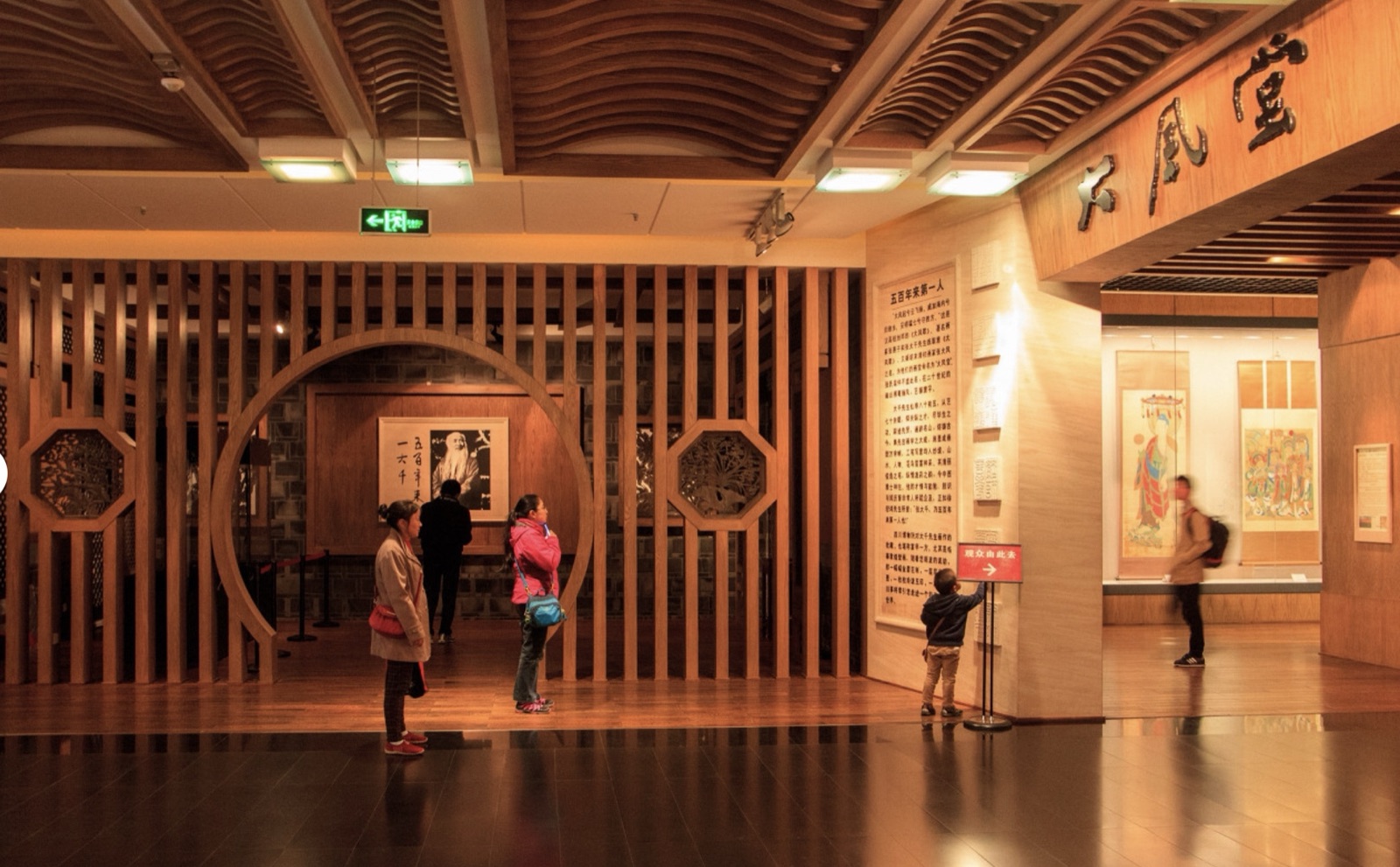
Zhang Daqian (1899–1983) is one of the 20th century's most internationally influential Chinese painters. The museum—located in his long-time creative base of Chengdu—hosts the Dafengtang memorial hall, displaying his artistic evolution in three phases. Early works like "Lotus" and "Imitation of Shitao Landscape" reveal literati elegance; the mid-period features 1:1 copies of Dunhuang Mogao frescoes and previously unpublished sketch drafts from his 1941–43 pilgrimage; the late-period showcases splash-ink and splash-color masterpieces such as "Ten-Thousand Li of the Yangtze," "Peach Blossom Spring," and "Love-Traces Lake." The gallery's vitrine also displays Daqian's personal brushes, seals, palette, and Panama hat—primary sources for biographical research.

On-site narration · read it where you stand

We now arrive at the gallery with the highest international profile in the entire museum — the Zhang Daqian Painting and Calligraphy Gallery, also known as the "Dafeng Tang." This is the gallery Sichuan Museum is most proud of, because it holds over 400 works by Zhang Daqian — the largest collection of his work in China — including 183 copies he made of Dunhuang murals.

Who was Zhang Daqian? Zhang Daqian (1899–1983), a native of Neijiang, Sichuan, was one of the most celebrated Chinese painters of the twentieth century. The Western art world called him "the brush of the East" and placed him alongside Picasso. He was accomplished in landscape, figure, and bird-and-flower painting, equally skilled in the meticulous gongbi style and in the free-flowing xieyi style. In 1956 he met Picasso in France, and the two masters of Eastern and Western art exchanged paintings — one of the great artistic encounters of the twentieth century. In the West, when people think of Chinese painting, Zhang Daqian is often the first name that comes to mind.

This gallery is organized in three sections: Zhang Daqian's copies of Dunhuang murals, his xieyi free-style paintings, and his collection of personal seals.

The first section — the Dunhuang mural copies — is the heart of the gallery. In 1941, Zhang Daqian traveled to Dunhuang with his family and students and spent two years and seven months in that desolate stretch of the Gobi Desert, copying 276 murals spanning centuries of Buddhist art. Why put himself through such hardship? Because the Mogao Caves at Dunhuang preserve a thousand years of Buddhist murals — from the fourth century through the fourteenth — making them the most complete "underground museum" of ancient Chinese painting history. But the conditions at Dunhuang were brutal: no electricity, no running water, scorching summers and bitter winters, and the murals deep inside caves where hardly any light reached. Zhang Daqian had his team use mirrors to reflect sunlight into the caves, then copied every brushstroke by hand.

Look at this scroll, "Prince Sattva Sacrifices His Body to Feed a Tigress" — twelve meters long, it depicts a Buddhist Jataka tale: an Indian prince throws himself off a cliff to feed a starving tigress and her cubs. The composition is sweeping, the colors radiant, and the proportional relationships between figures, animals, and landscape are handled with extraordinary skill. Zhang Daqian's copies were never simple facsimiles — he brought his own artistic understanding and creative interpretation to each piece while honoring the originals. It was this Dunhuang experience that transformed his art. Before, he worked within the tradition of Ming and Qing literati painting; afterward, he absorbed the grandeur of Tang dynasty murals and the sacred solemnity of Buddhist art, forging a style entirely his own — what came to be called the "Daqian style."

The second section features his xieyi free-style paintings, including landscapes, figure paintings, court beauty portraits, and bird-and-flower works. His landscape paintings are vast in scale, and his "splash-ink and splash-color" technique is particularly original — he poured ink and pigment directly onto rice paper, then worked with the natural flow of the spreading colors to develop the composition further. The result has the spirit of Chinese painting and the visual impact of Western abstract art. Look at this splash-color landscape — sweeping fields of blue-green, mountain peaks appearing and vanishing in mist, the line between what was poured and what was painted impossible to trace. This "semi-abstract" approach was strikingly avant-garde for its time.

The third section is his collection of seals. Zhang Daqian used hundreds of seals throughout his life — name seals, "leisure seals," and collector's seals. These are not merely signatures on his works; they are miniature masterpieces of seal carving in their own right. Every seal has a story — some were carved by friends as gifts, some he designed himself. Their inscriptions include his courtesy name, art name, and studio name.

Photography tip: to protect works on paper, this gallery uses a sound-activated lighting system — the lights automatically dim when no one is nearby. Please do not use flash under any circumstances; it can cause irreversible damage to ink and pigments that are centuries or even millennia old.

One more thing worth knowing: if you want to see authentic works by Zhang Daqian, Sichuan Museum is the right place. The National Palace Museum in Taipei also holds a large collection of his work, but when it comes to Dunhuang mural copies, Sichuan Museum ranks first in the country.

Painting & Calligraphy Gallery (Chengdu Museum, 2F)

书画馆(成都博物院二楼)

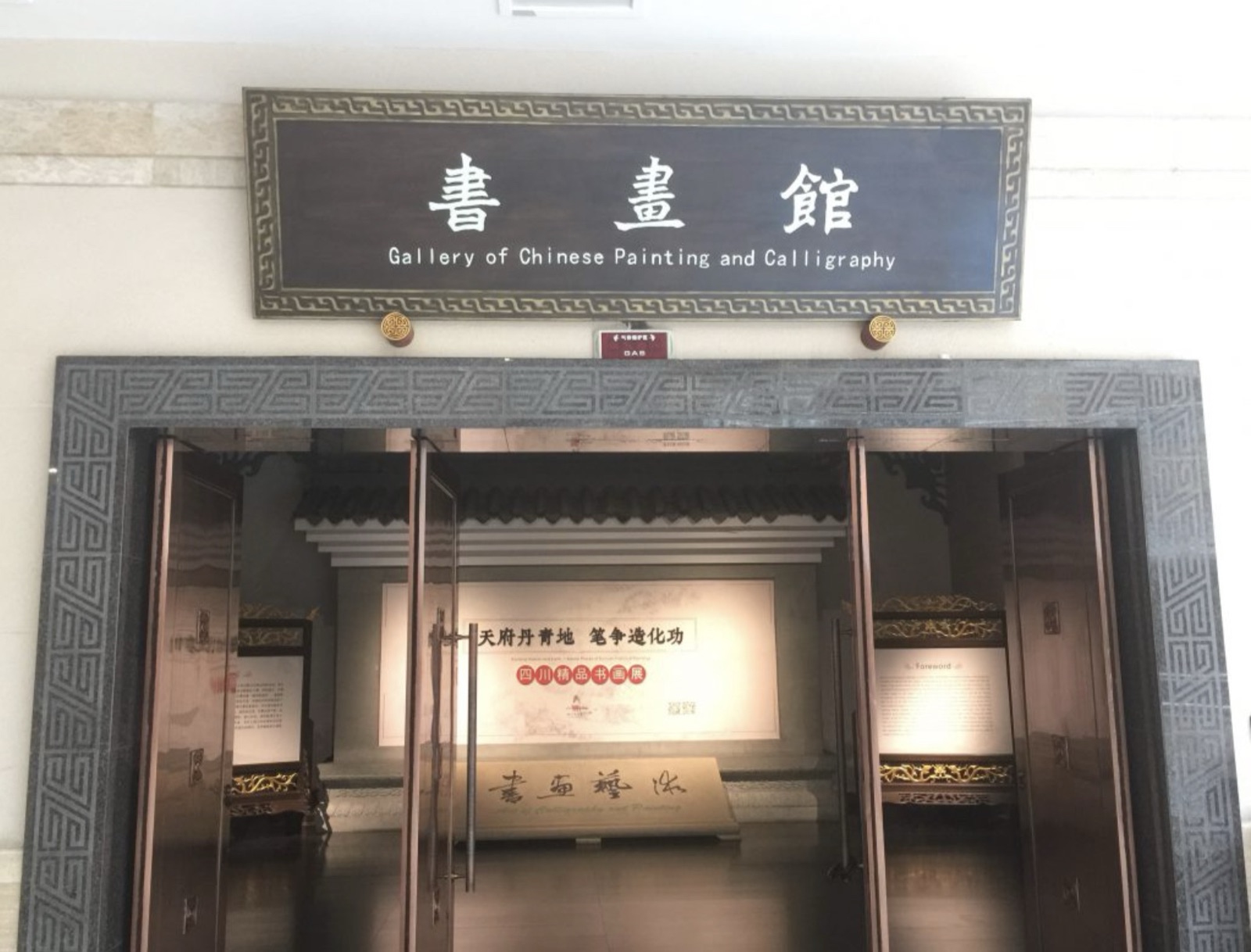
Echoing the Zhang Daqian hall, this gallery is organized into four themes: Song academic style, Yuan literati, Ming-Qing Ba-Shu masters, and modern Shu-connected artists. Highlights include rubbing-and-original editions of Su Shi's "Gongfu Tie," Wen Tong's "Huzhou Bamboo School" ink-bamboos, Yang Shen's running-script, works by Tang Yin, Wen Zhengming, Dong Qichang, plus modern masters with Shu ties—Kang Youwei, Liang Qichao, Yu You-ren, Guo Moruo, Xu Beihong, Qi Baishi, and Huang Binhong. Museum-grade temperature-controlled vitrines rotate exhibits seasonally: Spring Festival couplets, Duanwu fan paintings, and an autumn Ba-Shu master show. Digital kiosks allow searching the museum's full calligraphy and painting archive by dynasty, author, or theme.

On-site narration · read it where you stand

Stepping out of the Zhang Daqian gallery, the adjoining Calligraphy and Painting Gallery is equally unmissable. It displays over a hundred masterworks of calligraphy and painting spanning the Tang dynasty through the modern era.

The most important piece on display is "Wintersweet and Two Birds," a fan-shaped silk painting by Emperor Huizong of the Song dynasty, Zhao Ji. Huizong is often described as "an artist born into the wrong role as emperor" — his reign may not have been distinguished, but his artistic achievements stand at the absolute apex among all Chinese emperors. He created a distinctive script known as "Slender Gold" calligraphy — strokes that are lean, upright, and incisive, almost as if cut with a blade, perfectly unified with the style of his bird-and-flower paintings. "Wintersweet and Two Birds" is a quintessential example of Song dynasty court-style bird-and-flower painting: a wintersweet branch sweeps diagonally across the frame, two small birds perched on the twigs — one still, one in motion — the composition spare yet endlessly resonant. The painting also bears Huizong's Slender Gold inscription and the "Xuanhe" reign-period mark. "Xuanhe" was his final reign title, allowing this painting to be dated precisely to between 1119 and 1125 — exactly nine hundred years ago.

Why does Huizong's bird-and-flower painting matter so much? Before his time, Chinese painting was dominated by figure subjects and landscape; bird-and-flower painting had not yet established itself as an independent art form. Huizong vigorously promoted observational study of birds and flowers, established an imperial painting academy, and trained a generation of professional painters, raising Song dynasty bird-and-flower painting to the highest peak in the history of Chinese art. He set standards such as "a peacock stepping onto a platform always lifts its left foot first" — the precise detail of which foot a peacock leads with had to be accurately painted. This level of rigorous, almost scientific observation was exceptionally rare in Chinese painting history.

The gallery also holds other precious works — "Evening Cool in an Empty Pavilion" by Tang Yin (Tang Bohu) of the Ming dynasty, "Eminent Scholars in a Famous Garden" by Wen Zhengming of the Ming dynasty, and "Autumn Mountain with Travelers" by Liu Songnian of the Qing dynasty, among others. It is worth noting, however, that paintings on paper and silk are rotated periodically to protect them, so not every work will be on view at every visit. The essence of looking at calligraphy and painting is not simply "what you see" but "how you see it" — slow down, stand before a single work for a few extra minutes, and let the rhythm and spirit within the brushwork come to you.

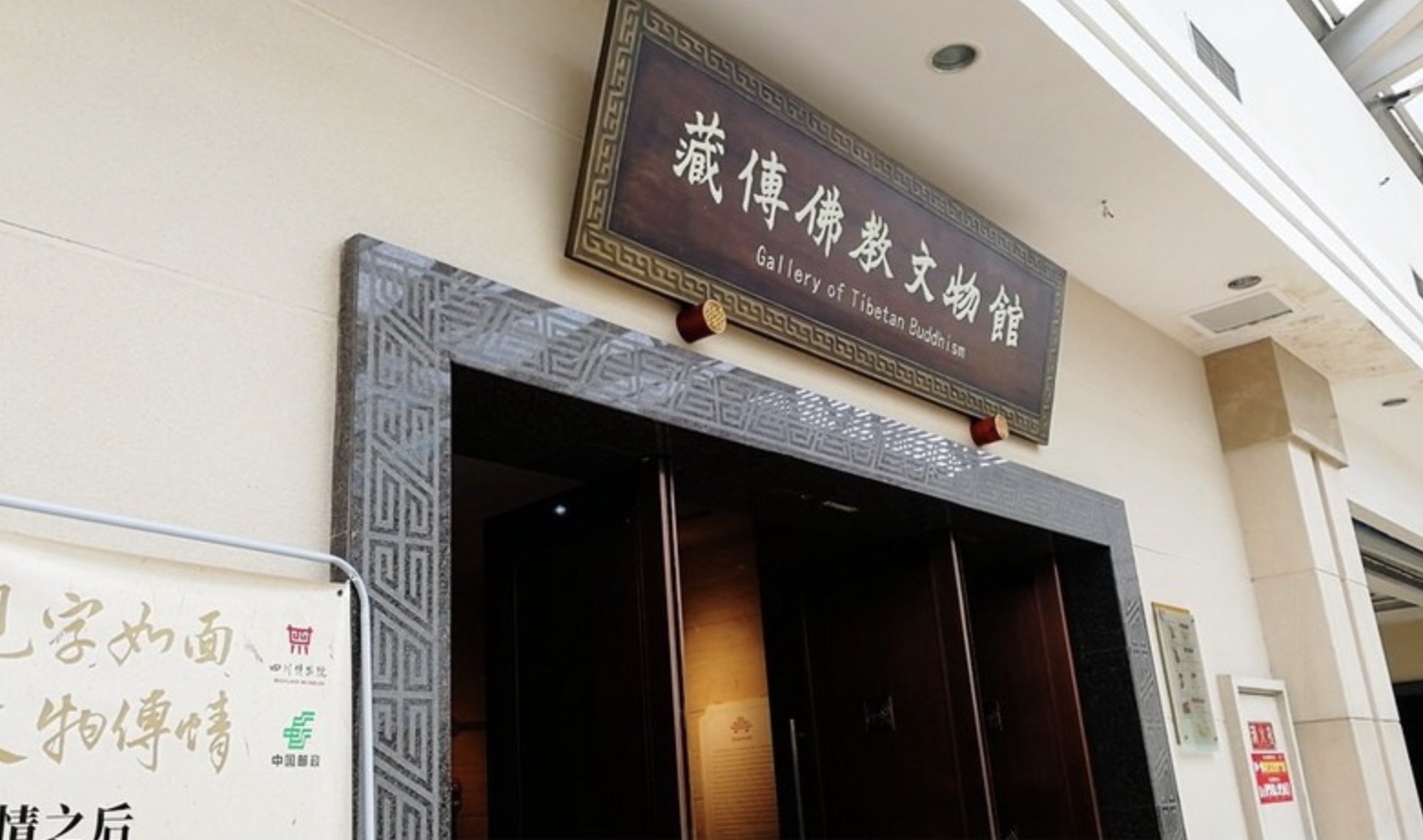
Tibetan Buddhist Artifacts Gallery (Chengdu Museum, 3F)

藏传佛教文物馆(成都博物院三楼)

Located on 3F West Wing, this hall reflects Sichuan's role as a Sino-Tibetan cultural hub. The collection centers on Ming-Qing gilt-bronze statues, thangkas, mandalas, ritual implements, dharma bells, gyaling horns, and Tibetan sutra woodblocks, organized by five major schools: Tsongkhapa lineage, Gelug, Nyingma, Sakya, and Kagyu. The highlight is an ~80 cm Yongle-era (Ming) imperial gilt-bronze Buddha of extraordinary craftsmanship; alongside a set of 13 ~1.5m × 1m thangkas depicting the Life of Shakyamuni, still vibrant after five centuries. An interactive "mani wheel" wall lets visitors spin carved wooden prayer wheels and experience daily Tibetan Buddhist practice. The hall is the best window into western Sichuan Tibetan-region culture and history.

On-site narration · read it where you stand

Coming up from the second floor, we're now on the third floor. The first gallery to visit is the Tibetan Buddhist Artifacts Gallery — another exhibition hall that is truly one of a kind in China. Sichuan is China's second-largest Tibetan region, after Tibet itself, and the Ganzi Tibetan Autonomous Prefecture and Aba Tibetan and Qiang Autonomous Prefecture have a deep tradition of Tibetan Buddhist culture. As a result, Sichuan Museum has assembled a large and exceptional collection of Tibetan Buddhist artifacts, most of them on public display for the very first time.

What is Tibetan Buddhism? Put simply, after Buddhism spread from India into China, it traveled along three different routes. One became Chinese Buddhism — passing along the Silk Road into the Central Plains and giving rise to the Chan school, the Pure Land school, and other familiar traditions. A second path became Theravada Buddhism, spreading into Southeast Asia. The third became Tibetan Buddhism — transmitted onto the Tibetan Plateau, where it absorbed elements of the indigenous Bon religion and took on a wholly distinctive character. Tibetan Buddhism has more than 1,300 years of history and is divided into four main schools: the Nyingma school (known as the Red Hat school), the Sakya school (the Multicolored Hat school), the Kagyu school (the White Hat school), and the Gelug school (the Yellow Hat school). Both the Dalai Lama and the Panchen Lama belong to the Gelug school.

The most breathtaking objects in this gallery are the eleven-scroll thangka set depicting the Epic of King Gesar, dating from the Qing dynasty. The Epic of King Gesar is the heroic epic of the Tibetan people — over one million lines long, it is the longest epic in the world, many tens of times longer than Homer's Iliad and Odyssey combined. King Gesar is the legendary hero of Tibetan tradition, said to be the son of a sky deity who descended to earth, subdued demons and monsters, unified the tribes, and brought blessings to the people. These eleven thangkas string together the complete story of King Gesar from his birth to his unification of the Tibetan region — each scroll blazing with color, crowded with figures, rich in detail, and painted with mineral pigments derived from precious stones. After two to three centuries, the colors remain as vivid as the day they were made.

What is a thangka? "Thangka" is a transliteration from Tibetan, meaning "scroll painting." It is a form of painting unique to Tibetan Buddhism, typically executed on cloth or silk and then mounted in brocade borders for display and devotion. The subject matter is predominantly Buddhist: images of Buddhas, bodhisattvas, protective deities, mandalas, and Buddhist stories. Creating a thangka follows strict ritual protocols — the painter must be vegetarian, must bathe and burn incense before picking up a brush, and every proportion, color, and hand gesture of every deity is specified by scripture and cannot be freely altered. A thangka is therefore not merely a work of art — it is a form of religious practice.

The gallery also contains a particularly striking artifact — a Qing dynasty gilt-bronze ritual mask, 57 centimeters long, 65 centimeters wide, and 25 centimeters high, used in ceremonies as a representation of a Tibetan Buddhist protective deity. Three eyes glare fiercely, the teeth are bared and the tongue curled, and the skull crown is inlaid with turquoise and coral beads, with colorful silk tassels across the forehead. In ordinary times this mask would hang in the main hall of a monastery; during major religious ceremonies, a monk would wear it while performing the "Vajra Dance" (Cham dance) — a Tibetan Buddhist ritual in which performers wear deity masks and dance to drive away evil spirits and invoke blessings.

Other objects on display include Buddhist statues in various materials (gilt-bronze, jade, and carved wood), ritual implements (vajras, conch shells, kapala skull cups), and scripture texts. The strength of Sichuan's Tibetan Buddhist collection lies in its diversity — from Bon religion relics of the western Sichuan plateau to the exquisite ritual implements of Gelug school monasteries, it covers more than a thousand years of Tibetan Buddhist history in full.

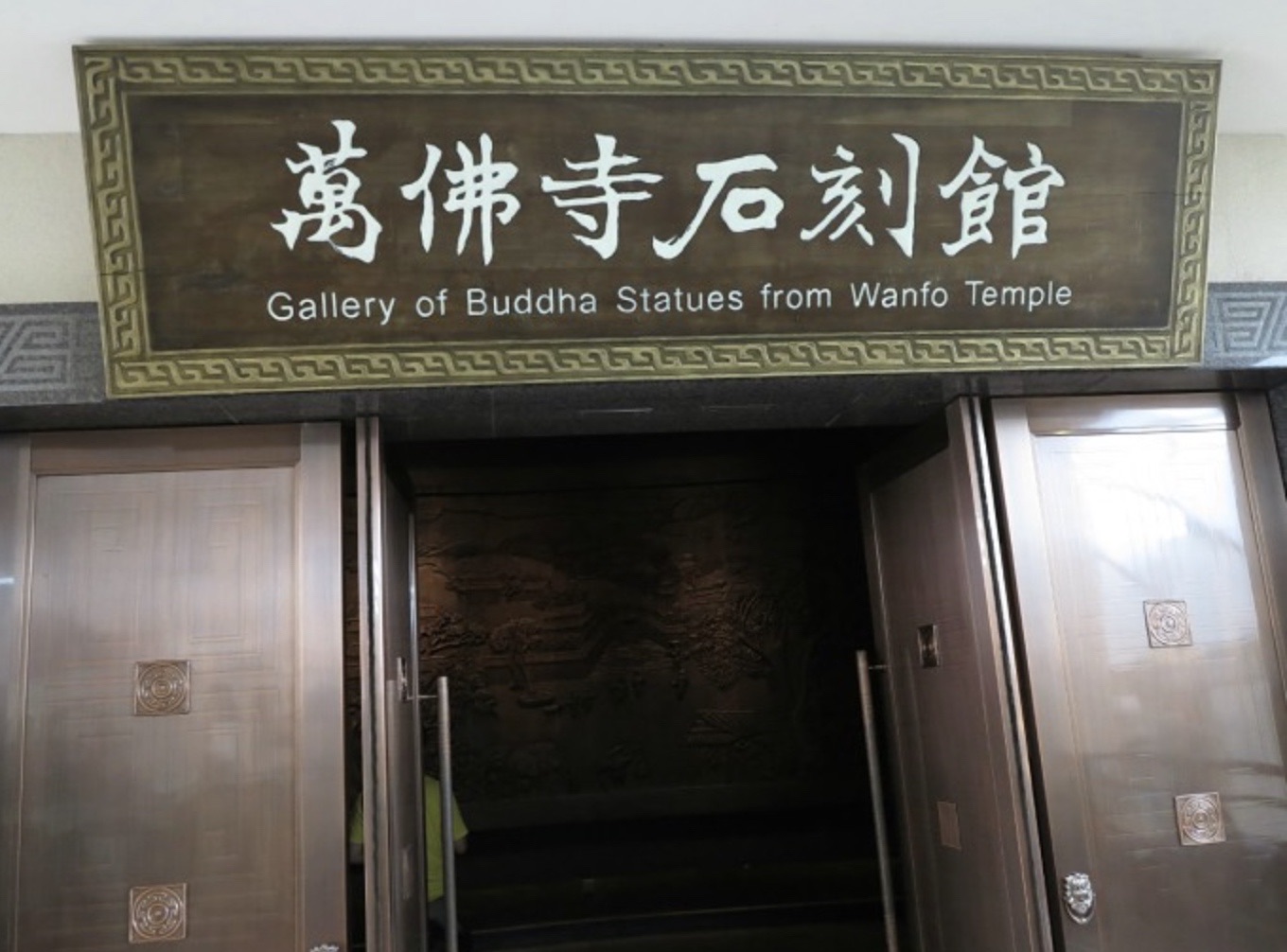
Wanfo Temple Stone Sculpture Gallery (Chengdu Museum, 3F)

万佛寺石刻馆(成都博物院三楼)

Wanfo Temple, near Tongjin Bridge outside Chengdu's west gate, was one of the city's most important official temples from the Southern Dynasties through the Tang. Excavated in four campaigns between 1882 and 1953, the site yielded hundreds of sculpture fragments—the most important Southern Dynasties Buddhist stone-carving discovery in southern China after Yungang and Longmen. The gallery is organized into five periods: Liang, Northern Zhou, Sui, Early Tang, and High Tang. Highlights include a 523 CE Liang Pingtong-4 statue, Ashoka-style pagodas, a Sui Daye Amitabha, an Early Tang yab-yum Buddha, and a High Tang guardian figure. Wanfo carvings uniquely merge the "Cao Yi Chu Shui" (Cao-style flowing-drapery) and "Wu Dai Dang Feng" (Wu-style fluttering-ribbon) styles—key evidence for the "Southern Dynasties sinicization" of Chinese Buddhist sculpture.

On-site narration · read it where you stand

Leaving the Tibetan Buddhist gallery, we come to the Wanfo Temple Stone Sculpture Gallery. This gallery is compact, but its scholarly significance is immense — it fills a critical gap in the study of Southern Dynasties Buddhist stone carvings in China.

Where was Wanfo Temple? The Wanfo Temple site lies in the northern part of central Chengdu. The temple was founded during the Yanxi reign of the Eastern Han dynasty (158–167 CE), nearly 1,900 years ago, and was destroyed in warfare at the end of the Ming dynasty. Beginning in 1882 (the eighth year of the Guangxu reign of the Qing dynasty), four successive excavations at the site unearthed over 200 stone Buddhist sculptures. These figures span the Southern and Northern Dynasties, the Sui and Tang dynasties, and the Five Dynasties period, with the Southern Dynasties pieces being the most academically significant.

Why are the Southern Dynasties carvings so important? Chinese Buddhist sculptural art developed along two main lines: the north is represented by the Yungang Grottoes in Datong, Shanxi, and the Longmen Grottoes in Luoyang, Henan; the south is represented by sites such as Qianfo Cliff in Guangyuan and the Nakan Grottoes in Bazhong, both in Sichuan. But physical remains of Southern Dynasties stone carving — from the Song, Qi, Liang, and Chen states (420–589 CE) — are exceedingly rare across the country. The Southern Dynasties capital was at Nanjing, where the humid climate and soft stone meant carvings rarely survived. The sculptures unearthed at the Wanfo Temple site, however, were miraculously preserved by the sandstone geology and the conditions in which they were buried. The Wanfo Temple carvings are therefore a unique surviving record for the study of Southern Dynasties Buddhist art.

This gallery presents 65 selected masterworks, organized in three sections: the Southern and Northern Dynasties, the Tang dynasty, and the Five Dynasties period. Begin with the Southern Dynasties standing figure of Shakyamuni Buddha — the face is delicate and slender, the smile quietly inward, and the garment folds ripple like flowing water. This is the defining "slender figure with refined features" style, in vivid contrast with the bold, vigorous style of the northern Yungang Grottoes. It reflects the refined aesthetic of the educated southern gentry. Then look at the Tang dynasty figures — faces full and rounded, bearing opulent and dignified, radiating the confidence of a great dynasty at its height. From the Southern Dynasties to the Tang, Buddhist sculpture shifted from slender and angular to full and voluptuous — and that shift is itself a portrait of two eras.

One piece in the gallery deserves special attention — a Southern Dynasties screen-backed votive stele. This sculpture has a complete body-halo behind the figure, carved with flying apsaras, lotus blossoms, and flame patterns in lines that are fluid and beautifully refined. Notice that the arms of the flying apsaras and their trailing ribbons are carved in openwork relief — 1,500 years ago, craftsmen managed to achieve such a weightless, floating effect in hard red sandstone. The skill involved is astonishing.

Sichuan Ethnic Cultural Relics Gallery (Chengdu Museum, 3F)

四川民族文物馆(成都博物院三楼)

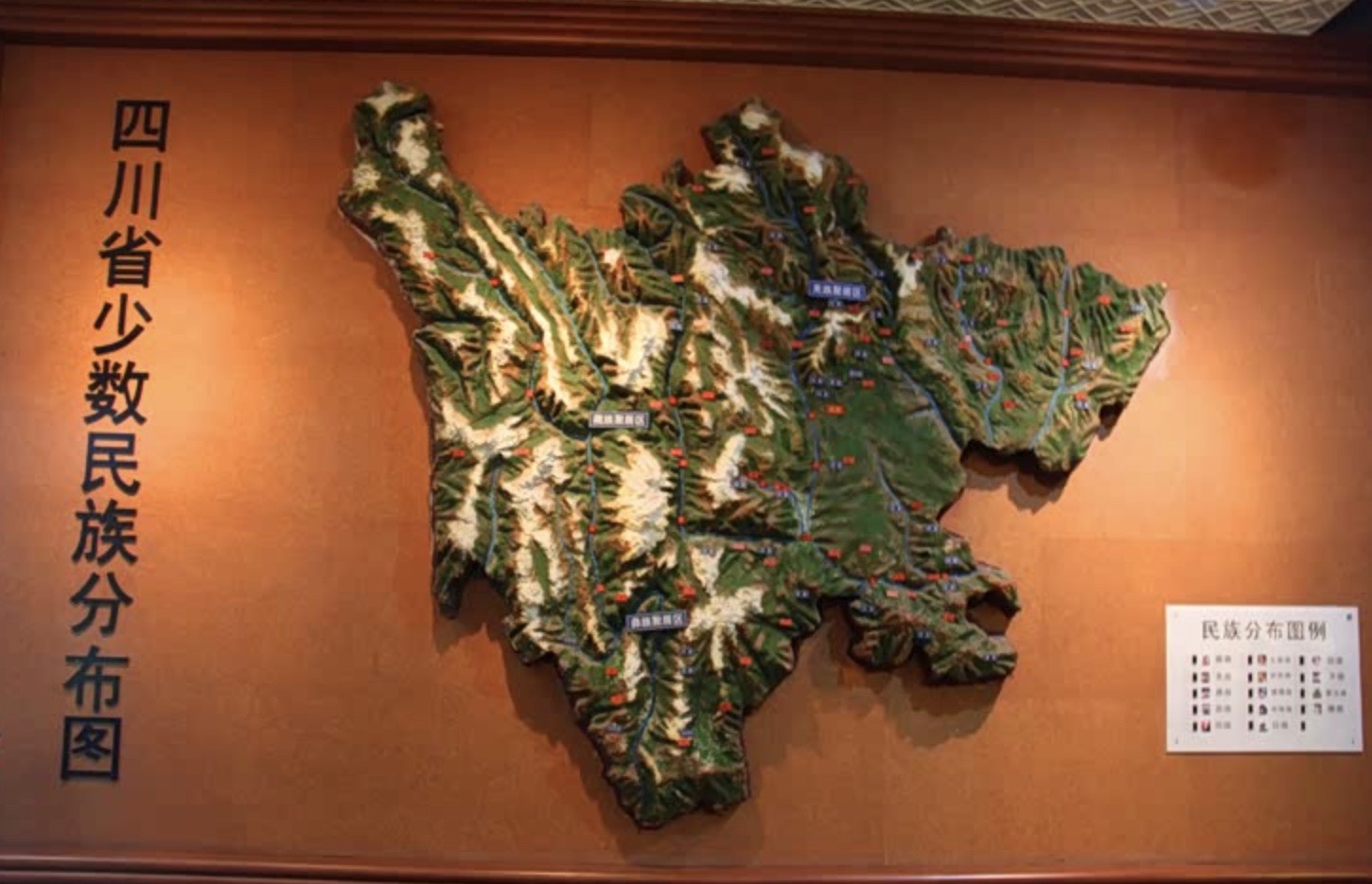
This gallery is the museum's premier window into the "diverse yet unified" Chinese nation on Sichuan soil. Sections cover Tibetan (Jiarong, Amdo, Khampa), Qiang, Yi (Liangshan), Miao, Tujia, Naxi, Lisu, Mongol, Hui, and Manchu groups. Costumes are the highlights: Jiarong Tibetan women's colorful robes with turquoise-coral-amber headdresses, Liangshan Yi men's "chaerwa" woolen cloaks and "tianbaba" hero-knot, Qiang cross-stitch embroidery and silver plaques, Miao pleated skirts and batik, and Tujia "Xilankapu" brocade. The gallery also displays ethnic musical instruments (Qiang flute, mouth harp, long-necked qin, mabu), ritual objects (Bon-buddhist butter flowers, Bimo divining cylinders, Dongba scriptures), tools, and wedding items. The closing "ethnic unity" relief wall embodies the vision of a Chinese national community.

On-site narration · read it where you stand

Next, we move into the Sichuan Ethnic Minorities Gallery. Sichuan is one of China's most ethnically diverse provinces. Beyond the Han majority, fourteen ethnic groups have called this land home for generations — among them the Tibetan, Yi, Qiang, Miao, Hui, and Tujia peoples. This gallery focuses on four of the most distinctive: Tibetan, Yi, Qiang, and Miao.

Let's start with the Tibetan collection. Back in the Tibetan Buddhist Art Gallery we saw the religious side of Tibetan culture; here the emphasis shifts to everyday life — chubas (traditional robes), Tibetan knives, butter-tea kettles, tsampa containers, and other household objects, alongside finely crafted Tibetan furniture and rugs. Take a close look at the patterns on the Tibetan garments — the swastika motif, the Eight Auspicious Symbols, sun, moon, and stars — every single design carries religious meaning. Buddhist faith permeates every corner of daily Tibetan life in a way that feels quite different from the Han tradition, where religion and everyday routine tend to stay separate.

The Yi people are Sichuan's largest ethnic minority group, concentrated mainly in the Liangshan Yi Autonomous Prefecture. The Yi have their own independent writing system, calendar, and religious tradition. The Yi lacquerware on display here is a national-level intangible cultural heritage. Three colors define it: black, red, and yellow — black for the earth, red for fire, yellow for the sun. The patterns are bold geometric forms, lines strong and forceful. Making a single piece is an extraordinarily involved process — from harvesting raw lacquer and forming the base, to layering coats and painting the designs, one finished object can require dozens of steps and several months of work.

The Qiang people are known as "the people who live in the clouds" — for generations they have inhabited the high mountain gorges of northwestern Sichuan. Their most iconic architectural achievement is the diaolou, a tall defensive tower built from stone and yellow clay that served both as a watchtower and a fortification. The 2008 Wenchuan earthquake devastated many Qiang villages and dealt a severe blow to Qiang cultural heritage. The gallery displays Qiang embroidery — vivid silk threads worked onto dark cloth in patterns of flowers, clouds, and ram's horns, with striking color contrasts and a needlework technique found nowhere else. The Qiang have no written script; their embroidery is their historical record, and every pattern tells an ancient story.

The Miao are celebrated for their clothing and silverwork. The festival dress on display here — embroidered jacket, pleated skirt, and a full body of silver ornaments — can weigh more than ten kilograms. Miao silver craftsmanship is extraordinarily refined: wire-drawing (pulling a silver ingot into threads finer than a human hair), chiseling (cutting designs into silver sheet with engraving tools), and openwork (removing the background material so only the pattern remains). A Miao girl begins collecting and commissioning her bridal silver while she is still young, and a single masterpiece piece often represents the combined effort of a mother and daughter across two generations.

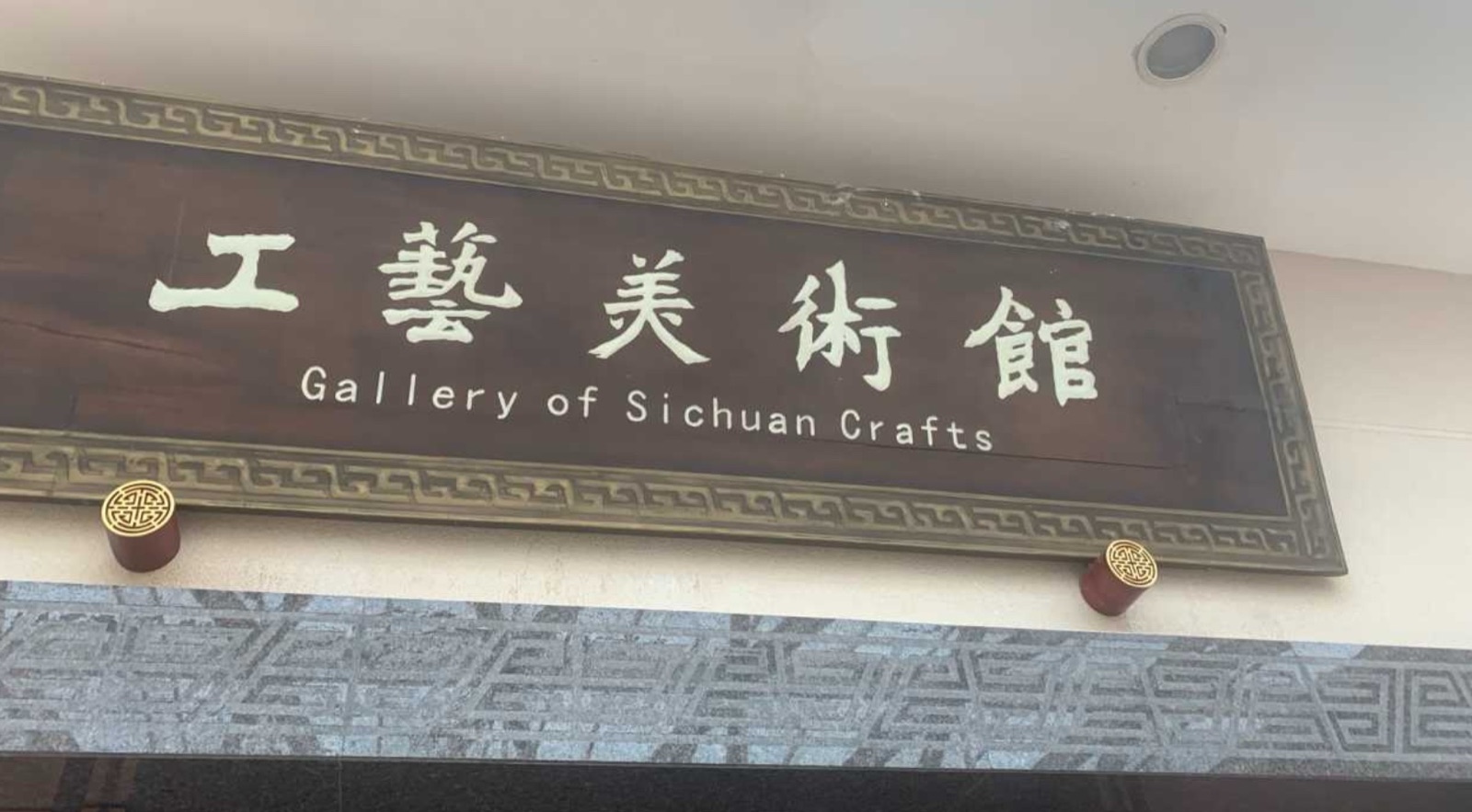
Arts & Crafts Gallery (Chengdu Museum, 3F)

工艺美术馆(成都博物院三楼)

Located at the end of 3F East Wing, the gallery brings together over ten Ba-Shu craft genres: Shu brocade, Shu embroidery, Chengdu lacquerware, silver filigree, bamboo weaving, porcelain-bamboo composite, ivory and jade carving, gold-silver inlay, paper-cut, shadow puppetry, and masks. The center stage replicates a late-Qing Shu-brocade "great-flower-loom" wooden machine—heritage inheritors demonstrate "picking-and-tying pattern cards" at scheduled times, letting visitors watch "wanzi" and "bing-mei" patterns take form. The double-sided Shu-embroidered panda won the Hundred Flowers Gold Award; the silver-filigree showcase displays "flat-fill" filigree of intricate complexity; the porcelain-bamboo pieces wrap hairlike bamboo strips around thin porcelain. The closing "Intangible Heritage Experience Zone" offers Shu-embroidered fans, silver filigree, and paper-cut classes—reserve at the service desk.

On-site narration · read it where you stand

We've arrived at the final gallery on today's tour — the Arts and Crafts Gallery. If the earlier rooms told the story of Sichuan's history, this one is devoted to the ingenuity of Sichuan's craftspeople.

Sichuan's traditional crafts are remarkably varied and technically accomplished, earning recognition across China and beyond. The gallery highlights five major categories: Shu embroidery, lacquerware, bamboo weaving, gold and silver work, and Zigong lanterns.

Shu embroidery is one of China's Four Great Embroideries, alongside Su embroidery from Suzhou, Xiang embroidery from Hunan, and Yue embroidery from Guangdong. What sets Shu embroidery apart is the sheer variety of its stitches — more than 120 distinct techniques that produce extraordinarily nuanced gradations of tone and light. Look at this piece: a giant panda eating bamboo. The fluffy texture of the fur, the veins running through each bamboo leaf, the sharp contrast of black and white — all of it rendered stitch by stitch in silk thread. Shu embroidery's "gradient stitch" technique creates seamless color transitions, moving through a dozen or more tonal steps from dark to light, achieving an effect as rich as oil painting. The gallery also displays double-sided embroidery — one piece of fabric carries two completely different images on its two faces. The difficulty lies in the fact that every single stitch must be correct on both sides simultaneously, with absolutely no margin for error.

Sichuan lacquerware has a history of more than three thousand years. Chengdu lacquer is celebrated for its "carved and inlaid color" technique: floral patterns are carved into the lacquered base, colored lacquer is pressed into the grooves, and the surface is then sanded smooth until the design and the background merge into a mirror-like finish. One case holds a fragment of Western Han lacquerware — incomplete, yes, but the swirling cloud patterns and phoenix motifs remain vivid and perfectly legible. The fact that lacquerware made over two thousand years ago can still hold such brilliant color is precisely what earns it the reputation of being "immune to decay for a thousand years."

Bamboo weaving is the practical genius of Sichuan's mountain communities. Sichuan has more species of bamboo than anywhere else in China, and its weavers can split a single stalk into filaments finer than a human hair, then use those filaments to create baskets, mats, fans, and decorative vases of remarkable delicacy. Look at this bamboo-woven vase — from a distance it looks like carved rosewood; only up close does it reveal itself as woven bamboo. The patterns on the body are formed by interweaving filaments of different colors, each strand just 0.1 millimeters in diameter — thinner than a hair.

The gold and silver work and the Zigong festival lanterns are equally impressive. Zigong lanterns carry the title of "China's Greatest Lanterns." The gallery displays scale models of these famous creations — dragons, phoenixes, qilin, lotus flowers, every form imaginable. They can't be lit here, but even unlit, the shapes and craftsmanship alone convey something truly extraordinary.

Exit & Surroundings (Chengdu Museum)

出口与周边(成都博物院)

The museum's exit integrates with the "Qinghua Road Museum Cluster" master plan. From the south gate, walking ~800m south leads to Dufu Thatched Cottage (5A scenic area); the opposite side of the road opens onto Huanhuaxi Park and the "Poetry Avenue" stone corridor; 1.5 km east reaches Sichuan University's West China campus (bell tower, Maode Hall, old library); another 2 km east brings you to Sichuan Provincial Library, Sichuan Science & Technology Museum, and Tianfu Square—Chengdu's dense cultural core. The exit plaza hosts a cultural-creative shop and "Chengdu Gifts" souvenir store, with replica artifacts, Shu-brocade ties, panda plush, and Sichuan-opera mask toys. Adjacent F&B includes Starbucks, %Arabica, and Bread Talk. In late autumn, photograph the golden ginkgo leaves along Qinghua Road—a perfect Chengdu-style farewell contrasting the museum's solemnity.

On-site narration · read it where you stand

We've now walked through all the main galleries of the Sichuan Museum. If you can only take three things away from today, make it these three:

First, the Warring States bronze hu vessel with water-and-land battle scenes — a documentary of the Warring States era etched onto bronze. Only two such vessels exist in all of China; the one here is the only piece recovered through an official excavation.

Second, Zhang Daqian's Dunhuang copy murals — 183 panels, the largest collection in the country. One man spent two years and seven months in the Gobi, then brought Dunhuang back to Sichuan.

Third, the Eastern Han pottery storyteller figurine — people in Sichuan were already laughing this hard two thousand years ago. The spirit of optimism and humor that defines Sichuan people is literally baked into the clay.

A few practical notes before you go: The Sichuan Museum is free but requires advance reservation. It is open Tuesday through Sunday, 9:00 a.m. to 5:00 p.m., closed on Mondays, with last entry at 4:00 p.m. The exit is right next to the main entrance — simply retrace your steps. Turn right out of the museum and you'll reach the famous Huanhua Stream Park, which is free and well worth a stroll. Du Fu Thatched Cottage is about 600 meters away — a five- to eight-minute walk. Qingyang Palace is roughly 1.2 kilometers away. Wuhou Shrine is about 3 kilometers away, with Jinli Ancient Street right next to it. Museum — Du Fu Thatched Cottage — Qingyang Palace — Wuhou Shrine — Jinli: this route can comfortably be done in a single day, and it is the classic cultural day-trip through central Chengdu.

Thank you for listening. We hope that the millennia of artifacts in the Sichuan Museum have given you a whole new window into the culture of Ba and Shu.

Prefer to be shown around?

A local guide walks these 13 stops with you and answers what the page cannot.

Chengdu tours ↗