Travel Guide› Chengdu› Du Fu Thatched Cottage
Chengdu · Museum

Du Fu Thatched Cottage 杜甫草堂

Du Fu Thatched Cottage
Address
37 Qinghua Road, Qingyang District, Chengdu, Sichuan Province (by the Huanhua Stream)

Du Fu Thatched Cottage — Site Introduction

Du Fu Thatched Cottage 杜甫草堂, located at 37 Qinghua Road, Qingyang District, Chengdu, was the home of the celebrated Tang dynasty poet Du Fu 杜甫 (712–770) during his years in the city. In 759 AD, fleeing the chaos of the An Lushan Rebellion 安史之乱, Du Fu made his way to Sichuan with his family and built a modest but deeply poetic dwelling on the banks of the Huanhua Stream 浣花溪. He spent nearly four peaceful years here, writing more than 240 poems — among them timeless masterpieces such as Spring Night's Delightful Rain 《春夜喜雨》 and Song of My Thatched Hut Torn Apart by the Autumn Wind 《茅屋为秋风所破歌》. The site today covers nearly 300 mu (about 200 acres) and retains the architectural layout established during two major restorations — one in the thirteenth year of the Hongzhi reign of the Ming dynasty (1500) and another in the sixteenth year of the Jiaqing reign of the Qing dynasty (1811). It has since become a cultural landmark that blends the character of a memorial shrine with the atmosphere of the poet's original home, and is celebrated as "the holiest site in the history of Chinese literature."

The Spirit Wall (Zhaobi 照壁)

The first stop on any visit to Du Fu Thatched Cottage, this grey-brick spirit wall 照壁 announces the beginning of a quiet, poetic world. Inlaid with the two characters "草堂" (Thatched Cottage), the inscription was written by Aisingioro Yunli 爱新觉罗·允礼, the seventeenth son of the Kangxi Emperor and Prince Guo 果亲王, and the wall itself was built in the thirty-fourth year of the Guangxu reign (1908). The couplet flanking the wall — "A home west of the Wanli Bridge, a retreat north of Baihua Pool" — comes from Du Fu's poem Longing for My Jinshui Dwelling 《怀锦水居止二首》, neatly placing the original cottage on the map. More than a fine piece of architectural craftsmanship, the spirit wall is a threshold into the world of Du Fu's poetry.

The Main Gate (Zhengmen 正门)

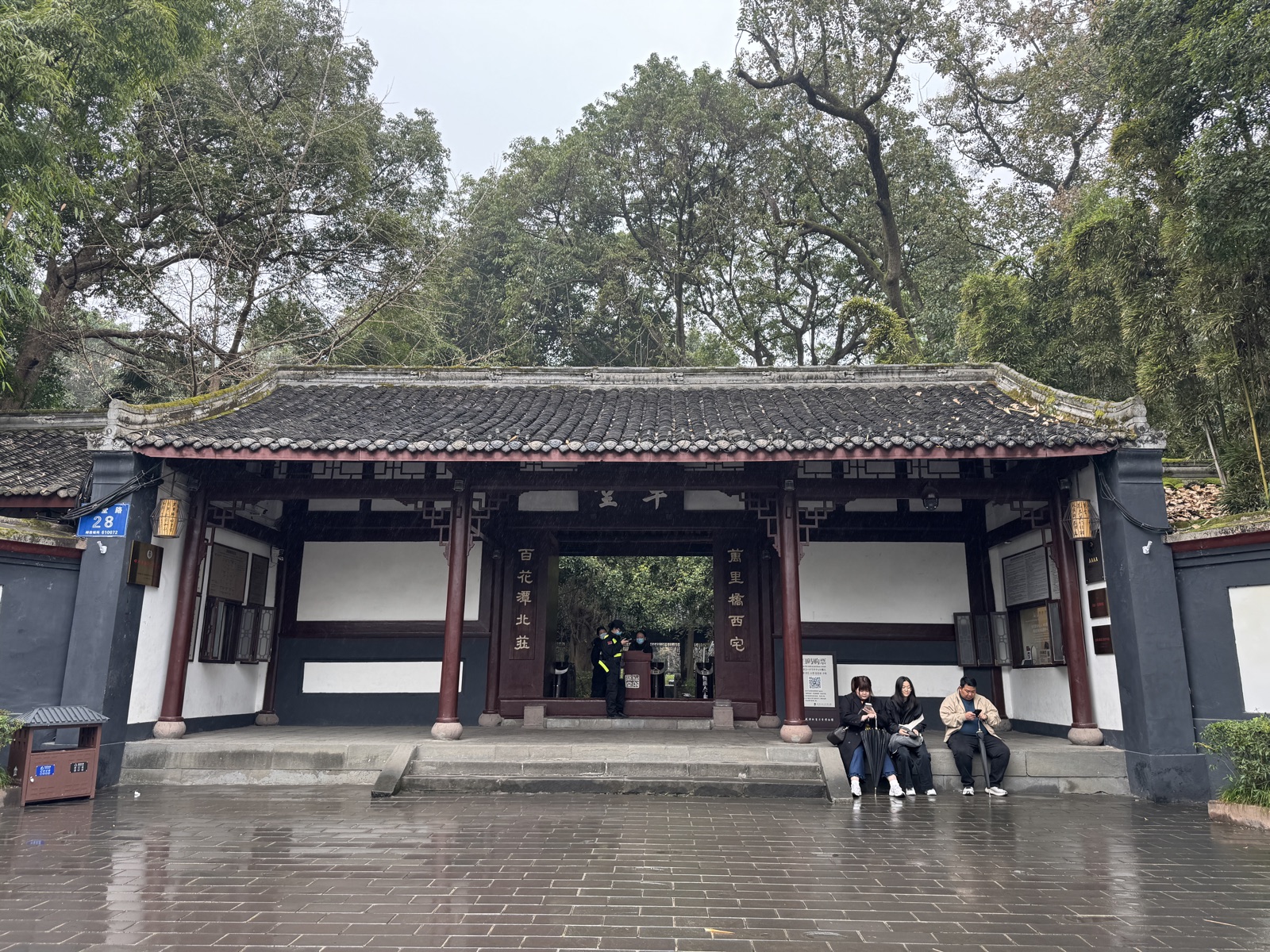
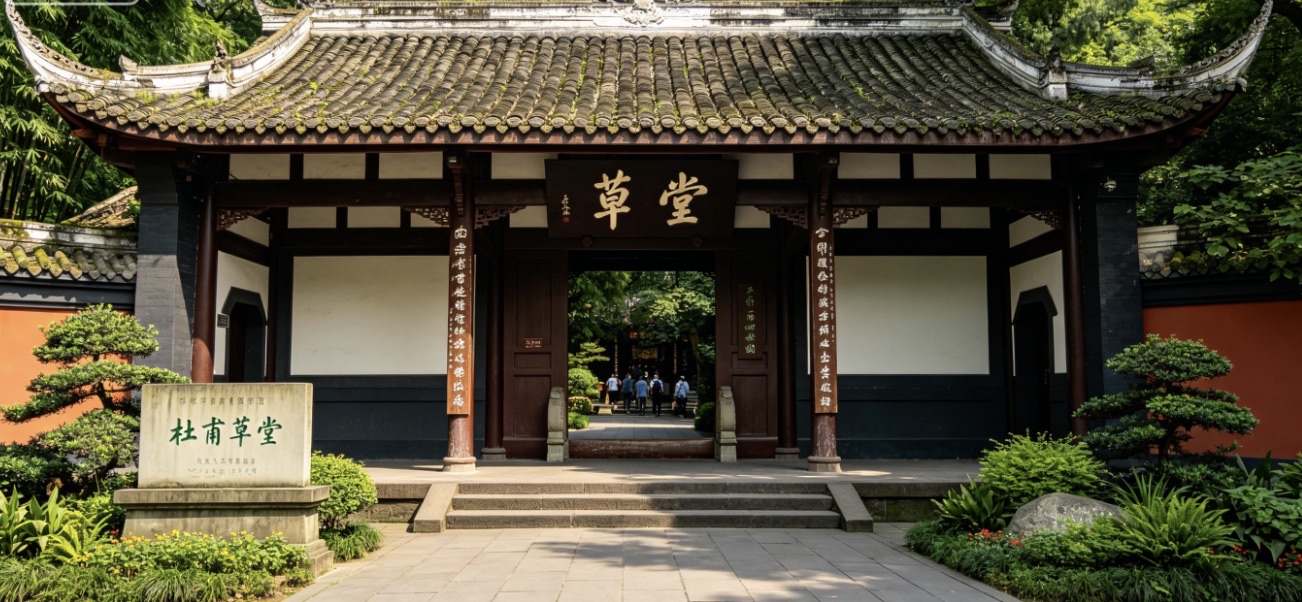
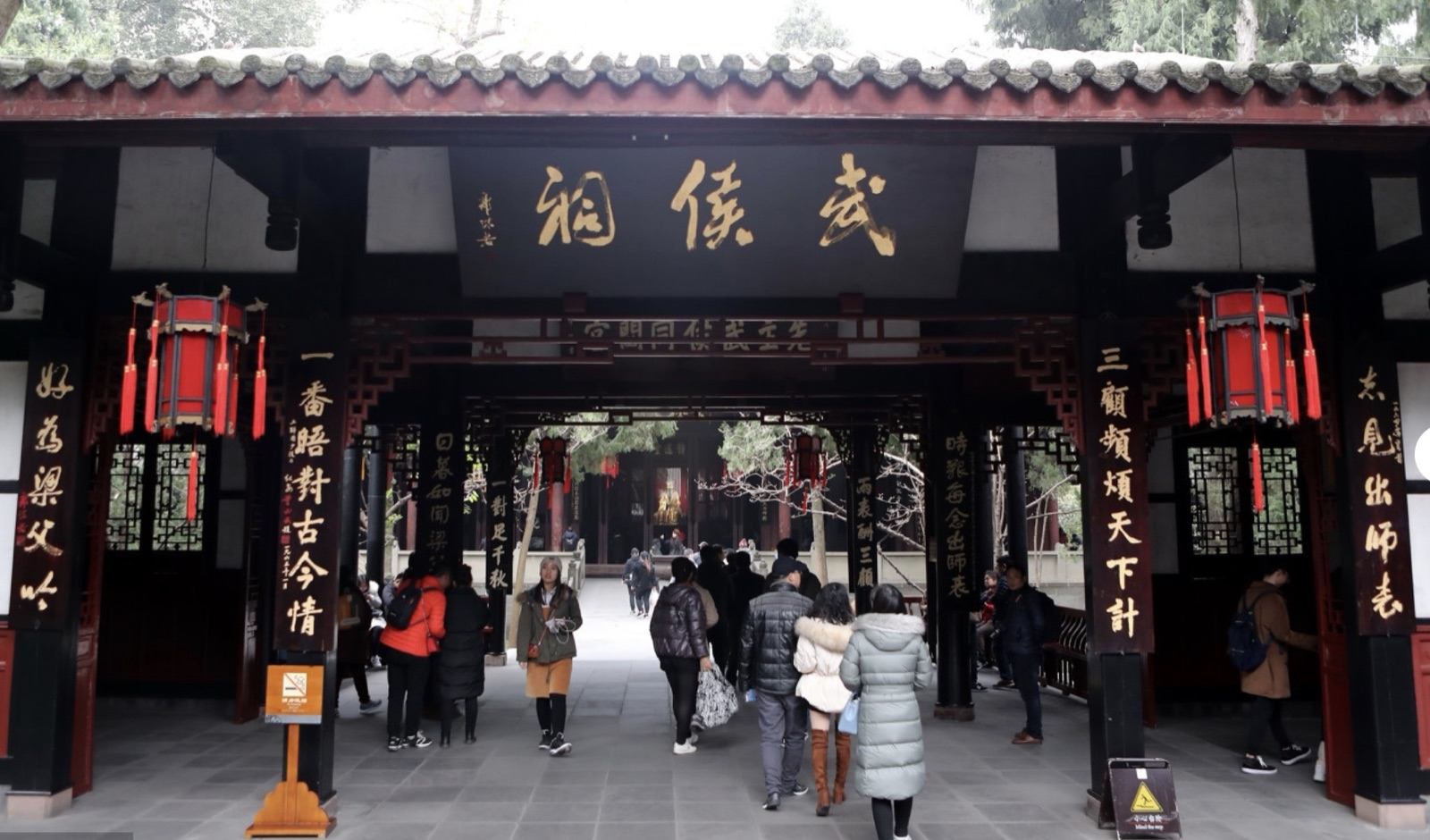
Passing through the spirit wall, you reach the main gate — the first structure in the memorial shrine complex and the starting point of the scenic route. The plaque above the entrance bearing the characters "草堂" was likewise inscribed by Prince Guo Aisingioro Yunli, echoing the writing on the spirit wall. The couplet on either side of the gate — "A home west of the Wanli Bridge, a retreat north of Baihua Pool" — again quotes Du Fu's Longing for My Jinshui Dwelling 《怀锦水居止二首》, grounding visitors in both the geography and the cultural spirit of the place.

The Grand Hall (Damiao 大庙)

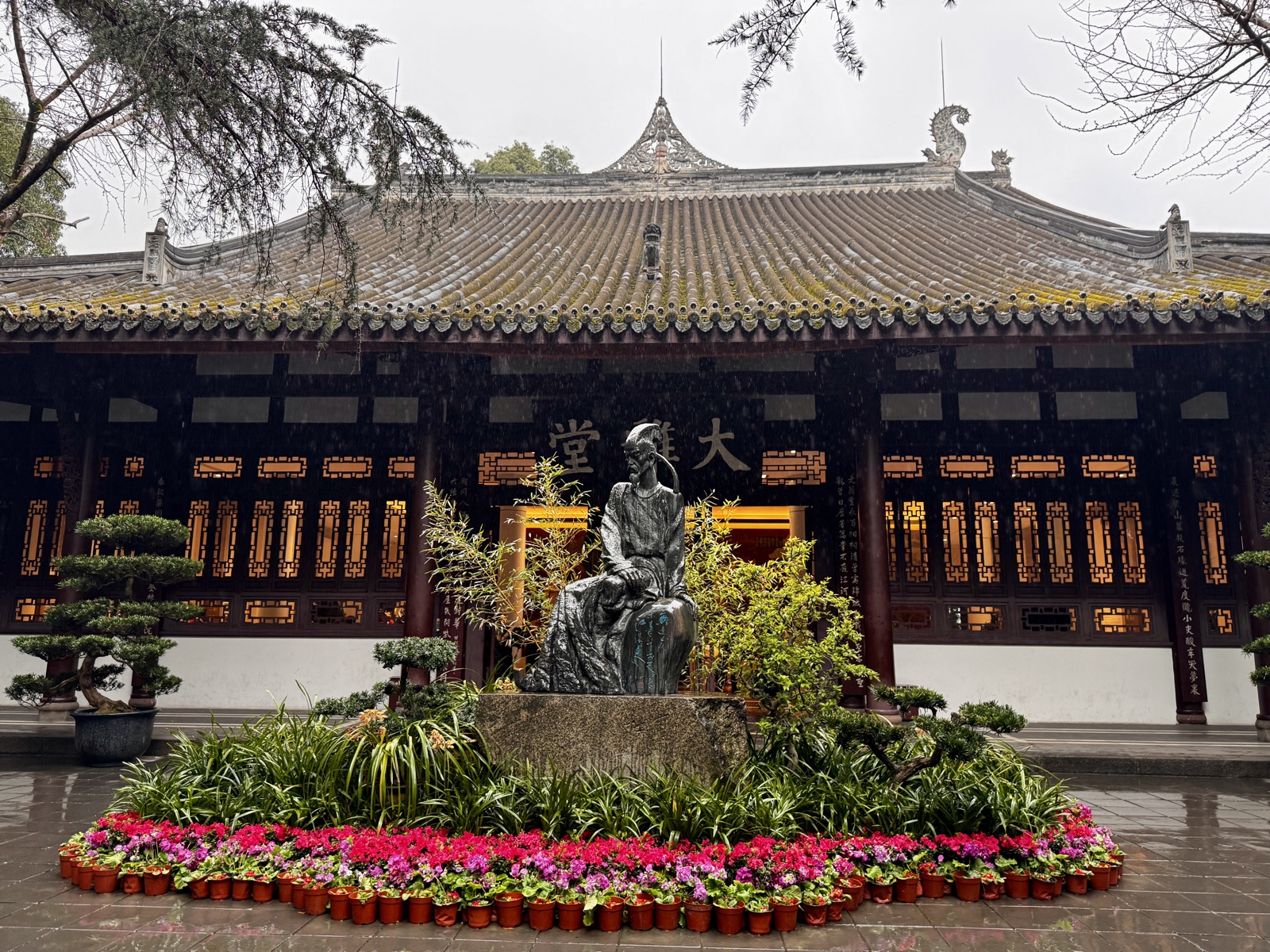
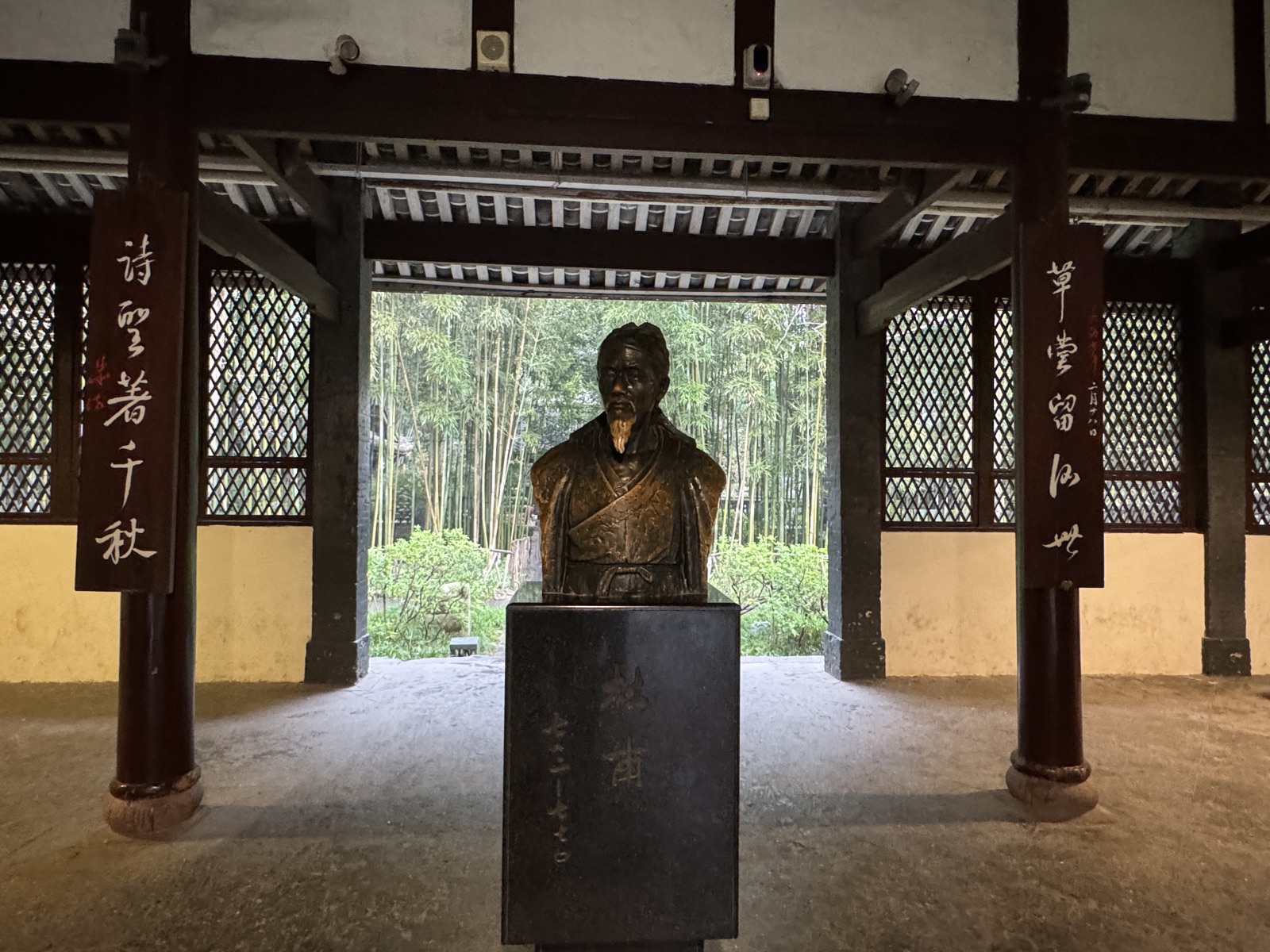
The Grand Hall 大庙 is the second structure along the central axis of Du Fu Thatched Cottage. Despite the word "miao" (temple) in its name, this open-hall building is not a religious site but a space dedicated to commemorating Du Fu. The name reflects the honorary official title Du Fu held in Chengdu — Supernumerary Vice Director of the Ministry of Works 检校工部员外郎 — and speaks to the deep reverence later generations held for the great poet. Inside the hall stands a bronze statue of Du Fu, accompanied by exhibits on his life and poetic output. The unpretentious architectural style mirrors the plain, unadorned spirit that runs through his verse.

The bronze statue of Du Fu inside the Grand Hall was created by the renowned sculptor Qian Shaowu 钱绍武. It portrays the poet in his later years — gaunt in frame yet sharp in spirit. This is an ideal place to build a full picture of Du Fu's life and creative work in Chengdu before exploring the rest of the site.

Hall of Poetic History (Shishi Tang 诗史堂)

The Hall of Poetic History 诗史堂 is the central building of the memorial shrine complex and one of the most important stops on the visit. Its name reflects a celebrated description of Du Fu's poetry: his verses are called a "poetic history" because they vividly documented the social upheaval surrounding the An Lushan Rebellion and bear witness to the Tang dynasty's decline. Inside the hall stands a full-length statue of Du Fu created by the eminent sculptor Liu Kaiqu 刘开渠, capturing the poet in a moment of deep contemplation. The hall also displays couplets and plaques inscribed by notable figures including Zhu De, Chen Yi, and Guo Moruo. The most celebrated of these is Guo Moruo's couplet: "The world's open wounds fill his verse with the vision of a sage; the suffering of the people surges through the waves of his brush" — a distillation of the unflinching realism at the heart of Du Fu's work.

The Brushwood Gate (Chaimen 柴门)

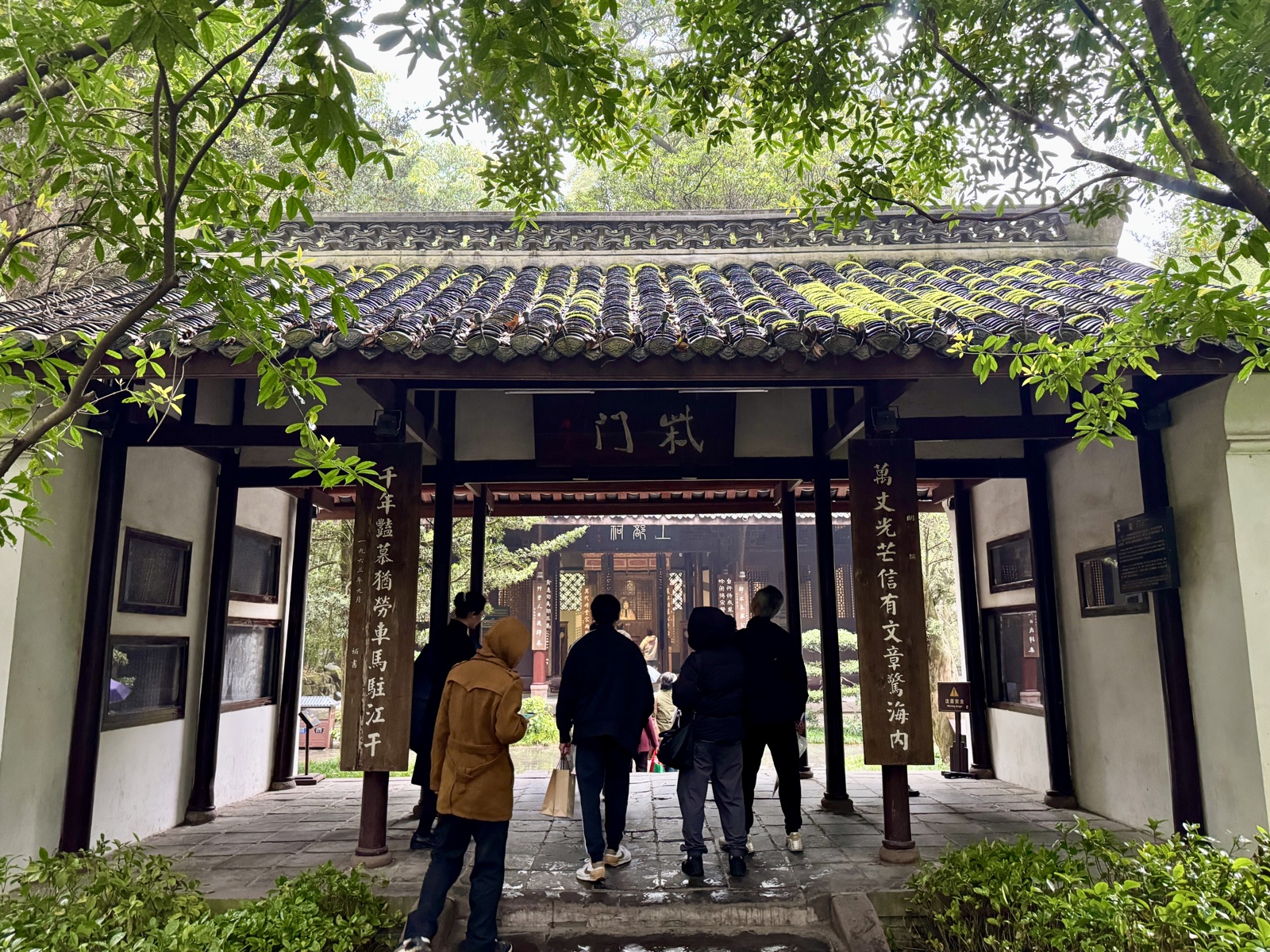
The Brushwood Gate 柴门 is the fourth structure along the central axis and the most understated of the five principal buildings. The name comes from a line in Du Fu's own poetry: "The old man of the wilds turns along the river's edge; the brushwood gate, askew, opens toward the stream." It referred to a rough-hewn gate made from branches and brambles — a reflection of the poet's humble circumstances. The gate today is no longer made of brushwood, yet its simple architectural style preserves that spirit of plainness. The plaque above the entrance was inscribed by Pan Tianshou 潘天寿, one of the great masters of modern Chinese ink painting. Seven stone steles embedded in the walls on either side bear poems composed by Qing dynasty scholars and local officials who came to pay their respects at the cottage, testifying to the enduring reverence in which Du Fu has been held.

Though modest in scale, the Brushwood Gate is a key link between the central shrine complex and the thatched dwelling beyond. Here visitors can appreciate Pan Tianshou's calligraphy and the Qing dynasty poetry steles in the walls — a place where history makes itself quietly felt.

The Ministry of Works Shrine (Gongbu Ci 工部祠)

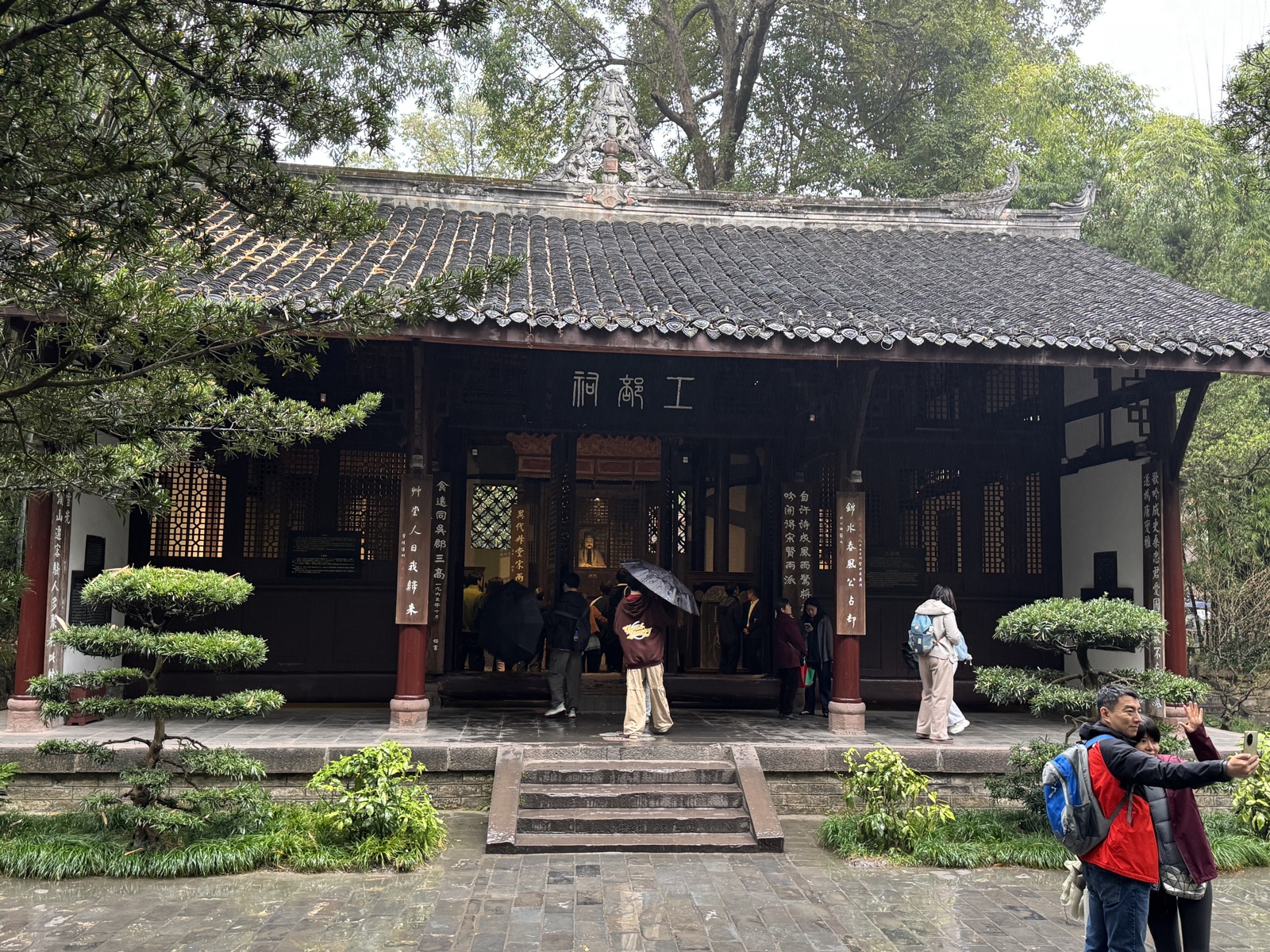
The Ministry of Works Shrine 工部祠 is the final structure on the central axis and one of the most significant in the entire complex. Because Du Fu served as Supernumerary Vice Director of the Ministry of Works 检校工部员外郎 during his time in Chengdu, later generations honored him with the epithet "Du Gongbu" 杜工部, and the shrine built in his memory took the same name. The plaque above the entrance was inscribed by the celebrated modern writer Ye Shengtao 叶圣陶. Inside the shrine, flanking the central statue of Du Fu, stand figures of two other poets: Lu You 陆游 of the Southern Song dynasty and Huang Tingjian 黄庭坚 of the Northern Song dynasty — earning the hall the alternative name "Shrine of the Three Worthies" 三贤堂. The shrine also preserves stone-carved portraits of Du Fu from both the Ming and Qing dynasties; the half-length stone portrait dated to the thirtieth year of the Wanli reign (1602) is the oldest surviving stone carving at the cottage. Set into the walls are stone steles engraved during the Qianlong and Jiaqing eras of the Qing dynasty, including a map of the Shaoling Thatched Cottage 少陵草堂图, which has served as a crucial reference for later efforts to restore the site.

The Ministry of Works Shrine is the essential place to understand Du Fu's life and literary legacy. The three statues represent poets of different eras and speak to the far-reaching influence of Du Fu's work. The Qing dynasty stone-carved map of the cottage is a precious historical document for tracing the site's transformation over the centuries.

The Shaoling Stele Pavilion (Shaoling Beiting 少陵碑亭)

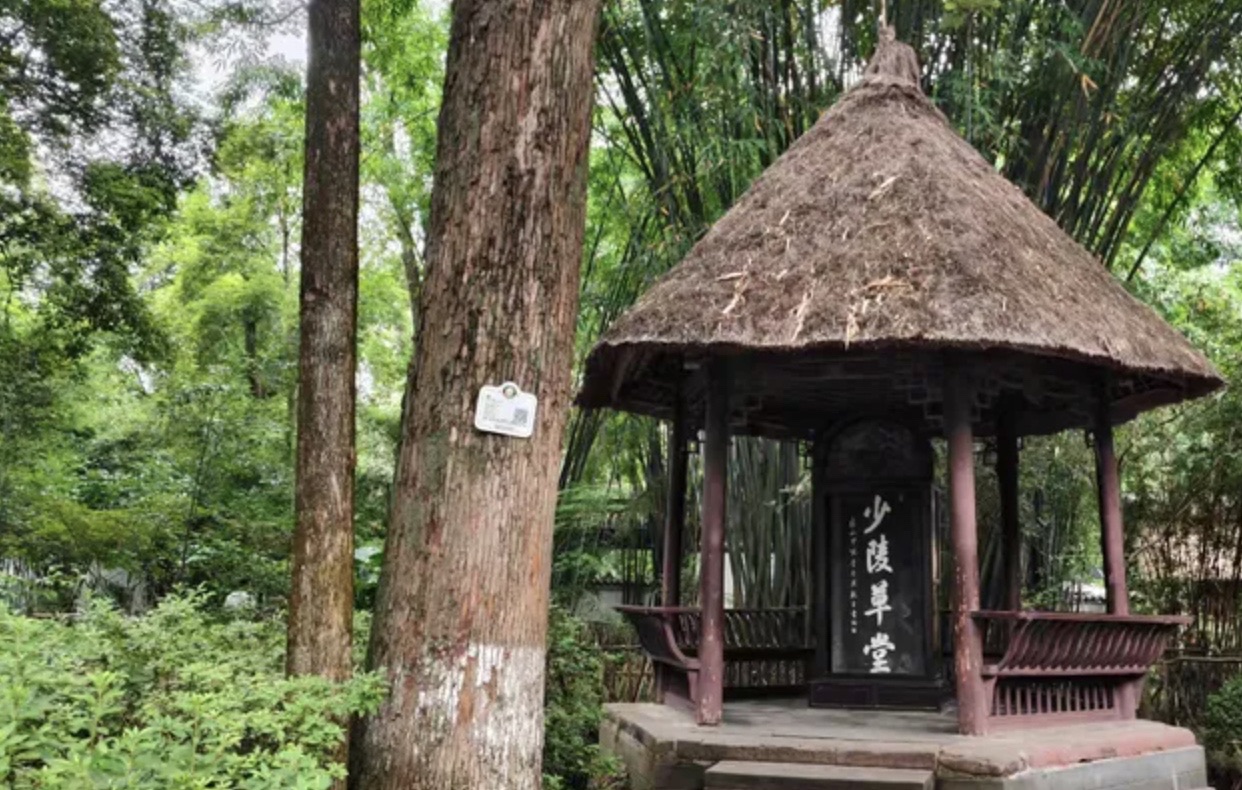
The Shaoling Stele Pavilion 少陵碑亭 stands to the east of the Ministry of Works Shrine and is one of the most iconic structures at Du Fu Thatched Cottage. At its centre is a stone stele inscribed with the four characters "少陵草堂" (Shaoling Thatched Cottage). "Shaoling" 少陵 was a sobriquet Du Fu adopted for himself: the name derives from the Han dynasty Emperor Xuan's mausoleum, known as Duling 杜陵, while the empress's smaller adjacent tomb was called Shaoling (the "lesser mausoleum"). Du Fu referred to himself in his poetry as the "wild old man of Duling" and the "rustic guest of Shaoling," and so later generations came to call him "Du Shaoling" 杜少陵, with his cottage following suit. The characters on the stele were written by Aisingioro Yunli 爱新觉罗·允礼, the brother of the Yongzheng Emperor. The pavilion's spare, unadorned style is very much in keeping with the simplicity of Du Fu's verse.

The Shaoling Stele Pavilion is one of the defining symbols of Du Fu Thatched Cottage, and a favourite spot for photographs. The stele offers an easy entry point into Du Fu's pen names and the cottage's history. The calm, elegant surroundings bring visitors as close as possible to the atmosphere the poet himself would have known.

The Thatched Dwelling (Maowu Guju 茅屋故居)

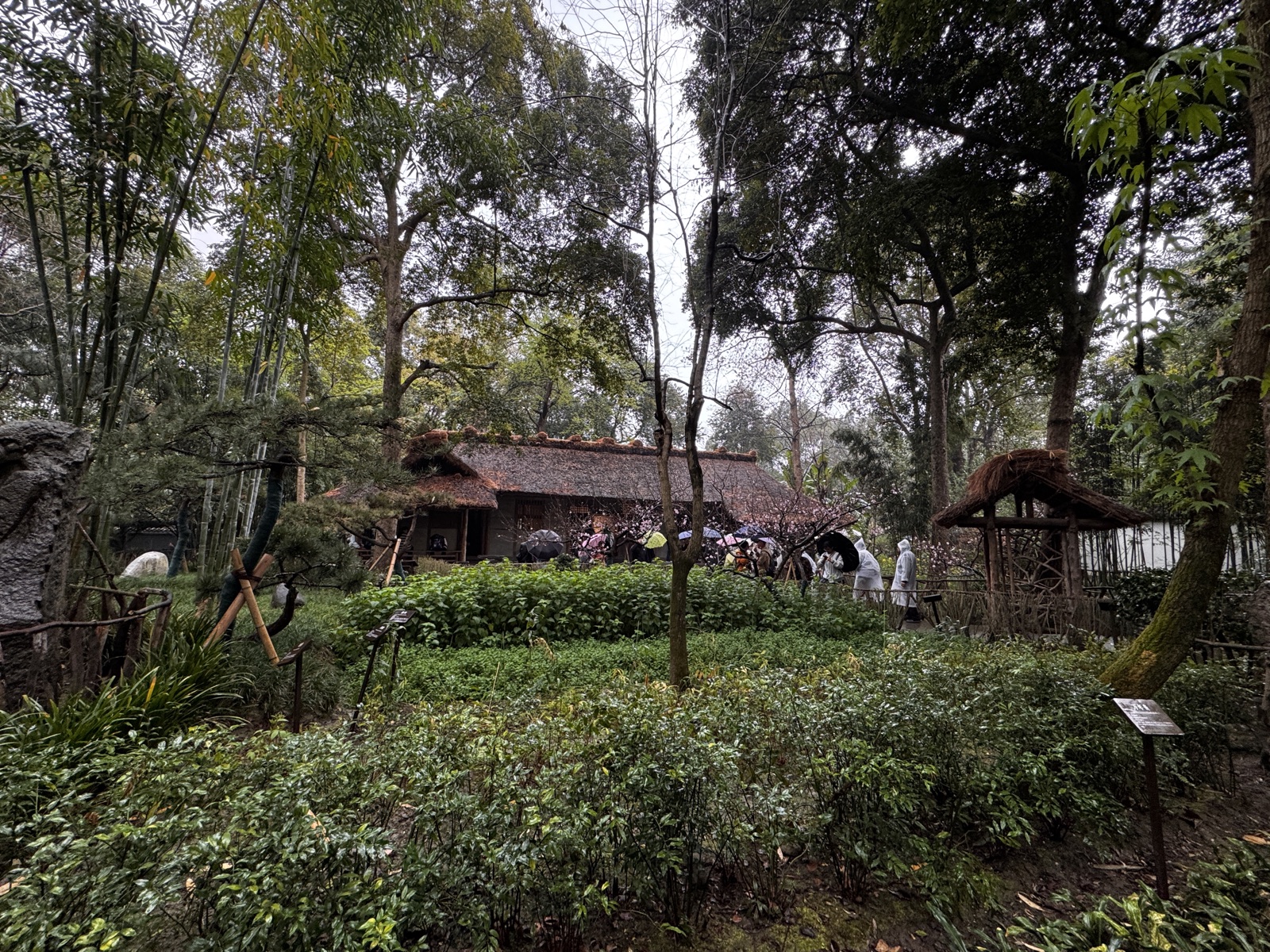
The Thatched Dwelling 茅屋故居 is the heart of Du Fu Thatched Cottage — and the emotional high point of the visit. The building was reconstructed in 1997 based on descriptions in Du Fu's poetry and the "front shrine, rear dwelling" layout recorded from the Ming dynasty. True to the building traditions of western Sichuan, it uses a mortise-and-tenon timber frame, mud-plastered walls, and a thatched roof, recreating the living environment Du Fu would have known in Chengdu. A small bamboo grove grows in front of the dwelling, and stone tables and stools are set beside it, evoking the poet's modest daily life. Inside, the rooms are arranged as Du Fu's study, bedroom, and kitchen, allowing visitors to experience the space as he might have inhabited it.

The Thatched Dwelling is the place to feel, in the most immediate way, the world in which Du Fu lived and created. It gives life to the great aspiration running through his poetry: "Would that I had a mansion of ten thousand rooms to shelter every poor scholar under heaven with a joyful face."

Tang Dynasty Archaeological Site (Tangdai Yizhi 唐代遗址)

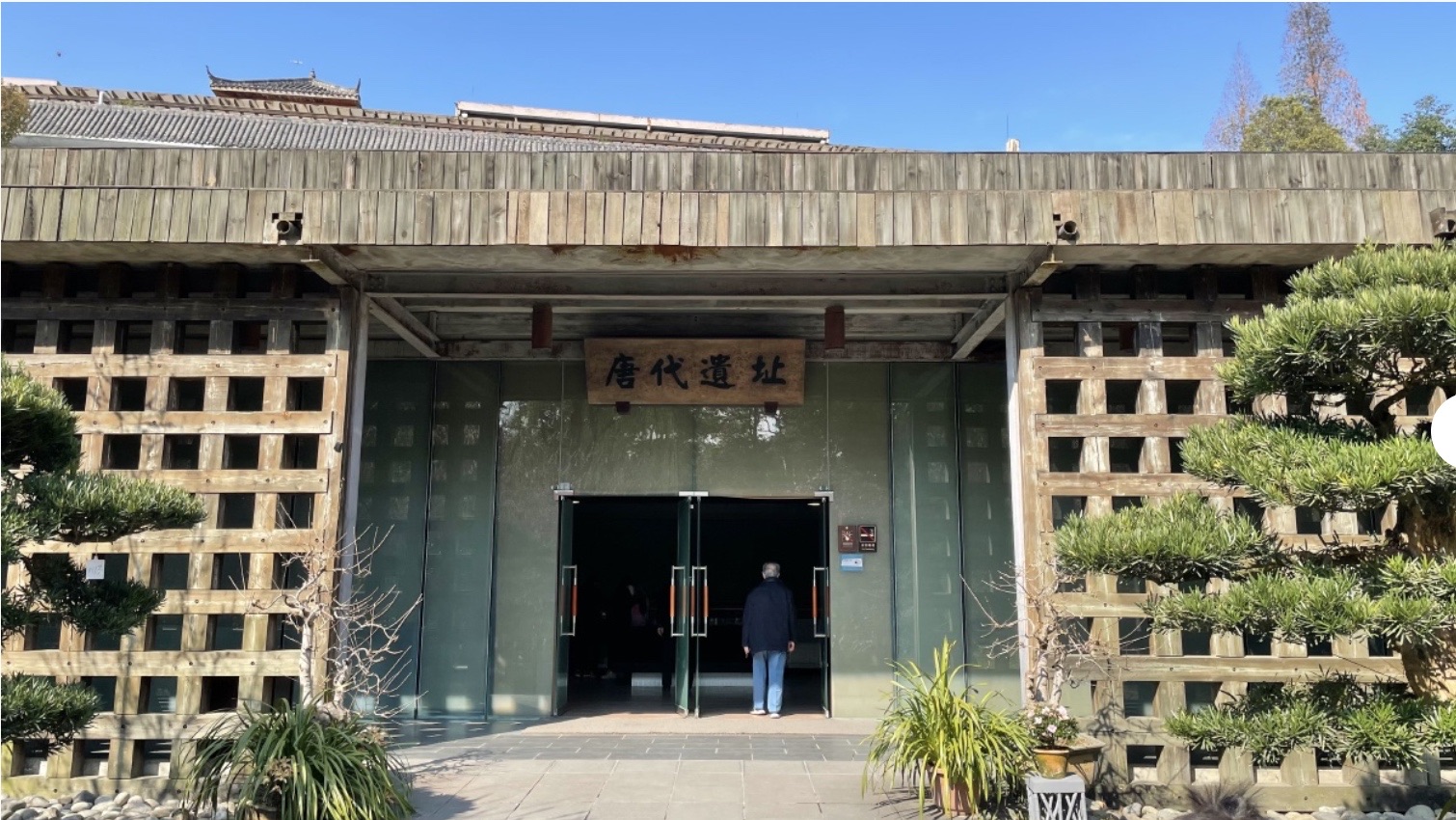
The Tang Dynasty Archaeological Site 唐代遗址 was excavated within the cottage grounds at the end of 2001 and covers an area of 1,020 square metres. The discovery was of major significance: it ended years of uncertainty about whether any Tang dynasty remains existed on the site, provided concrete physical evidence for reconstructing the cottage's original appearance, and confirmed that the current site has been rebuilt on the same location in an unbroken chain of succession — settling longstanding debates about whether the modern cottage stood in the right place. The exhibition hall preserves 420 square metres of the excavation in its original state, including three wells, the foundations of eight structures, one hearth pit, five storage pits, nine ash pits, and four drainage ditches. A substantial quantity of Tang dynasty artefacts and fragments was also unearthed, among them bowls, jars, four-eared wide-mouthed bottles, half of a ceramic beast-head inkstone with four feet, and several Tang dynasty patterned bricks — vivid material evidence of everyday life in Du Fu's era.

*The Tang Dynasty Archaeological Site is the place to appreciate the historical authenticity of Du Fu Thatched Cottage. Visitors can see actual Tang dynasty remains — wells, building foundations, and more. The artefact displays help bring the domestic scenes described in Du Fu's poems into sharp focus. Key passages from his poetry are displayed alongside the physical objects, making the connection between verse and life all the more vivid.

The Thousand-Poem Stele Gallery (Qianshi Bei 千诗碑)

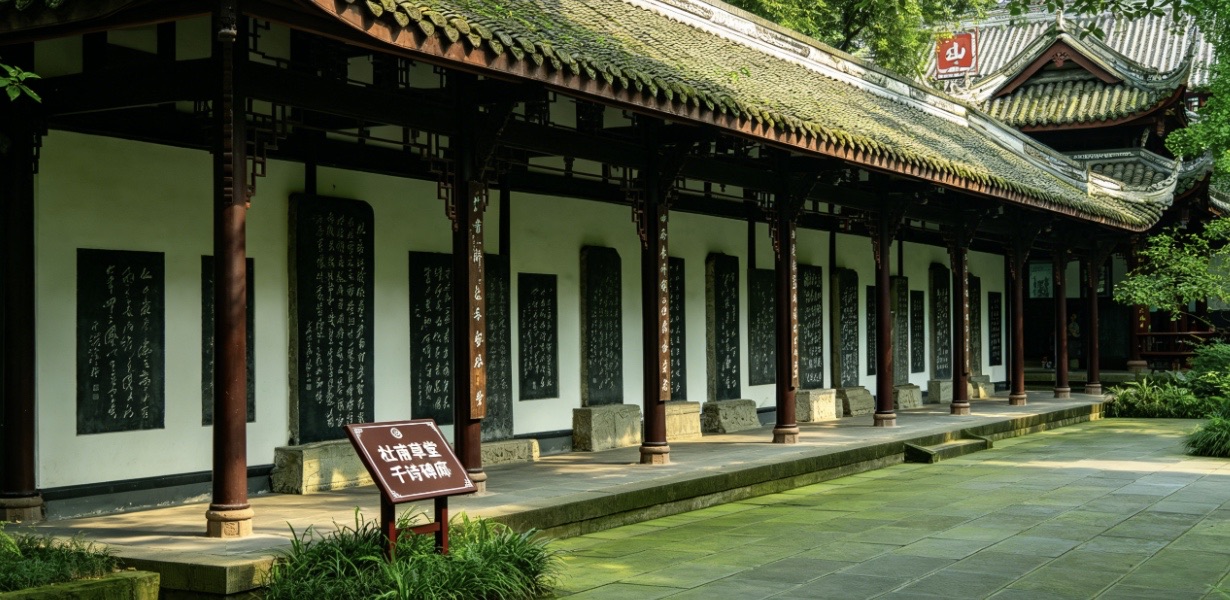
The Thousand-Poem Stele Gallery 千诗碑 was completed in December 2018 and presents the complete surviving corpus of Du Fu's poetry — all 1,455 poems. The project has its roots in the ninth year of the Shaoxing reign of the Southern Song dynasty (1139), when Zhang Tao, the prefect of Chengdu, had Du Fu's poems carved onto stone steles. Those steles were later lost to the ravages of history. In 2015, Chengdu launched a restoration project; three years later, it was complete. Within the Du Fu Thatched Cottage Museum, the gallery takes the form of a 310-metre stone calligraphy corridor displaying Du Fu's poems as rendered by celebrated calligraphers across the centuries. Set within the Spring Night's Delightful Rain Garden 春夜喜雨园, the corridor harmonises beautifully with the natural landscape of the cottage, creating a cultural experience that unites six art forms in one: poetry, calligraphy, stone carving, classical garden design, traditional architecture, and sculpture. The stone used for the steles is "Tianhui Green" 天灰青 bluestone from Jiaxiang, Shandong; the carvers were selected through a nationwide skills competition, ensuring the highest standard of craft.

The Thousand-Poem Stele Gallery is one of the finest places in the world to experience Du Fu's poetry alongside the art of Chinese calligraphy. Here, visitors can see how calligraphers of different eras and styles have interpreted the same poems, feeling the perfect marriage of brushwork and poetic imagination.

The Bonsai Garden (Penjing Yuan 盆景园)

The Bonsai Garden 盆景园 occupies a plot of several dozen mu in the northwest corner of Du Fu Thatched Cottage, blending classical Chinese garden art with the culture of Du Fu's poetry. The garden is planted with a wide variety of fine bonsai specimens, showcasing the essence of China's traditional garden aesthetic. In 1999, the "Du Fu Poetry Calligraphy Wood-Carving Gallery" 杜诗书法木刻廊 was built within the garden, displaying more than a hundred carved works. These pieces were selected from thousands of original handwritten manuscripts of Du Fu's poems by famous historical figures held in the museum's collection, then carved into nanmu 楠木 (phoebe zhennan) wood. Spanning different periods and calligraphic styles — including pieces attributed to Su Shi 苏轼 and Huang Tingjian 黄庭坚 — the collection has been praised for its "four excellences": the finest Du Fu poetry, the finest calligraphy, the finest nanmu timber, and the finest carving skill. The garden also features small bridges over meandering streams, pavilions, and terraces, all of which complement the bonsai and calligraphy works to create an atmosphere saturated with poetic feeling.

The Flower Path (Huajing 花径)

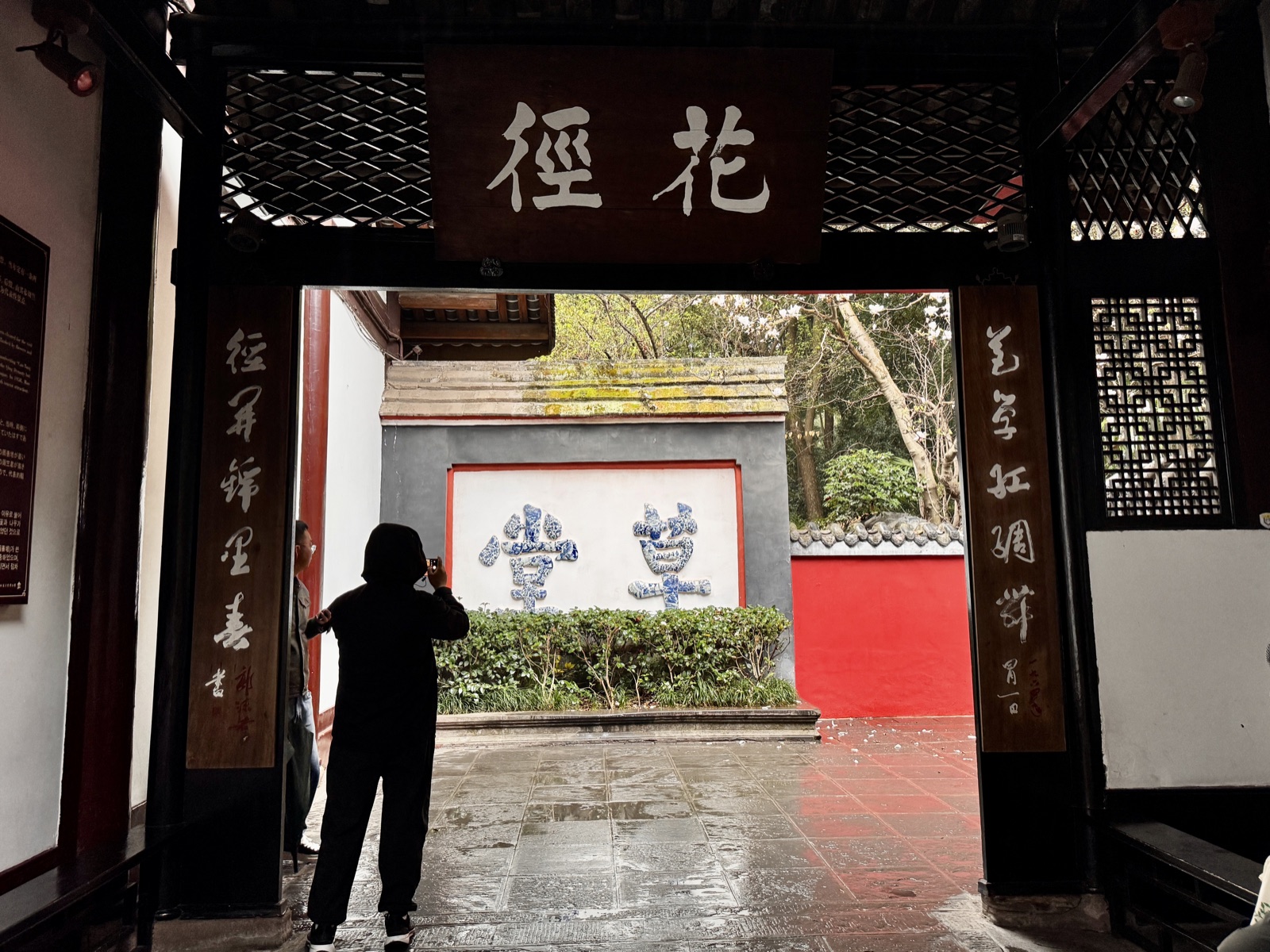
The Flower Path 花径 is a winding red-walled lane about a hundred metres long that connects the memorial shrine complex with the original Thatched Cottage Temple 草堂寺. Red walls rise on either side, green bamboo filters the light overhead, and the overall effect is both beautiful and deeply evocative of classical poetry. The name comes from a line by Du Fu himself: "The flower path has never been swept for a guest; today, for you, the brushwood gate is opened for the first time." A plaque inscribed "花径" at the eastern entrance of the path was written by the modern calligrapher Xiao Longyou 萧龙友. On the gate pillars hangs a couplet composed and written by Guo Moruo 郭沫若: "Flowers learn the dance of red silk scarves; the path opens spring along Brocade Mile" — a couplet that cleverly embeds the characters "花" and "径" at the head of each line, displaying the writer's literary flair.

The Flower Path is one of the most poetic walkways in Du Fu Thatched Cottage — it has appeared in many films and promotional videos about Chengdu. The red walls and bamboo on either side make an ideal backdrop for photographs. The path ends at the Cottage Spirit Wall 草堂影壁, another of the site's defining landmarks.

The Cottage Spirit Wall (Caotang Yingbi 草堂影壁)

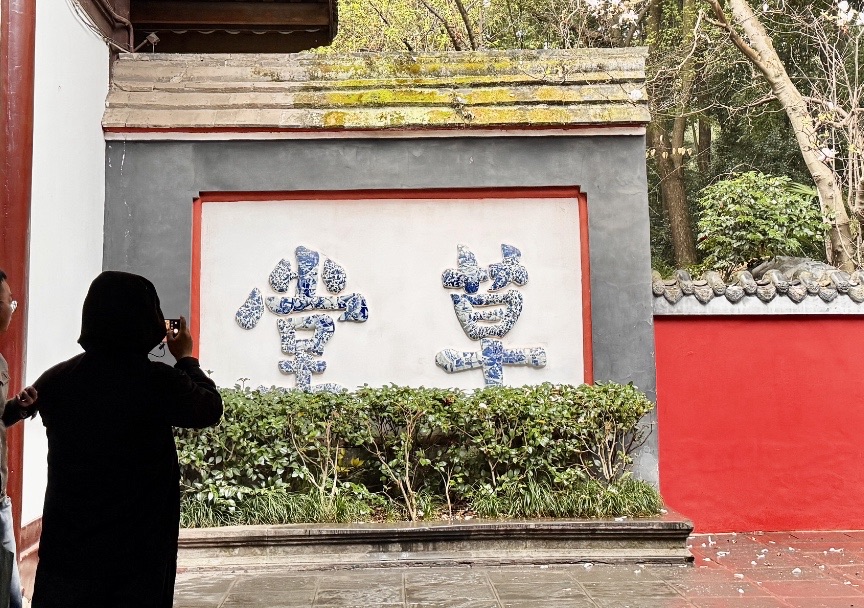
The Cottage Spirit Wall 草堂影壁 stands at the far end of the Flower Path and is one of the most recognisable features of Du Fu Thatched Cottage. The two characters "草堂" on the wall are formed from fragments of blue-and-white porcelain. The original inscription was composed in the thirty-fourth year of the Guangxu reign (1908) by Zhou Shenpei 周善培, the Commissioner of Industry for Sichuan, and inlaid in broken porcelain — but was later damaged. The "草堂" characters seen today were written by his younger brother, Zhou Zhujun 周竺君. This technique of setting broken porcelain into a wall is exceptionally rare, and stands as a testament to the ingenuity of traditional Chinese craftsmanship. In 1958, Chairman Mao Zedong visited Du Fu Thatched Cottage and stood before this wall for a long while, deep in contemplation; a photograph taken from behind him that day remains one of the most treasured historical images associated with the site.

The Cottage Spirit Wall is one of the defining sights of Du Fu Thatched Cottage and a popular spot for photographs. The porcelain-inlay technique is well worth a closer look.

The Grand Elegance Hall (Daya Tang 大雅堂)

The Grand Elegance Hall 大雅堂 is a cultural venue within the Du Fu Thatched Cottage Museum, originally the main hall of the Thatched Cottage Temple 草堂寺, and opened to the public in 2002. Its name is drawn from Huang Tingjian's 黄庭坚 essay Record of the Grand Elegance Hall 《大雅堂记》, while "da ya" 大雅 itself comes from the "Greater Odes" section of the Classic of Poetry 《诗经》, representing the most elevated register of poetic expression. The plaque above the entrance — "大雅堂" — is composed of characters taken from the calligraphy of Yan Zhenqing 颜真卿, the great Tang dynasty master, and has a bold, dignified presence. Inside the hall is the largest coloured-glaze mosaic lacquer mural in China at 64 square metres, depicting the events of Du Fu's life and the achievements of his poetry. The hall also houses twelve sculpted figures of celebrated poets from across Chinese history, including Qu Yuan, Tao Yuanming, Chen Zi'ang, Wang Wei, Li Bai, Bai Juyi, Li Shangyin, Su Shi, Huang Tingjian, Lu You, Li Qingzhao, and Xin Qiji. The sculptures were created by renowned artists including Ye Yushan 叶毓山 and Qian Shaowu 钱绍武, with eight figures by Ye Yushan, two by Qian Shaowu, and two by younger sculptors.

Huanhua Shrine (Huanhua Ci 浣花祠)

Also known as the Lady Jiguo Shrine 冀国夫人祠, Huanhua Shrine 浣花祠 sits in the middle section of the Flower Path's red walls. It is a compact, self-contained compound — a gatehouse, a main hall, and two side wings — with whitewashed walls, grey roof tiles, and flowers and trees scattered throughout, giving it a refined and antique charm. The shrine was built to honour Lady Ren 任氏, a remarkable woman of Tang dynasty Chengdu. Lady Ren was the concubine of Cui Ning 崔宁, the Military Governor of Xichuan 西川节度使. During the Dali era of Emperor Daizong (766–779 AD), when Cui Ning was summoned to the capital, Lady Ren took part of Du Fu's former property as her own residence. Later, when the rebel general Yang Zilin 杨子琳 attacked Chengdu, Lady Ren spent her personal fortune to recruit soldiers and personally led the force that repelled the assault, saving the city — for which she was granted the title Lady Jiguo 冀国夫人. After her death, the people of Chengdu built this shrine on the banks of the Huanhua Stream to honour her memory. The main hall inside contains a statue of Lady Ren flanked by two attendants. On either side hang couplets composed by two Qing dynasty scholars, Qian Baotang and Yu Yue, reading: "A red-skirted figure pursued on horseback, matchless in valour; still serene in jade ornaments and bright pendants" — a tribute to both her courage and her grace.

Huanhua Shrine is an important place to encounter the history and culture of Tang dynasty women. The statues and couplets inside tell the story of Lady Ren's heroism and dignified character. Visitors here discover a little-known piece of history and come away with a sense of the courage and wisdom of women in ancient China.

Caotang Academy (Caotang Shuyuan 草堂书院)

Caotang Academy 草堂书院 stands in the northwest corner of Du Fu Thatched Cottage and serves as the site's cultural and educational centre. The academy was first established during the Yuan dynasty and was once counted, alongside the Yang Xiong Inkstone Pool 杨雄墨池 and the Wen Weng Stone Chamber 文翁石室, as one of Chengdu's three great centres of learning. It was rebuilt and expanded several times during the Ming and Qing dynasties before falling into disrepair during years of conflict. In 2017, the Du Fu Thatched Cottage Museum launched a restoration project; the academy reopened in April 2021, covering an area of 3,586 square metres. The complex consists of two sets of triple-courtyard traditional Chinese architectural compounds and a single-building structure. The first compound contains a foyer introducing the culture of the academy, a classical studies lecture hall for educational activities, a scholar's study to honour literary predecessors, a library offering access to the academy's holdings, and a seminar room for academic gatherings. The second compound houses a large lecture theatre fitted with a full-width screen and a modern conference system. The single-building structure is the Yangzhi Hall 仰止堂 — the academy's children's wing — where programmes such as "A Lesson at the Cottage" and "Little Guides of the Cottage" are run for younger visitors.

The South Gate (Nan Damen 南大门)

The South Gate 南大门 marks the end of the scenic route and the exit point for most visitors. The plaque above the entrance again bears the characters "草堂," written by Qing dynasty Prince Guo Aisingioro Yunli. The couplet on either side of the gate mirrors that of the main entrance: "A home west of the Wanli Bridge, a retreat north of Baihua Pool," from Du Fu's Longing for My Jinshui Dwelling 《怀锦水居止二首》. From the South Gate, visitors can conveniently reach nearby public transport stops or car parks. The area around the South Gate is also home to Du Fu Thatched Cottage's gift shop, where a range of cultural products inspired by Du Fu's poetry makes for a fitting souvenir.

The South Gate is the natural conclusion to a visit to Du Fu Thatched Cottage.

The North Gate (Caotang Beimen 草堂北门)

The North Gate 草堂北门 is located in the northwest section of the site and serves as another main entrance and exit. It is conveniently close to Caotang North Road Station 草堂北路站 on Metro Line 4. The plaque above the entrance carries the characters "草堂," again written by Prince Guo Aisingioro Yunli. Inside the North Gate, a loop route allows visitors who enter here to tour the grounds and return to the same gate. The surroundings near the North Gate are tranquil and refined, with small bridges, running water, pavilions, and terraces — a showcase of the classical garden beauty of Du Fu Thatched Cottage.

If entering through the North Gate, following the loop route is recommended to take in more of the grounds, including the water pavilion, the plum garden, and the Yilan Pavilion 一览亭. The landscape near the North Gate is particularly scenic and well-suited for photography. Visitors arriving by car will find a car park nearby, though planning ahead for parking is advisable.

Wanfo Tower (Wanfo Lou 万佛楼)

Wanfo Tower 万佛楼 stands in the nanmu grove to the east of Du Fu Thatched Cottage and was rebuilt on its original foundations in 2005. The original structure was a four-storey wooden tower with a double-eaved pyramidal roof, octagonal in plan, with glazed tiles on the roof and clay Buddhist statues inside. The reconstruction restored a historic pairing in Chengdu's cityscape: "Chongli Tower 崇丽阁 to the east, Wanfo Tower to the west." Today it ranks among the landmark buildings at Du Fu Thatched Cottage. From the upper levels of the tower, visitors can look out over the lush expanse of the cottage grounds and the gentle scenery along the Huanhua Stream. The interior also holds an exhibition on Buddhist culture and the history of Chengdu.

Wanfo Tower offers the finest panoramic view of Du Fu Thatched Cottage. From here, visitors can take in the overall layout of the grounds and the beauty of the Huanhua Stream. The exhibition inside is well worth the time.

Huanhua Stream Park (Huanhua Xi Gongyuan 浣花溪公园)

Huanhua Stream Park 浣花溪公园 lies immediately to the south of Du Fu Thatched Cottage and can be entered directly from the South Gate. Covering roughly 200 mu (about 130 acres), it is a large urban park that blends classical garden design with contemporary landscape art. The park's highlights include Wanshu Hill 万树山, Canglang Lake 沧浪湖, and Egret Isle 白鹭洲, offering scenery that shifts beautifully across the seasons. Leisure amenities throughout the park — including teahouses and walking paths — invite visitors to relax and unwind while enjoying the natural surroundings.

Huanhua Stream Park is a natural extension of the Du Fu Thatched Cottage experience. Comfortable footwear is recommended for strolling the walking paths and taking in the views along the way. Visitors with an interest in the history and culture of the Huanhua Stream, and its connection to Du Fu's poetry, will find plenty to explore here.

Inside Du Fu Thatched Cottage

13 stops, in walking order — read top to bottom, no clicking needed.

1 Cao Tang Screen Wall (Thatched Cottage Screen Wall) of 13

Cao Tang Screen Wall (Thatched Cottage Screen Wall)

草堂影壁

The Cao Tang Screen Wall is located at the end of the Flower Path and is one of the most popular iconic landscapes in Du Fu Thatched Cottage. The screen wall, also called the Zhaobi, is an independent wall used to block sight and decorate the facade in traditional Chinese architecture. This screen wall is built of green bricks, with the two characters "Cao Tang" inlaid in the center, each character about 1.5 meters square. The most unique feature is that the two characters "Cao Tang" use the late Qing dynasty blue and white porcelain fragment inlay technique — craftsmen carefully cut and polished hundreds of late Qing dynasty blue and white porcelain fragments, then inlaid them according to the shape of calligraphy strokes, the blue and white porcelain fragments shine in the sun, which is both simple and elegant, and is an outstanding representative of late Qing folk craft. The screen wall has a red wall behind it, facing the Flower Path in front, with green bamboos and cherry blossoms in the background, forming the most poetic picture of the cottage. Every day, a large number of visitors queue up to take photos here, capturing the Chinese-style moment when the four elements of "red wall, green tiles, porcelain shadow and flower path" are integrated, which has become one of the most representative internet-famous check-in landmarks in Chengdu.

On-site narration · read it where you stand

At the end of the Flower Path, you come face to face with the Shadow Wall. A shadow wall — or spirit screen — is a freestanding short wall in traditional Chinese architecture, typically positioned just inside or outside a main gate to deflect direct sightlines and serve as decoration. But this particular wall is quite unusual: it is composed entirely of blue-and-white porcelain fragments set into the plaster.

Step closer and look. The two characters Cao Tang — "Thatched Cottage" — are not painted on the surface and not carved into stone. They were assembled, piece by tiny piece, from blue ceramic shards pressed into the wall — a white ground with blue glaze, the same palette as the most classic Chinese blue-and-white porcelain. In sunlight or lamplight the pieces catch the light at slightly different angles, giving the whole wall a quiet, living shimmer — as though the porcelain itself has come alive.

When was this wall made? In the late Qing dynasty. A craftsman from Jingdezhen — the porcelain capital of China — assembled these characters from discarded kiln fragments: pieces that had been misfired or cracked and could not be sold. He transported them from Jiangxi Province all the way to Chengdu and pressed them into place here at the end of the Flower Path. Why go to such lengths, bringing porcelain from so far away? Because blue-and-white porcelain is the most recognizable symbol of Chinese ceramic culture, and using the most precious, most distinctly Chinese material to display the name of the most plain and honest place in Chengdu — that contrast is itself a kind of poetry.

The wall and the path form a perfect pair. The experience of walking the Flower Path is one of gradual compression: tall red walls close in on both sides, the bamboo above presses the sky smaller, the world narrows — and then, suddenly, the wall opens the space before you, standing there in blue and white. This spatial rhythm is a deliberate technique of classical Chinese garden design: yu yang xian yi — first suppress, then release. Confine the visitor, hold them in, and then let go; the release, when it comes, hits twice as hard.

Photography note: Avoid shooting at midday under direct sunlight — the porcelain shards will overexpose and you'll lose all the texture. The best light is overcast, when the diffused glow brings out a particularly warm depth in the blue. Alternatively, try shooting at dusk — the wall faces the Flower Path, and a landscape lamp in front of it will illuminate it in warm yellow tones that play beautifully against the cool blue of the glaze. The cottage does not have regular evening hours, but if there is a night event, this scene is exceptional.

Just beyond the shadow wall is the final stop on our tour — the Hall of Great Elegance.

Firewood Gate

柴门

The Firewood Gate is located on the central axis after the Hall of Poetic History and before the Gongbu Shrine, serving as a landmark landscape. In ancient times, "Chai Men" referred to a simple door made of branches and thorns, often used to describe the residence of hermits or impoverished families. Du Fu wrote in his poem "Thatched Cottage" that "The four pines stand at the gate, ten thousand bamboos sparse by the steps", and in "Field House" he also wrote "The firewood gate opens toward the river unevenly", making the Firewood Gate a true reflection of the poet's former residence. The current Firewood Gate is a low wooden gate rebuilt according to Du Fu's poetic imagery and the style of western Sichuan folk houses, with bamboo fences and thatched cottages on both sides, and a plaque with the characters "Chai Men" on the lintel. The "low" design of the gate is intentional — visitors must lower their heads and bend over to enter, symbolizing the poet's noble character of not pursuing power or wealth and maintaining humility. Inside the gate, bamboo shadows dance and pines and cypresses are verdant, creating a reclusive atmosphere of "building a hut in the human world without the noise of carriages and horses".

On-site narration · read it where you stand

We've arrived at the Twig Gate. It's small and low — almost unremarkable beside the grand scale of the halls we've just come through. But within the layout of the cottage, the Twig Gate marks a crucial threshold: passing through it, we leave the "memorial zone" and enter the "residential zone" — the place where Du Fu actually lived.

Why "Twig Gate"? The name comes from Du Fu's own poetry. In his poem "A Guest Arrives", he wrote: "The flower path has never been swept for any guest; today, for you, my brushwood door opens for the first time." That penmen — a door woven from reeds or brushwood — is this gate. When Du Fu lived here, the door was probably not even wooden planks; more likely it was a simple frame of bamboo or branches. The version you see today is a later reconstruction, but it deliberately keeps that quality of plainness — nothing like the ornate buildings behind us, just a faithful echo of the "poor poet's" reality.

The characters Chai Men above the lintel are written in a sturdy, unaffected hand. Stand here for a moment and picture it: twelve hundred years ago, Du Fu passed through this gate every day — out to fetch water from the Huanhua Stream, back to sit under the eaves and watch the bamboo shoots pushing up through the soil. He wrote: "Countless spring shoots fill the grove; the twig gate, shut tight, blocks all human traffic." In spring the bamboo forest was so thick with new growth that closing the gate felt like sealing the world outside. Lines this tranquil, this domestic, are rare in Du Fu's poetry — which is why these years at the cottage may have been the closest thing to home he ever had.

Once you've stepped through and turned back to look, notice something in the sequence of spaces we've just walked: from the main gate to the Grand Hall to the Poetry History Hall to the Twig Gate, each structure has been a step lower in scale, a step quieter in tone. The main gate offered formal grandeur; the Grand Hall had the dignity of an official building; the Poetry History Hall felt like a commemorative temple. Then suddenly: this small, plain, low gate. The design is deliberate. It says: you are no longer visiting a monument to the poet. You are entering the poet's home. Du Fu was not a god. He was a person — a person who lived in a thatched hut and worried about food and firewood. Step through the Twig Gate, and you step into his life.

Ahead of us now is the building that honors Du Fu's spirit — the Ministry of Works Shrine.

Hall of Great Affairs (Da Xie)

大廨

Da Xie is located behind the Main Gate and in front of the Hall of Poetic History, serving as the first main hall on the central axis. "Xie" refers to an official residence. Du Fu once served as Left Reminder and Vice Minister of Works, hence the name "Da Xie" to highlight his official status. Da Xie was originally the Mahavira Hall of Caotang Temple and was rebuilt as a reception hall and Du Fu life exhibition hall after 1949. In the center of the hall stands a standing bronze statue of Du Fu, depicted in official robes with profound gaze; the side walls display biographical panels of Du Fu, detailing his life from "Study and Travel" to "Struggles in Chang'an" and finally to "Wandering in Southwest China". The door pillars of Da Xie feature a couplet written by Qing dynasty scholar Wanyan Chongshi: "Jin River Spring Wind you claim, Thatched Cottage Renri I return", cleverly incorporating the Chengdu custom of "Visiting Thatched Cottage on Renri" (the seventh day of the first lunar month).

On-site narration · read it where you stand

We've now arrived at the first major structure along the cottage's central axis — the Grand Hall. What is a xie? It's the term for an official's place of work in ancient China. Du Fu's highest office was "Acting Assistant Minister of the Ministry of Works", and so later generations built this Grand Hall to honor the fact that he had once held official rank — an expression of their deep reverence for the poet.

Take a look at the center of the hall — that is the bronze statue of Du Fu. It was created in the 1960s by Liu Kaiqu, one of China's most celebrated sculptors. Look closely: Du Fu is seated on a rock, his body tilted slightly forward, one hand resting limply on his knee, the other bracing against the stone. His head is bowed, his brow furrowed — the posture of a man who has just arrived after a long and exhausting journey. The bronze at his knees has been worn to a bright shine by countless visitors, because folk tradition holds that rubbing the Sage's knees will bring a flow of literary inspiration. A charming notion — and plenty of students and parents make sure to give it a try.

What sets this statue apart from other poet monuments is precisely this: it does not portray Du Fu as tall, commanding, or triumphant. It captures him at his most real, his most vulnerable. Because what is most moving about Du Fu is not how much he achieved, but that in the depths of poverty and hardship he never stopped caring about his country and its people. A man who couldn't feed himself, yet spent every day thinking about "the cold and hungry scholars of the world" — that quality of character carries more force than any grand heroic narrative.

The walls on either side of the hall are hung with plaques and couplets inscribed by famous figures across the centuries. The most celebrated of these is a couplet by the Qing scholar Gu Fuchu: "Across the ages we were not contemporaries — yet ask of these rivers and mountains: how many poets could truly match them? You too were a wanderer here, sir — yet you left behind a thatched cottage that endures with heaven and earth, for all who come in moonlit, wind-swept nights to remember you." In just two lines, it captures the great paradox of Du Fu's life: he was a drifter with no permanent home, yet what he left behind is as permanent as the sky above us.

The hall itself is also worth admiring. Look up at the wooden beams and eaves. Every major structure at the cottage uses the traditional Sichuan chuandou timber-frame construction — joints fitted together with mortise and tenon, not a single nail. This technique has been practiced in Sichuan for thousands of years and performs remarkably well in earthquakes. Ancient timber buildings of this style are found throughout western Sichuan, but the cottage's examples are exceptionally well preserved — an architectural heritage in their own right.

That's our look at the Grand Hall. Continue along the central axis and we'll reach the most important building in the entire complex — the Poetry History Hall.

Hall of Great Elegance (Da Ya Tang)

大雅堂

The Hall of Great Elegance is located on the east side of the central axis of Du Fu Thatched Cottage, the largest and most artistically valuable exhibition hall in the cottage. The word "Da Ya" comes from "Da Ya" of the "Book of Songs", representing the "righteous and elegant music" of the Western Zhou royal domain, symbolizing the orthodox poetics and cultural peak. The plaque "Da Ya Tang" in front of the hall is composed of characters from the famous Tang dynasty calligrapher Yan Zhenqing, full of momentum. The Hall of Great Elegance was originally the Mahavira Hall of Caotang Temple, and was officially converted into an art exhibition hall and opened to the public in 2002. The most famous art treasure in the hall is the large-scale colored glaze inlaid lacquer mural "Poets Walking and Chanting", the largest of its kind in China to date, with Du Fu's life journey as the clue, bringing Li Bai, Wang Wei, Meng Haoran, Gao Shi, Cen Shen and other Tang dynasty poets together in one painting, with a grand picture and brilliant colors. The hall also displays 12 sculptures of famous poets of all dynasties, including Qu Yuan, Tao Yuanming, Xie Lingyun, Li Bai, Du Fu, Bai Juyi, Su Shi, Lu You, Li Qingzhao, Xin Qiji and other peak poets in the history of Chinese literature, allowing visitors to feel the long history of Chinese poetics in every step.

On-site narration · read it where you stand

We've arrived at the final chapter of the cottage — the Hall of Great Elegance. This magnificent hall was originally the main Buddhist worship hall of the Caotang Temple. In 2002 it was renovated by the museum and opened to the public, becoming the culminating experience of the entire visit. The plaque above the entrance reads Da Ya Tang in characters assembled from the calligraphy of Yan Zhenqing, the great Tang dynasty master — his script broad, powerful, and upright. Du Fu's poetry is described as chen yu dun cuo: deep, somber, and rhythmically forceful. The two men's temperaments are a natural match.

Why "Hall of Great Elegance"? The term Da Ya — "Great Elegance" or "Great Odes" — comes from the Book of Songs, China's oldest collection of poetry, in which the Da Ya and Xiao Ya ("Minor Odes") were distinct sections reserved for court verse on matters of national importance. Huang Tingjian — Du Fu's most devoted Northern Song disciple, whom we encountered at the Ministry of Works Shrine — once argued that Du Fu's poetry is spiritually continuous with the Da Ya of the Book of Songs. Naming this final hall after that tradition is a statement: Du Fu is not simply a "poet" in the ordinary sense. He is a cultural foundation of a civilization, standing beside the Book of Songs at the very source of the Chinese literary tradition.

Inside the hall, two works of monumental art command the space. The first is a large lacquer mural with inlaid colored glaze covering the entire back wall — at roughly 18 meters wide, it is the largest indoor lacquer painting in China. It was created using techniques of large lacquer, gold and silver foil, shell, and colored stone mosaic. The narrative moves from left to right across Du Fu's life: on the right, the young poet's years of bold adventure — climbing Mount Tai, touring the Wu and Yue regions, his famous first meeting with Li Bai; on the left, the years of flight following the An-Shi Rebellion — family in tow, sick and impoverished, dying alone on a small boat on the Xiang River. At the center of the composition: Du Fu writing at the cottage, a white-robed old man seated in a bamboo chair before the thatched hut, brush in hand, a wall of green bamboo rising behind him. Walk the length of this painting from one end to the other and you have walked through the whole of Du Fu's life.

The second work is a set of twelve sculptures depicting major poets of Chinese literary history, displayed on a platform at the center of the hall. The gathering includes Qu Yuan, Tao Yuanming, Chen Zi'ang, Wang Wei, Li Bai, Bai Juyi, Li Shangyin, Su Shi, Huang Tingjian, Lu You, Xin Qiji — and at the center, Du Fu. Together these twelve trace the essential lineage of classical Chinese poetry. Qu Yuan stands for poetry's origins and its devotion to country; Tao Yuanming for the pastoral spirit; Li Bai for the soaring brilliance of pure genius; Du Fu for the weight of reality and a humane conscience. No one stands higher than any other. Together they form the great tradition.

Look at the platform in front of Du Fu's stone figure — whenever you visit, you will find fresh flowers there. Some placed by the cottage staff, more placed by visitors of their own accord. Du Fu wrote in life: "Leftover cups and cold dishes — everywhere, hidden grief and bitterness." He was never well treated by his own time. Yet in every generation since, flowers have not stopped coming. A man his era never looked after has been deeply loved by every era that followed. That is Du Fu.

Gongbu Shrine (Ministry of Works Shrine)

工部祠

The Gongbu Shrine is located behind the Firewood Gate and east of the Shaoling Thatched Cottage Stele Pavilion, the most solemn sacrificial building at the deepest part of the central axis. Du Fu once served as Vice Minister of Works (Jianxiao Gongbu Yuanwailang), commonly known as "Du Gongbu", hence the name "Gongbu Shrine". The shrine is a traditional ceremonial hall with green tiles and white walls, housing statues of Du Fu, Huang Tingjian and Lu You, commonly known as the "Hall of Three Sages". Huang Tingjian was the founder of the "Jiangxi Poetry School" of the Northern Song Dynasty, and Lu You was a patriotic poet of the Southern Song Dynasty, both of whom admired Du Fu's poetic art. The Gongbu Shrine enshrines them on both sides of Du Fu, showing the poetic lineage of the three. The shrine is full of plaques and couplets, among which the couplet by Qing dynasty scholar Qian Baotang "Building a hut by the desolate river, you live forever; Different eras ascending the hall, these two sages" is a famous masterpiece. In front of the shrine there are incense burners and incense tables, with constant incense throughout the year, making it the core place for visitors to mourn the poet saint and express their respect.

On-site narration · read it where you stand

We've reached the fifth major structure on the central axis — the Ministry of Works Shrine. This is the most solemn and significant building in the entire complex. Why is it called the Ministry of Works Shrine? When Du Fu was in Chengdu, his friend Yan Wu, the military governor of Jiannan, recommended him for the position of "Acting Assistant Minister of the Ministry of Works" — a junior sixth-rank advisory post responsible for matters of construction and engineering. Modest in rank as it was, it was the highest office Du Fu ever held. Posterity came to call him "Du of the Ministry of Works", and the shrine built in his memory took that name.

In front of the shrine hangs a couplet with a story that has been told in Chengdu for centuries — written by the Qing scholar He Shaoji: "The spring breezes along the Brocade River are yours to command, sir; on the seventh day of the new year, I return to the thatched cottage." Behind these lines lies a folk tradition that has endured for hundreds of years: Renjri, the seventh day of the first lunar month. Legend holds that this is the day the goddess Nüwa created humanity. He Shaoji, when serving as an education commissioner in Sichuan, made a personal habit of visiting the cottage every year on the seventh of the first month to pay his respects to Du Fu — feeling, perhaps, that a life as painful as Du Fu's deserved the company of someone on this particular human day. Over time, what began as one man's private ritual became a citywide custom: every seventh day of the first month, the people of Chengdu come to the cottage in families — old and young together — to enjoy the early spring plum blossoms and recite Du Fu's poetry. The tradition continues to this day and has been recognized as an intangible cultural heritage of Sichuan Province. Du Fu may be the only poet in the world whose name has become a city's annual festival.

Please step inside the shrine. The central altar holds Du Fu's spirit tablet, and flanking it — look carefully on either side — are tablets for two other poets: Lu You of the Southern Song dynasty, and Huang Tingjian of the Northern Song. Why do they share Du Fu's altar? Because both men were among his most devoted admirers and heirs. Huang Tingjian founded the Jiangxi School of Poetry and spent his entire life studying Du Fu, whom the school revered as its single founding ancestor. Lu You was the greatest patriotic poet of the Southern Song — his deathbed verse "When the imperial armies reclaim the Central Plains, do not forget to tell your father at the ancestral rites" carries exactly the same spirit as Du Fu's "The kingdom has fallen; the mountains and rivers remain." The three of them — Tang dynasty Du Fu, Northern Song Huang Tingjian, Southern Song Lu You — strung together, trace the deepest and most enduring thread running through Chinese poetry: living in a small room, yet holding the whole world in one's heart.

The shrine also houses two stone portrait engravings of Du Fu — one from the Ming dynasty, one from the Qing, and the two could hardly be more different. The Ming version, carved in the thirtieth year of the Wanli reign, shows Du Fu as a full-faced, dignified figure with the ease of a man well provided for — in reality Du Fu was poor his entire life and never well-fed; this is idealization born of reverence. The Qing version gives us a gaunt face, sunken cheeks, deep-set eyes, a furrowed brow — unmistakably a man worn down by hardship. Two carvings, two interpretations: one honors the grandeur of the "Sage of Poetry," the other captures the truth of the "wandering old man."

The shrine also contains two Qing dynasty stone engravings showing the cottage's full layout — one from the fifty-eighth year of the Qianlong reign, one from the sixteenth year of the Jiaqing reign. See what the cottage looked like two hundred years ago: a few thatched rooms among bamboo groves, a stream winding around the grounds, narrow paths crossing the fields — nearly identical to what Du Fu describes in his poems. Every generation that has maintained and restored this site has worked to preserve the appearance of Du Fu's own time, rather than remodel it to suit their own taste. That fidelity to the past is part of what makes this place worth preserving.

That's our visit to the Ministry of Works Shrine. Now follow me — a few steps to the left — to see the cottage's most iconic landmark: the Shaoling Thatched Cottage Stele Pavilion.

Flower Path

花径

The Flower Path is located on the east side of the central axis of Du Fu Thatched Cottage, a small red wall path connecting the Hall of Poetic History and the Firewood Gate. The name "Flower Path" comes from Du Fu's poem "The flower path has never been swept for guests, the pine door is now opened for you" ("Guest Arrival"), originally referring to the small path in front of Du Fu's residence leading to the Firewood Gate. The current Flower Path has been renovated many times and has become the most popular internet-famous check-in point in the cottage: red walls lining the path, green bamboos shading, cherry blossoms and crabapples blooming alternately in four seasons; at the end, a screen wall is inlaid with the two characters "Cao Tang" with Qing dynasty blue and white porcelain fragments, with exquisite craftsmanship and strong classical charm. Walking slowly along the Flower Path, visitors can feel the poetic imagery of "The flower path has never been swept for guests" — from Tang to Qing, this small path has welcomed countless literati and dignitaries. In spring and summer, cherry blossoms are like snow and crabapples are like rosy clouds, making it one of the most popular Chinese-style photo spots in Chengdu; in autumn and winter, red leaves dot and wintersweet is fragrant, showing another kind of quiet beauty. It is recommended to visit in the morning or evening when the light is soft, to take the most artistic red wall flower shadow photos.

On-site narration · read it where you stand

You're now standing in what is probably the most photographed spot in the entire cottage — Flower Path. A lane of blue stone slabs, flanked by tall red walls capped with dark gray tiles, with dense bamboo leaning over the wall tops from outside. Red walls, green bamboo, gray tiles, stone paving — four colors in a composition that has become one of Chengdu's most recognizable images.

The name "Flower Path" comes from the warmest lines in Du Fu's poem "A Guest Arrives": "The flower path has never been swept for any guest; today, for you, my brushwood door opens for the first time." The flower path is the lane leading to the thatched cottage, always scattered with fallen petals because — simply — no guests ever came. But today the brushwood door opens, just for you. The poem describes a moment when a close friend appears at Du Fu's door without warning, in an age without telephones or messaging, when a friend's visit arrived on the strength of a letter sent weeks ago or sheer luck. The joy leaping out of those two lines is barely contained.

The classic angle here is shooting from north to south: stand at the entrance to the path, crouch slightly to let the perspective lines of the two walls converge toward the far end, position your subject off-center left or right, and leave sky at the top — the shot practically composes itself into a magazine cover. The best light comes in the early morning around eight or nine, or in the late afternoon around four or five, when the sun hits the wall at a low angle and brings out the texture of the old plaster, while bamboo shadows fall across it in shifting patterns. If you want the path to yourself, come within the first half hour after opening or the last half hour before closing — most visitors concentrate on the buildings along the central axis, and the path stays relatively quiet at those times.

Alongside the path runs a stretch of bamboo grove and a section of the Huanhua Stream. Bamboo is the image Du Fu returned to most often when writing about the cottage — "Green bamboo half-sheathed in their cases; new shoots just clearing the wall." The Huanhua Stream appears in poem after poem: "At the headwaters of the Huanhua Stream, the owner chose this secluded woodland grove for his home." Notice something in the way Du Fu describes his home: he never says "my house." He says "my bamboo," "my stream," "my vegetable patch." His sense of home was not four walls and a roof — it was this whole landscape of water and woodland. A much larger kind of home than a thatched hut.

A small thing to try as you walk the path: think about the friend you've gone longest without contacting. If you sent them a message right now — "I've been thinking of you, come visit sometime" — how would they respond? That poem of Du Fu's, "A Guest Arrives," is exactly that feeling. More than a thousand years have passed, and human affection has not changed at all.

At the far end of the path you'll see a wall standing before you. That's our next stop.

Thatched Cottage Former Residence

茅屋故居

The Thatched Cottage Former Residence is located west of the Shaoling Thatched Cottage Stele Pavilion, a landmark attraction rebuilt in 1997 based on Du Fu's poetic imagery and the style of western Sichuan folk houses, covering an area of about 5 mu. The overall building uses traditional western Sichuan farmhouse craftsmanship of bamboo-woven mud walls and wooden windows with paper seams, the roof is covered with thatch, and the front of the door has vegetable fields enclosed by fences, connected to a pond and Huanhua Stream. The interior of the cottage is simply furnished: a thatched bed, a writing desk, brushes and inkstones, poetry manuscripts, and medicine jars are restored according to Tang dynasty life style, recreating Du Fu's impoverished life of "No dry place at the head of the bed or under the eaves, the rain drops like hemp without ceasing". A stone statue of Du Fu stands in front of the cottage, leaning on a staff with a solemn expression, as if still worrying about the country and the people here. The cottage is surrounded by green bamboos, plum trees and peach trees, with different scenery in four seasons — peach blossoms in spring, green shade in summer, yellow chrysanthemums in autumn, plum blossoms in snow in winter. Visitors can feel the great mind of "How can I get a vast mansion of a million rooms to shelter all the poor scholars of the world with joy" here, which is the core place to experience the life scene of the poet saint.

On-site narration · read it where you stand

Welcome to the Thatched Cottage Residence — I'd say this is the place in the entire complex most likely to tug at your heart. In 1997, the Du Fu Thatched Cottage Museum reconstructed this thatched dwelling on its original site, working from descriptions in Du Fu's poems and the layout of the cottage as recorded in the Ming dynasty, to recreate as faithfully as possible the home in which he lived.

Let's look at the layout. A main room at the center, a side wing on each flank, and a small courtyard in front. The main room served as both Du Fu's living space and his study: a wooden table, a bamboo chair, a bookshelf, an oil lamp — the complete "studio" of China's greatest poet. The left wing is the kitchen, with a clay-plastered stove, a cast-iron pot, and a bundle of firewood beside it. The right wing is the bedroom: a wooden bed frame and a thin quilt, the wind blowing in from all four sides in winter. The whole structure is bamboo and timber for the frame, yellow mud for the walls, and thatch for the roof. When it rained, Du Fu wrote: "No dry place remains beside the bed where the roof leaks; the rain falls unbroken, fine as hemp thread." Picture that: deep in the night, a man past fifty curls under a soaked blanket while the wind howls outside and water drips everywhere inside — unable to sleep, yet his thoughts turn to these words: "If only I could find ten thousand rooms of shelter, to house every cold and hungry scholar under heaven with a joyful face." That kind of grace is not given to most people.

The vegetable patch behind the house is also reconstructed from Du Fu's poems. He grew his own food at the cottage — in his verses he mentions lettuce, cabbage, cucumber, and a small herb garden with medicinal plants. He was not a literary man who merely imagined the hardships of ordinary life. He lived those hardships with his own hands. That is what gives his poetry its particular power — he was not observing poverty from the outside; he was poverty itself.

The stone bench and the old well in front of the cottage are also worth a moment. This well is said to be where Du Fu drew his water — "spring water fills the land south and north of the house," that water filtering through from the Huanhua Stream. The well still holds clear, cold water today.

Visiting the Thatched Cottage Residence feels different from anywhere else in the complex. You don't need to "appreciate an artifact" here — you just need to feel. Stand in the courtyard, close your eyes, and imagine a certain autumn night twelve hundred years ago: a thin old man sitting at that table, by the light of one small oil flame, writing: "The watchman's drum cuts off all movement in the streets; at the border a lone goose cries into the autumn sky. From this night forward the dew will be white; the moon shines brightest over my home village." The home he could never return to. That homesickness crosses twelve hundred years and lands squarely in the chest.

The courtyard also holds a stone statue of Du Fu — right hand holding a brush, left hand resting on a stone, head slightly bowed, as if composing a line. It answers the bronze in the Grand Hall: that Du Fu is exhausted and bowed low; this one is quiet and inward. If you want a photograph that simply says "the Sage of Poetry was here," this statue is the spot.

That's the Thatched Cottage Residence. Behind it lies an actual archaeological site — the Tang Dynasty Ruins. Please follow me.

South Gate

南门

The South Gate is located on the south side of the Chengdu Du Fu Thatched Cottage Museum and is one of the secondary entrances of the cottage, mainly serving visitors entering the park from the direction of Huanhua Stream Park. The South Gate tower is in an antique architectural style, with green bricks, gray tiles and upturned eaves, echoing the main gate but more elegant and restrained. In front of the gate is close to the Huanhua Stream, with the stream water gurgling; inside the gate, bamboo shadows are dancing and the green is lush. Entering through the South Gate, visitors can directly reach the garden landscape belt connecting the south area of the cottage with Huanhua Stream Park. Compared with the main gate, the South Gate has fewer visitors and a quieter environment, making it the best entrance for visitors who want to avoid the crowds and deeply experience the quiet beauty of the cottage. Entering the park from the South Gate in the morning or evening, visitors can listen to the sound of the Huanhua Stream, watch the green bamboos swaying, and feel the poetic imagery of "The water of Huanhua Stream is at the west end, the host divined that the forest pond is quiet" (Du Fu's "Divining Residence"). After entering from the South Gate, visitors can follow the signs northward to visit the Thatched Cottage Former Residence, Shaoling Thatched Cottage Stele Pavilion, Firewood Gate, Hall of Poetic History, and finally reach Da Xie and the main gate, taking about 2 hours in total.

On-site narration · read it where you stand

Friends, we've walked from the Main Gate all the way to the South Gate — about two hours, fourteen major stops along the central axis. From the Cao Tang plaque inscribed by Prince Guo, to three poets sharing an altar at the Ministry of Works Shrine, to the thatched stele pavilion, to the thatched cottage itself shaking in wind and rain, to the Flower Path between its red walls, to the Hall of Great Elegance and its lacquer-and-porcelain chronicle of a life — we have followed two paths at once: a path of commemoration, and a path of restoration. On one side, Du Fu honored as the "Sage of Poetry" and revered; on the other, Du Fu understood as a human being.

Two lines to take with you as you leave. The first is Du Fu's own: "Writing is a task that spans all ages; whether one has done it well or poorly, only one's own heart knows." The second is the poet and scholar Wen Yiduo's judgment: Du Fu is the most solemn, the most magnificent, and the most enduring light in four thousand years of Chinese civilization.

Thank you all for listening. If you'd like to go back and sit for a while in front of the thatched cottage, or linger in the Flower Path for a few more photographs, there's no hurry at all. Out the South Gate and turn left is Huanhua Stream Park — a stroll along the water is a lovely way to finish the afternoon. Enjoy the rest of your time in Chengdu. Goodbye!

Thousand Poetry Stele Corridor

千诗碑廊

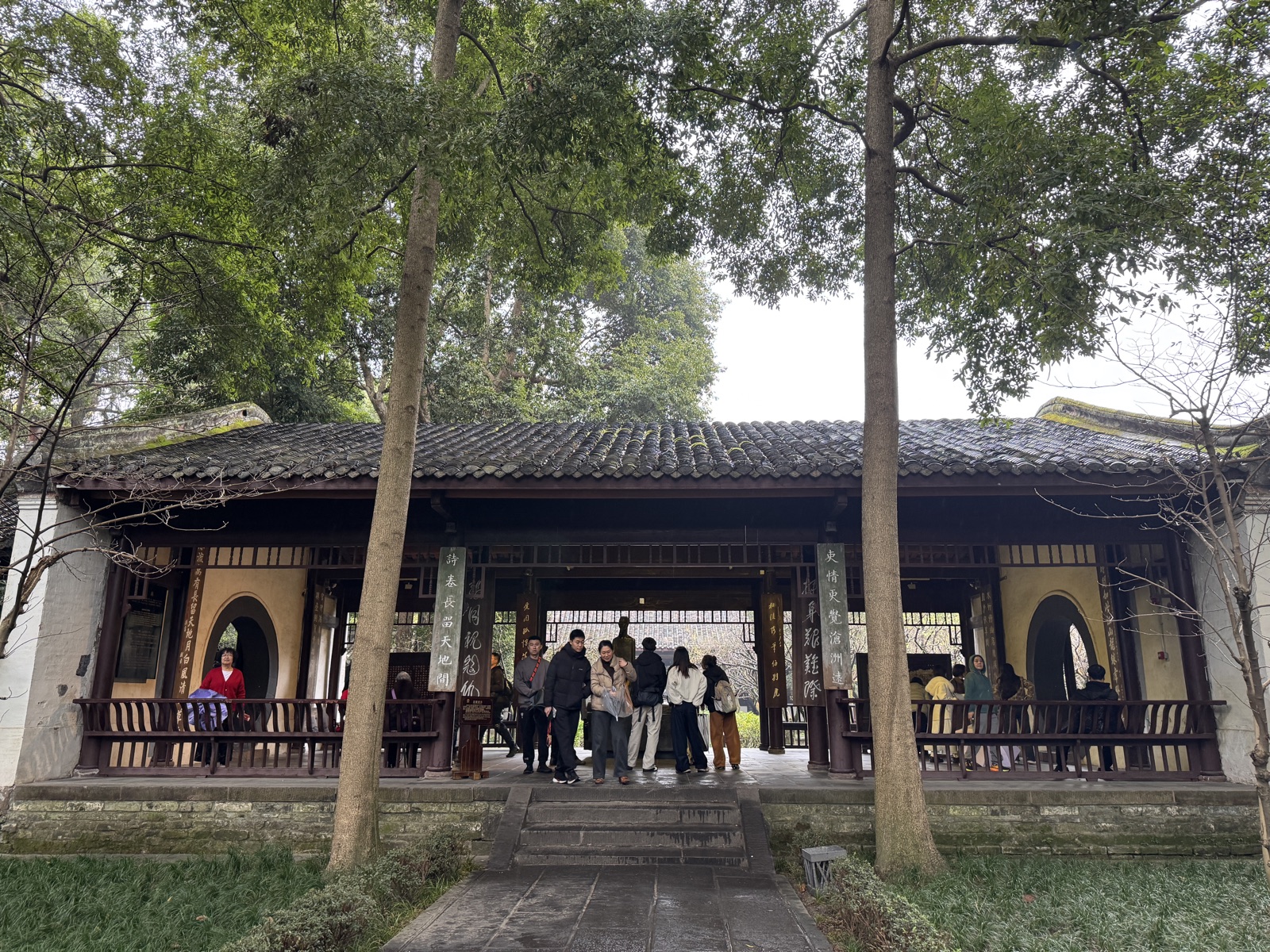
The Thousand Poetry Stele Corridor is located on the east side of the central axis of Du Fu Thatched Cottage, close to the south side of the Hall of Great Elegance, and is a corridor-style building about 100 meters long. The stele corridor is composed of green bricks, green tiles and carved wooden windows, and on both sides of the corridor are inlaid with bluestone steles, on which more than 1,450 of Du Fu's surviving poems are engraved in the form of calligraphy, which is a cultural landmark of the perfect combination of Chinese classical literature and calligraphy art. The stele calligraphy collects calligraphy works of Du Fu's poems by calligraphy masters of all dynasties such as Su Shi, Huang Tingjian and Mi Fu of the Song Dynasty, Zhao Mengfu of the Yuan Dynasty, Dong Qichang and Wen Zhengming of the Ming Dynasty, He Shaoji and Zhao Zhiqian of the Qing Dynasty, and Yu Youren, Guo Moruo, Qi Gong, Sha Menghai of modern times, with all five scripts of seal, clerical, regular, running and cursive, making it a "small museum of Chinese calligraphy art". Walking slowly along the corridor, visitors feel as if they are strolling in the long river of history: on the left are the immortal poems of the poet saint, on the right are the brush and ink style of calligraphers, and in the middle is the sculpture group of poets in the Hall of Great Elegance. Visitors are advised to stop and appreciate in the stele corridor, each stele is a piece of history, and each calligraphy work is a kind of style.

On-site narration · read it where you stand

We've arrived at the Thousand Poems Gallery — a covered corridor several hundred meters long, its walls lined from end to end with stone-carved transcriptions of Du Fu's poems in the calligraphy of celebrated hands across the centuries. The total number of inscriptions exceeds one thousand, making this the most concentrated display of Du Fu's poetry anywhere in the cottage.

Why build a gallery like this? Because Du Fu's poems were never meant to sit locked in a cabinet — they were made to be walked through. As you move along the corridor reading, a pattern emerges: his early and late poetry sound like they were written by different people. The young Du Fu wrote "I will reach the summit and see all the other mountains made small" — bold, full of sky, the whole world seemingly at his feet. But in his later years, what did he write about? Hunger: "Entering the house I heard wailing; my youngest son had already starved to death." Cold: "The quilt, unwashed for years, is stiff as iron." Loneliness: "Not one word from family or friends; sick and old, I have only this solitary boat." Read these poems from beginning to end, and you watch a man travel from the fire of youth to the desolation of old age. The weight of it is hard to put into words.

The calligraphy carved into these stones is itself a major attraction. The gallery brings together the brushwork of hundreds of calligraphers from ancient times to the present — among them the imperial hands of the Kangxi and Qianlong Emperors, the celebrated modern masters Yu Youren and Guo Moruo, and contemporary names as well. The same poem in different hands becomes an entirely different experience. Look at this rendition of "Spring Night Rain": "Good rain knows its season; with spring it comes to life. It slips with the wind into the night, silently watering every living thing." This poem was written in Chengdu — no sorrow, no national grief, just the pure delight of a spring shower. A Du Fu we don't often meet.

Next to the gallery is the Bonsai Garden. Sichuan-style bonsai is one of China's five major bonsai traditions, known for its composition of tree and stone together, and for its twisting, dynamic forms. The garden holds what are nearly all prime examples of the Sichuan style — Jin Danzi, podocarpus, ginkgo, Pyracantha — some no larger than a hand, yet the trunks already carry the deeply furrowed, weathered texture of a century-old tree. Bonsai and Du Fu's poetry share the same aesthetic instinct: both are the art of containing the vast within the small. A twenty-character verse can hold all the sorrow of an era; a bonsai thirty centimeters tall can hold the presence of an entire mountain. This capacity to find the immense inside the miniature is one of the most distinctive qualities of East Asian aesthetics.

The bonsai garden also holds a hidden photo spot — in the northwest corner stands an old plum tree said to date from the Qing dynasty. In late winter or early spring when it is in full bloom, stand beneath it and shoot into the angled backlight; the petals go semi-transparent and the effect is dreamlike. Du Fu loved plum trees all his life and planted several at the cottage, though none of those original trees survive. This two-hundred-year-old Qing dynasty plum has picked up where the Sage left off, keeping watch over the garden in his place.

Thousand Poems Gallery and the Bonsai Garden — done. Now follow me to the most photogenic spot in the entire cottage: Flower Path.

Shaoling Thatched Cottage Stele Pavilion

少陵草堂碑亭

The Shaoling Thatched Cottage Stele Pavilion is located east of the Gongbu Shrine and serves as the core landmark of the Du Fu Thatched Cottage park. "Shaoling" is the abbreviation of Du Fu's self-styled name "Shaoling Yelao" (Old Man of Shaoling). There was a Shaoling Plateau in Chang'an in the Han Dynasty, and Du Fu's ancestor Du Yu of the Xiangyang Du family was a Jinzhao Du, so he called himself "Old Man of Shaoling". The stele pavilion is a wooden hexagonal pavilion with a thatched roof, supported by 6 wooden pillars, with a gourd-shaped finial, surrounded by beauty-rest chairs, and the base is built of bluestone in a hexagonal shape. In the center of the pavilion stands a huge stone tablet, on which are engraved the four majestic characters "Shaoling Cao Tang", signed by Qing Yongzheng Emperor's brother Prince Guo Aisin Gioro Yunli. According to legend, Yunli passed through Chengdu on his way to Tibet on imperial order, made a special pilgrimage to the cottage and wrote the inscription. The inscription is in regular script with strict structure and strong bones, making it a masterpiece among inscriptions of all dynasties. Surrounded by towering ancient trees and verdant bamboo, the pavilion is the core landscape that visitors must take photos with.

On-site narration · read it where you stand

Before us now is the Shaoling Thatched Cottage Stele Pavilion — the image you've almost certainly seen on postcards and in travel photos: a small open pavilion with a thatched roof, sheltering a single stone stele carved with four bold characters: Shaoling Caotang — "Shaoling's Thatched Cottage."

What does "Shaoling" mean? Du Fu styled himself "Shaoling Yenao" — the old rustic of Shaoling. Shaoling was a place on the southern outskirts of the Tang capital Chang'an, where Empress Xu of the Han dynasty was buried. Du Fu lived near there in his younger years, and the place left a lasting mark on him. He took it as his pen name — and yenao, "rustic elder," is perfectly fitting: for most of his life Du Fu was drifting, displaced, dependent on others' goodwill — truly an old man with no settled home.

Who inscribed the four characters on this stele? Once again, Prince Guo Yun Li — the same man who wrote the Cao Tang plaque above the main gate. You'll remember: in the twelfth year of the Yongzheng reign, Prince Guo was escorting the Dalai Lama back to Tibet and stopped in Chengdu to visit the cottage. He left these four characters behind, full of vigor and life — widely regarded as the finest example of his calligraphy. Consider the scene: a Manchu prince, a son of the Emperor, bowing before a Han poet who spent his life as a refugee. That image alone says something about Du Fu's place in Chinese culture — he transcended ethnicity, class, and era to become a shared spiritual ancestor for all Chinese people.

Small as it is, this pavilion is the most essential symbol of the entire cottage. For many people, the stele inscribed Shaoling Caotang simply is Du Fu's home. The thatched roof above it is built in the style of Du Fu's original hut, and every few years the old thatch is replaced with new — a gesture that feels less like maintenance and more like an act of remembrance that has never been interrupted.

Best spot for photos: Stand five or six meters in front of the pavilion and frame the whole structure in your shot. The texture of the thatching and the carved characters on the stele will both be clear. With bamboo behind and a plum branch or two in the foreground, the composition has a quality of deep antiquity. On a rainy day, water beads cling to the thatch and the stone slabs glisten — without any filter, it already reads like a Du Fu poem.

Let's move on — just a few more steps, and we reach what I think is the most affecting place in all of Du Fu's Cottage: the Thatched Cottage Residence.

Hall of Poetic History

诗史堂

The Hall of Poetic History is located behind Da Xie and serves as the core main hall on the central axis. Du Fu's poems truly record the historical transformation of the Tang Dynasty from prosperity to decline around the An Lushan Rebellion, and are honored as "Poetic History" by later generations, hence the name "Hall of Poetic History". The plaque "Shi Shi Tang" in front of the hall was inscribed by the famous philosopher and former Peking University President Feng Youlan in 1980. In the center of the hall is a bronze bust of Du Fu created by the famous sculptor Liu Kaiqu, with a lean face and solemn expression, embodying the spirit of caring for the country and the people. The walls on both sides of the hall are inlaid with calligraphy works of Du Fu's representative works such as "Five Hundred Words on the Way from Chang'an to Fengxian County", "The Thatched Cottage Broken by Autumn Wind", "Climbing High", "Spring View", "Three Officials" and "Three Farewells", which is a must-see for visitors to understand the essence of Du Fu's poetry. At the back wall of the hall is a 1:1 scale restoration of a Tang dynasty poet Du Fu walking and chanting statue.

On-site narration · read it where you stand

We've arrived at the Poetry History Hall — the heart of the cottage's central axis, and the principal exhibition hall displaying illustrated poems and the story of Du Fu's life.

First, the name itself — why "Poetry History"? Because Du Fu's work has long been called shi shi — "history in verse." He lived at the precise turning point when the Tang Dynasty began its long decline, and he recorded what he witnessed: the fires of the An-Shi Rebellion, the desperate flight of the common people, the corruption of the court, the grinding hardship of everyday life, the beauty and fragility of the natural world. Taken together, his more than 1,400 surviving poems form a living chronicle of the dynasty's fall. Later generations said it plainly: to read Du Fu is to read Tang history.

At the center of the hall stands a full-length painted statue of Du Fu. Notice how it differs from the bronze figure we just saw in the Grand Hall. Here Du Fu is neatly dressed, his expression composed and resolute, a scroll in hand. One statue shows us the man of daily life — exhausted, worn down. This one shows us the poet of the spirit — focused, unbroken. Together they give us a complete portrait of the Sage of Poetry.

On the pillars of the hall hangs a couplet you must not miss. It was written in 1957 by Marshal Zhu De, after his visit to the cottage: "The thatched cottage endures through the ages; the Sage of Poetry's name illumines a thousand autumns." Ten characters that contain both space and time. Zhu De was a native of Sichuan who had read Du Fu's poetry in his youth; in his later years he returned to his homeland and made a special pilgrimage here, leaving behind this treasured inscription.

The display cases on either side hold different editions of Du Fu's collected poems. Look at this Song dynasty woodblock edition — one of the earliest surviving compilations of his work, eight hundred years old, the paper yellowed and the ink aged to a deep gray. Yet the words are still clear: "The kingdom has fallen; the mountains and rivers remain. Spring comes to the city; the grass and trees grow deep. Grieving over the times, the flowers draw tears. Hating this separation, the birds startle the heart." Eight hundred years, and not one drop of the anguish in those lines has diminished.

The paintings on the walls are illustrations of Du Fu's poems — works created by artists across the centuries in response to his verses. Take this scene from "Song of My Thatched Cottage Torn by Autumn Wind": an autumn gale scatters bundles of thatch across the sky; a group of children chase after the flying grass; an old man stumbles after them, helpless against the wind. Even if you've never read the poem, the painting alone conveys the desolation.

One detail in the Poetry History Hall that many visitors walk past — the floor. The green stone slabs are not new; they are Qing dynasty originals, polished smooth by the feet of countless people across several centuries. Stand still for a moment on these stones and think about who else has stood here — not Du Fu himself, his cottage is long gone, but the scholars and officials and ordinary people of every dynasty, the refugees of wartime seeking a moment's peace, and today, visitors from every corner of the world. That is the power of this place: it belongs to everyone.

Next, we continue along the central axis and pass through a small, low doorway — the Twig Gate.

Tang Dynasty Site

唐代遗址

The Tang Dynasty Site is located at the westernmost end of the central axis of Du Fu Thatched Cottage, a Tang dynasty living site area excavated archaeologically and protected in situ. Since the 1980s, archaeologists have conducted multiple excavations within the cottage area, successively unearthing Tang dynasty house foundations, wells, porcelain, bronze ware, pottery and a large number of daily necessities, among which the location of some Tang dynasty house sites is highly consistent with the location of Du Fu's former residence recorded in literature, providing indisputable physical evidence for the "Thatched Cottage". The site area adopts a protective display method: Tang dynasty stratigraphic sections are completely preserved and protected with glass covers, so that visitors can clearly see the original appearance of Tang dynasty architectural foundations, drainage ditches, stoves, wells and other relics. Next to the site is a small exhibition hall, which systematically displays the real life scene of Du Fu in the Chengdu Thatched Cottage through excavated artifacts, archaeological photos and literature. Here, visitors can touch the historical pulse of 1,200 years ago, making it an important place for parent-child study and in-depth understanding of Tang dynasty culture.

On-site narration · read it where you stand

Stepping out from the world of the poem and into the world of the archaeologist — we are now looking at a genuine excavation site: the Tang Dynasty Ruins. In 2001, during garden renovation work at the cottage, construction crews unexpectedly struck a Tang dynasty cultural layer. Archaeologists went on to uncover refuse pits, wells, hearths, drainage ditches, and a large quantity of Tang ceramic fragments and everyday objects. These finds provide physical evidence that the land to the west of Du Fu's cottage was indeed inhabited and lived in during his era, giving real archaeological weight to the scenes described in his poetry.

Look down into the excavation trenches. That grayish layer of earth is the Tang cultural stratum — laced with ceramic shards, charcoal, and fired clay particles. Most of the pottery is everyday coarse ware produced in the Chengdu area during the Tang: bowls, plates, jars. It's rough stuff — nothing like the refined official kiln pieces in a museum. But that roughness is precisely the point. It confirms that the people who lived here were ordinary people, not members of the elite. Du Fu was an ordinary person.

The most interesting find is the remnant of a well. Its walls were built with stacked ceramic rings and reached several meters down. The Chengdu Plain has a high water table, and a courtyard well would have supplied everything needed. Du Fu mentions wells in his poetry more than once — "The hall was built with its back to the city, shaded by white thatch; familiar with the riverside path, I look down on green fields beyond." The well was just outside the door; you went to draw water in the morning and looked up to see the distant hills. The archaeological finds give those lines a sudden, vivid three-dimensionality.

The discovery of these ruins also carries a larger significance: it confirmed that the site of today's cottage is authentic. There had always been skeptics — was this really where Du Fu lived, or did later generations simply choose a convenient spot to build a memorial? The 2001 excavation answered that question: this entire area was a working-class residential neighborhood in the Tang dynasty, which matches Du Fu's poetic descriptions closely. The ground we are standing on is, without any doubt, the bank of the Huanhua Stream where Du Fu made his home.

The ruins are small, but they hold more archaeological weight than any other spot in the cottage. Spend five minutes looking at the fingerprints pressed into the ceramic fragments — more than a thousand years ago, someone shaped this bowl with their hands. That person may not have known Du Fu at all. Perhaps they walked past his gate, or borrowed a green onion from him. History is not some grand abstraction. History is these small, broken, everyday things.

The Tang Dynasty Ruins are behind us now. Follow the bamboo path forward — the Thousand Poems Gallery is just ahead.

Main Gate

正门

The Main Gate is the main entrance of the Chengdu Du Fu Thatched Cottage Museum, located at the southern end of Qinghua Road and serves as the first stop for visitors. The gate tower is built in a five-pillar, three-bay Tang-style architecture with upturned eaves and grand momentum. The four golden characters "Du Fu Cao Tang" inscribed on the lintel were written by the famous writer and poet Guo Moruo in 1958, with powerful and vigorous brushstrokes, making it the most recognizable landmark of the cottage. A couplet on both sides reads: "Wanli Bridge West Residence, Baihua Pool North Villa", indicating the geographical location of the cottage. Entering the main gate, visitors can tour the Hall of Great Affairs, Hall of Poetic History, Firewood Gate, Gongbu Shrine, Shaoling Thatched Cottage Stele Pavilion, Thatched Cottage Former Residence and other attractions in turn.

On-site narration · read it where you stand

Welcome, everyone! Thank you for joining us at the Du Fu Thatched Cottage Museum in Chengdu. I'll be your guide today, and we'll follow this route: Main Gate → Grand Hall → Poetry History Hall → Twig Gate → Ministry of Works Shrine → Shaoling Thatched Cottage Stele Pavilion → Thatched Cottage Residence → Tang Dynasty Ruins → Thousand Poems Gallery → Flower Path → Shadow Wall → Hall of Great Elegance → South Gate. Together, we'll walk through the former home of the Sage of Poetry and step back more than twelve hundred years — to a time when an ailing, impoverished old man living beside the Huanhua Stream wrote some of the most moving verses in the entire history of Chinese poetry.

Let's start with a little background on Du Fu's Thatched Cottage. This site was originally Du Fu's residence during his years as a wanderer in Chengdu. In 755 CE, the An-Shi Rebellion erupted and shattered the splendor of the Tang Dynasty. Du Fu fled with his family — first to Gansu, then onward to Sichuan. In the winter of 759 CE, with the help of friends including Yan Wu, he found this spot on the western outskirts of Chengdu and built a humble thatched hut with his own hands. He described it in verse: "West of Wanli Bridge, a house; north of Baihua Pool, a retreat" — the very ground we're standing on now. Du Fu lived here for nearly four years, the most peaceful stretch of his turbulent life. During that time he wrote over 240 poems — roughly one lasting work every five days.

Now, a word about Du Fu himself. His courtesy name was Zimei, and he styled himself Shaoling Yenao — "the old rustic of Shaoling." Posterity has honored him with the title "Sage of Poetry," and he is often paired with Li Bai as "Li and Du," the twin peaks of Tang verse. Du Fu lived through the moment when the Tang Dynasty tipped from its height into decline, and his poetry bears the weight of that catastrophe — raw, unflinching, and true. Later generations called his work "poetic history" because he documented an entire era in verse. His poems contain no romantic escapism; they are filled with the suffering of ordinary people, the brutality of war, and the fate of a nation. His most famous lines say it all: "If only I could find ten thousand rooms of shelter, to house every cold and hungry scholar under heaven with a joyful face" — he was living in a leaking thatched hut, yet his thoughts were with the poor of the entire world. That is Du Fu.

A few practical notes before we go in. Admission is 50 yuan per person; students and those under 18 pay half price at 25 yuan; visitors 60 and over, active military personnel, and people with disabilities enter free with valid ID. Opening hours are 9 a.m. to 6 p.m., with ticket sales ending at 5 p.m. Getting here by public transit: take Metro Line 4 to Caotang North Road Station and walk to the north gate, or take Metro Line 2 to Chengdu University of TCM Provincial Hospital Station and transfer to Bus 58 directly to the cottage. Allow two to three hours to see the full site at a comfortable pace.

Now look up at the plaque above the gate — those two characters, Cao Tang ("Thatched Cottage"), written with a bold, steady hand. Who wrote them? Yun Li, Prince Guo of the Qing dynasty — the seventeenth son of the Kangxi Emperor and a younger brother of the Yongzheng Emperor. In the twelfth year of Yongzheng's reign, Prince Guo was dispatched to escort the Dalai Lama back to Tibet. Passing through Chengdu, he made a special visit to pay his respects at the cottage and left this inscription behind. That was nearly three hundred years ago.

Now look at the couplet flanking the gate: "West of Wanli Bridge, a house; north of Baihua Pool, a retreat." These lines are taken from Du Fu's own poem "Remembering My Home by the Jin River" — his own address for the cottage, given in verse: Wanli Bridge lies to the west, Baihua Pool lies to the north, and his home sits between the two. More than a thousand years later, reading those lines, the poet's home feels as close as yesterday.

Photo tip: The main gate faces east, so morning light comes in from the side — the plaque and couplet show their finest detail then. Stand directly in front with a standard lens for a clean, well-balanced arrival shot.

All right — let's pass through the main gate and officially enter the cottage. Our first stop: the Grand Hall.

Prefer to be shown around?

A local guide walks these 13 stops with you and answers what the page cannot.

Chengdu tours ↗