Travel Guide› Chengdu› Chengdu Museum
Chengdu · Museum

Chengdu Museum 成都博物馆

Chengdu Museum
Address
No. 1 Xiaohe Street, Qingyang District, Chengdu, Sichuan Province (west side of Tianfu Square)

General Overview

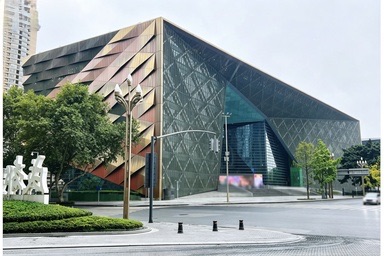
The Chengdu Museum stands on the west side of Tianfu Square in central Chengdu. It is the largest comprehensive city museum in Southwest China and a cultural landmark that chronicles the evolution of Ba-Shu civilization and bears witness to the city's long arc of history. The building's exterior blends the geometric imagery of the "Jinsha Sun Bird" and "ancient Shu megalith," striking a balance between archaeological resonance and contemporary form. The museum integrates collection, exhibition, academic research, and public education under one roof, housing nearly 300,000 artifacts of various kinds. Its permanent galleries — including "Flowers Heavy on Brocade City" and "Shadow Dance of a Thousand Forms" — trace the origins of ancient Shu civilization through to the folk customs of later centuries. As the central window into the cultural heritage of the Land of Abundance, this museum not only enshrines the legendary story of a city that has kept its name and location unchanged for over two thousand years, but also stands as an important base for understanding China's pluralistic and unified cultural tradition.

Gallery-by-Gallery Guide

Basement Level (B1): Nature and Humanity — The Belin Donation Exhibition

Location: Underground Level 1 Theme: Exploring global biodiversity and natural ecosystems Highlights: The museum's first nature-themed exhibition, displaying more than 300 animal specimens representing flagship species from five continents. The exhibition is divided into three parts — "A Journey through the World's Nature," "Nature and Us," and "Respect and Protection" — using vivid specimen displays to help visitors understand the characteristics of different continental ecosystems and the importance of species diversity.

This exhibition is especially well-suited to families with children. Through direct engagement with animal specimens, international visitors gain insight into China's wildlife conservation efforts and the global importance of biodiversity. An interactive question-and-answer component helps visitors deepen their understanding of the concept of living in harmony with nature.

Ground Floor (1F): Special Exhibition Hall (Temporary Exhibitions)

The ground-floor special exhibition hall hosts a rotating program of high-caliber temporary exhibitions, such as international art shows and historical artifact exhibitions. The content changes regularly according to season and theme, meaning there is always something new to discover at the Chengdu Museum.

Temporary special exhibitions typically carry significant international recognition and academic value, with many co-organized with top museums abroad. Through these exhibitions, visitors can approach Chengdu's history and culture from new angles and explore the dialogue between local civilization and the wider world.

Second Floor (2F): Flowers Heavy on Brocade City — Chengdu Historical and Cultural Exhibition (Ancient Section)

Chengdu's historical development from the Pre-Qin period through the Northern and Southern Dynasties. This exhibition is presented in two parts: "Chengdu Rises from the Heavens: Chengdu in the Pre-Qin Period" and "Western Shu, Land of Abundance: Chengdu from the Qin-Han Era through the Northern and Southern Dynasties." Through more than 240 selected artifacts, it reveals the deep historical roots of Chengdu as the birthplace of ancient Shu civilization.

This section of the exhibition is the gateway to understanding Chengdu's history and culture. Through these rare objects, visitors can appreciate the dazzling mystery of ancient Shu civilization and the prosperity of Han dynasty Chengdu as the "Land of Abundance." In particular, the Stone Rhinoceros and the Lacquered Acupuncture Figure are among the museum's most prized treasures — not to be missed.

Third Floor (3F): Flowers Heavy on Brocade City — Chengdu Historical and Cultural Exhibition (Sui-Tang through Ming-Qing Section)

Chengdu's historical transformation from the Sui-Tang dynasties through the Ming-Qing period. This exhibition presents two parts: "A City of Clamorous Splendor: Chengdu from the Sui and Tang Dynasties through the Song and Yuan Period" and "Crimson Towers in the Evening Glow: Chengdu during the Ming and Qing Dynasties," displaying more than 600 items and sets of artifacts, illustrating Chengdu's flourishing identity as the great metropolis of the Southwest.

Through rich artifacts and scene reconstructions, this gallery brings to life Chengdu's brilliant history from the Sui-Tang era through the Ming-Qing period. The model of a Shu brocade drawloom is a particular highlight, giving visitors a direct sense of the extraordinary skill behind ancient Shu brocade weaving and the allure of China's silk culture.

Fourth Floor (4F): Flowers Heavy on Brocade City — Chengdu Historical and Cultural Exhibition (Modern History and Folk Culture Sections)

Chengdu's modern history and distinctive folk culture. This floor is divided into two parts: the "Modern History Section" covering Chengdu's transformation from the Opium War of 1840 through liberation in 1949, and the "Folk Culture Section" celebrating Chengdu's unique human character and spirit.

The Modern History section helps visitors understand Chengdu's significance in China's modern history, especially its contributions during the Railway Protection Movement and the War of Resistance against Japan. The Folk Culture section uses immersive scene reconstructions and original objects to let visitors experience Chengdu's distinctive street culture and way of life, and feel the appeal of "old Chengdu."

Fifth Floor (5F): Shadow Dance of a Thousand Forms and Puppet Theater in All Its Grandeur — Chinese Shadow Puppet and Puppet Exhibition

The display and hands-on experience of China's traditional shadow puppet and puppet arts. Highlights: The Chengdu Museum also carries the designation "Chengdu China Shadow Puppet Museum," making it Sichuan's first and Chengdu's only nationally designated museum of its kind — and currently the world's largest shadow puppet collection in terms of quantity, variety, and quality. The exhibition is divided into "Shadow Dance of a Thousand Forms: The Chinese Shadow Puppet Exhibition" and "Puppet Theater in All Its Grandeur: The Chinese Puppet Exhibition," drawing on nearly 2,000 items and sets of artifacts to comprehensively present the development of Chinese shadow puppet and puppet art.

Chinese shadow puppetry was inscribed on the UNESCO Representative List of the Intangible Cultural Heritage of Humanity in 2011. Beyond its extensive collection of shadow puppets and puppets, this exhibition offers hands-on experiences: visitors can try operating the puppets themselves, or take part in weekend shadow puppet performances and experience this traditional Chinese art form firsthand.

Sixth Floor (6F): Cultural Creative Shop and Observation Deck

Cultural creative products from the Chengdu Museum and a panoramic view of Tianfu Square. The sixth floor houses the museum's cultural creative shop and observation deck, offering a wide range of creative products — including Stone Rhinoceros blind boxes, glazed rhinoceros figures, and glazed entertainer figurines — all inspired by the museum's most treasured artifacts. There is also an observation deck from which visitors can look out over the full panorama of Tianfu Square.

The cultural creative shop is the perfect place to take a piece of the Chengdu Museum's cultural spirit home with you. The products here are beautifully designed and carry real cultural depth. The observation deck offers visitors the chance to take in the sweeping view of Tianfu Square from above, a fitting finale to the entire museum experience.

Inside Chengdu Museum

10 stops, in walking order — read top to bottom, no clicking needed.

1 2F · "From Nine Heavens Emerged Chengdu" — Chengdu in the Pre-Qin Period of 10

2F · "From Nine Heavens Emerged Chengdu" — Chengdu in the Pre-Qin Period

二楼·九天开出一成都——先秦时期的成都
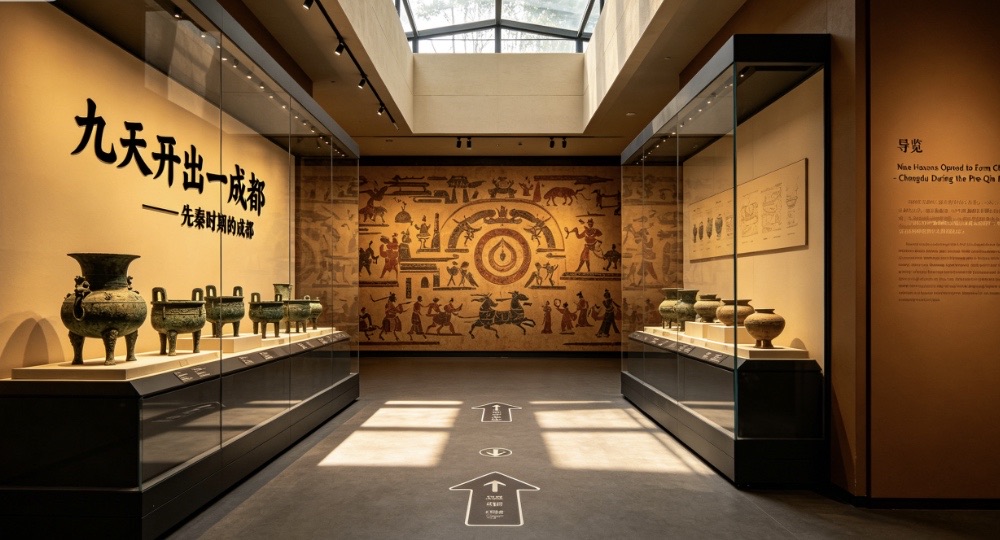
"From nine heavens emerged a Chengdu" is taken from the Tang Dynasty poet Li Bai's poem "Song of the Emperor's Western Journey to the Southern Capital," with the full line reading "From nine heavens emerged a Chengdu, with ten thousand households and a thousand gates forming a picture scroll."

On-site narration · read it where you stand

Welcome, everyone. We've now entered the first section of the museum's permanent collection — "Chengdu Rises from the Heavens: Chengdu in the Pre-Qin Period." This gallery is on the second floor and serves as the starting point of the entire chronological exhibition. Through more than 240 selected artifacts, it brings to life the dazzling civilization of ancient Shu during the Pre-Qin era. The content spans from the Baodun Culture of the late Neolithic period through the Sanxingdui and Jinsha sites of the Xia, Shang, and Zhou dynasties, all the way to the boat-coffin burials and Ba-Shu pictographic symbols of the Warring States period — tracing the full arc of ancient Shu civilization.

Let's begin over here. The opening section introduces the Baodun Culture — a cluster of ancient city sites dating back roughly 4,500 to 4,000 years, scattered across the Chengdu Plain. These sites prove that, more than four thousand years ago, the Chengdu Plain already supported mature settlements and social organization. The walls of Baodun were built from rammed earth and were quite extensive in scale — they represent the earliest and largest group of prehistoric city sites discovered in Southwest China to date. It was the foundation laid by the Baodun Culture that eventually gave rise to the brilliant bronze civilization of Sanxingdui.

Now let's move into the Sanxingdui section. You've probably heard of Sanxingdui — often described as "asleep for thousands of years, and when it woke, it stunned the world." The Sanxingdui site lies about 40 kilometers north of Chengdu in Guanghan City, and dates back roughly 3,000 to 5,000 years. It was the capital of the ancient Shu kingdom. On display here are bronze human heads, bronze bells, jade zhang blades, jade ge blades, and other representative artifacts. Look closely at these bronze heads — the eyes are extraordinarily large, the nose bridge straight and prominent, the mouth wide, the earlobes pierced, and the braided hair falls elegantly down the back. These are not realistic portraits; they are ritual objects used in ancient Shu religious ceremonies, serving as intermediaries between humans and the divine. Their style is strikingly different from anything produced in the Central Plains, and when Sanxingdui was first discovered, some people half-jokingly suggested it was the work of an alien civilization — but of course, Sanxingdui is very much a vital part of China's diverse and unified civilization.

Moving further along, we reach the Jinsha Site section. Jinsha is located in the western part of Chengdu's urban area and dates to approximately 3,000 years ago. It represents the next great peak of ancient Shu civilization after Sanxingdui. If Sanxingdui was the first flowering, Jinsha was its worthy heir. This section displays collar-ringed bi-shaped bronze objects, jade axes, jade spearheads, bronze cone-shaped implements, and more. The gold and jade pieces are the real highlights — although the iconic golden Sun Bird ornament from Jinsha is housed at the Jinsha Site Museum, the Jinsha section here uses a rich combination of artifacts and multimedia displays to fully convey the grandeur of the ancient Shu royal capital. Notice these collar-ringed bi-shaped objects: each has a circular hole at the center with a raised collar around the rim, and their surfaces are either plain or decorated with bird motifs. Similar objects have been found from the Central Plains all the way to the southeastern coast and into Southeast Asia, showing that the people of Shu were engaged in far-reaching cross-regional cultural exchange long before the Qin unification — ancient Shu was anything but isolated.

Finally, we arrive at the Warring States period section. The centerpieces here are the boat-coffin burials excavated from Commercial Street in Chengdu, and the mysterious Ba-Shu pictographic symbols. Boat-coffin burial was a distinctly ancient Shu funeral practice — placing the deceased in a boat-shaped coffin — possibly connected to the people's life along waterways and a belief in the soul crossing a river to the afterlife. The Ba-Shu pictographic symbols are a unique script system from Warring States-era Shu, found engraved on bronze weapons, seals, and other objects. The symbols include tiger motifs, palm motifs, flower-bud motifs, and many others, and they have yet to be fully deciphered — earning the title of "one of China's most enigmatic writing systems."

Photography tip: The lighting design around the Sanxingdui bronze head display cases is one of the museum's visual highlights — shooting from a slightly elevated frontal angle best captures the contours of the faces. The Pre-Qin gallery is deliberately dimly lit to protect the artifacts, so please make sure your flash is turned off.

Up next, we'll pass through the connecting corridor into the Han dynasty gallery on the same floor, where we'll see the true rise of the "Land of Abundance."
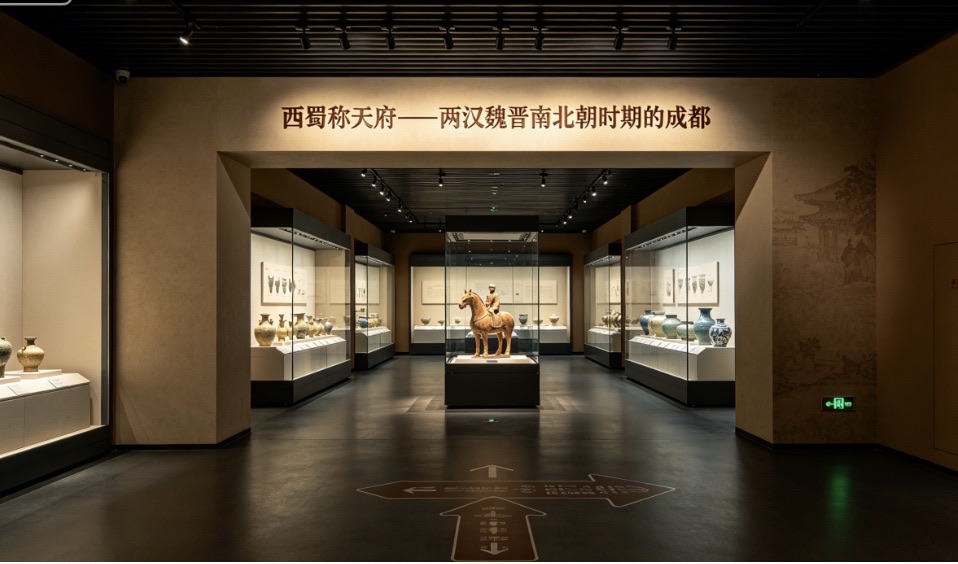
2F · "Western Shu Known as Land of Abundance" — Chengdu in the Han, Wei, Jin, Southern and Northern Dynasties Period

二楼·西蜀称天府——两汉魏晋南北朝时期的成都

The "Western Shu Known as Land of Abundance" gallery is located on the 2nd floor of Chengdu Museum, as the second part of the "Flowers Weigh Down Brocade City — Chengdu Historical and Cultural Exhibition (Ancient Period)."

On-site narration · read it where you stand

Welcome to the second section of the ancient history exhibition — "Western Shu, Land of Abundance: Chengdu from the Han Dynasty through the Northern and Southern Dynasties." If the Pre-Qin gallery told the story of ancient Shu's origins and mystique, this gallery answers a different question: how did Chengdu transform from a remote southwestern kingdom into one of the most prosperous cities in all of China?

How significant was Chengdu during the Han dynasty? By the Western Han period, Chengdu was already counted among the five greatest cities in the empire, alongside Luoyang, Handan, Linzi, and Wan. Its produce was legendary, and the world called it the "Land of Abundance." In 221 CE, Liu Bei declared himself emperor here and established the Shu Han kingdom, setting the stage for the famous Three Kingdoms era. Then, through the Jin and Northern and Southern Dynasties periods, while northern China was torn apart by war, Chengdu emerged as the starting point of the southern branch of the Silk Road, playing a vital role in economic and cultural exchange across Eurasia.

There are several artifacts in this gallery that you absolutely cannot miss. First, please take a look at this — the Stone Rhinoceros, one of the museum's most celebrated treasures. It was unearthed in 2012 during metro construction on the east side of Tianfu Square. This massive stone sculpture is more than three meters long and weighs 8.5 tons. Scholars date it to the Qin-Han period, and it is widely believed to be one of the "water-taming divine beasts" buried by Li Bing during the construction of the Dujiangyan Irrigation System. Look at its form — rounded body, thick sturdy legs. Even after more than two thousand years underground, traces of the original chisel marks and red pigment are still visible on its surface. When this rhinoceros was found, it caused a sensation throughout the archaeological world, and it has since been called "the guardian spirit of Chengdu."

Now look over here — the Pottery Entertainer Figure. This is one of those artifacts that makes you smile the moment you see it. Dating to the Eastern Han dynasty, it stands 60 centimeters tall and depicts a folk performer in full swing: head thrown back in laughter, one hand beating a drum, the other raised in the air, right knee lifted high. The exaggerated pose and vivid expression capture a street performer in mid-act with remarkable life. People in Chengdu were clearly this good at having fun two thousand years ago — doesn't he remind you of the storytellers you still find in Chengdu's teahouses today?

Next, please look at this extraordinarily rare piece — the Lacquered Acupuncture Figure, excavated in 2012 from the Han-era Laoguan Hill Tombs in Chengdu. It stands just 14 centimeters tall. Small as it is, this is a national treasure that rewrote the history of Chinese acupuncture. The entire surface is painted in black lacquer, with fine incised lines mapping the meridian pathways of the human body and dozens of acupoint markings. It is the earliest and most complete human meridian model ever found in China, and it proves that by the Western Han period, the theories of meridians and acupuncture in traditional Chinese medicine were already highly sophisticated.

Then there are the Tianhui Medical Bamboo Strips, also from the Laoguan Hill Tombs — 930 strips in all, containing more than 20,000 characters. They spent two thousand years submerged in water underground, and took over a decade of restoration work before they could be fully recovered. These strips record a vast body of ancient medical formulas that had been lost to history, and they have been celebrated as "the Han dynasty encyclopedia of Chinese medicine."

Near the exit, there are several more pieces worth a closer look: a lacquered dou vessel from the Warring States period, its wooden core coated in black lacquer with intricate patterns painted on the surface — a testament to the mastery of ancient Shu lacquerware craftsmanship. There are also Eastern Han pictorial relief bricks depicting life on a manor estate, with scenes of sowing, harvesting, brewing, and banqueting from two thousand years ago rendered in low relief.

That covers the Han dynasty gallery. Let's head up to the third floor now, to explore what many consider Chengdu's most brilliant era — the Sui, Tang, Five Dynasties, Song, and Yuan periods.

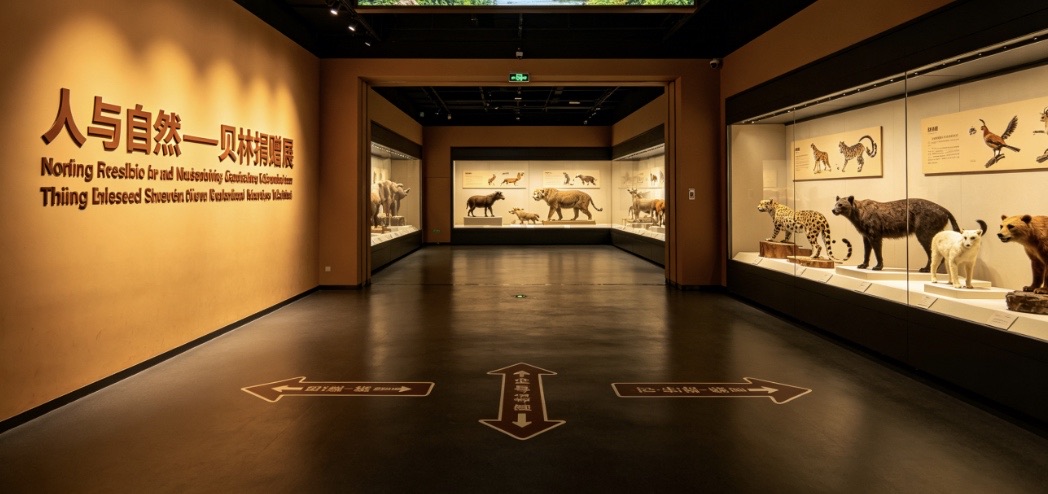
B1F · "Man and Nature" — Behring Donation Exhibition

负一楼·人与自然——贝林捐赠展

"Man and Nature — Behring Donation Exhibition" is located on the basement level 1 of Chengdu Museum, and is the first nature-themed exhibition since the museum's establishment.

On-site narration · read it where you stand

Welcome to the basement level — "Nature and Humanity: The Belin Donation Exhibition." This is the first nature-themed exhibition in the Chengdu Museum's history, featuring more than 300 animal specimens from around the world — a precious gift from American philanthropist Kenneth Belin.

Why does a history museum have a nature exhibition? Because the Chengdu Museum wants to remind us that human history has never existed in isolation. Our relationship with the natural world runs through every stage of civilization. Understanding the animals that share our planet, and understanding the ecosystems of the Earth, is another way of understanding ourselves.

The exhibition is arranged by continental region. This section represents the African savanna, where you'll see a giraffe stretching its neck, a lion family resting in the midday heat, and wildebeest in full migration — all specimens posed to reflect how these animals actually live in the wild, creating an immersive sense of place. Over in the polar zone, a polar bear, penguins, and seals bring the ice world to life before your eyes. There are also the tigers and black bears of the Asian jungle, the bison and gray wolves of North America, the kangaroos and koalas of Australia — nearly every corner of the world is represented here.

The interactive zone is what children love most. There's a tactile station where you can touch the actual skin or shell of a snake, a tortoise, a bear, and a mink, and feel first-hand how different their textures are. Nearby, multimedia screens play wildlife documentaries and short conservation films, making the case for protecting biodiversity through vivid, living imagery.

The core message of this exhibition is: respect nature, protect nature. At the far end of the gallery there is a reflection wall, lined with questions about environmental challenges: What can we actually do to protect the Earth? What kind of ecological corridors do urban wildlife need? These are questions each of us should sit with, because the answers live inside the choices we make every day.

That brings us to the end of the Belin Donation Exhibition — and to the end of the Chengdu Museum's complete permanent collection.

Let me leave you with a brief reflection. We've traveled from the second floor all the way down to here: from the ancient city walls of Baodun Culture four thousand years ago, to the mysterious bronzes of Sanxingdui and Jinsha; from the flourishing "Land of Abundance" of the Qin-Han era to the "Yang first, Yi second" prestige of the Tang dynasty; from the bustling markets of the Song to the palace of the Ming Prince of Shu; from the Railway Protection Movement to the Sichuan troops marching off to war; from the teahouses and alleyways of old Chengdu to today's UNESCO Creative City of Gastronomy. Over four thousand years, Chengdu has told a story that is at once sweeping in scale and intimate in detail. I hope that today's tour has given you not just a look at artifacts and exhibitions, but a feeling for the living, breathing spirit of a city that has never stopped reinventing itself.

Thank you all for listening. If any gallery has caught your interest and you'd like to explore it further, please feel free to return at your own pace. Enjoy the rest of your time in Chengdu!

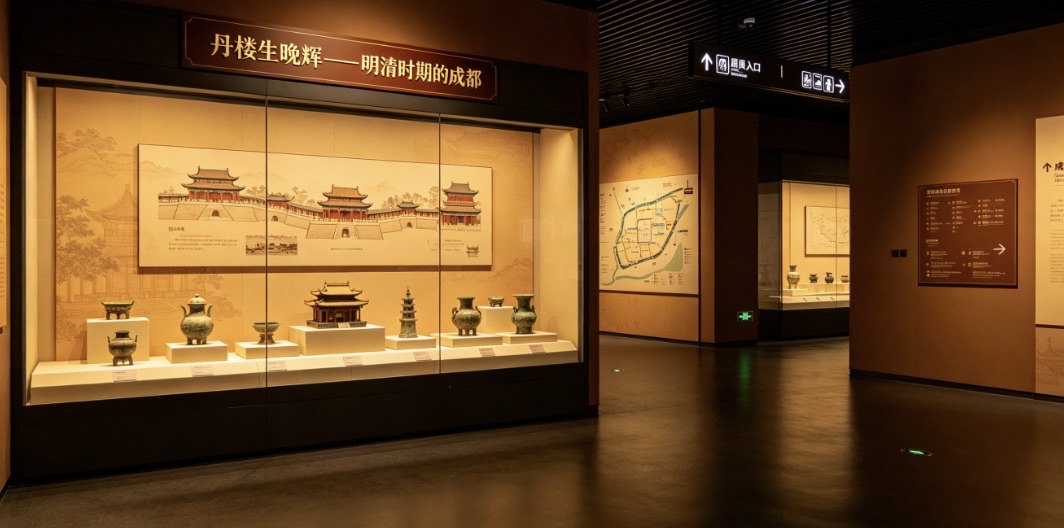
3F · "Red Towers Glow in the Evening" — Chengdu in the Ming and Qing Period

三楼·丹楼生晚辉——明清时期的成都

"Red towers glow in the evening" is taken from the poem of Yang Shen, a Ming Dynasty scholar from Sichuan. The gallery is located on the 3rd floor of Chengdu Museum.

On-site narration · read it where you stand

We've now arrived at the gallery "Crimson Towers in the Evening Glow: Chengdu during the Ming and Qing Dynasties." This section covers Chengdu's history from the Ming through the Qing dynasties. By this period China's political center had shifted to Beijing, but Chengdu remained the most important provincial capital in the Southwest, exerting enormous influence over the entire region.

The first thing you'll see as you enter is a display of architectural components and a restored model of the Ming Prince of Shu's Palace. The founding emperor of the Ming dynasty, Zhu Yuanzhang, enfeoffed his eleventh son Zhu Chun as the Prince of Shu and had a vast palace built for him in Chengdu. The complex was modeled on the layout of the Imperial Palace in Beijing, grand in scale and imposing in presence. The people of Chengdu called it simply the "Imperial City." Although the wars at the end of the Ming and beginning of the Qing dynasties reduced the palace to near rubble, these exquisite glazed tile-end pieces, drip tiles, and roof-ridge ornaments allow us to imagine something of its former splendor. Look at the glaze on these architectural components — after more than six hundred years, the colors are still vivid and striking, a testament to the extraordinary skill of Ming dynasty kilns.

Next, take a look at the large number of Ming dynasty pottery figures on display here. Tombs from Ming dynasty Chengdu have yielded a remarkable quantity of painted pottery figures — honor guards, civil officials, warriors, attendants, female musicians — a whole "underground army" of human forms. These figures are not only numerous but also finely modeled and well-preserved in their colors, reflecting many facets of daily life in Ming dynasty Chengdu.

Now let's look at these exquisite Ming dynasty gold and jade objects. Notice this golden piece in particular — crafted entirely from pure gold, with surface patterns so fine they look almost like hair. The owners of these gold, silver, and jade objects were largely the high officials and nobility of Ming dynasty Chengdu, and together they paint a picture of the luxury and refinement enjoyed by the upper classes of the time.

The Qing dynasty exhibits focus primarily on Chengdu's flourishing commercial trade. Look at this array of ceramics — blue-and-white porcelain, famille rose, five-color ware — all finely made and richly decorated. The ceramics trade in Qing dynasty Chengdu was exceptionally active, with official kiln masterworks arriving from Jingdezhen alongside a wide range of everyday wares for the common people. The display cases over here hold a collection of Qing dynasty snuff bottles, a distinctly characteristic object of the era. Small and delicately formed, they were made from porcelain, jade, glass, enamel, and other materials, and within their tiny dimensions they integrated painting, carving, and calligraphy. Some are so finely painted that you need a magnifying glass to take in the full detail.

It is also worth noting that the Qing dynasty saw Chengdu produce a remarkable number of distinguished scholars. The artifacts here associated with Liu Yuan, known as "the Confucius of Western Sichuan," and with the classical scholar Liao Ping reflect Chengdu's importance as the cultural and educational center of the Southwest. During this period, Chengdu also developed considerably as a city — the alleyways of Kuanzhai Alley and Jinli, along with the guild halls that once dotted the city, are all legacies of the Qing dynasty era that have survived in the city's memory.

That brings us to the end of the Ming and Qing gallery. Please follow me up to the fourth floor, where we'll see how Chengdu wrote its own chapter in the sweeping transformations of modern China.

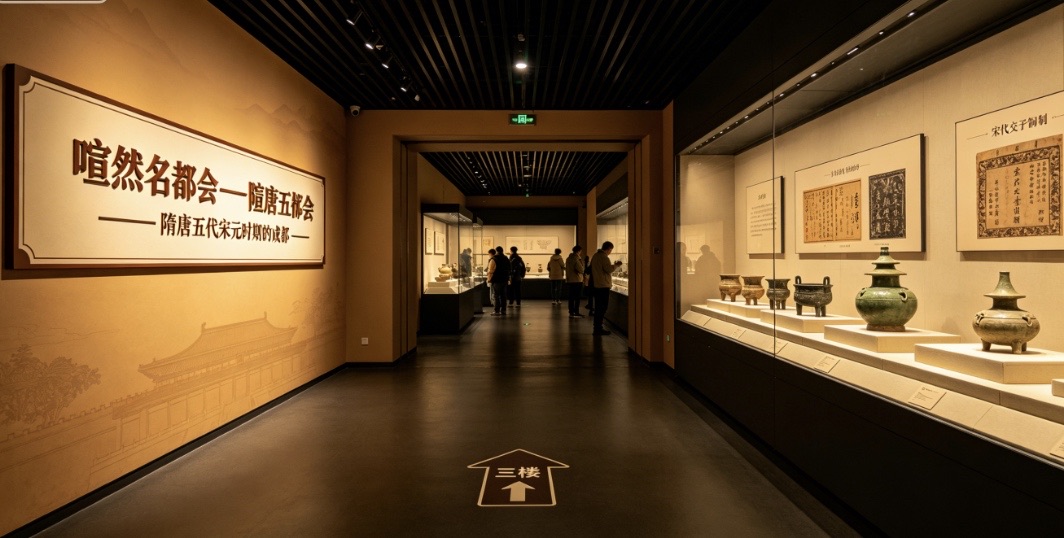
3F · "A Bustling Famous Metropolis" — Chengdu in the Sui, Tang, Five Dynasties, Song, and Yuan Period

三楼·喧然名都会——隋唐五代宋元时期的成都

"A bustling famous metropolis" is taken from the Tang Dynasty poet Du Fu's poem "Chengdu Fu," with the line "A bustling famous metropolis, with flutes and sheng pipes alternating."

On-site narration · read it where you stand

Welcome to the third floor. We've now entered the third chapter of the ancient history exhibition — "A City of Clamorous Splendor: Chengdu from the Sui and Tang Dynasties through the Song and Yuan Periods." This gallery holds more than 380 artifacts, including ceramics, pottery, gold and silver objects, and bronzes. It is the largest and richest of the four ancient history galleries.

One phrase sums up Chengdu during the Sui-Tang era: "Yang first, Yi second." At that time, the two most prosperous cities in China were Yangzhou in first place and Yizhou — present-day Chengdu — in second. Chengdu was the economic and cultural hub of the entire Southwest, and its commerce, craft industries, and arts reached an unprecedented level of vitality. You may know the famous line: "The road to Shu is harder than climbing to the sky." Precisely because it lay tucked away in a southwestern basin, sheltered from the wars that ravaged the Central Plains, Chengdu became a haven of relative peace and stability, attracting poets, merchants, and artisans from across the empire. Li Bai, Du Fu, and Bai Juyi all spent time here and left behind some of their most celebrated verse.

Take a look at this piece — a half-sleeved garment with paired-beast roundels and linked-pearl paired-bird patterns. The name is a mouthful, but the object itself is extraordinary. This is a Tang dynasty brocade half-sleeve — essentially a short-sleeved outer garment — stitched together from two completely different fabrics: one half is Chinese Shu brocade, the other is Sogdian brocade from ancient Persia. A single garment merging the textile traditions of East and West — a perfect material witness to cultural exchange along the Silk Road, and the best possible proof of Chengdu's role as an international metropolis of the Southwest.

The next area is an immersive re-created scene: "Shu Ships Laden with Red Brocade." What was Tang dynasty Chengdu most famous for? Shu brocade. Chengdu's silk-weaving craft was unmatched in all of China, and through an extensive network of waterways, boatload after boatload of red Shu brocade floated down the Min River and the Yangtze, fanning out to every corner of the country and beyond. This scene uses multimedia and scale models to vividly re-create the bustle of a Tang dynasty Chengdu wharf — brocade-laden vessels, a swirl of dock workers, merchants haggling over prices — you can almost hear the shouts and the lapping of water from a thousand years ago.

Next is the miniature scene of the "Third-Month Silkworm Market." The Silkworm Market was Song dynasty Chengdu's most famous seasonal fair, held every year on the third lunar month. It centered on trading silkworm eggs, sericulture tools, and silk goods, but also encompassed general commerce and popular entertainment of every kind, drawing enormous crowds. Look at the scene: the streets are lined with stalls selling silk, ceramics, medicinal herbs, and street food; the flow of people includes riders, porters, and street performers putting on shows. Su Dongpo once wrote: "The people of Shu often toil for their daily bread, yet when it comes to pleasure, they never want to leave." Chengdu's people seem to have been born with a life philosophy that says: no matter how hard things get, the fun must go on.

Here is a particularly fascinating artifact — a Song dynasty Qiong kiln green-glazed oil-saving lamp. Look at the clever design: the lamp has a hollow double-wall structure. Water poured into the space between the walls keeps the oil cooler, slowing evaporation and reducing oil consumption. An energy-efficient lamp from a thousand years ago — the ingenuity of our ancestors never fails to impress.

This gallery also features a late Tang–Five Dynasties Qiong kiln yellow-green-glazed high-footed censer, decorated with three tiers of curling lotus-petal appliques, each petal bearing a molded image of a flying celestial figure. The craftsmanship is exquisite. The Qiong kiln was the most celebrated ancient kiln tradition in Sichuan, with an eight-hundred-year history of production. Its wares combine practicality and artistry, and stand as outstanding representatives of the ceramic culture of the Ba-Shu region.

Please follow me as we continue into the last gallery of the ancient history section — Chengdu during the Ming and Qing dynasties.

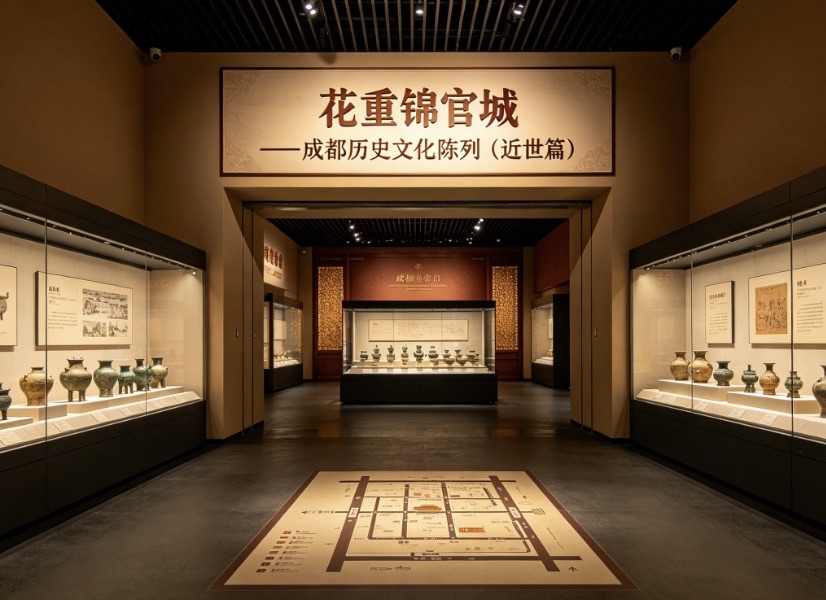
4F · "Flowers Weigh Down Brocade City" — Chengdu Historical and Cultural Exhibition (Modern Period)

四楼·花重锦官城——成都历史文化陈列(近世篇)

"Flowers Weigh Down Brocade City — Chengdu Historical and Cultural Exhibition (Modern Period)" is located on the 4th floor of Chengdu Museum, focusing on Chengdu's modern history from the mid-19th century to the mid-20th century.

On-site narration · read it where you stand

Welcome to the fourth floor. This is "Flowers Heavy on Brocade City: Chengdu Historical and Cultural Exhibition — Modern History Section." From the mid-nineteenth century onward, China went through upheavals of unprecedented scale, and Chengdu played an irreplaceable role in that transformation. This gallery focuses on three defining chapters in Chengdu's modern history — the Railway Protection Movement, Chengdu's role as a strategic rear base during the War of Resistance against Japan, and its position as a key battleground in the liberation of Southwest China.

Let's start with the Railway Protection Movement. In May 1911, the Qing government announced that the Chuan-Han Railway — already funded by private citizens — would be nationalized, then promptly used it as collateral for foreign loans. This act of selling off national railway rights provoked fierce resistance from the people of Sichuan. Citizens across Chengdu formed the "Railway Protection Comrades' Association," drawing hundreds of thousands of members and unleashing a wave of protest that shook the province. When the Qing government sent in troops to suppress the movement, it triggered an even larger armed uprising. The Railway Protection Movement was the direct spark that ignited the Revolution of 1911. Sun Yat-sen later reflected: "Without the uprising of Sichuan's Railway Protection Comrades' Association, the Wuchang Revolution might have come a year or even eighteen months later." The model you see here depicts the "Monument to the Martyrs of the Autumn 1911 Railway Protection Movement," which stands in Chengdu's People's Park and is the first monument in modern Chinese history dedicated to the heroes of the democratic revolution.

Moving on to the War of Resistance against Japan. When the war broke out, factories, universities, and government agencies from the coastal and central regions of China relocated en masse to the west. As one of the most important cities in the rear base, Chengdu bore enormous historical responsibilities. Look over here — the "Soul of the Sichuan Army" sculpture, which is one of the most moving pieces in the entire gallery. During the war, more than 3.5 million Sichuan men went to the front, more than from any other province, and their casualties were the highest in the country. The saying "no army without Sichuan men" traces back to this era. Sichuan soldiers, wearing straw sandals and carrying modest rifles, marched all the way to Shandong, Jiangsu, Hunan, and Hubei, fighting across the better part of China. "A man yearns to repay his country's great kindness — to die on the battlefield is a worthy end." These were the words a father wrote to his son as the Sichuan troops departed.

The exhibits along both sides of this gallery also document Chengdu's cultural and educational life during the war years: Sichuan University and West China Union University kept their doors open through the turmoil, training generation after generation of talent. Ba Jin, Guo Moruo, Liu Shahe, A Lai, Ai Wu, Li Jieren — many of China's most celebrated writers and intellectuals were Sichuanese. The archival materials here also record how young Sichuan students of that era traveled to Japan or sailed to France on work-study programs. Chengdu may be deep in the interior, but the gaze of its intellectuals has always turned toward the wider world.

Finally, we come to the gallery dedicated to the peaceful liberation of Chengdu. In December 1949, regional Sichuan commanders Liu Wenhui, Deng Xihou, and Pan Wenhua issued a joint telegram from Peng County announcing their peaceful transition, and Chengdu was liberated. This ancient city of a thousand years passed into the People's Republic without being consumed by the final flames of war.

That concludes the Modern History section on the fourth floor. Please follow me through the corridor into the Folk Culture gallery on the same floor, where we'll step into the everyday life of old Chengdu.

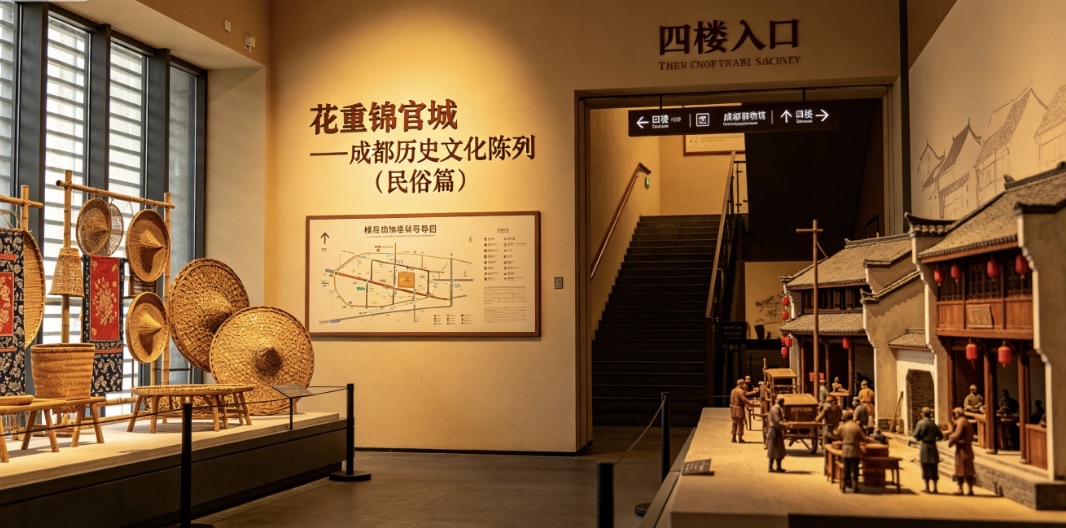
4F · "Flowers Weigh Down Brocade City" — Chengdu Historical and Cultural Exhibition (Folk Customs Section)

四楼·花重锦官城——成都历史文化陈列(民俗篇)

"Flowers Weigh Down Brocade City — Chengdu Historical and Cultural Exhibition (Folk Customs Section)" is located on the 4th floor of Chengdu Museum.

On-site narration · read it where you stand

We've now entered "Flowers Heavy on Brocade City: Chengdu Historical and Cultural Exhibition — Folk Culture Section." This gallery preserves Chengdu's unique folk traditions in their full richness, organized into four themes: Streets and Lanes, Food and Drink, Leisure and Entertainment, and Teahouse Culture. Together they walk you through the daily life of old Chengdu.

The first thing you'll encounter is a recreated scene of old Chengdu's streets and lanes. Stone-paved paths, wooden shop shutters, vendors balancing shoulder poles, old men chatting on doorsteps — these sights have gradually faded from modern Chengdu, but through the museum's reconstruction you can feel the texture of street life a century ago. The names of Chengdu's old lanes are wonderfully evocative: Mule and Horse Market, Fat Pig Market, Dyer's Lane, Salt Market Crossing — every name carries a piece of the city's past.

Next is the Food and Drink section — perhaps the most irresistible part of the entire museum. Chengdu is a UNESCO Creative City of Gastronomy, and Sichuan cuisine has a long and layered history. Do you know how Sichuan food's signature "mala" — that mouth-numbing, fiery combination — came to be? Sichuan has always been one of China's most important sources of Sichuan peppercorn. But the chili pepper only arrived in China from the Americas during the Ming dynasty. At the beginning of the Qing dynasty, chili peppers entered Sichuan with migrants from Huguang, and Sichuan cuisine quickly absorbed the new ingredient, weaving together the native peppercorn and the newcomer chili in a combination that became world-famous. As the display puts it: a chili pepper from the Americas and a Sichuan peppercorn from the local soil met in a Chengdu wok — and that is the soul of Sichuan cuisine.

There's a dedicated section here on Chen Mapo Tofu. In 1862, a restaurant called Chen Xingsheng opened beside the Wanfu Bridge in Chengdu. The owner's wife had a pockmarked face, and everyone called her "Mapo Chen" — pockmarked Mrs. Chen. The tofu dish she prepared for passing porters — numbing, spicy, tender, fresh, and aromatic all at once — became one of the most beloved classics in Sichuan cooking. A single bowl of mapo tofu has been delighting people for over 160 years.

The section on other famous street foods is equally captivating: a replica shoulder-pole prop re-creates how Dandan noodle vendors once worked the streets; a model demonstrates the three dramatic thuds — clang, clang, clang — made when glutinous rice balls are flung onto the wooden board for San Da Pao; vendor pole models for Lai's Tangyuan and Guo's Tangyuan; a bread-baking stove for guokui flatbread; and the origin story of Fuqi Feipian, the famous sliced offal dish — all of it vividly showing Chengdu people's passion for food and their endless creativity in the kitchen.

The next section is devoted to Teahouse Culture. In Chengdu, a teahouse is far more than a place to drink tea. It carries the weight of countless social functions. There is the "chi jiang cha" — the dispute-resolution tea: when people had a disagreement, instead of going to court they would meet at the teahouse, invite a respected elder to hear both sides, and by the time the tea was finished, so was the argument. There is the "sixth-month and twelfth-month battle" for hiring: every year in the sixth and twelfth lunar months, school principals would gather at Hemingteahouse in Shao Cheng Park to hire teachers on the spot — the competition was fierce, hence the warlike name. Brotherhood association leaders conducted their society business over tea. And opera enthusiasts held "circle drumming" sessions — showing up without costumes or makeup, bringing their own instruments, singing and playing for pure enjoyment. A Chengdu teahouse is, in every sense, the city's "second living room" — and within its walls you can read the full social life of the city.

The Leisure and Entertainment section documents old Chengdu's recreational culture: the Qingyang Palace Flower Fair has a long history, held on the fifteenth day of the second lunar month each year; at its height during the Republican era it combined culture, commerce, and entertainment, making it the ancestor of every festival and expo Chengdu hosts today. The "Golden Badge" contest was an old-style martial arts open challenge — anyone could step up to compete, and the winner took home a gold medallion. And then there is mahjong, the peep show box, and the "baba feast" — outdoor communal banquets for weddings, funerals, and other occasions, where the whole neighborhood sat down together to eat, part social bond and part grand celebration.

The Folk Culture gallery has shown us a vivid, full-blooded portrait of old Chengdu. Let's take the elevator up to the fifth floor, where we'll discover two of China's most extraordinary folk performance arts — shadow puppetry and puppet theater.

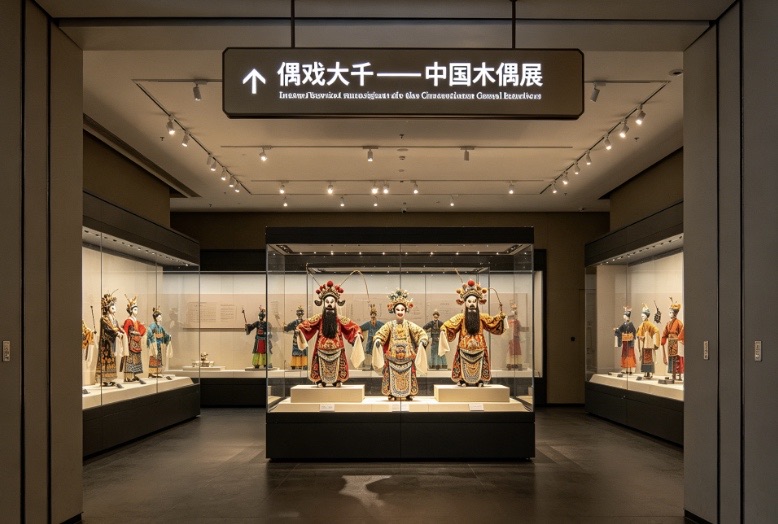
5F · "Puppet Theater of the Great Thousand" — Chinese Puppet Exhibition

五楼·偶戏大千——中国木偶展

"Puppet Theater of the Great Thousand — Chinese Puppet Exhibition" is located on the 5th floor of Chengdu Museum, adjacent to the "Shadow Dance of All Phenomena — Chinese Shadow Puppetry Exhibition."

On-site narration · read it where you stand

We've now arrived at the northern section of the fifth floor — "Puppet Theater in All Its Grandeur: The Chinese Puppet Exhibition." This gallery covers more than 400 square meters and displays over 200 puppet pieces, offering a systematic introduction to the history of Chinese puppet art and the characteristics of its major traditions.

Chinese puppet theater has a history of more than two thousand years, traceable as far back as the Zhou dynasty. Puppets began as toys and ritual objects before evolving into an independent theatrical form. The gallery is organized by puppet type:

First, string puppets — the most technically demanding of all puppet forms. A single string puppet can have twenty to thirty silk threads attached to it, each one controlling a different part of the body: head, shoulders, back, hands, feet. The performer stands above, holding the control frame, and manipulates dozens of threads with ten fingers simultaneously, bringing the puppet to life with subtle and expressive movement. The string puppets of Quanzhou in Fujian Province are the most celebrated in China, recognized as "the pinnacle of the suspended-marionette art." Look at these figures — dressed in exquisite period costumes, their faces carved with remarkable detail. In a skilled performer's hands, they can pour tea, wield weapons, and even write with a brush. A single tremor along a silk thread is enough to bring a puppet to life. That is the magic of string puppetry.

Over here are rod puppets — a central rod supports the puppet's head, and two additional rods control the hands. These puppets are larger and better suited to big stages, with broader, more powerful movements. Sichuan's rod puppets have a character all their own; the famous large Sichuan rod puppets can stand over a meter tall and weigh more than ten kilograms, and their performances carry a commanding presence.

Next are iron-rod puppets, which originated in the Chaoshan region of Guangdong Province. Three iron rods are inserted from behind the puppet's back and through the hands, allowing flexible and varied movement — particularly well-suited to action scenes. Watch this one: a general holding a long spear, and when the performer flicks a wrist ever so slightly, the spear tip traces a beautiful arc through the air.

Glove puppets, also known as hand puppets, may be the form most familiar to many of you — the puppet is fitted over the hand like a glove, and the fingers do the performing. Compact and nimble, a single performer can operate two puppets at the same time — conversing, fighting. In Taiwan, glove puppetry has been reinvented for the modern era with film special effects and popular music, and has become a hugely influential cultural phenomenon. Look at the pieces displayed here — every glove puppet is hand-painted, and each character's hairstyle, costume, and weapon has been thoughtfully designed.

Finally, there is the "carrying-pole theater" — the most grassroots form of puppet performance. One performer, one shoulder pole carrying everything needed: a small stage, a curtain, all the puppets. Wherever the performer goes, the show follows. During a performance, the performer ducks behind the curtain and single-handedly operates every character, provides the music, does the singing, speaks all the dialogue — one person is the whole production.

Having experienced both shadow puppetry and puppet theater, we now have a much richer sense of the depth and breadth of China's folk performing arts. Please take the elevator down to the basement level, where we'll visit the gallery that is most popular with younger visitors — Nature and Humanity.

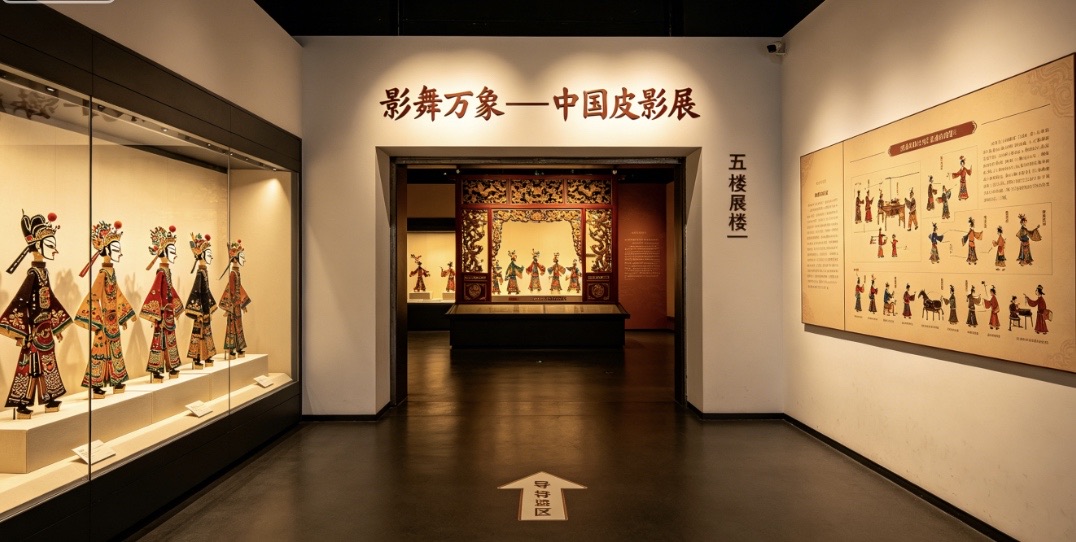
5F · "Shadow Dance of All Phenomena" — Chinese Shadow Puppetry Exhibition

五楼·影舞万象——中国皮影展

"Shadow Dance of All Phenomena — Chinese Shadow Puppetry Exhibition" is located on the 5th floor of Chengdu Museum. It is one of the museum's most distinctive permanent exhibitions and the largest and finest shadow puppetry thematic exhibition in China.

On-site narration · read it where you stand

Welcome to the fifth floor. This is "Shadow Dance of a Thousand Forms: The Chinese Shadow Puppet Exhibition." The Chengdu Museum holds the world's largest and most comprehensive collection of shadow puppetry, and virtually the entire fifth floor is devoted to this art form.

What is shadow puppetry? Simply put, it is the art of making silhouetted figures from animal hide or cardboard, projecting them onto a white screen using a light source, while performers behind the screen manipulate the figures and sing the story. It has been called "the ancestor of cinema" — for hundreds of years before the invention of film, shadow puppet theater was the "movie theater" for ordinary people across China.

Let's begin with the craft of making a shadow puppet. To transform a piece of rawhide into a performance-ready puppet takes more than a dozen stages: selecting the hide, curing it, sketching the design, transferring the pattern, carving, applying color, heat-flattening, and assembling the joints. A skilled puppet maker can spend months on a single figure. Look at how the joints are constructed — head, shoulders, elbows, wrists, waist, knees — all moveable, with some figures having more than a dozen connection points. A single slender rod can make a figure walk, ride a horse, fight, or flip through the air. The carving is often as fine as a strand of hair — the patterns on a figure's robes, the scales of armor, even the expression in the eyes are rendered with striking lifelikeness.

The gallery is organized by regional school. Shaanxi shadow puppetry is known for its intricate carving and bold, saturated colors. Hebei shadow puppetry is more austere, with broader, stronger lines. Sichuan shadow puppetry uses bright, cheerful colors and exaggerated figures. Hunan paper-figure shadow puppetry is small and delicate, with its own distinct character. Each regional style reflects its local cultural traditions and aesthetic sensibilities.

This section displays scenes from classic shadow puppet performances. Look at this one — "Sun Wukong's Three Battles with the White Bone Demon" from Journey to the West. Sun Wukong's fiery golden eyes, the White Bone Demon's seductive form, and the Monk Xuanzang's compassionate face are all rendered with near-perfect expression in shadow. The gallery also features scenes from Romance of the Three Kingdoms, Water Margin, Legend of the White Snake, and other classic stories — shadow puppetry has carried a nation's oral storytelling tradition across centuries, one performance at a time.

The section on shadow puppet music and vocal styles is also engaging. Every regional school has its own singing tradition — some soaring and intense, others flowing and lyrical. The multimedia stations here let you listen to classic pieces from different traditions. If you're curious, pick up the headphones and give it a try.

The fifth floor shadow puppet exhibition is remarkably rich. Feel free to spend time on what interests you most. When you're ready, head through the passage on the south side and we'll enter the equally fascinating puppet theater gallery.

Main Entrance Hall

正门大厅

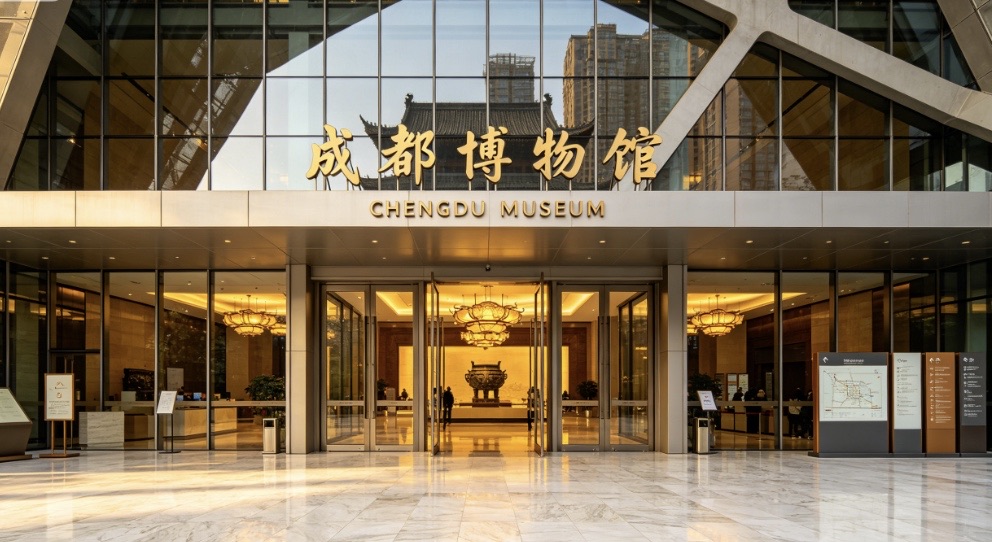
The Main Entrance Hall is the entrance space and core atrium of the new Chengdu Museum building, with a soaring ceiling of tens of meters, creating a magnificent and imposing atmosphere. The hall's design integrates modern architectural language with ancient Shu cultural elements.

On-site narration · read it where you stand

Welcome, everyone! Thank you for joining us at the Chengdu Museum. I'll be your guide today. We'll follow this route: Main Hall → Second Floor Pre-Qin Gallery → Han through Northern and Southern Dynasties Gallery → Third Floor Sui-Tang through Song-Yuan Gallery → Ming-Qing Gallery → Fourth Floor Modern History Gallery → Folk Culture Gallery → Fifth Floor Shadow Puppet Exhibition → Puppet Exhibition → Basement Level Belin Donation Exhibition. Together, we'll walk through the full museum and explore the story of a city that has kept its name and its location for three thousand years without interruption.

Let's start with some background on the Chengdu Museum. The building you're standing in is the new wing, which opened officially in 2016. The total floor area is approximately 65,000 square meters, with 20,000 square meters dedicated to exhibitions. The museum holds nearly 220,000 artifacts, of which close to 1,400 are classified as precious cultural relics. It is the largest comprehensive city museum in Southwest China and holds the top designation as a National First-Class Museum.

Before we begin, here are a few practical notes. Admission is free, but you need to book a time slot in advance through the WeChat mini-program "Chengdu Museum Ticketing System." Opening hours are Tuesday through Sunday, 9 a.m. to 5 p.m. — last entry at 4:30 p.m. The museum is closed on Mondays, except on public holidays. Audio guides are available for rent at the ground-floor service counter for 20 yuan, with a deposit of your ID card or 200 yuan. We're currently on the west side of Tianfu Square — take Metro Line 1 or Line 2 to Tianfu Square Station and exit from the west exit.

Now take a moment to look up at this building's distinctive exterior. Does it strike you as unusual? The outer walls are a patchwork of golden copper panels and clear glass, which from a distance looks like "gold inlaid with jade." This design is far from arbitrary — the ancient Shu civilization held gold and jade as its most sacred materials. Sanxingdui yielded the world-famous golden mask and golden scepter, and the Jinsha Site produced the golden Sun Bird ornament along with an abundance of fine jade objects. This building is, in its own way, a tribute to the ancient Shu civilization. If you shoot from across the square with a wide-angle lens — especially on a sunny afternoon when the light catches the copper cladding — the golden glow is genuinely breathtaking.

All right, let's head up to the second floor and begin our journey through four thousand years of Chengdu's history.

Prefer to be shown around?

A local guide walks these 10 stops with you and answers what the page cannot.

Chengdu tours ↗