Travel Guide› Chengdu› Chengdu Wenshu Monastery
Chengdu · Temple & shrine

Chengdu Wenshu Monastery 文殊院

Chengdu Wenshu Monastery
Address
66 Wenshuyuan Street, Qingyang District, Chengdu

Official Visitor Route and Attraction Guide — Wenshu Monastery

Wenshu Monastery is located at 66 Wenshu Yuan Street, Qingyang District, Chengdu, Sichuan Province. Originally founded during the Daye reign of the Sui dynasty (605–617 CE) under the name Xinxiang Temple, it was destroyed in warfare at the end of the Ming dynasty and rebuilt in 1697 by Chan Master Cidu during the Kangxi reign of the Qing dynasty, at which point it was renamed Wenshu Monastery. Wenshu Monastery is one of the key Chinese-language Buddhist monasteries designated by the State Council, and has long been honored as "foremost of the four great Chan temples along the Yangtze River." Covering approximately 200,000 square meters, it is the most completely preserved Buddhist temple within the city of Chengdu.

1. Mountain Gate (Spirit Screen)

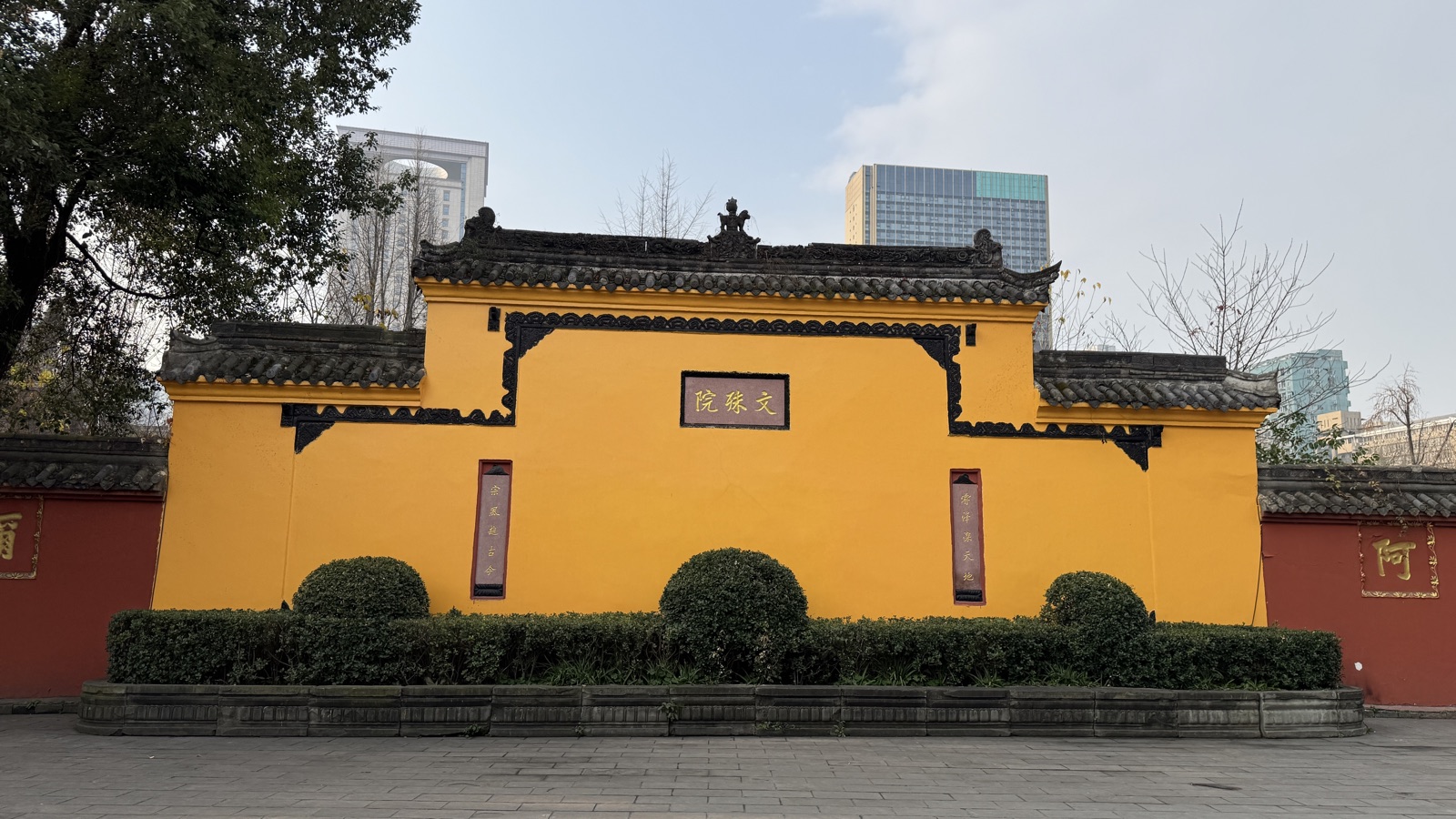
The Mountain Gate (Spirit Screen) is the entrance to Wenshu Monastery. A yellow spirit screen standing roughly eight meters tall in the "triple-cascade" style, it bears the three gold characters for "Wenshu Monastery" in the calligraphy of Master Cidu, the monastery's founding patriarch during the Kangxi reign. The couplet flanking the screen — "Imperial grace runs deep through heaven and earth; the Chan lineage transcends the ancient and the modern" — reflects the monastery's profound cultural heritage.

The three characters on the screen are more than a name: they carry the meaning of "Kong Lin," or Empty Grove — a title bestowed by Emperor Kangxi, symbolizing the purity and solemnity of the monastery. This spirit screen has witnessed over 1,400 years of history at Wenshu Monastery, from the Sui dynasty to the present day.

2. Heavenly Kings Hall

The Heavenly Kings Hall is the first hall of Wenshu Monastery, integrated with the Mountain Gate into a single structure with a single-eave flush-gable roof, standing 8.3 meters tall. First built in 1706 during the Kangxi reign and rebuilt in 1821 during the Daoguang reign, the hall enshrines a seated bronze Maitreya Buddha (1.7 meters tall), Four Heavenly Kings (each 3.3 meters tall), and the Twin Guardian Generals.

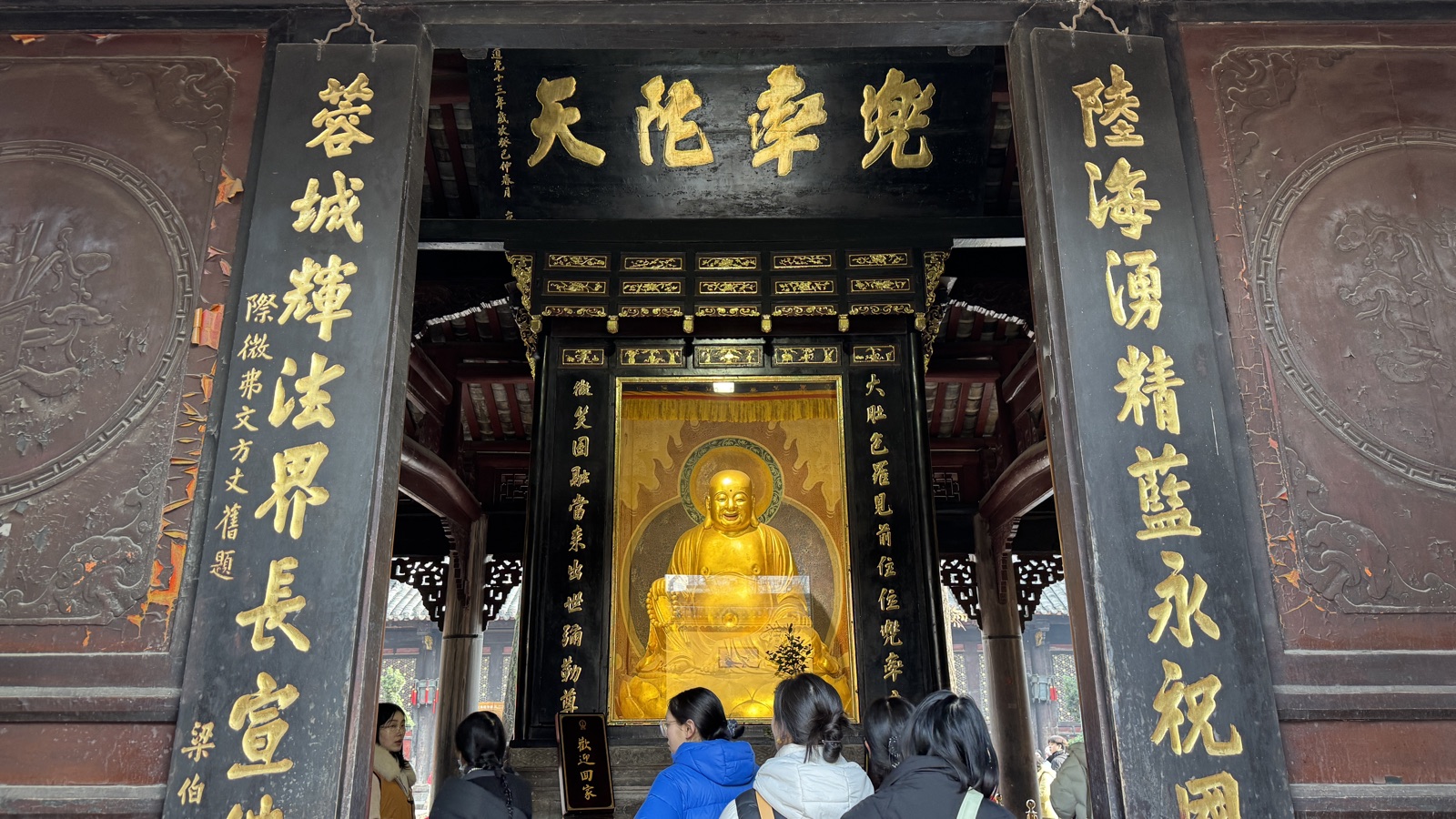
As the first hall of the monastery, the Heavenly Kings Hall embodies the Buddhist spirit of "a great belly that can hold all things in the world, a smiling mouth that laughs at all people." The Maitreya inside is depicted as the Cloth-Bag Monk, said to be a manifestation of Maitreya Bodhisattva. The pillars of the hall bear a couplet composed by the Qing-dynasty abbot Fuwen Jiwei: "From sea and land surges this great monastery, forever blessing the dynasty for ten thousand generations; from the lotus city its sacred realm shines forth, ever spreading the Buddha's teaching across three thousand worlds" — a couplet that encodes a thousand years of shared history between this monastery and the city of Chengdu.

3. Hall of Three Great Bodhisattvas

The Hall of Three Great Bodhisattvas, also called the Guanyin Hall, was built in 1697 during the Kangxi reign and rebuilt in 1807 during the Jiaqing reign. It is a single-eave hip-and-gable structure spanning five bays across the front. The hall enshrines bronze statues of three bodhisattvas — Guanyin, Manjushri, and Samantabhadra — representing compassion, wisdom, and the practice of vows respectively. Behind the altar stands a bronze statue of Skanda, the guardian of the Dharma, cast in 1829 during the Daoguang reign, two meters tall, embodying the spirit of "a bodhisattva's youthful face with the authority of a general."

The Hall of Three Great Bodhisattvas is one of Wenshu Monastery's most important venues for prayers and blessings. The Skanda statue inside is associated with a remarkable story — according to tradition, it was successfully cast under the direct guidance of a wandering monk who was himself a manifestation of Skanda Bodhisattva. The hall also enshrines Wenchang, the God of Literature, and Guan Yu, reflecting the fusion of Buddhist and Confucian culture. This hall represents a high achievement in Qing-dynasty Buddhist architecture and is counted among the Eight Wonders of Kong Lin.

4. Mahavira Hall

The Mahavira Hall is the main hall of Wenshu Monastery, built in the single-eave hip-and-gable style and standing 10.56 meters tall. Founded by Master Cidu and rebuilt by Abbot Zhangbo, the hall enshrines a seated bronze statue of Shakyamuni Buddha (2.64 meters tall, cast in 1829 during the Daoguang reign), flanked by standing bronze statues of Mahakashyapa and Ananda, symbolizing the transmission of the Dharma. The hall's interior decoration — intricately carved window screens and door panels — represents the finest in classical architectural art.

The Mahavira Hall is the architectural heart of the Wenshu Monastery complex. "Mahavira" refers to the great power of the Buddha, symbolizing the strength to overcome all afflictions and awaken all beings. The hall's bronze figures, cast during the Daoguang reign with exceptional craftsmanship, reflect the outstanding level of Qing-dynasty Buddhist art. The hall also enshrines two Burmese jade Buddhas — one of which was brought back on foot from Burma by the monk Xingling in 1922 — and is counted among the Eight Wonders of Kong Lin.

5. Dharma Hall (Kong Lin Hall)

The Dharma Hall, also known as the Medicine Buddha Hall, is a double-eave hip-and-gable structure standing 12 meters tall. Founded by Master Cidu in 1697 during the Kangxi reign, it displays Emperor Kangxi's personal calligraphy of the two characters "Kong Lin" (bestowed in 1701), which is why Wenshu Monastery is also known as the "Kong Lin Monastery." The hall enshrines one Medicine Buddha flanked by Twelve Yaksha Generals, symbolizing the dispelling of disaster and the prolongation of life. The hall also contains the remains of a brick ordination platform from the Ming dynasty, a symbol of Buddhist precept lineage.

The Dharma Hall is counted among the Eight Wonders of Kong Lin. The two characters "Kong Lin," written by Emperor Kangxi, symbolize the purity and serenity of the monastery — a place apart from the world's dust. The hall walls also bear Buddhist narrative murals, including "A Young Boy Offering Sand to the Buddha" and "Sudhana Visiting Manjushri." This hall is not only a place for expounding the Dharma, but also an important carrier of Wenshu Monastery's historical and cultural lineage.

6. Scripture Repository (Chen Jing Lou)

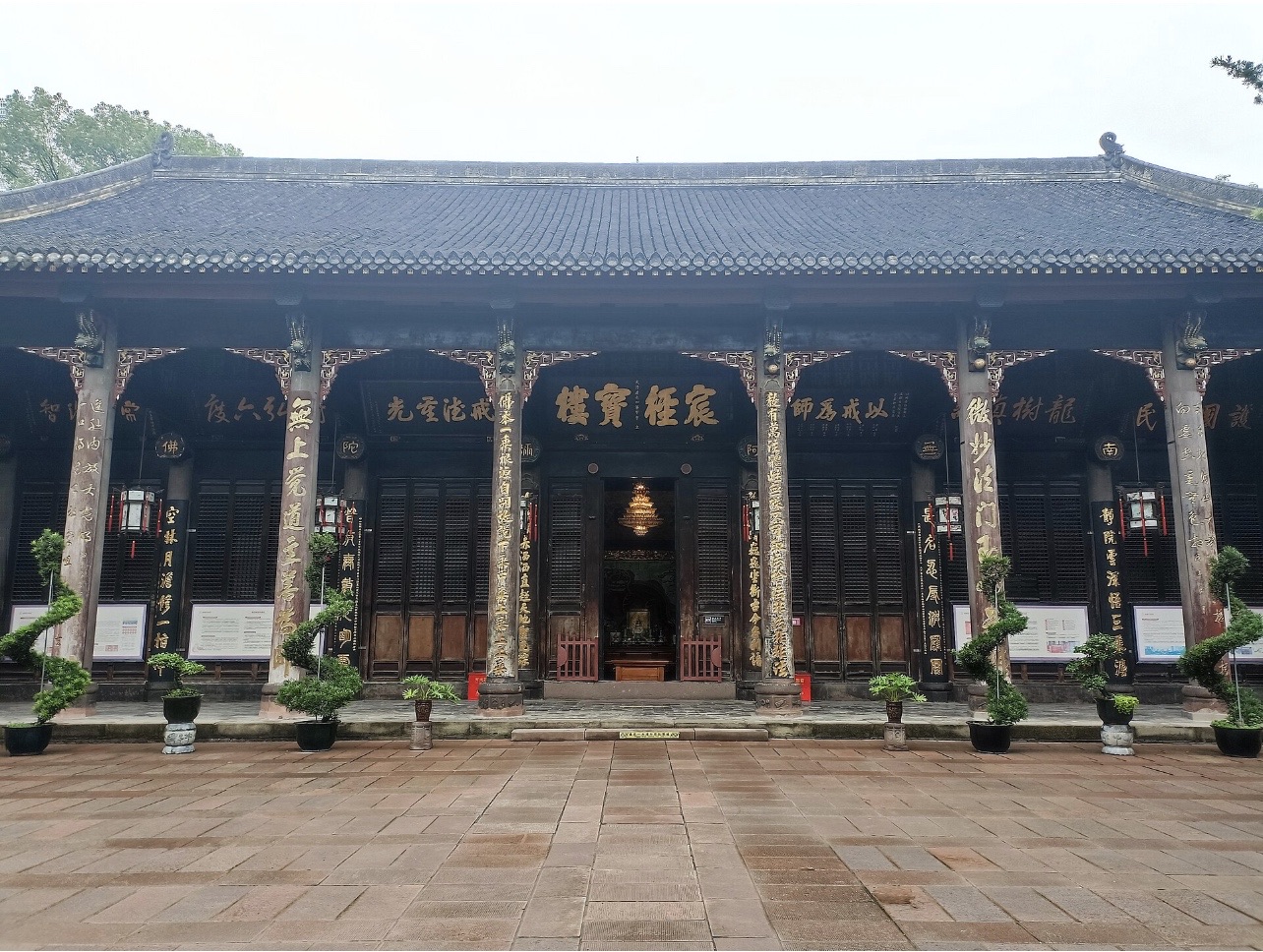
The Scripture Repository, also called the Chen Jing Lou, stands 15.84 meters tall as a two-story timber structure. First built in 1697 during the Kangxi reign, it was rebuilt in 1824 during the Daoguang reign by Abbot Benyuan. The repository holds a large collection of Buddhist scriptures and cultural artifacts and is the monastery's "treasure house."

It enshrines the "Two Sacred Relics of Kong Lin" — a relic of Shakyamuni Buddha and the skull bone relic of the Venerable Xuanzang (available for veneration on specific religious festival days).

The Scripture Repository is the most important repository of cultural objects at Wenshu Monastery. The skull bone relic of Xuanzang is of exceptional significance: Xuanzang's skull bone, discovered in Nanjing in 1942, was distributed to a number of sites, and Wenshu Monastery received a portion because it is the place where Xuanzang was ordained — making it the only monastery in southwest China to enshrine Xuanzang's skull bone relic. The Buddha relic was brought from Bodh Gaya in India in the 1920s by the Venerable Master Nenghai. These sacred objects carry immense religious meaning and stand as vital testimony to the living transmission of Buddhist culture.

7. Xiang Yuan Chan Experience Area

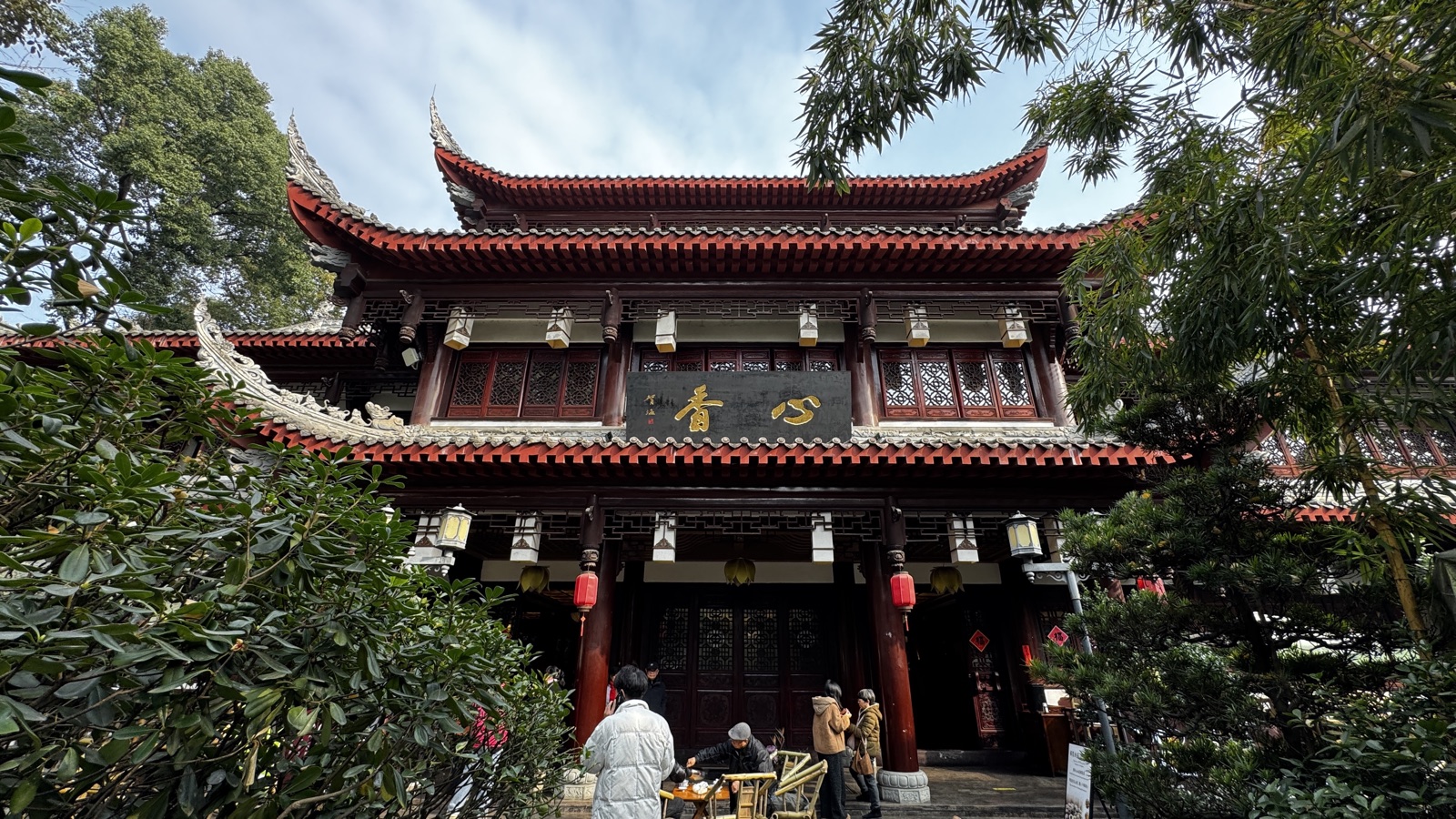
The Xiang Yuan Chan Experience Area is located behind the five main halls of Wenshu Monastery and serves as the monastery's cultural engagement zone, combining Chan tea, vegetarian dining, and sutra copying under one roof.

The Xiang Yuan Chan Lifestyle Experience Area is Wenshu Monastery's public-facing cultural space. Its purpose is to forge a connection with visitors through traditional cultural activities — vegetarian food, Chan tea, sutra copying — and to share the wisdom of the Chan tradition. Copying sutras is both a preservation of Buddhist culture and a form of spiritual purification. The Chan tea experience embodies the cultural philosophy of "Chan and tea as one taste," inviting visitors to discover a quality of stillness and insight through the act of drinking tea. The vegetarian restaurant advocates a healthy way of living and reflects the Buddhist value of compassion through non-harm.

9. Thousand-Buddha Peace Pagoda

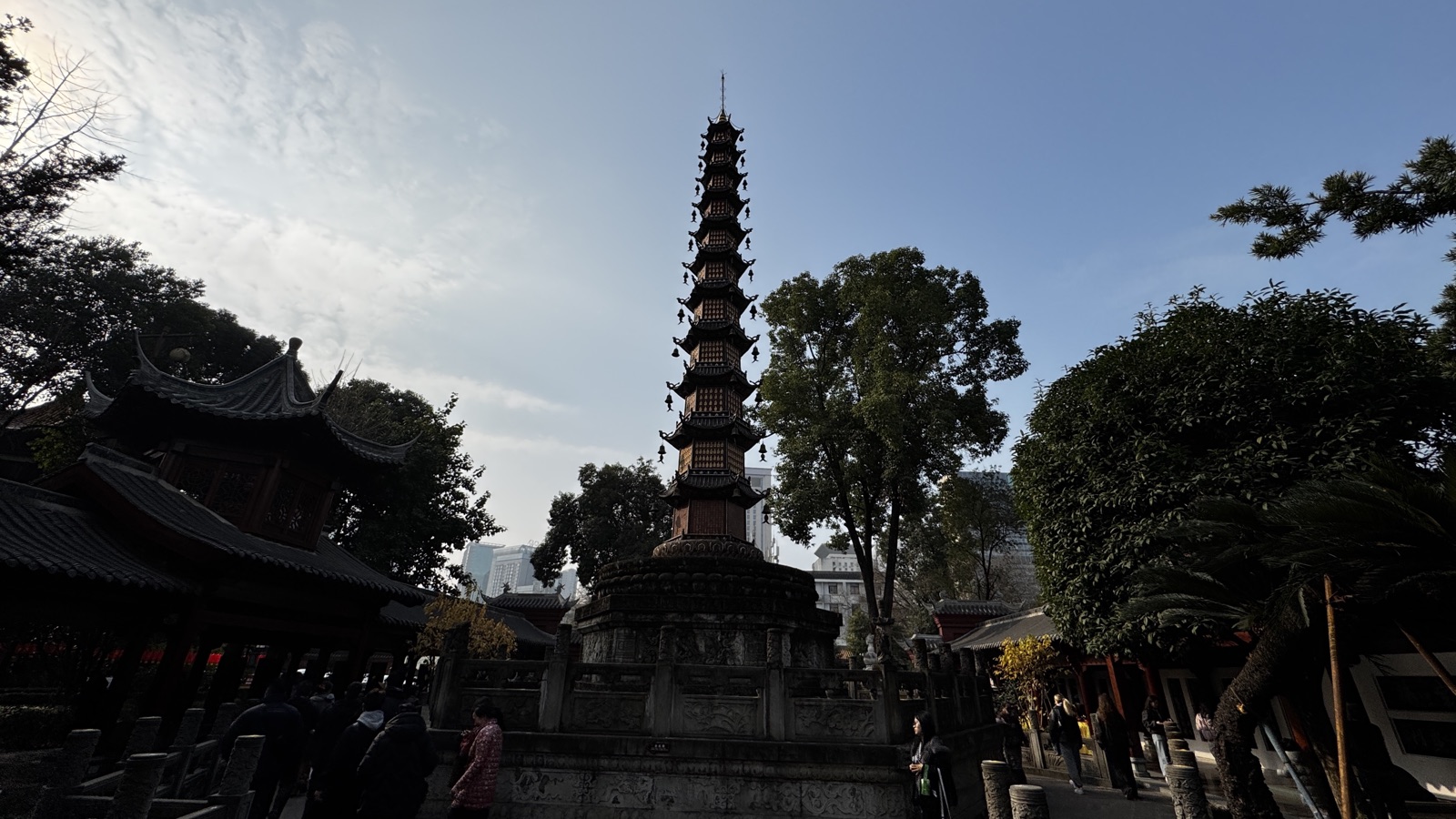
The Thousand-Buddha Peace Pagoda was built in 1988 in commemoration of the International Year of Peace. Hexagonal in shape, it stands eleven stories tall at a total height of 21 meters, weighing 27 tons. The surface of the pagoda bears 999 small cast-iron Buddha images in relief; together with the bronze Shakyamuni Buddha statue at ground level, the total count reaches one thousand — hence the name. The pagoda also bears inscribed passages from the Avatamsaka Sutra, the Lotus Sutra, and other Buddhist texts.

  • Walk three clockwise circuits around the pagoda to pray for blessings — the clockwise direction, or "right circumambulation," symbolizes a prayer for world peace.
  • Two six-tusked white elephant sculptures stand beside the pagoda, symbolizing Buddhist compassion and peace.
  • A sacred crypt beneath the pagoda contains precious ritual objects, though it is not open to the public.

The Thousand-Buddha Peace Pagoda is the foremost example of modern architecture at Wenshu Monastery, expressing the Buddhist universal ideal of "equality of all beings and peace for the world." The small children and sheaves of wheat carved at the feet of the white elephant sculptures represent "the protection of children" and "world peace," echoing the themes of the 1986 International Year of Peace. The practice of walking three circuits around the pagoda derives from Buddhist tradition: according to the Sutra on the Merit of Circumambulating a Stupa, right-circumambulation brings the merit of "acting without obstruction and attaining all wisdom." This custom originated in Indian culture, where the right side is held in honor, and circumambulating to the right symbolizes reverence and praise. The construction of the Thousand-Buddha Peace Pagoda marks Wenshu Monastery's continuing role in contemporary society as a center for promoting the ideals of peace and facilitating cultural exchange.

10. Garden / Stele Corridor

The Garden and Stele Corridor is Wenshu Monastery's recreational area, located on the eastern side of the complex. Composed of covered walkways, stone inscriptions, ancient trees, and open courtyards, the area is peaceful and atmospheric.

  • The garden is shaded by ancient trees and is ideal for a leisurely walk or a quiet rest.
  • The stele corridor bears inscribed tributes from celebrated figures since the Qing dynasty, including Emperor Kangxi's personal calligraphy and authentic works by the Qing-dynasty calligrapher Mi Fu.
  • Long benches are provided in the garden where visitors may sit and take in the surroundings.

The Garden and Stele Corridor is an integral part of Wenshu Monastery's architectural ensemble, expressing the Chan spatial philosophy of "a garden within a courtyard, a courtyard within a garden, and a scene within every courtyard." The inscriptions carved along the stele corridor — Emperor Kangxi's "Kong Lin" in his own hand, a transcription of Mi Fu's "Sea and Moon," and other works — bear witness to Wenshu Monastery's deep historical and cultural heritage. The ancient trees in the garden, including the two camphor trees behind the Mahavira Hall that stand on the site of those from the original Tang-dynasty Xinxiang Temple, symbolize the monastery's spiritual legacy of "a Chan mind that does not die." This area provides visitors not only with a place to rest, but also a meaningful window into the history and culture of Wenshu Monastery.

Inside Chengdu Wenshu Monastery

10 stops, in walking order — read top to bottom, no clicking needed.

1 Sutra Repository (Chen Scripture Hall) of 10

Sutra Repository (Chen Scripture Hall)

藏经楼(宸经楼)

The Canon Library, also called "Chenjing Lou," is the fifth hall on the central axis—originally built by Chan Master Cidu and rebuilt by Abbot Benyuan in 1824. Standing 15.84 m tall in two stories, it is the monastery's central repository for sutras and treasures. The name "Chenjing" comes from Kangxi's imperial calligraphy. Beyond the Ming and Qing Buddhist canons (Long, Pingqia, Taisho, Qianlong Da Zangjing and continuations), the library preserves Kangxi's "Konglin" hand and his Mi Fu-style "Hai Yue" calligraphy, Song dragon ink paintings, late-Ming and Qing calligraphy by Poshan and Zhangxue, paintings by Biyan and Zhuchan, and works by He Shaoji, Zheng Banqiao, Zhang Daqian, and Feng Zikai. To the left rests a portion of the cranial relic of Master Xuanzang, transferred from Nanjing in the 1940s—the monk was ordained in Chengdu and lived here for five years; to the right rests a Buddha Śarīra brought from Bodh Gaya by the monk Nenghai in the 1920s. The "Tian Yi Xuan Cai" qipao embroidered with 248 Buddha figures by Ming consort Tian, the Qing hair-embroidered Water-Moon Guanyin, four blood-written sutras, and the Diamond Sutra pagoda painting—all part of the "Eight Views of Konglin"—are also housed here.

On-site narration · read it where you stand

Moving further along, we come to the fifth hall — the Scripture Repository, also called the Chen Jing Lou, or Imperial Scripture Tower. Founded by Master Cidu and rebuilt in 1824 by Abbot Benyuan, it rises across two floors to a height of 15.84 meters, making it the tallest building at Wenshu Monastery. The Scripture Repository is the monastery's "heart" — it holds the most precious scriptures and cultural treasures of the entire complex.

Let's begin with the "Two Sacred Relics of Kong Lin," the two most precious objects at Wenshu Monastery — and among the rarest in the world.

The first sacred relic is a relic of the Buddha himself. What are relics? They are the crystalline remains found after the cremation of Shakyamuni Buddha following his parinirvana. In the 1920s, the Venerable Master Nenghai made a pilgrimage to Bodh Gaya in India — the very site of Shakyamuni's enlightenment — and brought back a portion of the Buddha's relics to be enshrined here in the Scripture Repository.

The second sacred relic is the skull bone of the Venerable Xuanzang. Xuanzang will be familiar to most people as the Tang Priest, the historical model for the monk at the center of the classic novel "Journey to the West." The real Xuanzang was the greatest Buddhist monk of the Tang dynasty: he traveled fifty thousand li to India alone, returned with 657 Buddhist scriptures, and spent nineteen years translating 1,335 volumes. He was ordained as a monk in Chengdu and lived in the city for five years. In the 1940s, construction work at Bao'en Temple in Nanjing uncovered Xuanzang's skull bone relic. Because of Chengdu's special connection to Xuanzang, a portion was sent here from Nanjing, where it is enshrined alongside the Buddha's own relic — thus completing "the Two Sacred Relics."

The Scripture Repository also preserves four Buddhist sutras hand-copied in blood — the Avatamsaka Sutra, the Lotus Sutra, the Shurangama Sutra, and others. All were written character by character by eminent monks of past generations who pierced their own tongues to use their blood as ink. In Buddhist tradition this practice is known as "blood-ink scripture copying," and it represents the most absolute expression of devotion to the Dharma. These four blood-sutras bear the name "Lotus Blooming from the Tongue, Cradling the Treasure" among the Eight Wonders of Kong Lin.

Two extraordinary textile works are also held here.

The first is a kasaya robe embroidered by Lady Tian, the beloved consort of the Chongzhen Emperor of the Ming dynasty, bearing 248 miniature Buddha figures worked in an exceptionally fine needlework technique. It is known among the Eight Wonders of Kong Lin as "Lady Tian's Robe in Resplendent Color." Why would an imperial consort embroider a monastic robe? During the Ming dynasty, a deep reverence for Buddhism pervaded the imperial court, and members of the royal family expressed their devotion through exactly this kind of painstaking handiwork.

The second is a portrait of the Water-Moon Guanyin, 104.4 centimeters tall and 41.2 centimeters wide, embroidered entirely from the hair of the daughter of Yang Yuchun — the Qing-dynasty governor-general of Shaanxi and Gansu. This work is counted among the Eight Wonders of Kong Lin as "Embroidered in Hair, a Hidden Jewel." Yang Yuchun's great-grandson Yang Guangqi also embroidered the full text of the Diamond Sutra into the form of a pagoda, with each tier of the tower composed of scripture text — 110 centimeters tall and 35.5 centimeters wide. This is the fourth wonder, known as "The Stupa Aglow in Gold."

Beyond these, the Scripture Repository holds paintings and calligraphy by celebrated figures of the Song, Ming, and Qing dynasties — a scroll by Emperor Kangxi copying the Song calligrapher Mi Fu's "Sea and Moon," an ink dragon painting from the Song dynasty, works of calligraphy by the monks Poshan and Zhangxue from the Ming and Qing periods, paintings by the monks Biyan and Zhuchan, and works by the well-known names He Shaoji, Zheng Banqiao, Zhang Daqian, and Feng Zikai.

A word of practical guidance: these rare artifacts are not on public display day to day. They are kept in climate-controlled storage and are only brought out for major religious ceremonies or special exhibitions. Though the objects themselves are not visible today, I hope the story of each one has given you a sense of the deep cultural richness that has accumulated here over more than a thousand years.

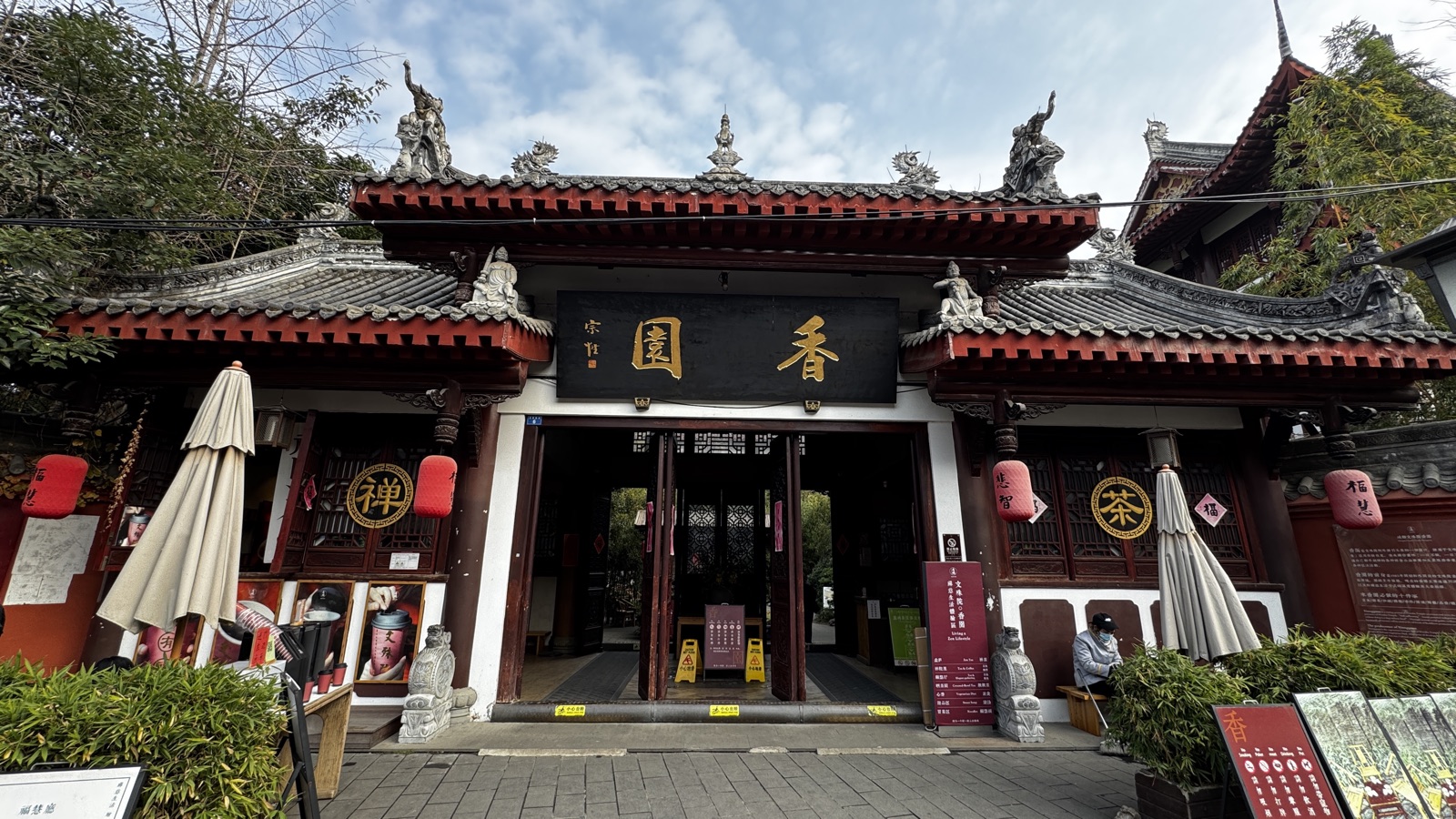
Tea Garden and Vegetarian Hall

茶园与香斋堂

The Tea Garden sits inside the monastery's east garden, opened in 1988 alongside the Thousand-Buddha Peace Pagoda, and operates as a "Chan-monastery teahouse" in old-Chengdu style. Bamboo roofs, blue-brick paving, square tables, covered-bowl tea, and long-spouted copper kettles recreate a classic "bada cha" open-air teahouse serving Bi Tan Piao Xue, Zhu Ye Qing, Mao Feng, Tie Guan Yin, and Pu'er teas at around RMB 10–30 per person, with free hot-water refills and outside snacks allowed. The Xiangzhai Hall vegetarian restaurant sits next to the Tea Garden and is separate from the monks' Wuguan Hall. The menu emphasizes Sichuan-style vegetarian cuisine: vegetarian Mapo tofu, vegetarian twice-cooked pork, sweet rice cake, monastery pickles, and full vegetarian set meals at RMB 20–60 per person, plus luohan noodles and mushroom wonton. Together they create a "worship, tea, dine" loop, expressing the monastery's "humanistic Buddhism" approach. Just outside the gate, Wenshu Yuan Street hosts Chengdu classics such as Long Chaoshou (Wenshu Yuan main branch), Yan Taipo Guokui, and Zhong Sui Jiao, making the visit a combined temple-and-old-streets experience.

On-site narration · read it where you stand

After a full circuit of the monastery, you may be ready to rest. The place in Wenshu Monastery most likely to make you want to stay is the tea garden on the eastern side — the Xiang Yuan. This is one of the rare Chan-flavored tea spaces still to be found within the city, quiet and unhurried, with bamboo chairs and wooden tables. A bowl-lid teacup costs around fifteen yuan, and you can sit for an entire afternoon. What sets this tea garden apart from other Chengdu teahouses is the quiet: many people come here specifically to copy sutras. The Fuhui Hall opens at ten in the morning. Order a pot of tea, pick up a sutra-copying booklet, settle by the window — outside, the flying eaves of the ancient halls and the green shade of old trees, and in your hands a brush slowly tracing the red-lined characters of scripture text. This is the most meditative way to experience Chengdu's famous culture of unhurried living.

At midday, a meal at the Xiang Zhai Tang vegetarian restaurant is well worth your time. The restaurant has been open to the public since 1985 and is considered the birthplace of Sichuan-style vegetarian cuisine, guided by the traditional principle of "three virtues and six flavors." Meals are available as a buffet, as individual dishes, or as hot pot, all at reasonable prices. A note on timing: service begins at 11:30, and by noon every seat is typically taken — arrive early if you'd like to eat. Vegetarian cooking might sound simple, but the kitchen here has elevated it to an art: bean curd and wheat gluten are transformed into dishes that look and taste like fish-fragrant pork shreds or kung pao chicken — same color, same aroma, no meat. In Chan Buddhism this is called "using the simulated to cultivate the real" — a practice of inner purity expressed through what you eat.

Mahavira Hall

大雄宝殿

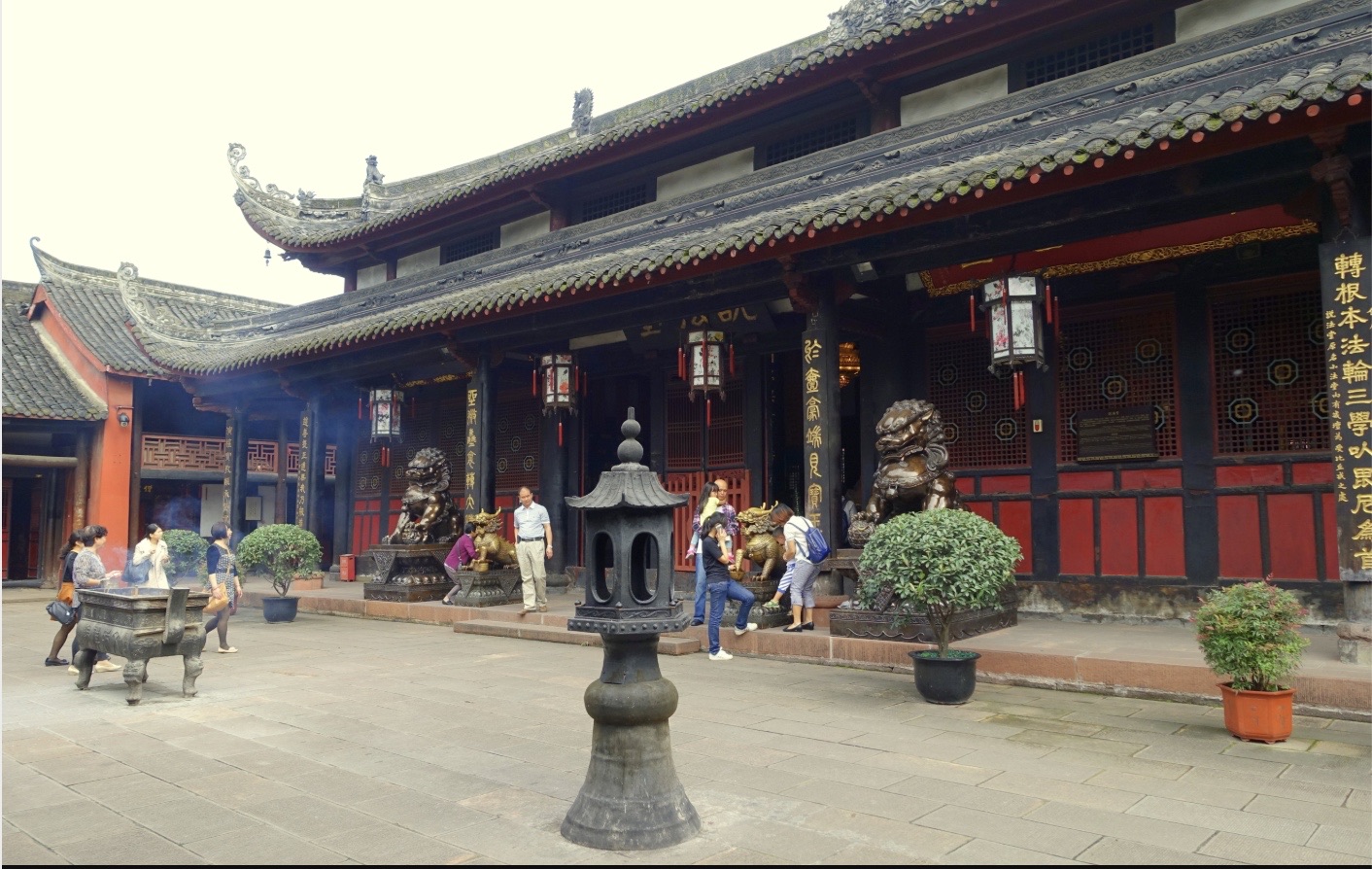
The Mahavira Hall is the third hall on the central axis, originally built by Chan Master Cidu and rebuilt by Abbot Zhangbai. Standing 10.56 m tall in single-eaved Xieshan style, it is the largest and highest-ranked hall in the monastery. The central glass shrine houses a bronze Sakyamuni Buddha cast in 1829, flanked by bronze Kasyapa and Ananda figures—the most important Qing-dynasty bronze trio in the monastery and part of the "Eight Views of Konglin." Two Burmese jade Buddhas brought back in 1923 and 1938 by monks Xinglin and Dengyun sit in the shrine ("Burmese Jade in the Shrine"). Two ancient fir trees, each 15 m tall, stand behind the hall: descendants of the firs that flanked the old gate and under which Master Cidu took shelter ("Twin Firs Auspicious"). Free incense is provided—one stick per person, taken with both hands.

On-site narration · read it where you stand

We have now reached the heart of Wenshu Monastery — the Mahavira Hall, the third of the six halls and the most magnificent structure in the entire complex. It stands 10.56 meters tall under a single-eave hip-and-gable roof — one of the highest categories of roof style in Chinese classical architecture, reserved for buildings of special importance.

Step inside and look straight ahead: the golden seated statue at the center is Shakyamuni Buddha, cast in bronze in 1829 during the Daoguang reign. Flanking the Buddha stand his two great disciples — the elder is Mahakashyapa, and the younger is Ananda — both also cast in bronze. Mahakashyapa was renowned for his ascetic practice and is honored as the first patriarch of Chan Buddhism. Ananda was known as "foremost in hearing much," meaning he had an extraordinary memory. The opening phrase of every Buddhist sutra — "Thus have I heard" — is attributed to Ananda, who recited the Buddha's teachings from memory when the scriptures were first compiled.

Please walk around to the sides of the altar — here you will find a Burmese jade Buddha enshrined on each side. The one on the left was brought back from Burma by the monk Xingling in 1923; the one on the right was brought from the Great Shwedagon Pagoda in Burma by the monk Dengyun in 1938. Sichuan is one of China's provinces closest to Burma, and since ancient times the Southern Silk Road has run from Chengdu through Yunnan to Burma and India. It is entirely natural, then, that temples in this region would enshrine Burmese jade Buddhas. Protected by generations of monks at Wenshu Monastery, these two statues remain in perfect condition. They are counted among the "Eight Wonders of Kong Lin" under the name "Burmese Jade Adorning the Shrine."

Now look up at the walls of the Mahavira Hall — on the bricks along both sides are 518 carved images of the Five Hundred Arhats, created during the Qing dynasty. Each arhat has a distinct expression and posture. Qing craftsmen carved these figures one by one in shallow relief on gray bricks, with fluid, expressive lines, and they have survived intact to the present day. It is a remarkable achievement in architectural decorative art.

In a corner of the hall there is an iron plaque bearing the character for "blessing," and many visitors give it a rub — a small Chengdu custom known as "touching fortune," the idea being that you carry a little of that good luck home with you. Feel free to try it yourself.

Thousand Buddhas Peace Pagoda and Stele Corridor

千佛和平塔与碑廊

The Thousand-Buddha Peace Pagoda stands in the eastern courtyard between the Canon Library and Wenshu Pavilion. Built in 1988, it was inscribed and coupleted by Zhao Puchu, then president of the Buddhist Association of China. The six-sided, eleven-story iron pagoda rises 21 meters and bears 1,000 cast Buddha images. Six dragons crown the spire with bells that ring in the wind. The east, west, and north sides are lined with stele corridors displaying dozens of stone tablets—Qing imperial and official inscriptions, poems by the monastery's abbots Cidu, Benyuan, Xuanlin, Nenghai, Biannen, and Weixian, and Buddhist maxims. The two-tiered surrounding walls are decorated with four-season floral motifs and bas-reliefs of the Journey to the West, symbolizing the two-way transmission of dharma along the Silk Road. Ginkgo, camphor, plum, and magnolia trees frame the pagoda, making it the monastery's most contemplative garden.

On-site narration · read it where you stand

Heading east from the Wenshu Pavilion, we reach the Thousand-Buddha Peace Pagoda. Built in 1988, it was the most significant new construction project undertaken at Wenshu Monastery since the founding of the People's Republic. The pagoda's name was inscribed and a dedicatory couplet composed by the late Zhao Puchu, former president of the Buddhist Association of China.

Take a close look at this pagoda: it is hexagonal, eleven stories tall, and stands 21 meters high in total — an iron-cast Buddhist tower. Arranged neatly across its surface are 1,000 Buddha images, each roughly the size of a human palm, covering every face of every tier from top to bottom. In Buddhism, "one thousand Buddhas" carries deep significance — it symbolizes the boundlessness of the Dharma and the all-pervasive radiance of Buddha light. At the very top, six dragons hold small bronze bells in their mouths; when the wind blows, the bells ring out with a clear, pure sound. This is "the bells proclaiming the Dharma" — even the wind becomes a teacher.

Please walk around the base of the pagoda — the low outer wall is decorated with vivid relief carvings depicting scenes from "Journey to the West." The Tang Priest on his pilgrimage, the Monkey King battling the White Bone Spirit, Zhu Bajie carrying his bride on his back — stories familiar to every Chinese person, carved in stone and wrapping around the pagoda. Placing "Journey to the West" imagery around a Buddhist pagoda is an inspired choice: the novel is itself a Buddhist classic in mythological dress, a story about going west to retrieve scripture, and this pagoda is itself a symbol of scripture. The two belong together naturally.

The pagoda is flanked on the east, west, and north sides by stele corridors. Set into the walls are stone inscriptions — couplets and verse tributes presented to Wenshu Monastery by the imperial family, officials, and scholars since the Qing dynasty, as well as brushwork by eminent monks across the generations. The inscriptions cover a wide range: some praise the Dharma, some record the history of the monastery's construction, and some are purely personal poems. Walking the full length of the stele corridors is something like reading through three hundred years of Wenshu Monastery's cultural guestbook. The corridors are cool, shaded, and rarely crowded — if you want a quiet moment away from the flow of visitors, this is the monastery's best-kept secret.

Hall of Three Great Beings (Guanyin Hall)

三大士殿(观音殿)

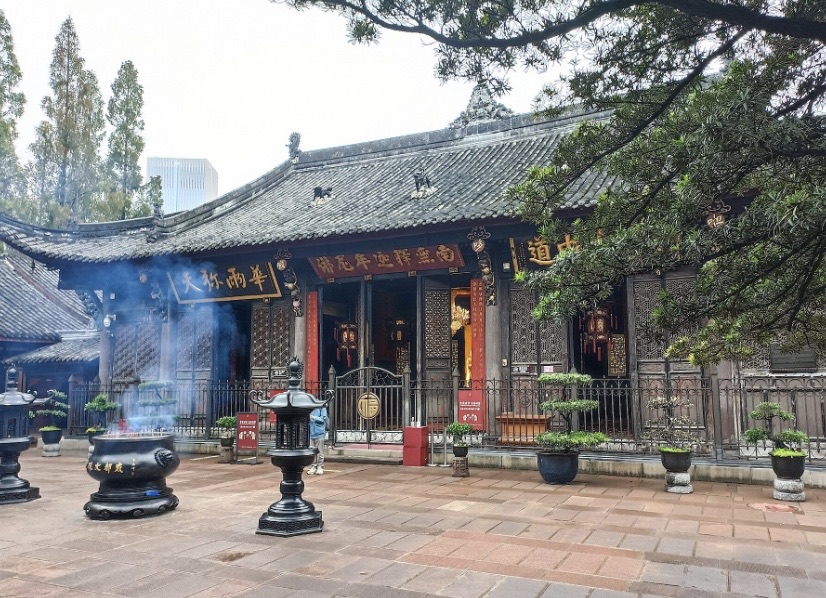
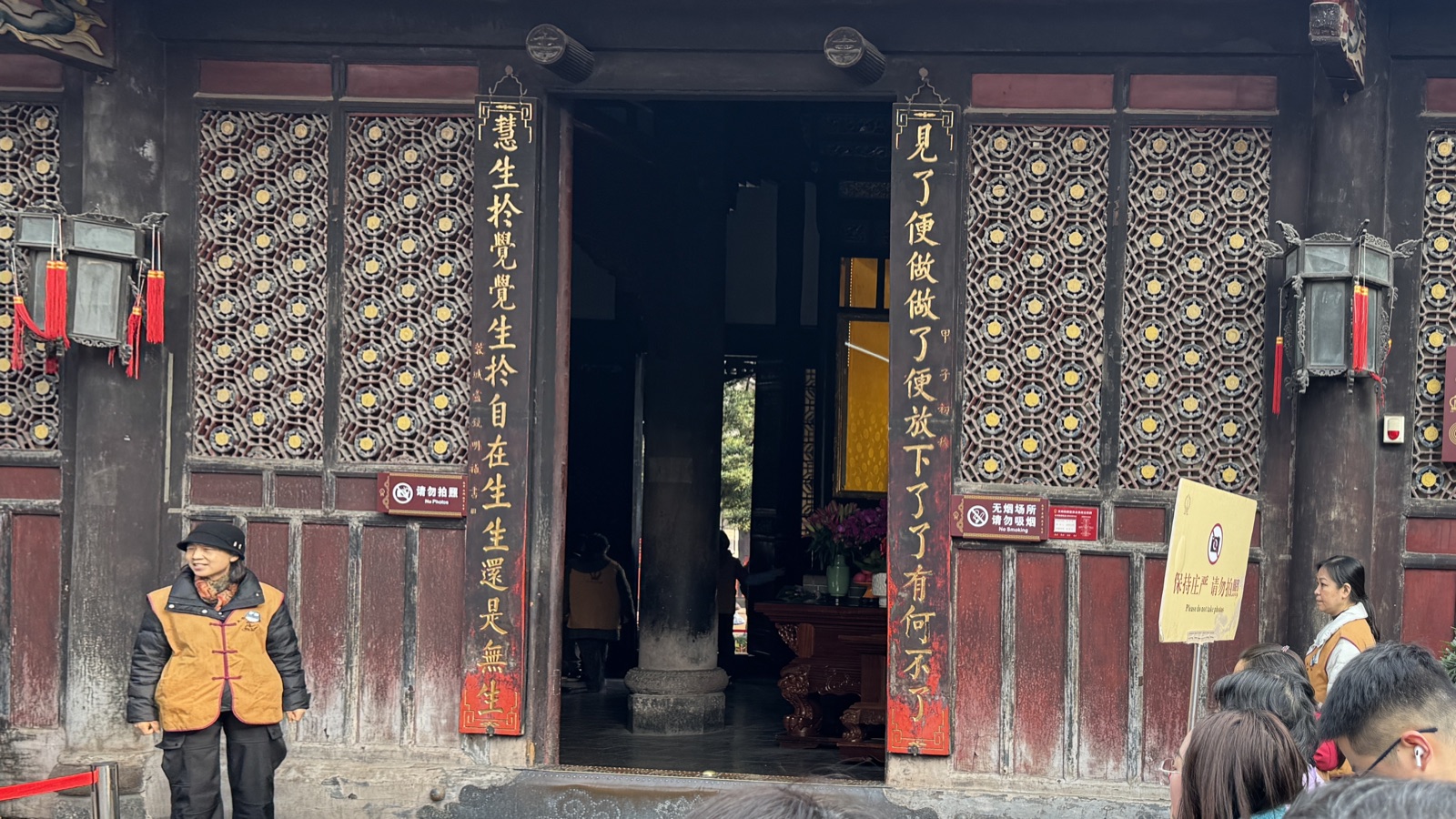
The Hall of the Three Great Beings, also called the Hall of Guanyin, is the second hall on the central axis and the only one of the six that retains its original 1697 Kangxi-period structure. Three principal statues stand on a central platform: Manjushri on a blue lion (wisdom), Guanyin holding a willow branch and pure-water vase (compassion), and Samantabhadra on a white elephant (vow and action). Side bays house Wenchang Dijun and Saintly Lord Guan, reflecting the late-imperial Sichuanese fusion of Buddhist, Daoist, and Confucian popular devotion. Behind the hall stands the bronze Weituo guardian, cast by Abbot Benyuan in 1829. The lintel couplet by late-Qing Chengdu literatus Fang Hezhai—"What is done let be done, what is let go let be let go, what ends, ends; wisdom is born of awakening, awakening is born of ease, what arises, arises and yet does not arise"—expresses the Chan spirit of resolving the matter at hand.

On-site narration · read it where you stand

Following the walkway forward, we arrive at the second hall — the Hall of Three Great Bodhisattvas, also known as the Guanyin Hall. Built in 1697 during the Kangxi reign, the hall spans five bays wide and three bays deep, standing ten meters tall. It is one of the oldest surviving structures at Wenshu Monastery.

Step inside and look at the three bronze statues at the center — these are the "Three Great Bodhisattvas": Guanyin Bodhisattva in the middle, Manjushri Bodhisattva on the left, and Samantabhadra Bodhisattva on the right. All three were cast in 1829 during the Daoguang reign, nearly two hundred years ago. The Manjushri statue on the far left is even older — it was sculpted in 1697, and stands 2.14 meters tall. This is the first place in the monastery to pay respects to Manjushri. What is Manjushri's place in Buddhism? He is the bodhisattva of supreme wisdom, depicted riding a blue lion and holding a sword. The sword cuts through delusion and suffering; the lion embodies the ferocity of wisdom. Every year around the time of middle school and university entrance exams, many parents and students make a special trip to Wenshu Monastery to pray before Manjushri for success in their studies.

Notice that both sides of the hall also enshrine Wenchang, the God of Literature, and Guan Yu, the God of War. This is fascinating — Wenchang is a Taoist deity of literary fortune, while Guan Yu is venerated both in Taoism as a divine ruler and in Buddhism as the bodhisattva Qielan. A Buddhist hall that simultaneously enshrines Taoist and Confucian figures: this is called the "fusion of the three teachings," and it is a cultural phenomenon unique to Sichuan.

Standing behind the altar is Skanda, the guardian deity of the Dharma. He holds the demon-subduing vajra club and faces toward the Mahavira Hall. In Chinese Buddhism, the way Skanda stands carries a specific meaning: if the club rests on his shoulder, it signals a major monastery that will lodge traveling monks for three nights free of charge; if the club is held horizontally across his chest, it indicates a mid-sized temple that offers one night's lodging; if the club is planted on the ground, it is a small temple that does not host overnight guests. See if you can spot Skanda's posture as you move through the monastery.

Finally, don't miss the couplet in front of this hall — it is the most celebrated couplet in the entire monastery, composed by the late-Qing Chengdu scholar Fang Hezhai: "See it, then do it; once done, let it go — when all is finished, what is there left to finish? Wisdom is born from awakening; awakening is born from ease — life arising endlessly is, in truth, no arising at all." The upper line is about action: do what needs to be done, then release it — stop dwelling on it. The lower line is about wisdom: wisdom grows from awakening, awakening grows from a free and easeful heart, and true ease is the realization that life and death are not what they seem. The couplet's brilliance also lies in its form: the character for "finish" recurs five times in the upper line, and the character for "life" or "arise" recurs five times in the lower line — a rare and masterly rhetorical device known in Chinese literary tradition as a "repeating-character couplet."

Mountain Gate (Hall of Heavenly Kings)

山门(天王殿)

The Main Gate / Hall of Heavenly Kings is the first hall on the central axis, originally built by Chan Master Cidu and rebuilt by Abbot Benyuan, facing south with a five-bay facade in classic Kangxi–Daoguang Sichuanese style. The gate and hall are combined: the two Heng-Ha guardians stand at the door, Maitreya is enshrined at the center (with Weituo behind), and the Four Heavenly Kings—Dhṛtarāṣṭra, Virūḍhaka, Virūpākṣa, and Vaiśravaṇa—flank the hall, each holding a sword, pipa, parasol, or serpent/dragon to symbolize favorable weather. The pillars bear the couplet by Qing abbot Fu Wenjiwei. In front, the three-story Drum and Bell towers face each other: the bell tower houses a 4,500+ kg Qing-dynasty bronze bell, the drum tower its great drum. Their morning bell and evening drum mark the monastic schedule and ritual calendar.

On-site narration · read it where you stand

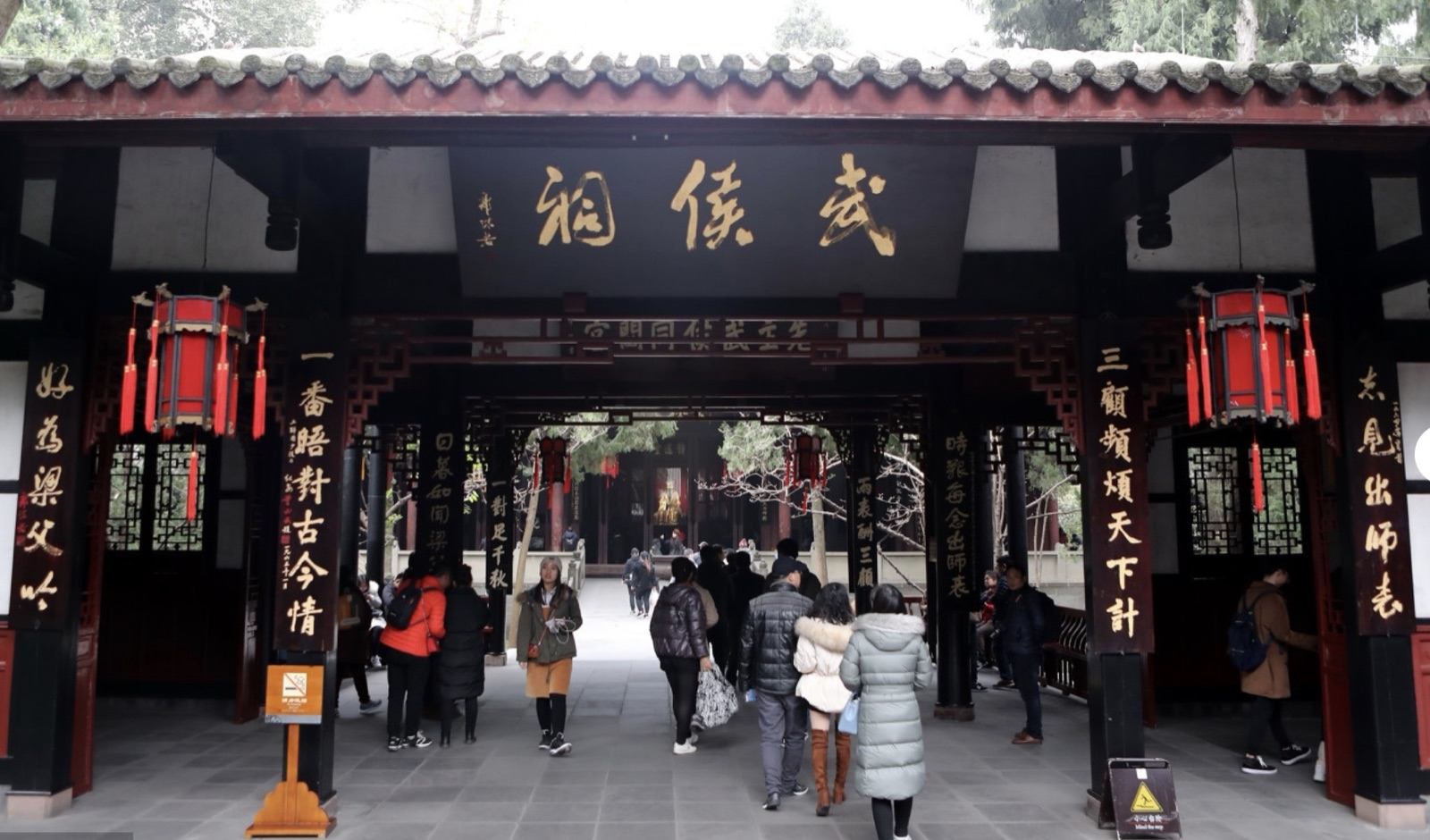
We are now stepping into Wenshu Monastery. Look up at the plaque above the Mountain Gate — it reads "Ancient Xinxiang Temple," a reminder of this place's origins. The Mountain Gate and the Heavenly Kings Hall are combined into a single structure here, which is typical of temples across the western Chengdu Plain: the first hall you enter through the gate is the Heavenly Kings Hall.

The first figure you see upon entering is Maitreya Bodhisattva, seated in the center — the beloved "big-bellied Buddha" familiar to everyone. He beams at every visitor who comes through the door, and behind him hangs a couplet that reads: "His great belly encompasses the present lord of Tushita Heaven; his smile, all-embracing, greets the future Buddha who will come into this world." The couplet tells us that Maitreya is now the master of Tushita Heaven, and that he will one day descend to this world to attain Buddhahood — this is what Buddhism calls the "future Buddha Maitreya who will come to be born in the world."

Look to your left and right — these two towering, powerful vajra guardians, one with his mouth open and one with it closed, are the Twin Generals known as Heng and Ha. The open-mouthed one is Mijiji Vajra; the closed-mouthed one is Luoyan Vajra. In Chinese folk tradition, these two are the guardian gods of Buddhist temples — one exhales white light through his nose, the other breathes out yellow mist from his mouth, and together they vanquish demons and evil. In Buddhist teaching, they represent two stages of practice: the open mouth of "Heng" symbolizes the spoken path — chanting sutras and reciting the Buddha's name; the closed mouth of "Ha" represents the entry into silent meditation. In a single breath — one sound and one silence, one motion and one stillness — the essence of the Dharma is already present.

Standing on both sides of the Heavenly Kings Hall are the Four Heavenly Kings: the one holding a sword is Virudhaka, King of the South, whose sword represents "wind"; the one playing a lute is Dhritarashtra, King of the East, whose tuning of strings represents "harmony" or "tune"; the one holding a parasol is Vaishravana, King of the North, whose parasol represents "rain"; and the one holding a dragon is Virupaksha, King of the West, whose dragon scales represent "smooth" or "following." Taken together, these four symbols spell out a timeless blessing: "wind and rain in their proper season" — the Chinese phrase for peace, good harvests, and prosperity. It is a beautiful example of how ordinary people's deepest hopes for a stable and bountiful life were woven seamlessly into the guardianship of Buddhist teaching.

Passing through the Heavenly Kings Hall, take a moment to look up at the eaves. All the buildings at Wenshu Monastery follow the traditional architectural style of the western Chengdu Plain — timber frame construction, with columns of local Xiashi stone. Notice the covered walkways connecting the halls. These corridors link all six halls into a unified whole, forming an enclosed courtyard. In Sichuan, this design is called the "horse-circle corner tower" style, and it means you can walk from the very first hall to the very last without an umbrella on a rainy day — a remarkably practical design.

Dharma Hall (Medicine Buddha Hall)

说法堂(药师殿)

The Dharma Hall, also called the Hall of Bhaisajyaguru, is the fourth hall on the central axis and is said to occupy the site of the original Tang-era Xinxiang Monastery. A double-eaved Xieshan Qing-dynasty building, it contains a brick ordination platform used for precepts ceremonies, lay refuge, and sutra lectures. At center, beneath a jeweled canopy, sits Bhaisajyaguru, the Medicine Buddha of the eastern Lapis Lazuli world, flanked by the twelve yakṣa generals—each guarding one of the twelve traditional double-hours and zodiac animals. The back wall bears the Kangxi Emperor's 1702 inscription "Konglin" (Empty Forest)—the calligraphic origin of the monastery's alternate name "Konglin Tang" and the first of the "Eight Views of Konglin." The Sichuanese-style Buddhist chanting preserved here was inscribed on Chengdu's seventh intangible cultural heritage list in 2021.

On-site narration · read it where you stand

Passing through the Mahavira Hall, we arrive at the fourth hall — the Dharma Hall, also known as the Medicine Buddha Hall. This is a double-eave hip-and-gable structure, adding an extra tier of eaves compared to the halls we've seen before — a higher architectural rank. Tradition holds that this very site is where the original Xinxiang Temple once stood, and that more than a thousand years ago, the earliest monks here gave their first teachings on the Dharma.

Step inside the Dharma Hall and look at the two large characters mounted on the center wall — "Kong Lin," meaning Empty Grove. These are the very words brushed by Emperor Kangxi in 1702, sent all the way from Beijing to Chengdu by imperial courier. The red seal pressed in the middle of the characters reads "Imperial Brush of Kangxi's Own Hand." To the left is inscribed "The middle month of winter, the ren-wu year of the forty-first year of Kangxi's reign," and to the right, "Bestowed upon the monk Chao Cun of Wenshu Monastery in Sichuan" — Chao Cun being Master Cidu's dharma name. This plaque is first among the "Eight Wonders of Kong Lin" — "Gazing at the Plaque Bestowed by Heaven" — meaning a plaque written by the Son of Heaven, revered as if it were an imperial proclamation. A plaque that traveled from the Forbidden City in Beijing to the Qingyang district of Chengdu, preserved for three hundred years — look at it, and history feels like it's hanging right before your eyes.

Beneath the canopy at the center of the hall is Bhaisajyaguru, the Medicine Buddha — known in full as the Lapis Lazuli Light Tathagata. Flanking the Medicine Buddha are the Twelve Yaksha Generals, who have each vowed to protect the Medicine Buddha's teachings and to alleviate a specific form of illness and suffering. In Chinese popular tradition, the Medicine Buddha is called the "Disaster-Dispelling, Life-Prolonging Medicine Buddha," and many people come here to pray for good health.

Look now at the floor in the center of the hall — this is a brick-built ordination platform. An ordination platform is a solemn place where Buddhist precepts are formally conferred. In Chinese Buddhism, only monasteries of sufficient size and standing are permitted to maintain one. As "foremost of the four great Chan temples along the Yangtze River," Wenshu Monastery has produced eminent monks across generations — Master Taixu and Master Nenghai, two of the most influential Buddhist figures of modern times, both lectured and transmitted precepts here. This ordination platform has witnessed three centuries of Buddhist precept lineage across Sichuan and the entire southwest of China.

Manjushri Pavilion

文殊阁

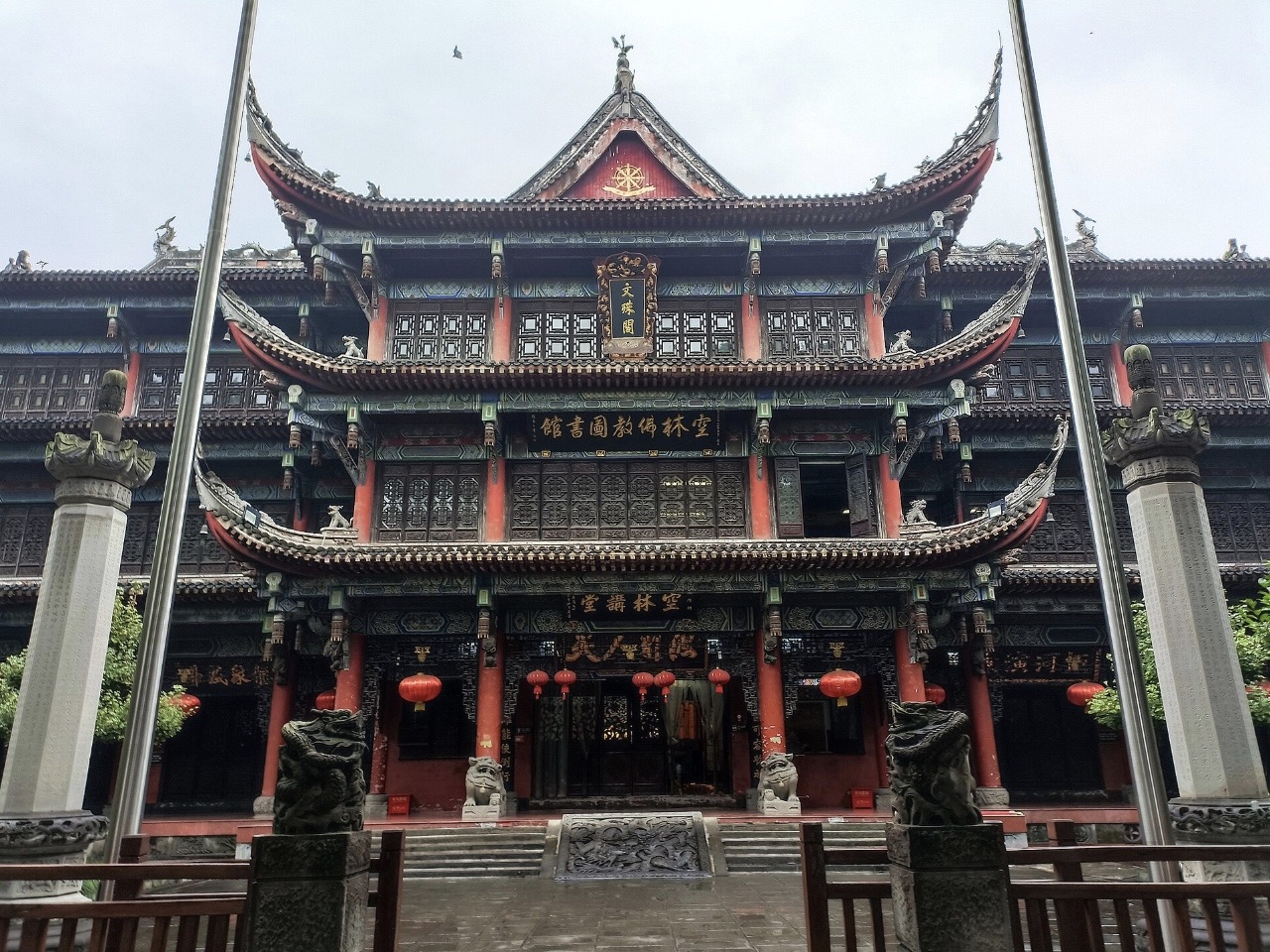
Wenshu Pavilion stands at the northernmost end of the central axis. Built in 1997 under the 17th abbot Xuanlin, it occupies about 1,000 square meters in a three-story Qing-style double-eave structure. The first floor, the "Konglin Lecture Hall," seats several hundred for dharma talks, meditation, and Chan practice. The second floor houses the "Konglin Buddhist Library," with sutras, modern Buddhist scholarship, and journals for both laypeople and researchers. The third floor, the "Ten-Thousand-Buddha Hall," enshrines the central principal Buddha surrounded by a thousand Buddhas on the four walls, creating the monastery's most contemplative space. The pavilion closes the central axis and complements the five earlier historic halls, forming a "front-court, rear-market" plan that joins devotional and cultural functions.

On-site narration · read it where you stand

Continuing along the central axis, we come to the last structure in the main sequence — the Wenshu Pavilion. Built in 1997 under the guidance of the seventeenth-generation abbot, the Venerable Kuanlin, it stands at the northernmost point of the central axis and covers a footprint of 1,000 square meters, making it the largest single building at Wenshu Monastery.

The Wenshu Pavilion has three floors. The first floor is the Kong Lin Lecture Hall, a space for teaching and expounding the Dharma to devotees. The second floor is the Kong Lin Buddhist Library, which holds tens of thousands of volumes of Buddhist scriptures and scholarly works and is open to researchers. The third floor is the Hall of Ten Thousand Buddhas, enshrining ten thousand small Buddha statues — a breathtaking expanse of golden light.

Standing before the Wenshu Pavilion and looking back along the central axis, you can trace the entire route: from the spirit screen, through the Heavenly Kings Hall, the Hall of Three Great Bodhisattvas, the Mahavira Hall, the Dharma Hall, and the Scripture Repository, all the way here to the Wenshu Pavilion — six halls rising in gradual succession, each stepping higher in scale and depth of meaning. This is one of the most important principles of traditional Chinese architecture: the further in you walk, the more elevated the buildings become and the richer the meaning grows. The whole central axis is like a long handscroll: each hall is a chapter, and the Wenshu Pavilion is its closing flourish.

Around the Wenshu Pavilion grow many century-old ginkgo trees. In autumn especially, they turn a brilliant gold that glows against the gray tiles and red walls — a wonderful setting for photographs. If you are visiting in autumn, consider lingering here at dusk: the warm, soft light, fallen ginkgo leaves carpeting the ground, and the quiet that settles over this corner of the monastery — it is the kind of stillness that makes you feel an afternoon spent simply sitting here would not be wasted at all.

Garden and Life-Release Pond

园林与放生池

The Wenshu Monastery gardens center on the east and west gardens flanking the central axis and the Release Pond—landscaped together with the Thousand-Buddha Pagoda in 1988. The Release Pond sits between the Hall of Heavenly Kings and the Mahavira Hall in an irregular L shape, home to koi, goldfish, and turtles, with water lilies, calamus, and willows along the banks; a Qing-era "Release Pond" stele stands on the north bank in Manchu and Chinese. The Tingsong Waterside Pavilion on the west bank responds visually to the Bell and Drum towers. The east garden ("Hearing and Reflecting") and west garden ("Cultivating and Realizing") flank the central axis, with Taihu rocks, ginkgo, camphor, plum, magnolia, crepe myrtle, and paths of bamboo. Covered corridors tie the halls, gardens, and the Peace Pagoda into a single meandering composition. The two ancient firs at the rear of the Mahavira Hall, said to mark Master Cidu's hermitage, are the "Twin Firs Auspicious" of the "Eight Views of Konglin."

On-site narration · read it where you stand

Continuing past the Thousand-Buddha Pagoda, we enter the monastery's back garden. Wenshu Monastery covers more than 200,000 square meters in total, and the garden takes up a generous share of that. Over the years, the monastery has planted thousands of ginkgo trees, camphor trees, plum blossoms, and magnolias. The colors shift completely with the seasons: in spring, white magnolia and pink plum blossom; in summer, the camphor trees cast a cool shade over the entire complex; in autumn, fallen ginkgo leaves paint the ground gold; in winter, winter-sweet flowers release their quiet fragrance into the cold air.

At the heart of the back garden is the Life Release Pond. Life release — freeing captured animals and returning them to nature — is one of Buddhism's most important expressions of compassion. Shoals of koi drift through the water; turtles bask on the rocks in the sun. These simple scenes carry the monastery's deepest message about the value of every living being.

Beside the Life Release Pond stand two camphor trees that deserve a mention. The two trees you see now were replanted in 1963 after the originals died, but they carry a special meaning at Wenshu Monastery. It was between two ancient camphor trees that Master Cidu built his thatched shelter and began his years of solitary practice — these trees stand as witnesses to the very moment of the monastery's rebirth. They are counted among the Eight Wonders of Kong Lin as "The Twin Camphor Trees as Auspicious Signs." The original trees are long gone, but the location is unchanged and the species is the same. Standing here, you can imagine a monk three hundred years ago laying down a grass mat between two trees and sitting, day after day, in perfect stillness.

Main Gate (Screen Wall)

正门(照壁)

The front gate and spirit wall stand at the south end of the Wenshu Monastery central axis, the first visual anchor before visitors reach the main gate. About 8 metres high and shaped like the Chinese character for "pin" in brick and stone, the wall bears the monastery name and a couplet meaning "wisdom deep as heaven and earth, lineage surpassing past and present," said to be in the hand of Chan Master Cidu of the Kangxi reign. The wall faces the city street on one side and the temple gate on the other—a classic Chinese monastic gesture of modesty and containment. Two side gates flank the central entrance, and the temple itself is open and free, with public transit and the city road reaching right up to the wall.

On-site narration · read it where you stand

Friends, our tour of Wenshu Monastery comes to a close here. Let's retrace the route we've walked today: the spirit screen, the Mountain Gate, the Hall of Three Great Bodhisattvas, the Mahavira Hall, the Dharma Hall, the Scripture Repository, the Wenshu Pavilion, the Thousand-Buddha Peace Pagoda, the stele corridors, the garden, and the tea courtyard.

Let me leave you with three thoughts to carry home — three ways to remember what Wenshu Monastery is really about.

First: Wenshu Monastery is a living, thousand-year-old temple. From the Sui-dynasty Xinxiang Temple to the Qing-dynasty Wenshu Monastery to what you see today, 1,400 years of incense have never truly been extinguished. The stone slabs beneath your feet may well be the same ones monks walked every day during the reign of Emperor Kangxi.

Second: the soul of Wenshu Monastery lives in its details. Fang Hezhai's couplet about doing and letting go; Emperor Kangxi's personal brushwork of "Kong Lin"; the blood-ink scriptures of generations of devoted monks; the 248 Buddha figures stitched by hand into Lady Tian's kasaya robe — none of these are cold artifacts. Behind every one of them is a human story.

Third: Wenshu Monastery is a place not just to "pray" but to "linger." Free admission. A cup of tea for an afternoon. A vegetarian meal that becomes a meditation. It is both a solemn place of Buddhist practice and an everyday backyard for the people of Chengdu. This is the most distinctive quality of Chinese temples: between the sacred and the ordinary, there is no high wall — only a door that is always open.

The exit is back toward the main gate. Once outside, you'll find yourself in the Wenshufang neighborhood, with many local Chengdu snack shops and cultural boutiques to explore. From here, you might head to the nearby Kuanzhai Alley district to experience the city's traditional lane culture, or take the metro to Chunxi Road to feel the pulse of modern Chengdu's commercial heart.

Thank you so much for joining us today. Wishing you safe travels, a peaceful mind, and always a road worth walking.

Prefer to be shown around?

A local guide walks these 10 stops with you and answers what the page cannot.

Chengdu tours ↗