No. 7 Tiantan Neidong Li, Dongcheng District, Beijing (east side of Yongdingmen Inner Street)
Practical infoOpening hours · Ticket · Getting there
Opening hours
Peak season (April 1-October 31): 06:00-21:00 (attraction ticket sales deadline is 20:00, last entry at 17:30)
Off season (November 1-March 31 next year): 06:30-21:00 (attraction ticket sales deadline is 19:00, last entry at 16:30)
Opening hours for Hall of Prayer for Good Harvests, Echo Wall, Circular Mound Altar: 08:00-17:30 (peak season) / 08:00-17:00 (off season)
Note: The best visiting time for Tiantan is early morning or evening, when you can avoid tour groups and experience the leisure life of old Beijing citizens; there will be a light show at the Hall of Prayer for Good Harvests at night (separate ticket purchase required), which is an excellent spot for taking photos and checking in
Ticket
Peak season (April 1-October 31): 15 RMB/person (including Hall of Prayer for Good Harvests, Echo Wall, Circular Mound Altar)
Off season (November 1-March 31 next year): 10 RMB/person (including Hall of Prayer for Good Harvests, Echo Wall, Circular Mound Altar)
Hall of Prayer for Good Harvests, Echo Wall, Circular Mound Altar: Separate tickets required for entry (already included in combo ticket)
Discounted Tickets: Students, seniors (over 60), military personnel, etc. can enjoy half-price or free admission with valid ID
Note: It is recommended to purchase tickets in advance on the official website or WeChat account for discounts and to avoid on-site queuing; Tiantan covers a large area, so it is recommended to allow 2-3 hours for visiting; if you want to experience the leisure life of old Beijing citizens, it is recommended to go in the early morning or evening
Getting there
Rail Transit:
Subway Line 5: Get off at Tiantan East Gate Station, exit from Exit A (Northwest Exit) or Exit B (Southeast Exit) to reach Tiantan East Gate directly
Subway Line 14: Get off at Jingtai Station, walk about 10 minutes from Exit C (Southeast Exit) to Tiantan South Gate
Subway Line 8: Get off at Tianqiao Station, walk about 15 minutes from Exit A (Northwest Exit) to Tiantan West Gate
Bus:
Tiantan East Gate Station: Take buses 6, 34, 35, 36, 39, 41, 43, 60, 116, 128, 525, 610, 684, 685, 707, 814, 958, Special 11, Special 30, etc., get off and arrive directly
Tiantan South Gate Station: Take buses 53, 122, 525, 830, 958, Special 3, Special 11, Special 30, etc., get off and arrive directly
Tiantan West Gate Station: Take buses 2, 20, 35, 36, 69, 71, 93, 120, 210, 610, 707, 729, 814, Special 11, etc., get off and arrive directly
Tiantan North Gate Station: Take buses 6, 34, 35, 36, 72, 106, 110, 687, 707, 743, 814, Special 11, etc., get off and arrive directly
Taxi/Ride-hailing: Directly tell the driver "Tiantan"; you will arrive directly; it is recommended to enter from the East Gate or South Gate
Note: Transportation around Tiantan is extremely convenient, with dense rail transit and bus routes; it is strongly recommended to take public transportation; Tiantan has multiple entrances, and you can choose the most convenient entrance to enter according to your subsequent itinerary arrangements
Inside Temple of Heaven
5 stops, in walking order — read top to bottom, no clicking needed.
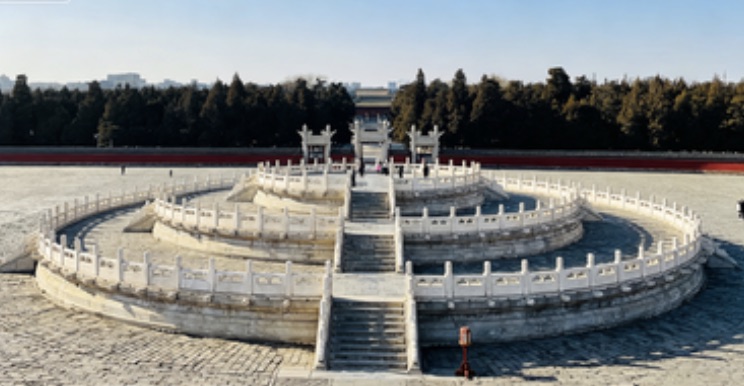
The Circular Mound Altar is the core sacrificial structure in the southern part of the Temple of Heaven, first built in 1530 (Jiajing 9) and expanded in 1749 (Qianlong 14). It is a three-tiered open-air circular stone platform constructed entirely of white marble; the number of balustrade panels and steps on each tier is always nine or a multiple of nine—the supreme yang number symbolizing the highest authority of the Lord of Heaven. At the centre of the top tier lies a round "Heart of Heaven" stone; speaking from it, sound waves reflect from the surrounding balustrades and converge back, creating a startling amplification as if Heaven itself replies. Two concentric enclosure walls surround the altar—inner circular, outer square—echoing the ancient cosmology of "round heaven, square earth." At dawn on the winter solstice the emperor conducted the grand sacrifice, burning offerings and reading prayers with solemn reverence. Though roofless, the altar expresses awe and understanding of Heaven through pure geometry and number—the pinnacle of Chinese ritual architecture.
On-site narration · read it where you stand
Welcome, everyone! Welcome to the Temple of Heaven in Beijing. Today we'll follow the officially recommended route — entering through the South Gate and visiting the Circular Mound Altar, the Echo Wall, the Divine Path, and the Hall of Praying for Good Harvests in sequence, before exiting through the North Gate.
First, let's talk about what this place actually is. The Temple of Heaven was where emperors of the Ming and Qing dynasties performed the rites of Heaven worship and prayed for a good harvest. Construction began in 1420, during the eighteenth year of the Yongle Emperor's reign. The park covers 273 hectares — four times the size of the Forbidden City. What makes the Temple of Heaven truly remarkable is the philosophy behind its design: it embodies the ancient concept of "heaven is round, earth is square" — circular in the north, square in the south — symbolizing the harmonious unity of heaven and earth. The emperor's ceremonial procession moved from south to north along this central axis: from earth, toward heaven.
We are now standing at the Circular Mound Altar, at the southern end of the complex — the very place where the emperor conducted the Grand Rites of Heaven on the winter solstice. Built in 1530, during the ninth year of the Jiajing Emperor's reign, it consists of three concentric terraces of white marble. This altar encodes the mystery of the number nine at every turn: in ancient China, nine was the highest yang number and represented heaven, so every dimension here — the number of stone steps, the diameter of each terrace, the count of balustrade panels — is nine or a multiple of nine. Each tier has nine steps; the diameter of the upper platform is nine zhang. Layer upon layer, it evokes the "nine heavens," expressing the ancient reverence for the sky at its most absolute.
Please make your way to the round stone slab at the very center of the altar — this is the famous Heavenly Heart Stone. Stand on it and speak at normal volume. You'll notice your voice sounds noticeably louder and fuller. This is no illusion — the Heavenly Heart Stone sits at the exact center of the circular altar. Sound radiates outward in all directions, reflects off the surrounding ring of balustrades, and bounces back to the same point, layering on top of your original voice and amplifying it. It is a masterpiece of ancient Chinese acoustic engineering. The emperor once stood on this very stone to address the heavens — his voice echoing back as if it truly reached the ears of the sky. After taking in the Circular Mound Altar, let's head north to something even more astonishing: the Echo Wall.
Imperial Vault of Heaven & Echo Wall
皇穹宇与回音壁
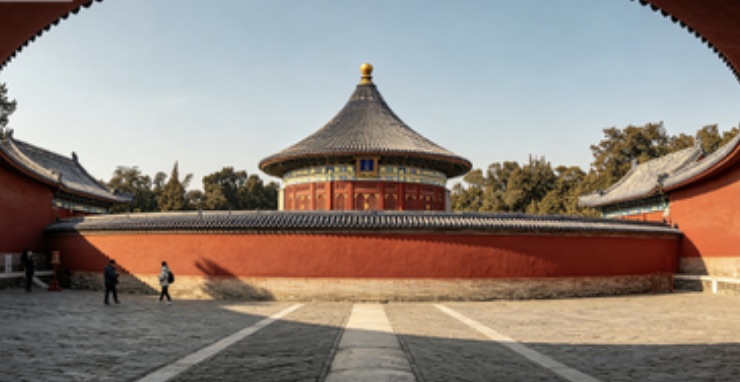
The Imperial Vault of Heaven stands north of the Circular Mound Altar, first built in 1530 (Jiajing 9) and rebuilt in 1752 (Qianlong 17). It is the hall where the tablet of the Lord of Heaven and ancestral spirit tablets were stored. A single-eaved circular structure with a conical roof under blue glazed tiles, it rises from a round stone platform—delicate and graceful, just 15.6 m in diameter yet displaying the sacred imagery of the celestial vault through perfect proportion and colour. The interior dome is beamless and columnless, supported entirely by intricate bracket sets—a masterwork of timber engineering. The circular enclosing wall outside is the celebrated Echo Wall—3.72 m high, 0.9 m thick, 195.2 m in circumference, with a triple-arched glazed doorway on each side. If two people stand at the rear of the east and west side halls and whisper against the wall, sound waves propagate along the smooth surface by successive reflection, and each hears the other clearly as though conversing across the wall—an acoustic analogue of optical reflection, a serendipitous masterpiece of ancient Chinese construction. The courtyard also contains "Three-Sound Stones"—clapping on them yields three echoes, adding further wonder.
On-site narration · read it where you stand
We've now arrived at the Imperial Vault of Heaven, just north of the Circular Mound Altar. This small circular hall, with its blue glazed tiles and gilded finial, is where the spirit tablets used in the Heaven worship ceremonies were kept on a permanent basis. The hall stands 19.5 meters tall and has a diameter of 15.6 meters. Step inside and look up at the ceiling — you'll find an elaborate caisson in tones of green and blue, with a magnificent gilded dragon at its center. The spirit tablets would be stored here throughout the year and ceremonially carried to the Circular Mound Altar for the winter solstice rites.
What made the Imperial Vault of Heaven truly famous, though, is the circular wall enclosing it — the Echo Wall. The wall stands 3.72 meters high and has a diameter of 65.2 meters. Its magic lies entirely in the craftsmanship: every brick was ground and fitted with seamless precision, leaving the surface extraordinarily smooth and even. Because of this, sound waves don't scatter when they strike the wall — instead they travel along its curved surface, hugging it all the way around. Give it a try: two people standing at the base of the east and west side halls — pressing close to the wall and speaking softly — can hear each other perfectly across a distance of 60 meters, even though they're completely out of sight of each other, almost like a phone call. That is where the name "Echo Wall" comes from, and it is a brilliant application of acoustic principles by the ancient builders. After experiencing this extraordinary wall, we'll make our way onto the central axis of the Temple of Heaven — the Divine Path.
Danbi Bridge (Sacred Way Bridge)
丹陛桥
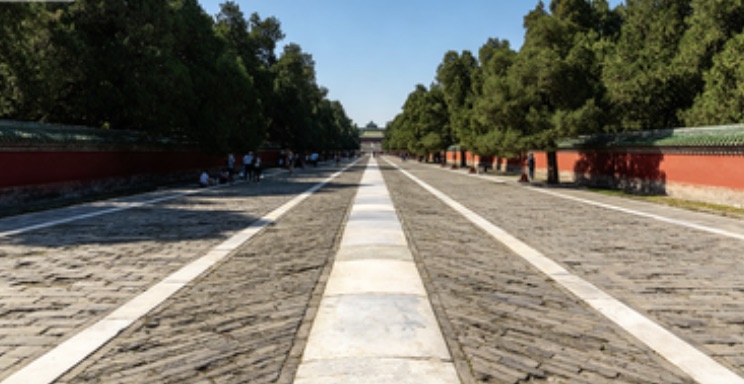
Danbi Bridge is the most prominent passageway on the Temple of Heaven's central axis, running from the Circular Mound Altar's north gate to the Hall of Prayer's south gate—about 360 m long and 28 m wide, paved in three parallel stone strips. The highest, central strip is the "Spirit Way," reserved for the tablet of the Lord of Heaven; the eastern strip is the "Imperial Way" for the emperor; the western is the "Princes' Way" for nobles and ministers—strict hierarchy, no trespassing. The surface rises gradually from south to north, symbolizing step-by-step ascent from the human realm toward heaven; walking it truly induces a sense of looking up at the sky with reverent awe. Ancient cypress trees flank both sides, centuries old, canopying like umbrellas—solemnity enriched by verdant vitality. Though called a "bridge," it is actually an elevated road rising 4 m above ground; beneath it ran a passage for sacrificial animals—a clever design. The entire sacred way, like a dragon's spine running north-south, binds the Circular Mound Altar and the Hall of Prayer into one ritual whole, the core axis of the Temple of Heaven's ceremonial space.
On-site narration · read it where you stand
The long, broad paved causeway we're walking on right now is the Divine Path — it connects the Circular Mound Altar to the south with the Hall of Praying for Good Harvests to the north. This raised walkway stretches 360 meters in total and sits approximately 4 meters above the ground on either side. It forms the central axis of the entire Temple of Heaven complex.
Look down at the pavement beneath your feet — the surface is actually divided into three distinct lanes, and each one has its own rules. The center lane, the most prestigious of the three, is the Divine Way, reserved for the spirit of Heaven alone. The eastern lane is the Imperial Way, for the emperor. The western lane was for princes and high officials. There's another detail worth noticing: the causeway rises gradually as you walk from south to north — from the Circular Mound Altar up toward the Hall of Praying for Good Harvests, the ground climbs steadily higher with every step. This symbolizes rising ever upward, step by step toward the heavens. So these 360 meters, short as they seem, are really a road to the sky. Cross the Divine Path, and ahead of you — that circular hall with the blue roof — is the star of the Temple of Heaven: the Hall of Praying for Good Harvests.
Hall of Prayer for Good Harvests
祈年殿
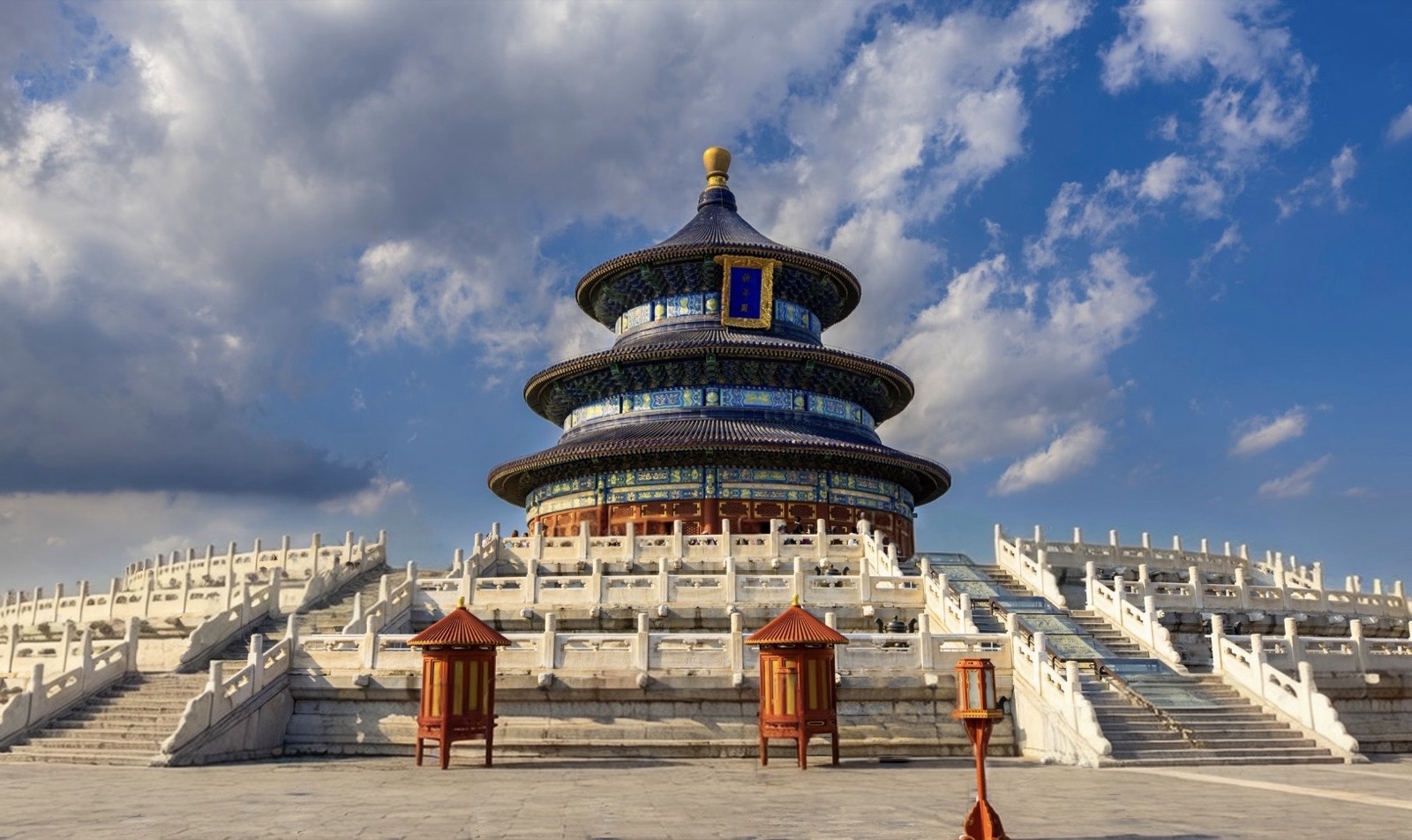
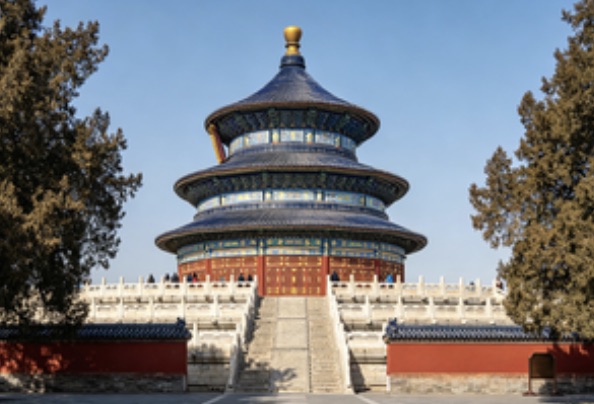
The Hall of Prayer for Good Harvests is the main hall in the northern part of the Temple of Heaven and its visual soul. First built in 1420 (Yongle 18) as "Great Sacrifice Hall," renamed "Great Offering Hall" under Jiajing, and given its present name in 1751 (Qianlong 16). It is a triple-eaved circular structure with a conical roof under blue glazed tiles, standing on a three-tiered white-marble circular platform—about 38 m high and 32 m in diameter. The interior is a structural marvel: 28 nanmu columns carry the dome without beams or nails, relying on mortise-and-tenon joints and bracket sets rising tier by tier. The inner ring of four "Dragon Well" columns symbolizes the four seasons; the middle ring of twelve "Golden" columns symbolizes the twelve months; the outer ring of twelve "Eave" columns symbolizes the twelve double-hours; the total of 28 implicitly echoes the twenty-four solar terms—space is time, building is cosmos. At the centre stands the tablet of the Lord of Heaven; on the first sin day of the first lunar month the emperor held the Praying-for-Harvest ceremony here, beseeching abundant crops. With its perfect circle, blue dome and ingenious structure, the Hall has become the symbol of Chinese ancient architecture and one of the most recognizable Chinese images among World Heritage sites.
On-site narration · read it where you stand
We've arrived at the most famous structure at the Temple of Heaven — the Hall of Praying for Good Harvests. This circular triple-eaved hall with its brilliant blue roof is where Ming and Qing emperors conducted the spring ceremony each year to pray for abundant harvests. It is the defining symbol of the entire complex.
Construction began in 1420, during the eighteenth year of the Yongle Emperor's reign. Originally built as a rectangular hall, it was redesigned into its current circular triple-eaved form in 1545, during the twenty-fourth year of the Jiajing Emperor's reign, and received its distinctive blue glazed tiles and gilded finial in 1751, the sixteenth year of the Qianlong Emperor. The hall stands 38.2 meters tall with a diameter of 24.2 meters. What is truly breathtaking about this structure is that its entire system of pillars encodes the Chinese conception of time in wood and stone. Step inside and look at the columns — the hall is supported by 28 pillars of golden-grain nanmu wood: the 4 innermost pillars, known as the "dragon-well columns," represent the four seasons; the 12 middle "golden columns" correspond to the twelve months of the year; the 12 outer "eave columns" represent the twelve two-hour periods of the traditional Chinese day; the middle and outer rings combined — 24 pillars — also correspond to the twenty-four solar terms; and all 28 together evoke the twenty-eight lunar mansions of the night sky. In other words, when you stand inside this hall, you are standing at the center of a universe built from timber.
The roof is covered in blue glazed tiles — blue symbolizing heaven. And there is one more detail that deserves particular admiration: this towering hall, from top to bottom, was assembled without a single nail. It holds together entirely through the traditional Chinese system of interlocking mortise-and-tenon joinery — and has stood for centuries. It is the pinnacle of ancient Chinese timber-frame architecture. On weekend evenings and major public holidays, the Hall of Praying for Good Harvests is illuminated, its blue-tiled roof and golden crown glowing against the night sky like a sacred hall bridging earth and heaven. With that, our visit to the Hall of Praying for Good Harvests — and very nearly our entire journey through the Temple of Heaven — is drawing to a close.
North Gate
北门
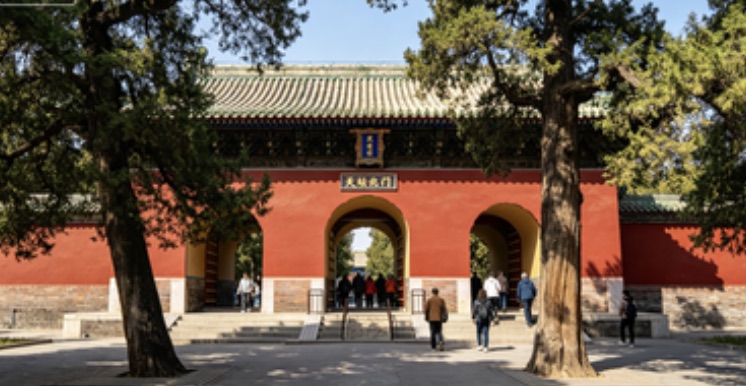
The North Gate sits on the park's north side, one of the main access points for the Hall of Prayer precinct. Its classical style features red walls and grey tiles; outside, ancient cypresses tower, their shade dense, seamlessly extending the park's landscape. Positioned close to the Hall of Prayer, exiting here after visiting the Hall is most convenient—no need to retrace southward. The path outside continues through a cypress grove, the air fragrant with pine and cedar; in spring blooming locust trees scent the whole approach. Walking east about 10 minutes from the gate reaches Subway Line 5's Tiantan East Gate station; west about 15 minutes reaches Qianmen Street and Tiananmen Square—prime positioning for connecting to other central-axis landmarks. Though less bustling than the East or West Gates, its quiet antiquity underscores the Temple's solemn character, a perfect finale to the visit.
On-site narration · read it where you stand
Friends, walking north from the Hall of Praying for Good Harvests brings us to the final stop of today's journey — the North Gate.
Standing here and looking back, it's the perfect moment to reflect on everything we've seen. We entered through the South Gate and walked northward along the central axis: we felt our voices amplified on the Heavenly Heart Stone at the Circular Mound Altar; we marveled at sound traveling along the curved wall of the Echo Wall; we crossed the Divine Path, that road "rising step by step toward heaven"; and we stood inside the Hall of Praying for Good Harvests, surrounded by a universe built from 28 pillars. From the square altar in the south to the circular hall in the north — this "circular north, square south" layout runs through the entire Temple of Heaven, and it is all saying the same thing: the ancient ideal of harmony between heaven and humanity.
Six hundred years ago, emperors walked this route to worship heaven and pray for rain, good harvests, and peace across the land. Today, it is a UNESCO World Cultural Heritage Site — and also a beloved public park where Beijingers come every morning to exercise, stroll, and sing opera. Thank you all for joining me today. I hope this ancient sanctuary of imperial Heaven worship leaves you with a lasting and beautiful memory. Wishing you a wonderful journey ahead — until we meet again!

 2
 3
 4
 5