Summer Palace Visitor Guide
Often called a "museum of royal gardens," the Summer Palace is a Qing-dynasty masterpiece covering 3.009 square kilometers, roughly three-quarters of which is water. A UNESCO World Heritage Site and one of China's first nationally protected monuments, it brings together the delicate refinement of southern Chinese garden traditions and the bold grandeur of northern landscapes — the apex of classical Chinese garden design.
Official Tour Route
East Palace Gate (main entrance) → Hall of Benevolence and Longevity → Garden of Virtue and Harmony → Hall of Jade Ripples → Hall of Joyful Longevity → Long Corridor → Hall of Dispelling Clouds → Marble Boat → Kunming Lake → Seventeen-Arch Bridge → South Lake Island → New Palace Gate (exit)
East Palace Gate
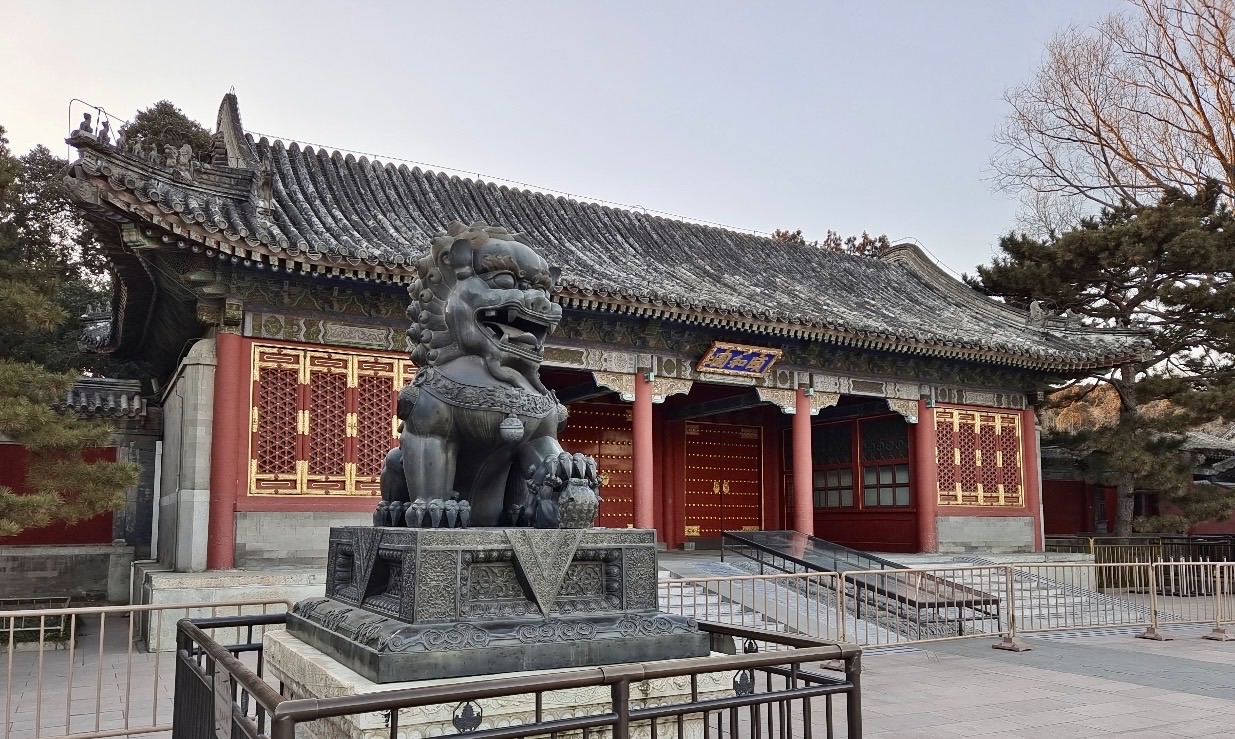
The main entrance to the Summer Palace. Above the gate hangs a gold-character plaque bearing the words "Summer Palace" in Emperor Guangxu's own hand, encircled by nine golden dragons — the highest-ranking plaque in the entire palace complex. A pair of bronze lions guards the entrance on either side: the male lion on the left plays with an embroidered ball, symbolizing power; the female on the right rests her paw on a cub, symbolizing the continuity of imperial lineage. As the gateway to a royal garden, the East Palace Gate captures the magnificent spirit of Qing imperial architecture.
Hall of Benevolence and Longevity
The imperial court hall. Built during the Qianlong era, this is where Qing emperors conducted state affairs when residing at the Summer Palace. The hall's interior displays a dragon-and-phoenix throne and a plaque reading "May longevity and benevolence accord." The forecourt is lined with bronze dragons, phoenixes, and qilin, alongside the "Longevity Star Rock" — a Taihu stone whose elaborate sculptures form the most striking display of imperial ritual ceremony in the entire palace. In 1898, after the Hundred Days' Reform collapsed, this hall became the site of the power struggle between Empress Dowager Cixi and Emperor Guangxu.
Garden of Virtue and Harmony
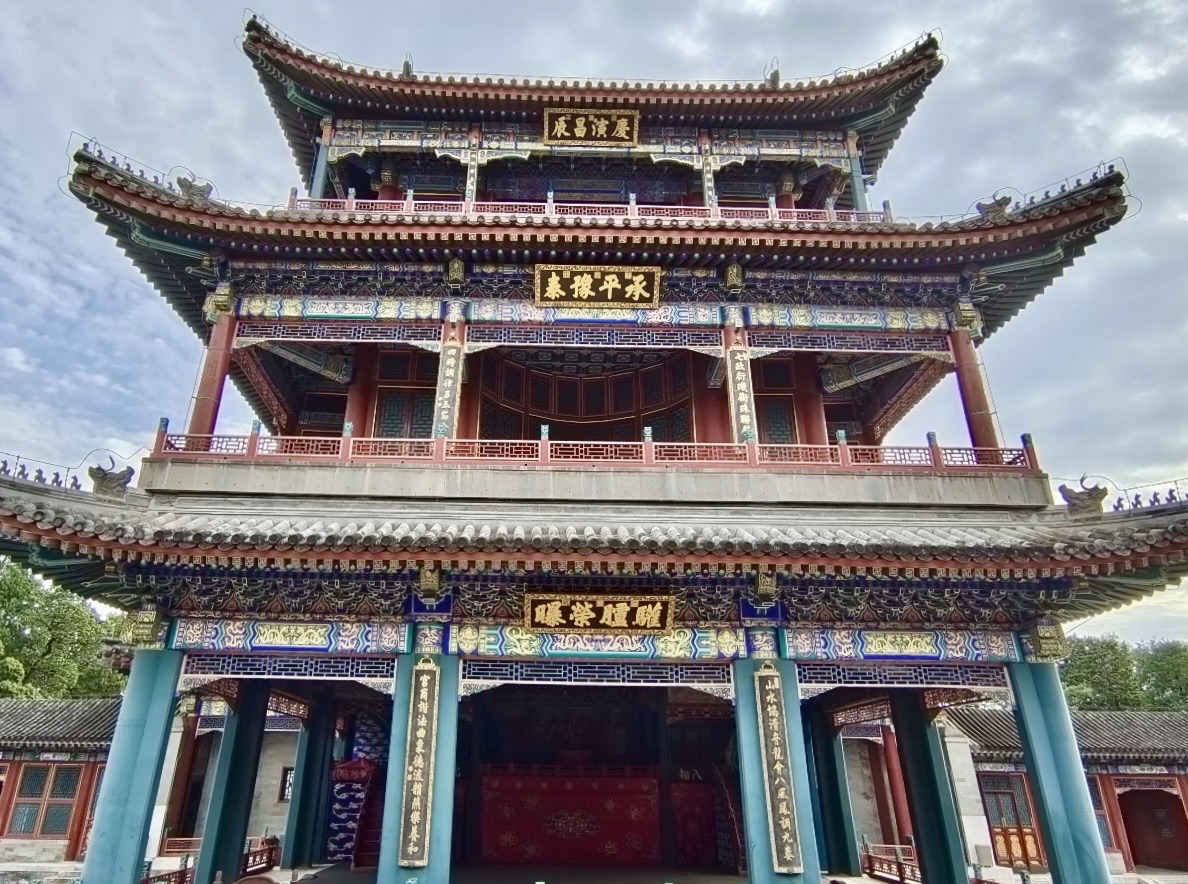
The largest surviving ancient theatre in China and the place where Empress Dowager Cixi watched opera performances. The stage stands about 16 meters tall, roughly 12 meters wide and 10 meters deep, with three tiers of seating and 258 seats in total, accommodating more than 200 spectators at once. The complete stage machinery and performance equipment are preserved inside, offering a vivid glimpse into the splendor of Qing court theatrical culture. The garden's elaborately painted and carved architecture is a fine example of classical Chinese building craft.
Hall of Jade Ripples
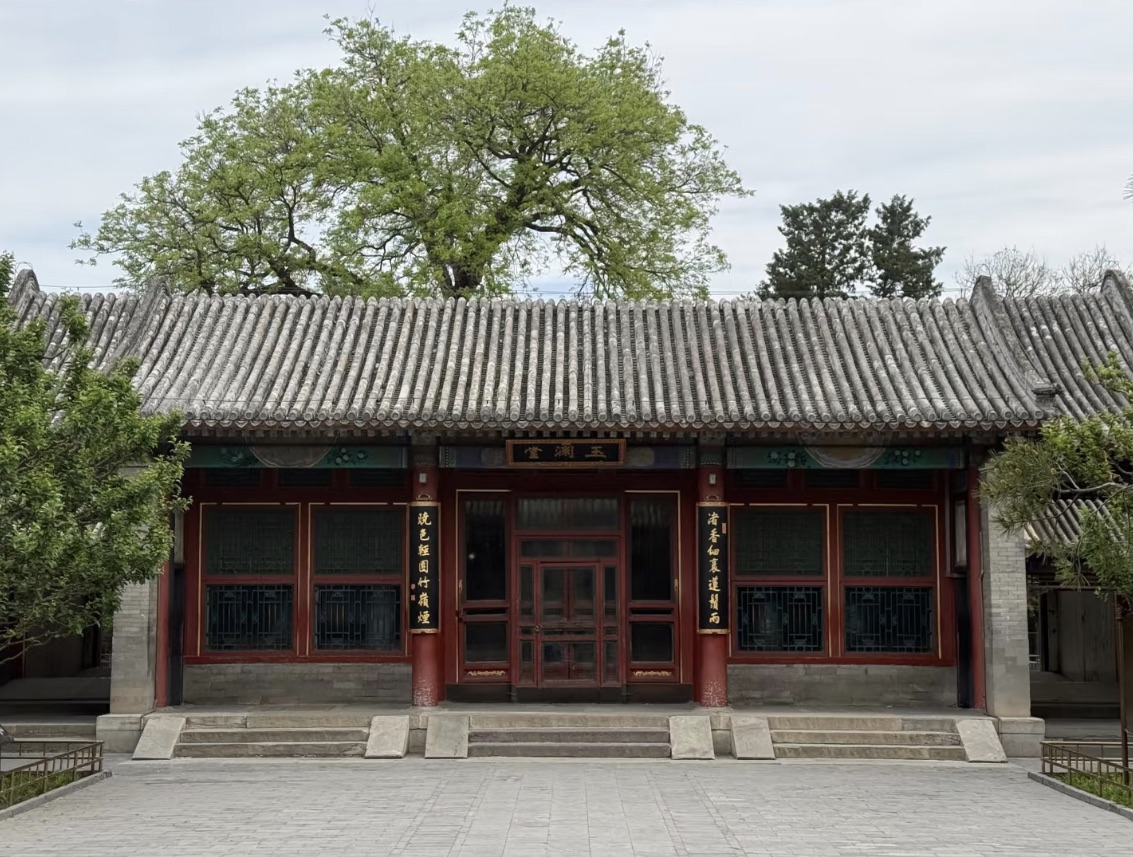
Emperor Guangxu's study and sleeping quarters — and, after the failure of the Hundred Days' Reform, his place of confinement. The hall's name alludes to a line from the Analects: "Jade without cutting cannot become a vessel; a person without learning cannot know the way" — a reminder that even an emperor must never stop learning. Original furnishings remain in place: writing desks, beds and wardrobes. In the courtyard stand a well and an old scholar tree — the only things the imprisoned emperor saw day after day. The hall faces Kunming Lake, creating a quietly melancholy beauty.
Hall of Joyful Longevity
Empress Dowager Cixi's residence. First built during the Qianlong period under the name Qingyan Hall, it was later renamed Hall of Joyful Longevity. The name echoes a line from the Analects urging that joy and sorrow be expressed with proper measure. The interior is lavishly appointed with rosewood furniture, jade objects and fine ceramics. In the courtyard stands an enormous Ming-dynasty rock called "Qingzhi Peak", weighing 150 tons and transported from Suzhou by the Qianlong Emperor. An ancient magnolia tree also grows here, erupting each spring into one of the most beautiful sights in the palace.
Long Corridor
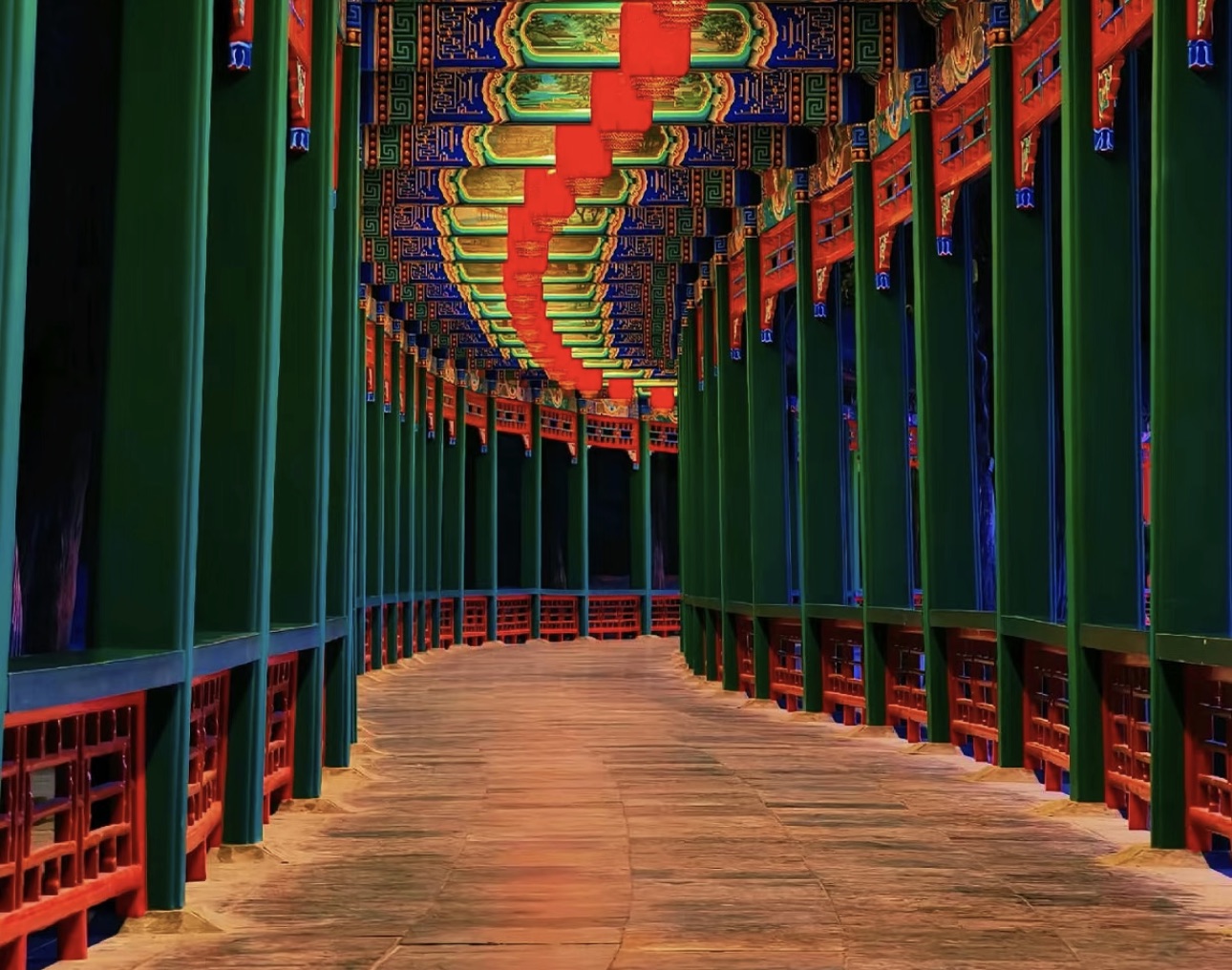
The world's longest painted corridor. Stretching 728 meters across 273 sections, it was certified by the Guinness World Records in 1990 as the longest gallery on earth. Along its beams and ceilings are more than 14,000 paintings in the Suzhou style, depicting Chinese mythology, folk tales, scenes from classic literature, and studies of flowers, birds, fish and insects. The paintings fall into three broad categories — narrative scenes, landscapes, and birds with auspicious imagery — with over 300 narrative panels alone, including scenes from Dream of the Red Chamber and Journey to the West. The corridor runs between the Hall of Joyful Longevity and the Tower of Buddhist Incense, serving as the palace's most important scenic promenade.
Hall of Dispelling Clouds
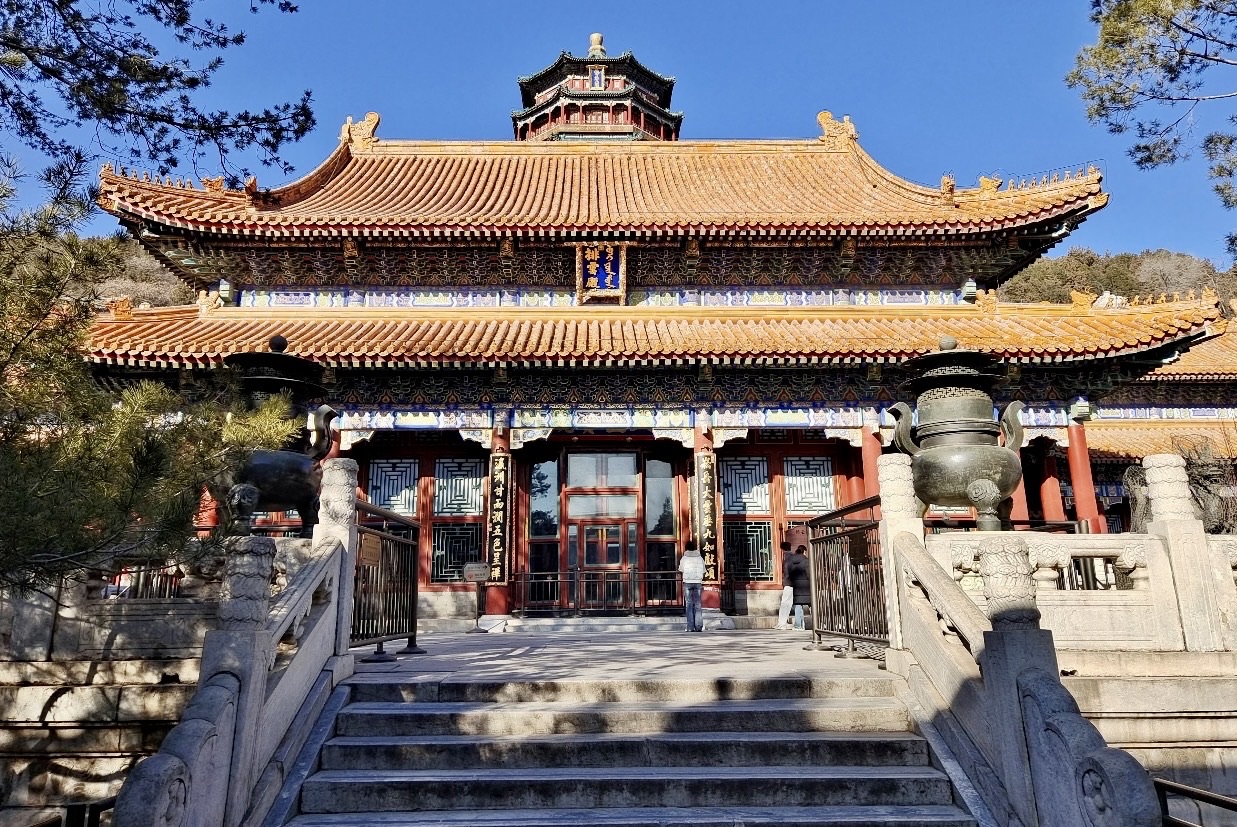
The hall where Empress Dowager Cixi celebrated her birthdays. First built in 1750 (the 15th year of the Qianlong reign) as the Great Thanksgiving Longevity Temple, it was burned down by Anglo-French forces in 1860 and rebuilt by Cixi in 1886 under its current name. The name is drawn from a poem by Jin-dynasty poet Guo Pu: "The immortals part the clouds and emerge, and all that is seen is of gold and silver" — suggesting this is a dwelling fit for celestial beings. The throne inside is a Nine-Dragon Throne, and the entire décor centers on the character for longevity. Covering roughly 8,000 square meters, the Hall of Dispelling Clouds complex is the most architecturally imposing ensemble in the Summer Palace.
Tower of Buddhist Incense
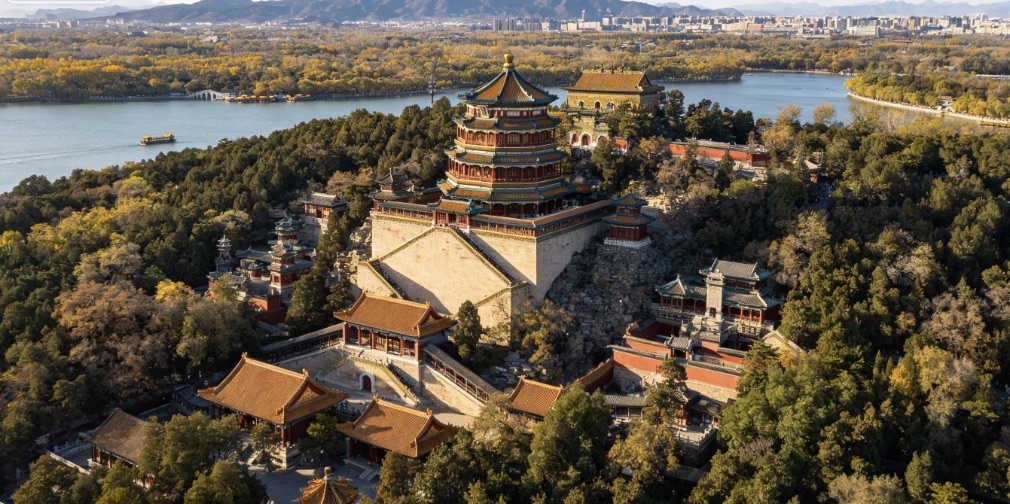
The defining landmark of the Summer Palace. Perched at the center of the south face of Longevity Hill, it rises from a 21-meter-high square stone terrace — an eight-sided, three-story, four-eaved structure standing 41 meters tall. Eight massive ironwood columns support the tower's intricate frame, a marvel of classical building craft. From the top, the entire Summer Palace and the distant cityscape of Beijing unfold below. The tower houses a statue of Amitabha Buddha and was where Empress Dowager Cixi came to burn incense and pray each month.
Sea of Wisdom
The highest religious structure on Longevity Hill — also called the Beamless Hall, built entirely of brick and stone without a single timber beam. Its exterior is sheathed in yellow and green glazed tiles, with touches of purple and blue at the crown; the 1,110 glazed Buddha figures embedded in the outer walls are its most remarkable feature. The name "Sea of Wisdom" comes from a Buddhist teaching: "The wisdom of the Tathagata is as vast as the ocean, with neither breadth nor depth that can be measured." Sitting at the very summit of Longevity Hill, it marks the end of the palace's central axis. Because of its all-masonry construction, it was not destroyed in the Anglo-French raid and remains one of the most intact Qianlong-era buildings in the complex.
Marble Boat (Qingyan Boat)
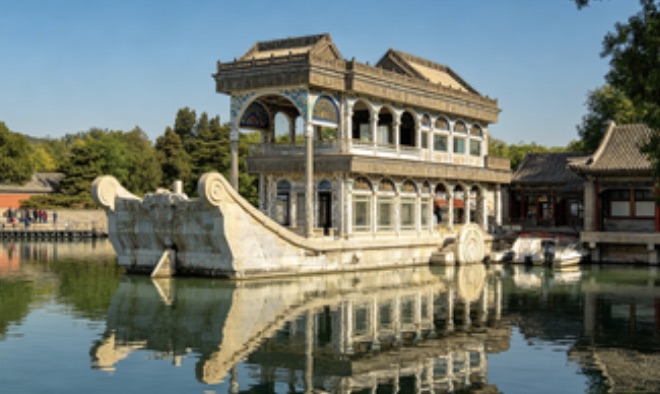
A stone vessel shaped like a European ship and one of the most-photographed spots in the Summer Palace. The boat is 36 meters long and 8 meters wide, weighing roughly 2,000 tons, built of white marble and brick in the form of a European-style vessel — yet fixed permanently to the shore. Its name, meaning "clear river, calm seas," evokes an image of lasting peace and prosperity. The prow bears bronze anchors and mooring lines; windows and cabin doors line the hull; the interior mimics the look of a ship's cabin. The Marble Boat is the most eye-catching landmark along the shore of Kunming Lake, and the most architecturally distinctive structure in the palace.
Kunming Lake
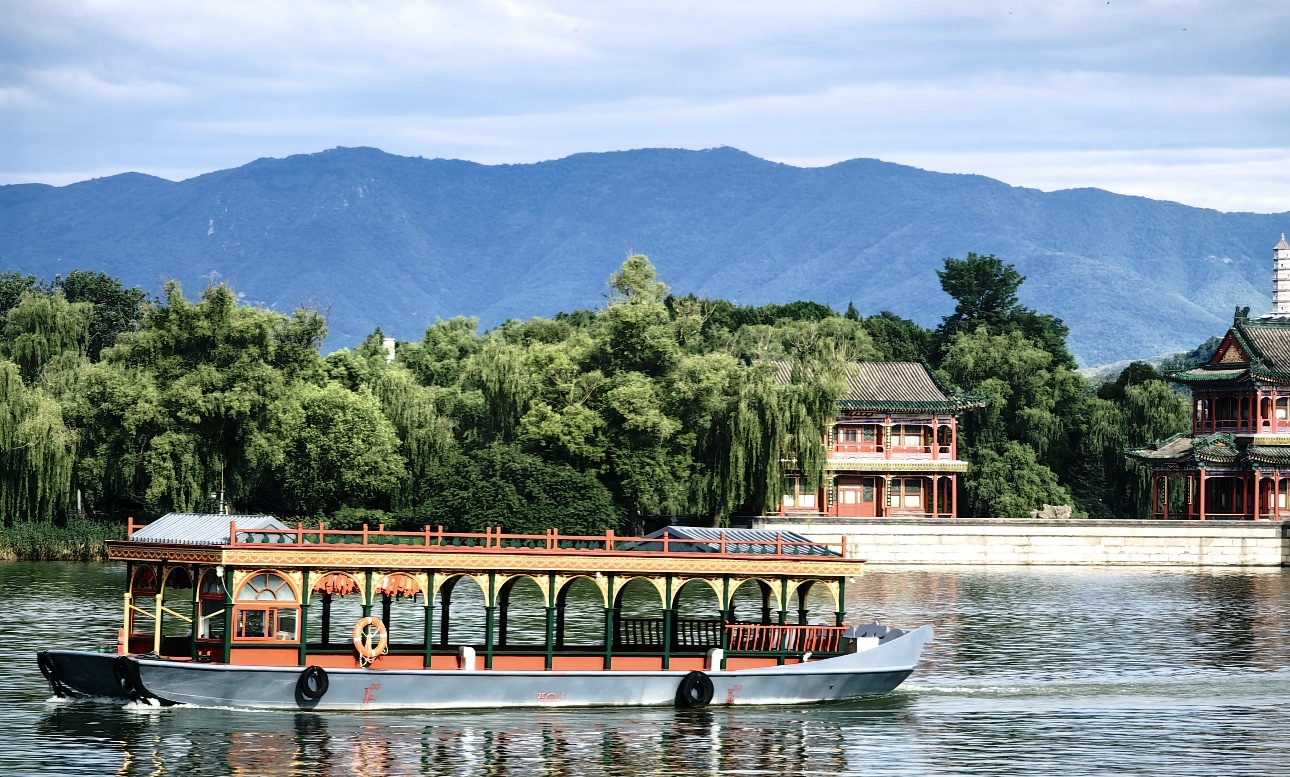
The great central body of water in the Summer Palace, covering around 220 hectares — three-quarters of the total park area. Originally called West Lake, it was dredged and expanded by the Qianlong Emperor as part of an effort to improve the capital's water management. The lake stretches wide and open, shimmering in every direction, with hills visible to the west and pavilions to the north. Three islands sit in its waters — South Lake Island, Zaojian Hall Island and Zhijing Pavilion Island — evoking the Taoist paradise of the immortals. Seen from above, Kunming Lake is shaped like a giant peach, and together with Longevity Hill, the whole Summer Palace quietly encodes the imagery of good fortune, longevity and prosperity.
Seventeen-Arch Bridge
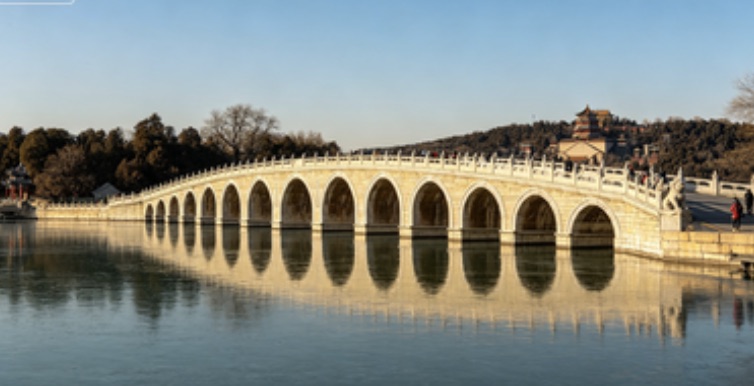
The longest bridge in China's surviving imperial gardens, stretching 150 meters, 8 meters wide, with seventeen arches. Its balustrades are lined with 544 stone lions, each one different from the rest. Each year around the Winter Solstice, at the right moment in the afternoon, sunlight passes through every arch simultaneously, creating a phenomenon known as "golden light threading the arches" — the moment photographers wait all year for. The bridge's proportions — length, width, height — are precisely calibrated to the scale of Kunming Lake and South Lake Island: it neither overpowers the scene nor shrinks from it, as if it grew there naturally.
South Lake Island
The island at the heart of Kunming Lake, covering just over a hectare, roughly circular in plan. Its buildings were all reconstructed after destruction; the main structures today are Hanxu Hall and the Dragon King Temple. Hanxu Hall sits atop a rockery on the island's north side — the largest building here — where Empress Dowager Cixi once watched naval academy drills during the Guangxu reign. The island faces Longevity Hill across the water and was a favored spot for the imperial family to view the moon and watch water pageants. Its scenery is among the finest in the Summer Palace.
Bronze Ox
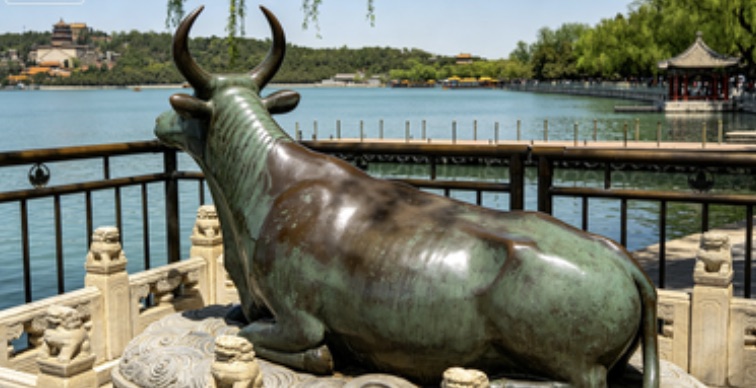
The mythical beast that guards Kunming Lake's eastern shore against floods, cast in 1755 (the 20th year of the Qianlong reign). Standing 1.14 meters tall, 1.75 meters long and 0.84 meters wide, the gilded bronze ox reclines on a white marble base carved with wave patterns. Cast into its body is the Qianlong Emperor's "Ode to the Golden Ox" in his own hand — "Cast in gold this divine ox, to calm and protect these waters forever" — continuing the ancient tradition of placing iron oxen at the water's edge, a practice associated with the mythic flood-tamer Yu the Great. The ox faces northwest, forming a landscape pairing with the Silkworm Temple (later called the Weaver Girl Pavilion) across the lake — a nod to the legend of the Cowherd and the Weaver Girl. Standing beside the ox on the lake shore, you can frame the Tower of Buddhist Incense perfectly within its horns.
New Palace Gate
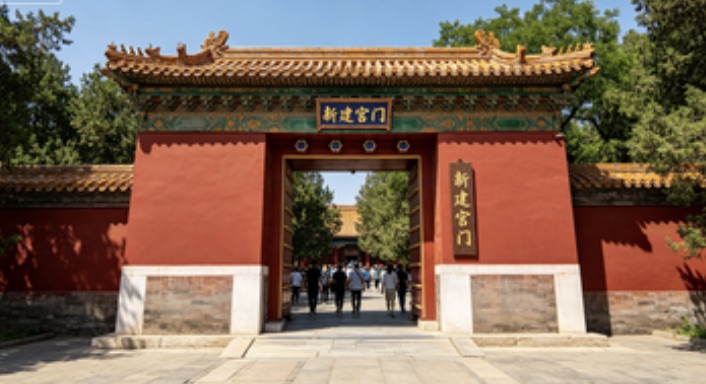
The exit from the Summer Palace, located on the eastern shore of Kunming Lake and the main route by which visitors leave the grounds. The gate was built in 1998, the year the Summer Palace was inscribed on the UNESCO World Heritage List, providing visitors with direct lakeside access to the outside. A visitor service center near the gate offers guided tour services and a gift shop. From the New Palace Gate, buses 74, 374 and 437 run directly into the city center, or visitors can cycle to the Western Suburbs Metro Line. The surroundings are pleasant, making this a fitting end to the Summer Palace experience.
Every corner of the Summer Palace carries the weight of history and the craft of generations. Following this classic official route, you'll discover why this UNESCO World Heritage Site has captivated visitors for centuries — and feel, firsthand, the ingenuity and humanity at the heart of China's royal garden tradition.
10 stops, in walking order — read top to bottom, no clicking needed.

 2
 3
 4
 5
 6
 7
 8
 9
 10