National Museum of China
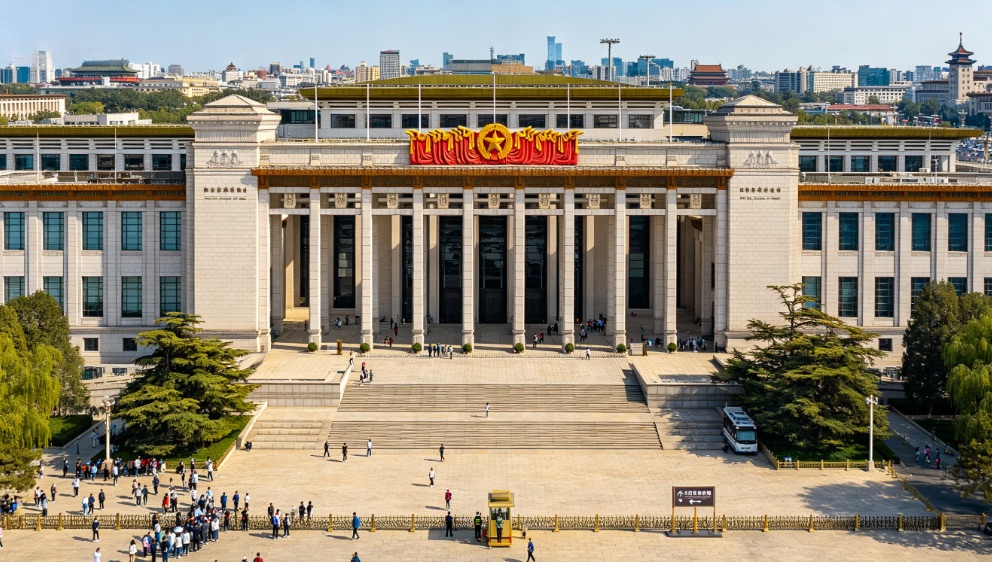
The National Museum of China stands on the east side of Tiananmen Square at 16 East Chang'an Avenue. It is China's comprehensive national-level museum, with a floor area of 191,900 square meters — the largest single-building museum in the world — and a collection of more than 1.4 million artifacts. The museum houses two permanent core exhibitions, "Ancient China" and "The Road to Rejuvenation," along with dedicated galleries for ancient porcelain, jade, coins, bronze mirrors, Buddhist sculpture, costume, food culture, and more, tracing the full arc of Chinese civilization from prehistory to the present day.
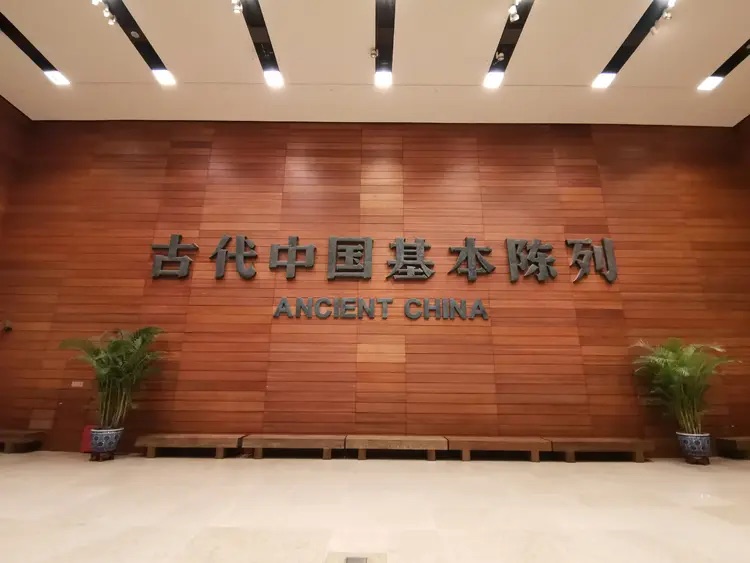
Ancient China
"Ancient China" is the museum's flagship permanent exhibition, located on the basement level. It presents the complete development of Chinese civilization from prehistoric times through the Ming and Qing dynasties, arranged chronologically across eight sections: the Prehistoric Period, the Xia-Shang-Western Zhou Period, the Spring and Autumn and Warring States Period, the Qin-Han Period, the Three Kingdoms through Northern and Southern Dynasties Period, the Sui-Tang and Five Dynasties Period, the Liao-Song-Xia-Jin-Yuan Period, and the Ming-Qing Period. The gallery brings together several of the museum's most prized treasures. The Houmuwu Ding, a late Shang dynasty ritual cauldron, weighs 832.84 kilograms and is the heaviest known bronze vessel in existence; its inner wall bears the inscription "Si Mu Wu," marking it as an offering vessel dedicated to a queen mother. The Four-Ram Square Zun, also from the late Shang dynasty, features a ram cast at each corner and stands as a masterpiece of Shang bronze craftsmanship. The Hongshan Jade Dragon, dating to the Neolithic period, was carved in the round from a single piece of jade and has been called the "First Dragon of China" — a key witness to the origins of Chinese civilization. The Sanxingdui Bronze Mask, unearthed at the Sanxingdui site in Sichuan Province and also from the late Shang dynasty, has wide, blade-like eyes that reflect the religious imagination of the ancient Shu people. The Phoenix Crown of Empress Xiaoduan, from the Ming dynasty, is set with 115 rubies and 4,414 pearls, representing the pinnacle of imperial court jewelry. From stone tools of primitive society to ritual bronzes of the Shang and Zhou, from Qin-Han terracotta figures to Tang-Song ceramics, and on to the gold, silver, and jade objects of the Ming and Qing, each artifact embodies more than five thousand years of Chinese civilization.
The Road to Rejuvenation
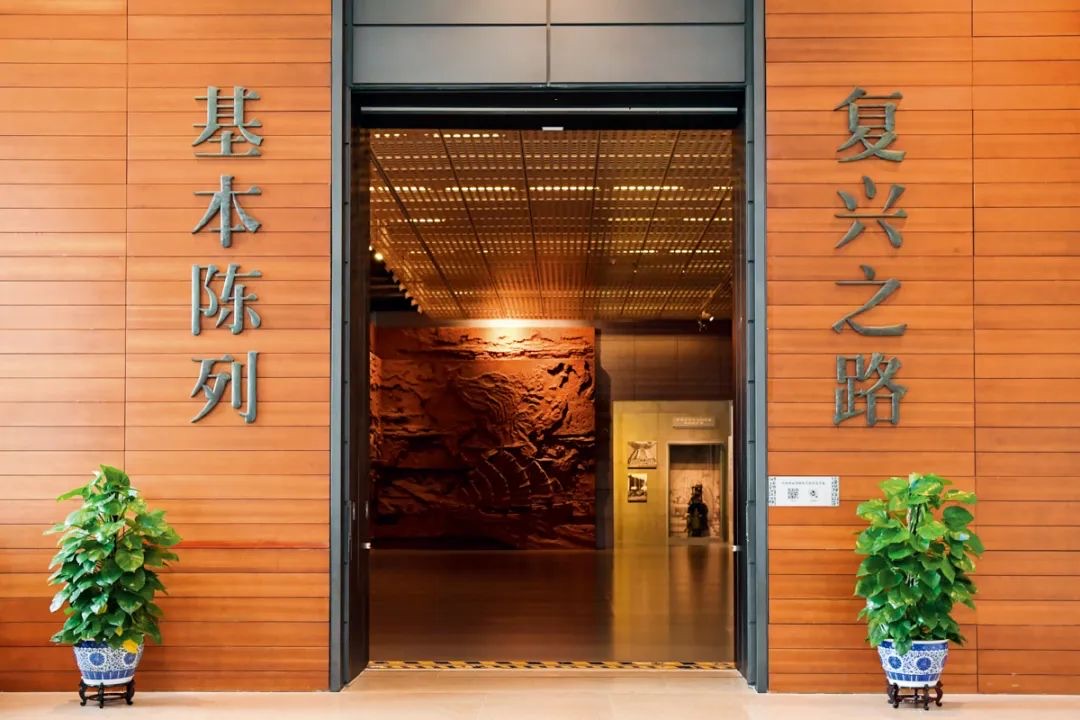
"The Road to Rejuvenation" is the museum's second permanent core exhibition. It focuses on China's modern history from the Opium War of 1840 onward, using more than 1,200 rare artifacts and historical documents to show how the Chinese people rose from humiliation and suffering to pursue national rejuvenation. Key exhibits include the first Chinese translation of The Communist Manifesto, completed by Chen Wangdao in 1920 — the cover misprints the title with two characters transposed, yet it stands as a landmark in the spread of Marxism in China. There is also the first Five-Star Red Flag raised at the founding ceremony of the People's Republic on October 1, 1949. Two bronze animal heads — a rat and a rabbit — originally part of the fountain at Haiyantang in the Old Summer Palace during the Qianlong reign, were returned to China in 2013 as a gift from the Pinault family of France, and bear witness to China's journey from humiliation to revival. Lunar Sample No. 001, brought back by the Chang'e-5 mission in 2020 and weighing approximately 1,731 grams, is also on display, as are fragments of the Shenzhou-5 return capsule from Yang Liwei's 2003 mission — China's first crewed spaceflight. The exhibition further features a scene reconstruction of the Humen Opium Destruction, artifacts from the Revolution of 1911, and rare historical materials from the War of Resistance Against Japan and the War of Liberation, together forming a complete panorama of modern Chinese history.
The Power of Science and Technology
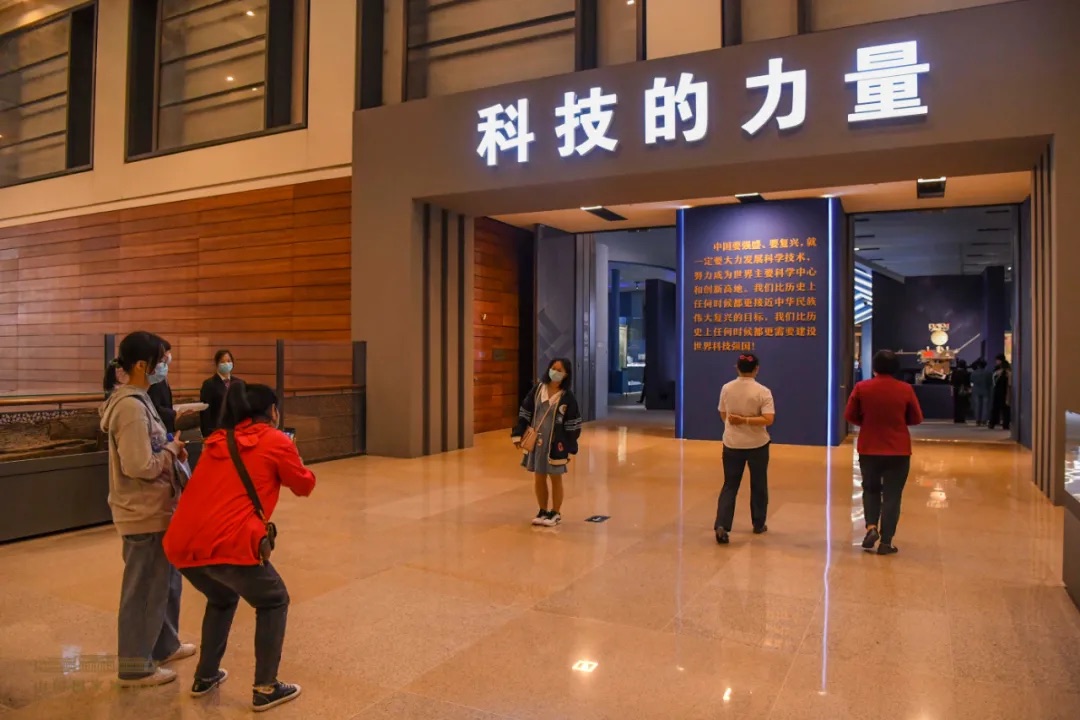
"The Power of Science and Technology" is located in the central hall on the second floor and is the museum's first large-scale thematic exhibition to systematically chronicle the development of Chinese science and technology. Its scope runs from astronomical records inscribed on Shang dynasty oracle bones all the way to the Micius quantum science experiment satellite, organized across four sections: "Investigating Nature," "Exploitation of the Works of Nature," "The Eastern Encounter with the West," and "Toward Rejuvenation." The exhibition presents more than 400 artifacts and objects (in sets) and over 50 models. Highlights include a bronze clepsydra that controlled the rise of a float-arrow through water-level changes, accurate to the minute; Lunar Sample No. 001 returned by Chang'e-5 in 2020, weighing approximately 1,731 grams; fragments of the Shenzhou-5 return capsule; and models of ancient astronomical instruments such as the armillary sphere and seismoscope. Models and audiovisual materials related to the Micius satellite and other contemporary achievements round out the displays, covering astronomy, the calendar, medicine, agriculture, and the Four Great Inventions.
Standing in the East
"Standing in the East" is an art exhibition located in the Central West Hall on the second floor. It brings together a large collection of classic artworks reflecting China's modern history and revolutionary spirit. The centrepiece is Dong Xiwen's celebrated oil painting Founding Ceremony, depicting the historic moment of October 1, 1949, when the People's Republic of China was proclaimed. Other highlights include Flag No. 100, the Tiananmen Square flag used at the 2021 centenary celebrations of the founding of the Communist Party of China; a national flag flown aboard Shenzhou-6 and displayed when the spacecraft passed over the South Pole; a flag raised by Wang Jicai and his wife during their years guarding Kaishan Island; the first national emblem; and the first official seal of the Central People's Government of the People's Republic of China. Together these works re-enact the struggle and revival of the Chinese nation in the modern era.
Red Flags
"Red Flags — Classic Revolutionary Artifacts from the Museum Collection" is displayed in the central hall and presents a systematic survey of the museum's collection of revolutionary-era red flags, Five-Star Red Flags and Party flags from the post-1949 period, and classic artworks on revolutionary themes — more than 60 items in all. The exhibition includes the first Five-Star Red Flag ever raised at Tiananmen Square, a symbol of the Communist Party of China's leadership in achieving revolutionary victory and the founding of New China; Flag No. 100 from the Party's centenary celebrations; classic artworks on revolutionary themes from the museum's collection; 100 high-resolution photographs of the national flag from the new era; and the first-ever display of the national flag using naked-eye 3D technology, recreating the story of the Five-Star Red Flag's creation and design.
Blanc de Chine
"China White — Blanc de Chine from Dehua" is housed in Galleries North 1 and North 2 on the second floor. It presents the history and artistic achievements of white porcelain from Dehua in Fujian Province. Dehua white porcelain is renowned for being "white as snow, clear as a mirror, thin as paper, and resonant as a chime," earning it the international name blanc de chine. Exhibits range from traditional works such as porcelain sculpture, porcelain panel paintings, and porcelain vases to modern innovations: Princess Yusu from the series Mythology, which blends traditional craft with contemporary design; a porcelain sheet that mimics the texture of Chinese xuan paper; a Swan Lake rendered in white porcelain echoing a Western artistic classic; and an elegant, fluid Ballet dancer figure. Dehua white porcelain was once a prized commodity on the Maritime Silk Road, traded across Europe and Asia, and stands as evidence of the flourishing of ancient China's foreign trade and cross-cultural exchange.
Ancient Chinese Porcelain
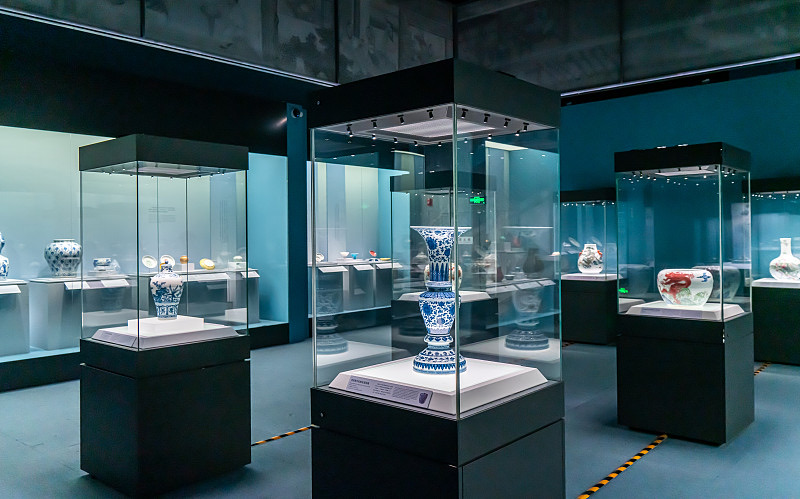
"Ancient Chinese Porcelain" is located in Gallery North 17 on the fourth floor. It brings together more than three hundred representative porcelain masterpieces selected from the museum's collection, arranged across four sections — "A Deep and Distant Heritage," "The Potter's Art and Vision," "The Elegance of Porcelain," and "Porcelain Travels the World" — offering a comprehensive view of the technical progress and aesthetic evolution of Chinese porcelain from primitive proto-porcelain to fully mature ceramic art, and from the flowering of great kilns to the dazzling refinement of later dynasties. Representative pieces include a Three Kingdoms-period celadon tiger-shaped vessel (hu zi), 12.3 cm tall, 3.8 cm in mouth diameter, and 4.9 cm in foot diameter, with a vivid and lifelike form; a Tang sancai glazed terracotta camel with musicians, capturing the cosmopolitan spirit of the Tang dynasty; a Song dynasty Ding-ware white porcelain child-shaped pillow (18th dynasty), 17.5 cm tall, 22.8 cm long, and 10.8 cm wide, modeled as a charmingly reclining child; exquisitely crafted and vividly colored Yuan dynasty blue-and-white porcelain; and blue-and-white wares from the Yongle and Xuande reigns of the Ming dynasty alongside famille rose and enamel-painted imperial kiln pieces from the Kangxi, Yongzheng, and Qianlong reigns of the Qing dynasty. Porcelain was one of China's most important export goods in the ancient world, shipped to destinations across Europe and Asia — a fact reflected in the word "china" itself in the English language.
Ancient Chinese Jade
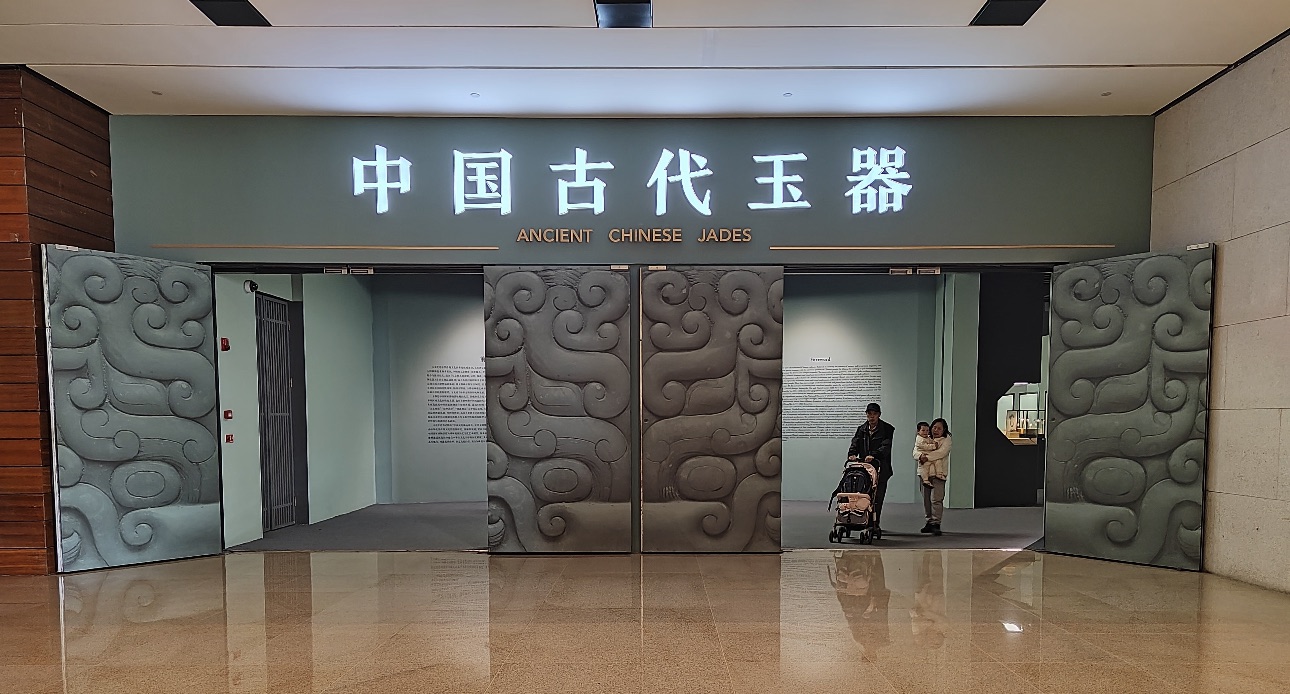
"Ancient Chinese Jade Art" is located in Gallery North 19 on the fourth floor. It provides a systematic account of the history, craftsmanship, and cultural significance of jade objects in ancient China. The star piece is the Hongshan Jade Dragon, unearthed at Saiqin Tala in Wengniute Banner, Chifeng, Inner Mongolia. Measuring 26.3 cm long, 29.3 cm wide, and 2.5 cm thick and carved from dark green Xiuyan jade, it has an elongated snout, refined eyes, and a body coiled in the shape of the letter C — a masterpiece of Neolithic jade carving hailed as the "First Dragon of China." Other key works include a Shang dynasty dragon-shaped jade pendant (15 cm long, 8 cm wide) of warm, lustrous jade; a Warring States period jade disc (bi) with interlaced dragon and tiger motifs, 25 cm in diameter; a Han dynasty jade burial suit assembled from thousands of jade plaques linked with gold wire, emblematic of Han funerary culture; and a Tang dynasty twin-dragon jade pendant (12 cm long, 7 cm wide) with fluid, graceful lines. Together they trace the arc of China's jade culture from the Neolithic age through the Tang dynasty.
Ancient Chinese Coins
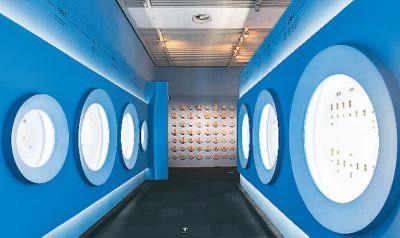
"Ancient Chinese Coins" is located in Gallery South 11 on the fourth floor. It traces the full history of Chinese coinage from beginning to end — from the knife coins and spade coins of the pre-Qin period, to the wuzhu coins of the Qin-Han era, to the kaiyuan tongbao and xiantong yuanbao of the Tang and Song dynasties, and on to the cast coins of the Ming and Qing. Just inside the entrance is the "Coins from All Directions" coin wall, assembled from thousands of coins spanning different dynasties and forms — an immediate and vivid impression of the richness of Chinese monetary history. Key coins to look for: the Warring States knife and spade coins, which reflect the diverse monetary forms of the pre-Qin regional states; the Qin banliang coin, introduced by Qin Shi Huang after he unified the six states and marking China's first ever nationally standardized currency; the finely cast Han dynasty wuzhu coin, which circulated widely for centuries; and the Tang dynasty kaiyuan tongbao, elegantly designed and representing the highest standard of coinage of its day. Coins are not merely instruments of trade — they are cultural symbols that carry the imprint of history.
Ancient Chinese Bronze Mirrors
"A Thousand Years Reflected — Ancient Chinese Bronze Mirror Culture" is located in Gallery South 14 on the fourth floor. It presents the history, craftsmanship, and cultural significance of bronze mirrors in ancient China. Among the exhibits is a particularly exceptional national treasure: a green glass lidded jar from the Sui dynasty, unearthed in 1957 from the tomb of Li Jinxun in Xi'an, Shaanxi Province. Measuring 4.3 cm tall and 2.8 cm in mouth diameter, the jar is transparent and translucent green throughout, made using high-lead glass technology, and is a Class-One cultural relic forbidden from export. Bronze mirror highlights include a Tang dynasty mirror decorated with a pair of luan birds and a pair of phoenixes, 20.5 cm in diameter; a Han dynasty cloud-and-thunder pattern mirror, 18 cm in diameter, clean and elegant; a Song dynasty floral mirror, 15 cm in diameter, with a refined decorative design; and a Qing dynasty bagua (Eight Trigrams) mirror, 22 cm in diameter, its reverse decorated with the Eight Trigrams as a symbol of traditional Chinese philosophical thought. The decorative patterns on these mirrors reflect the aesthetic sensibilities and social values of each era.
Ancient Chinese Buddhist Sculpture
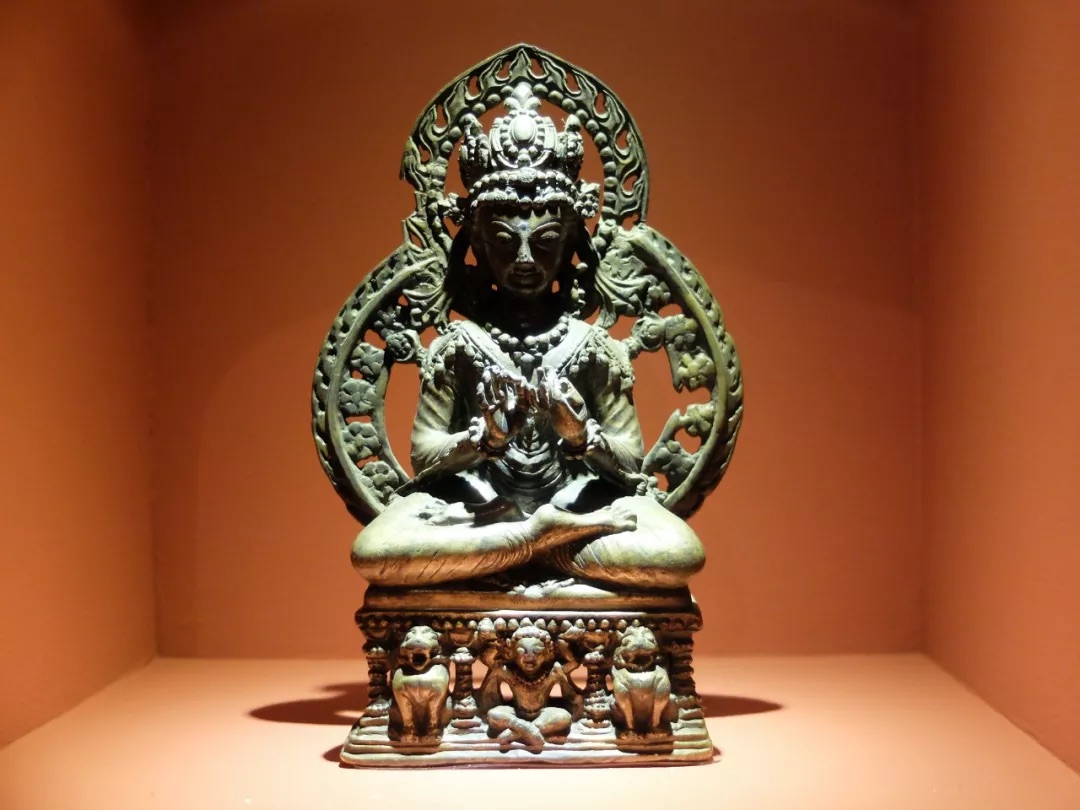
"Ancient Chinese Buddhist Sculpture" is located in Gallery South 13 on the fourth floor. It presents a systematic display of 236 Buddhist sculptural works of art, encompassing pieces created in China as well as works transmitted from ancient India and other regions. Exhibits include clay Buddhist figures unearthed in Xinjiang, carvings from the Yungang Grottoes, bodhisattva images from the Tianlong Mountain Grottoes, guardian king statues from Wanfo Temple in Sichuan Province, wooden Guanyin statues, gilt-bronze Guanyin figures, and Tibetan Buddhist sculptures from the Ming and Qing imperial courts. Representative works include a Northern Wei period carving from the Yungang Grottoes, bold and monumental in form; a Tang dynasty wooden seated Guanyin, compassionate in expression and graceful in posture, with a distinctly humanized quality; a Song dynasty polychrome wooden Guanyin bodhisattva head, vivid in color and expression; a Yuan dynasty gilt-bronze Buddha of great technical refinement and decorative richness, bearing the hallmarks of Tibetan Buddhist tradition; and a Ming dynasty polychrome wooden Maitreya Buddha, grand in scale and solemn in bearing. Moving through the gallery from one sculpture to the next is to witness, in brief, the story of Buddhism's localization in China.
Ancient Chinese Costume
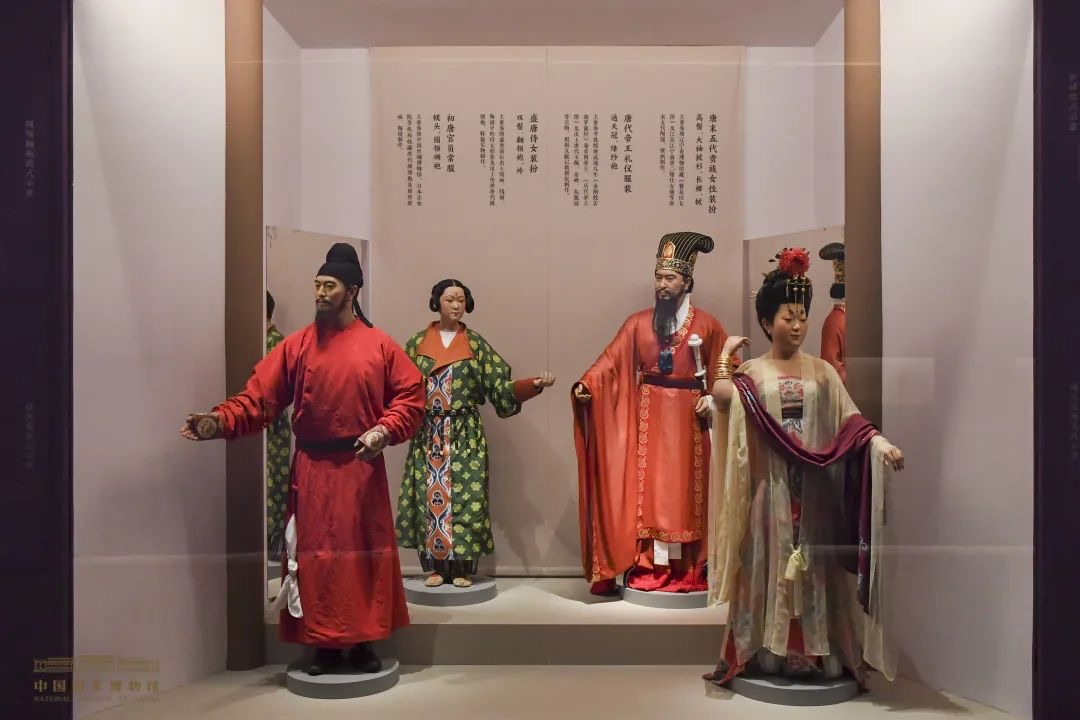
"Ancient Chinese Costume Culture" is located in Gallery North 18 on the fourth floor. It presents the history, craftsmanship, and cultural significance of costume in ancient China. A highlight that invariably draws gasps is the Han dynasty plain gauze robe (su sha chan yi): light as a cicada's wing, thin as paper, and weighing just 49 grams in its entirety — a testament to the extraordinary skill of Han dynasty weavers. Also on display is a Sui dynasty gold necklace inlaid with pearls and gemstones, unearthed from the tomb of Li Jinxun: 43 cm long and weighing 91.25 grams, it consists of 28 gold spherical links, each formed by soldering 12 small gold rings together and set with 10 pearls — the pinnacle of Sui dynasty jewelry-making. Further exhibits include a Tang dynasty sancai glazed terracotta camel with musicians, embodying the cosmopolitan character of the Tang; a Tang dynasty twin-handled dragon vase of elegant design; and a Qing dynasty hardwood screen approximately 2 meters tall and 1.5 meters wide, decorated with a sea-wave and cloud-dragon pattern. The materials, forms, and decorative motifs of each garment and ornament speak to the hierarchical order and aesthetic ideals of ancient Chinese society.
Ancient Chinese Food Culture
"Ancient Chinese Food Culture" is located in Gallery North 11 on the fourth floor. The exhibition is organized into five units — "Food from All Directions," "The Fragrance of Tea and Wine," "A Treasury of Fine Vessels," "Transformations in the Cauldron," and "Rites Begin at the Table" — and presents more than 240 carefully selected artifacts and objects (in sets). The most compelling group is perhaps the Tang dynasty dumplings and pastries unearthed at Turfan in Xinjiang: preserved intact for over a thousand years, they testify to the exchange of culinary cultures between East and West along the Silk Road. Other exhibits include a finely crafted and elegant Han dynasty lacquer ear-cup, representative of elite drinking vessels of the Han; a complete set of Song dynasty celadon tea ware, reflecting the flourishing of tea culture in the Song period; exquisitely decorated Qing dynasty enamel-painted porcelain; and scale models of ancient kitchens, cooking implements, and tableware. Taken together — vessels, ingredients, cooking techniques, and dining ritual — the exhibition tells the full story of Chinese food culture through the ages.
Telling the Story of the Rhinoceros Zun
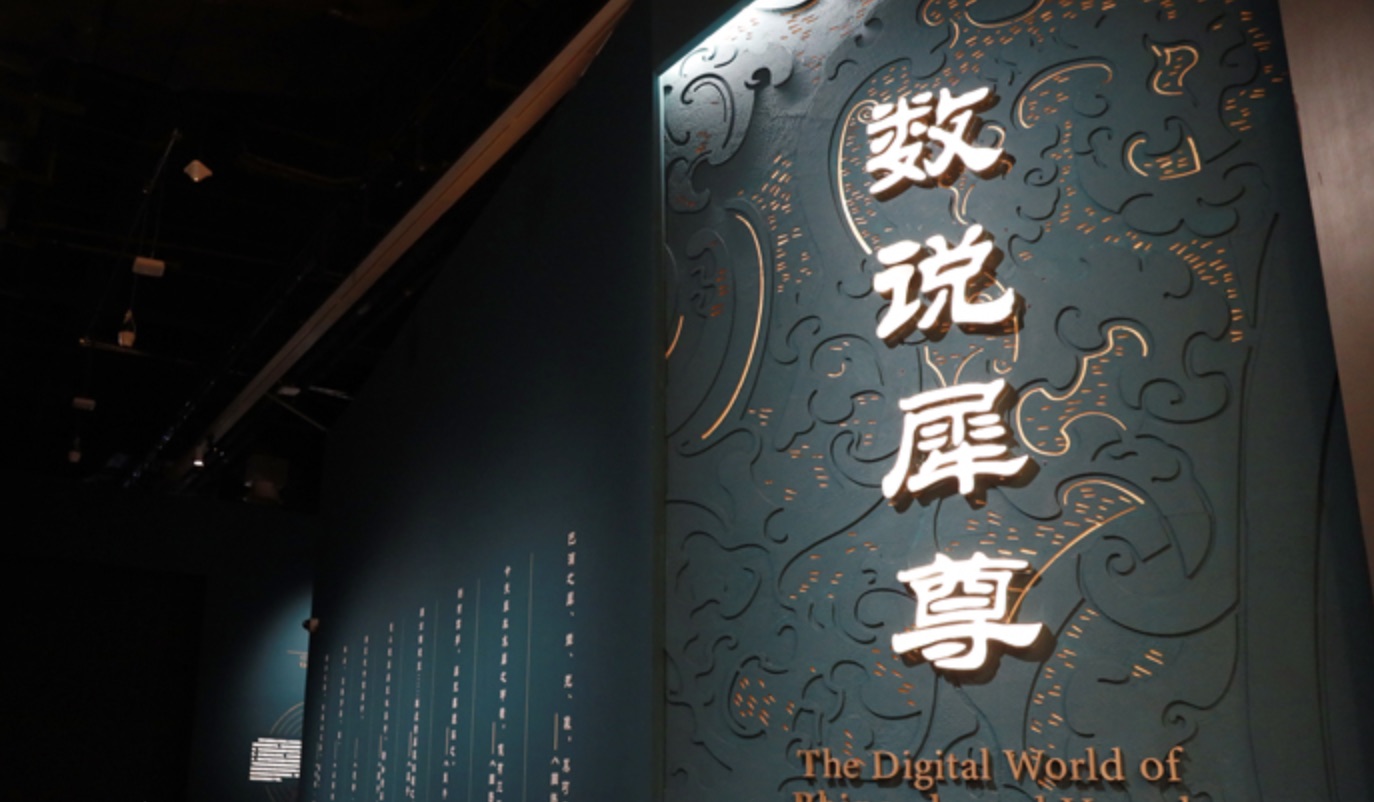
"Telling the Story of the Rhinoceros Zun" is located in Gallery North 16 on the fourth floor. It is the museum's first digital exhibition and first smart gallery, built entirely around a single national treasure: the Western Han dynasty rhinoceros-shaped bronze zun inlaid with gold and silver cloud motifs. The piece measures 23.5 cm in length, 19.7 cm in height, and weighs 3.1 kilograms; its body is covered with inlaid gold and silver cloud patterns, and the overall form is strikingly naturalistic — a pinnacle of Han bronze casting. One particularly fascinating detail: when the zun was excavated in 1963, its belly was found to contain 17 other objects, including a bronze mirror, a belt hook, a file, and cowrie shells, most of them items from the Western Han period. The gallery uses digital technology to examine the piece from every angle: a 3D-printed model of the zun is on display, and visitors can use a touchscreen to open the model's lid and explore the interior. Interactive projection installations also illuminate the casting and decorative techniques involved in its creation. The zun's discovery carries an additional significance — it confirms that rhinoceroses, today on the brink of extinction, once ranged widely across the Chinese landscape.
Calligraphy of Qing Dynasty Scholars
"Ancient Chinese Calligraphy and Painting — Ink Treasures of Qing Dynasty Jinshi Scholars" is located in Gallery South 12 on the fourth floor. The exhibition presents more than 70 carefully selected calligraphic works and fine rubbings from steles and model calligraphy books from the museum's collection, arranged across four thematic sections: "Copying Steles and Models," "Imperial Commissions and Gifts," "Writing of Objects and Feelings," and "Official Documents and Personal Letters." Exhibits include calligraphic works by Qing dynasty jinshi (imperial examination graduates) in running script, cursive script, and regular script; fine block-printed editions of celebrated steles and model calligraphy books from the Tang, Song, Ming, and Qing dynasties; literati paintings on themes of landscape, figures, and birds and flowers; and manuscript poems, essays, and correspondence by Qing dynasty scholars. Taken together, these works offer a window into the learning, sensibility, and daily life of educated men in imperial China.
Wax Figures of Heroes and Models
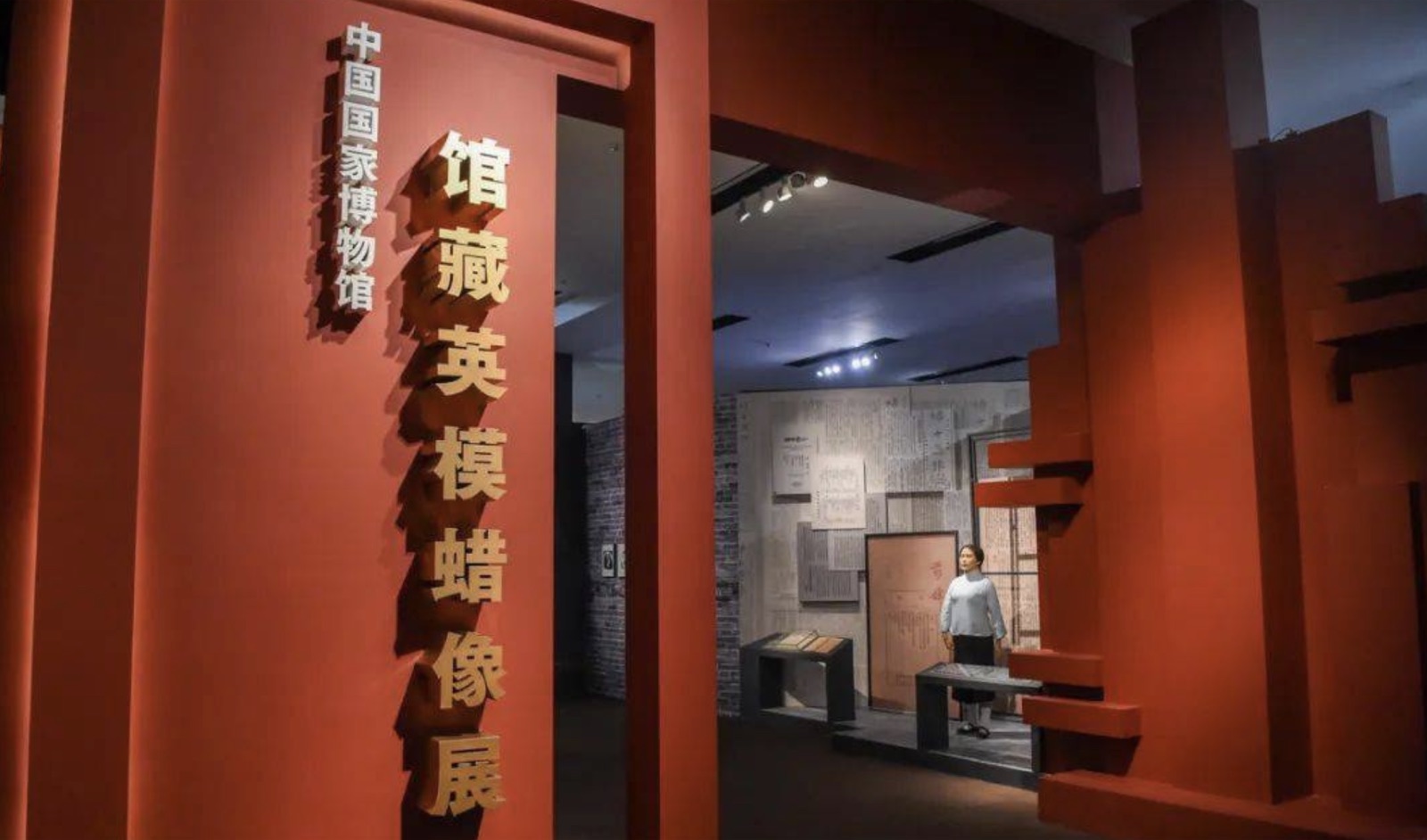
"National Museum of China Collection: Wax Figures of Heroes and Models" is located in Gallery North 9 on the fourth floor. It brings together hyperrealistic wax sculptures of many outstanding individuals, reproducing not only their physical appearance but the spirit and character of each subject. Visitors will find wax figures of Party and state leaders including Mao Zedong, Zhou Enlai, and Deng Xiaoping; scientists such as Qian Xuesen and Deng Jiaxian, contributors to China's nuclear and space programs; and distinguished figures from across society, including Yuan Longping, the father of hybrid rice, and Li Suli, a celebrated national model worker. The exhibition also displays the complex craft of wax figure-making through actual materials and video, and each figure is accompanied by a panel recounting the subject's life story and historical contribution.
10 stops, in walking order — read top to bottom, no clicking needed.

 2
 3
 4
 5
 6
 7
 8
 9
 10