Travel Guide› Shanghai› South Bund Fabric Market (commonly known as "Dongjiadu Fabric Market")
Shanghai · Market & old street

South Bund Fabric Market (commonly known as "Dongjiadu Fabric Market") 南外滩轻纺面料市场

South Bund Fabric Market (commonly known as "Dongjiadu Fabric Market")
Address
No. 399 Lujiabang Road, Huangpu District, Shanghai (near Nancang Street, close to Nanpu Bridge)
South Bund Fabric Market

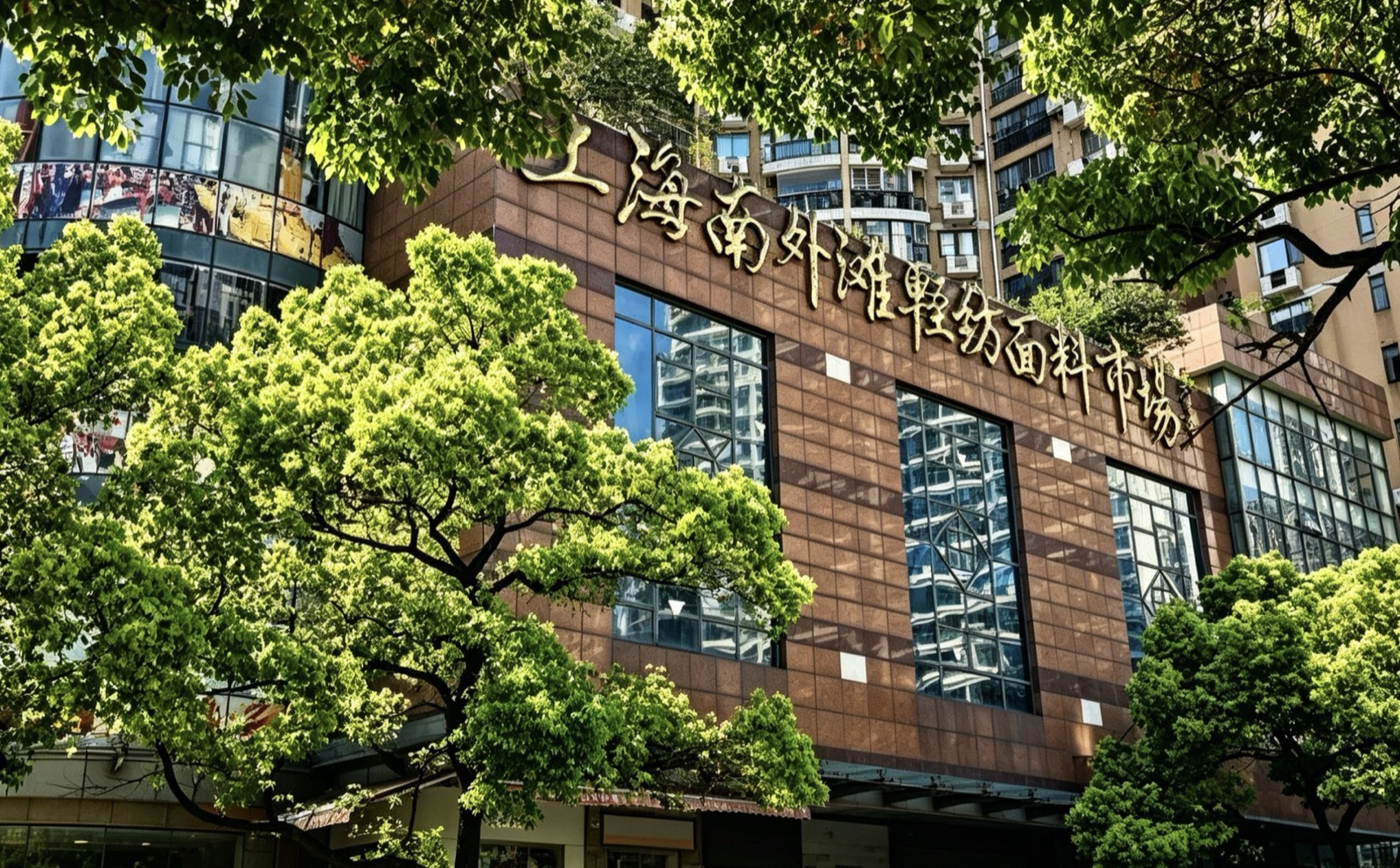
The South Bund Fabric Market is located at No. 399 Lujiabang Road, Huangpu District, Shanghai. Built in 2005, its predecessor was the Dongjiadu Fabric Market in Shanghai's old town in the 1990s. The market has four floors and about 285 tailoring shops, making it the largest fabric and custom-clothing market in Shanghai. It ranks second among Shanghai attractions in TripAdvisor's international travel reviews, and is known as the "Oriental Tailor's Paradise." The market holds to the principle of bespoke "one person, one pattern," serving customers from all over the world — from NBA players' formal wear to diplomatic and business suits, from wedding qipao to sports team uniforms, all cut to the individual's measurements. Within two kilometres around it are gathered more than a thousand processing manufacturers, covering the full range of processes — cutting, sewing, buttons, embroidery and more — forming a complete fabric-to-bespoke industry chain. In 2025, Huangpu Post set up here, so finished custom garments can be shipped directly to over 170 countries and regions worldwide.

Market Entrance Hall

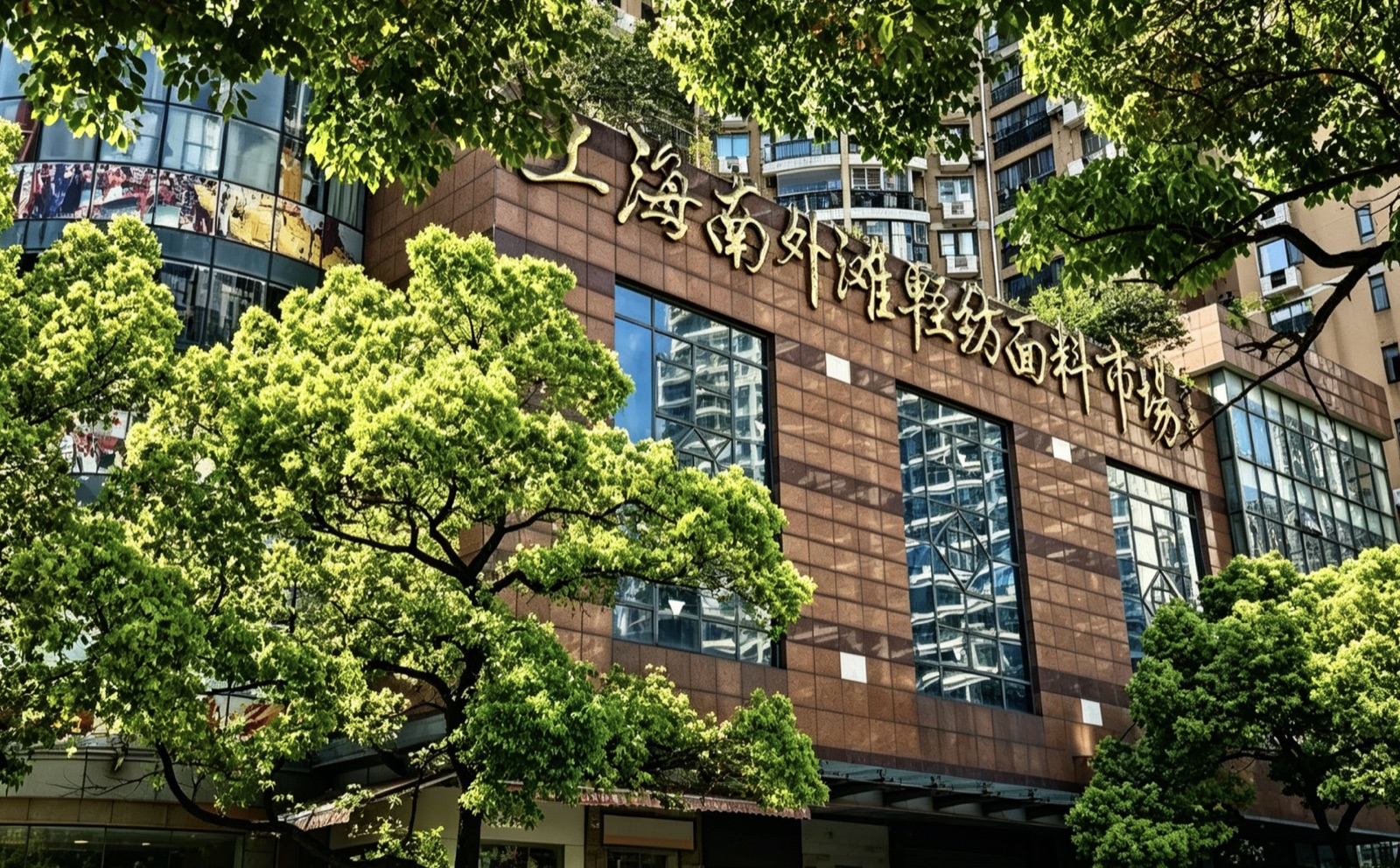
The entrance hall on the ground floor of the market connects the Lujiabang Road street frontage with the four floors of commercial space inside. The hall has floor-guide signage and zone directions, serving as the hub from which visitors enter the various tailoring areas.

1F Ready-to-Wear & Leather Goods Zone

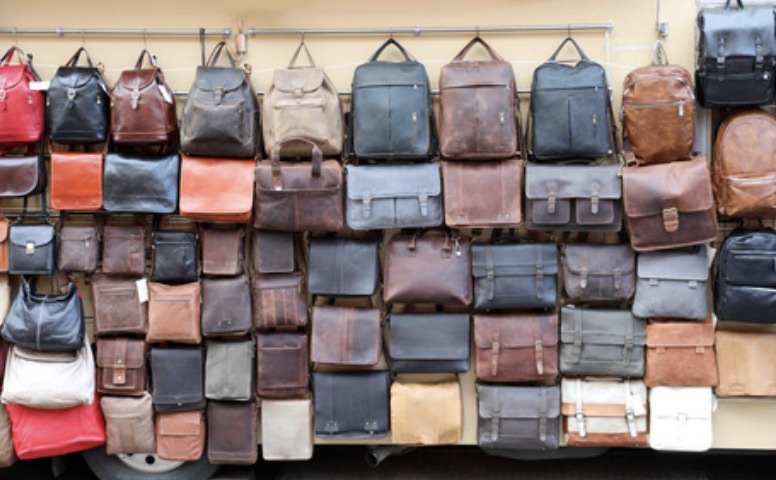
Located on the ground floor of the market, this zone mainly deals in ready-made coats, leather jackets and accessories, gloves, eyewear and similar items. It is chiefly finished-goods retail, supplemented by a small amount of custom service, and forms the first commercial frontage along the market's overall circulation route.

1F Kate & Kevin Custom Tailoring Workshop

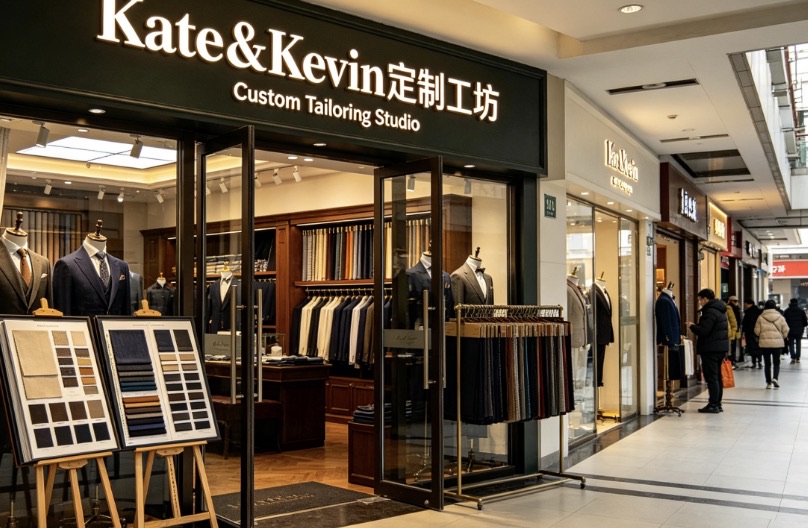
Located at stalls 128, 137 and 195 on the first floor, this is a representative shop that practises fixed, clearly marked pricing within the market. Suit tailoring ranges from ¥2,000 to ¥5,000, shirts from ¥150, with free lifetime alterations. Its transparent business model serves both first-time visitors and long-term customers.

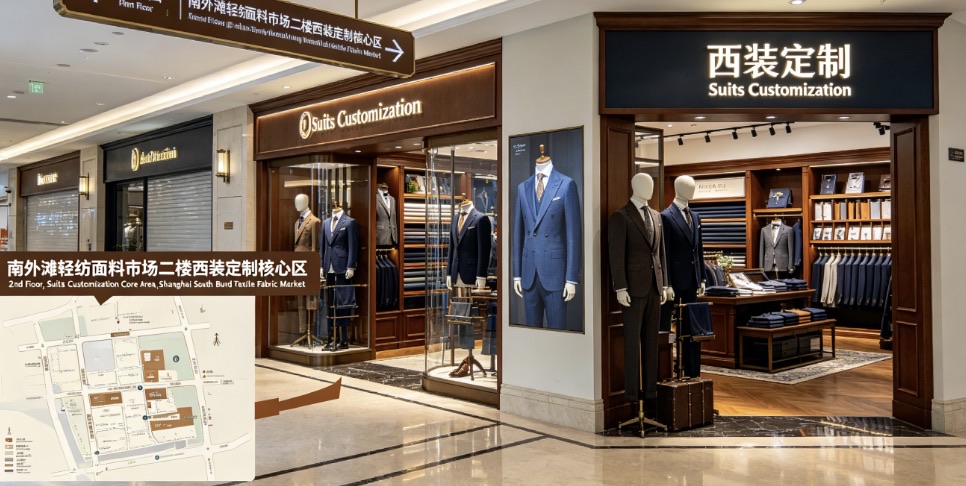
2F Bespoke Suit Core Zone

The second floor is the core area for custom clothing, chiefly suit and dress tailoring. The representative shop Dain Design (stall 278) uses boutique-design-grade craft, recording 28 body-measurement data points; stall 233 is known for the widest range of samples, covering corduroy, peak lapel, double-breasted and other styles.

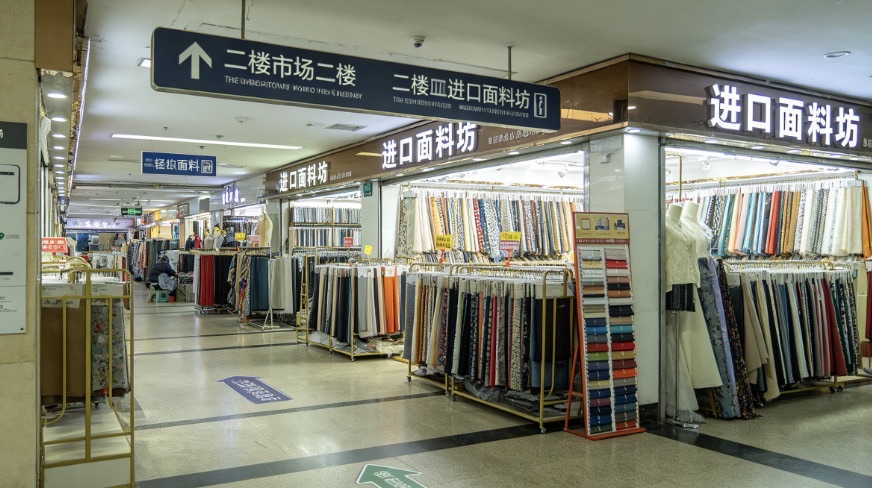
2F Imported Fabric Boutique

Stall 267 on the second floor (Fiona's Shop) specializes in high-end European surplus stock and leftover fabrics from luxury-brand supply chains, providing a source of imported fabrics for custom suits. The boutique's fabrics come from traditional textile regions such as Italy and Britain, allowing customers to select according to quality and budget.

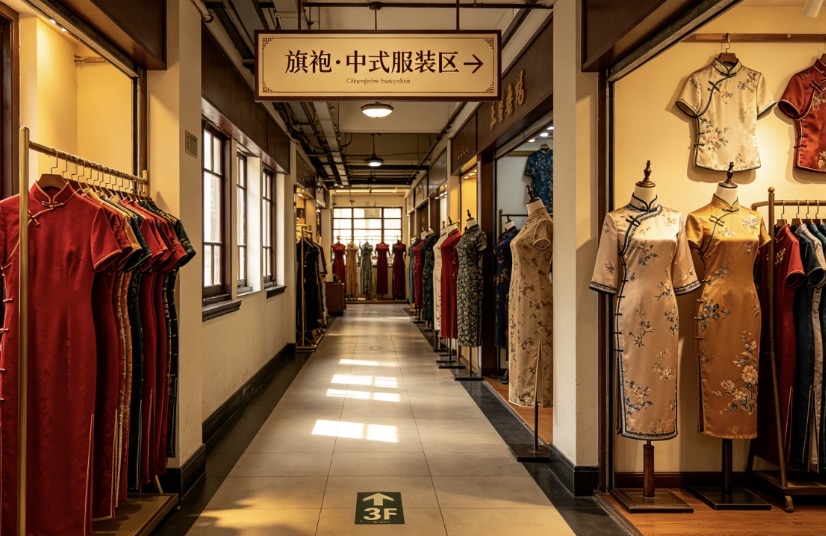
3F Qipao & Chinese-Style Garment Zone

The third floor specializes in women's wear, chiefly qipao, double-faced wool coats and modern Chinese-style garments. Stall 361, run by Zhang Fenlin, makes hand-tailored silk qipao using yunjin brocade, pure silk and acetate fabrics, priced from ¥1,000 to ¥1,500; stall 379, "Yi Lai Yuan," has over twenty years of history and makes reversible double-faced wool coats; stall 180 specializes in tweed-style suit sets.

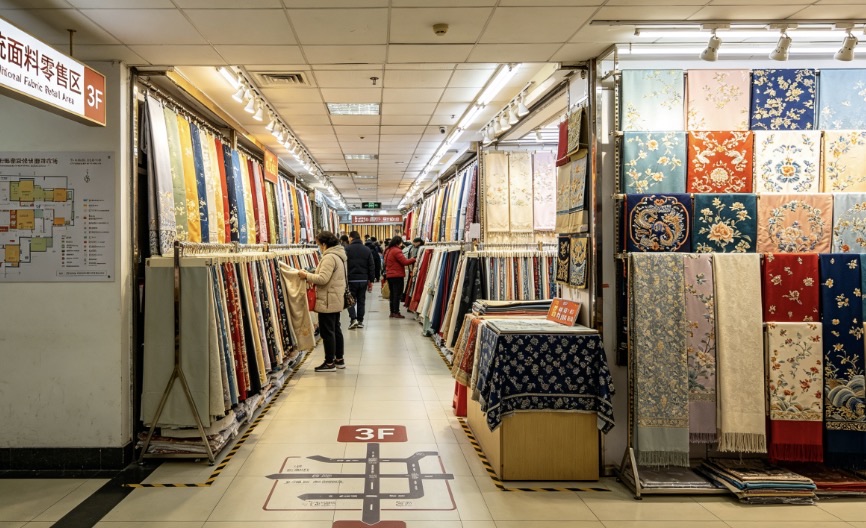
3F Traditional Fabric Retail Zone

A side lane opposite the lift on the third floor has brocade retail shops, whose owners offer original, exclusive printed silk fabrics. This zone also retails silk fabric, allowing customers to buy raw materials and then have them made up by tailoring shops on the same floor, forming a one-stop loop from fabric selection to bespoke making.

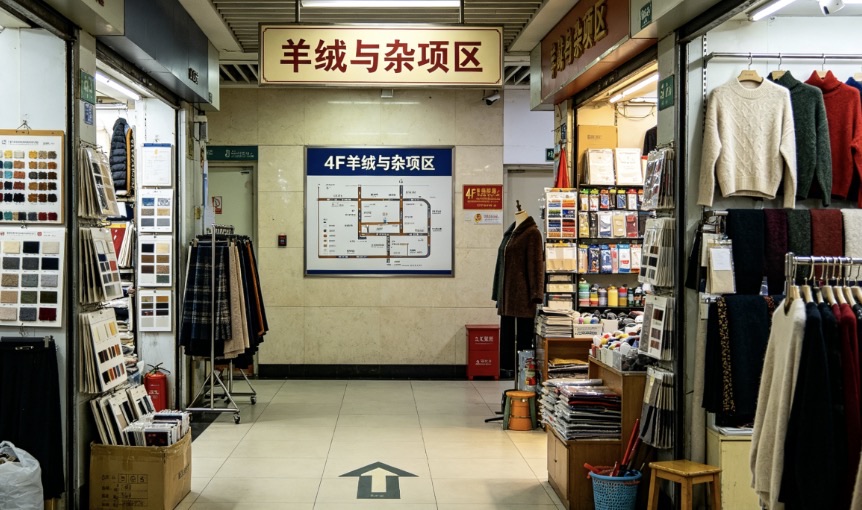
4F Cashmere & Miscellaneous Zone

The fourth floor of the market is a mixed retail area, chiefly cashmere products, along with small appliances and miscellaneous goods. Foot traffic on this floor is lower than on the first three, and its range of goods is broad — a supplementary level within the market's commercial system.

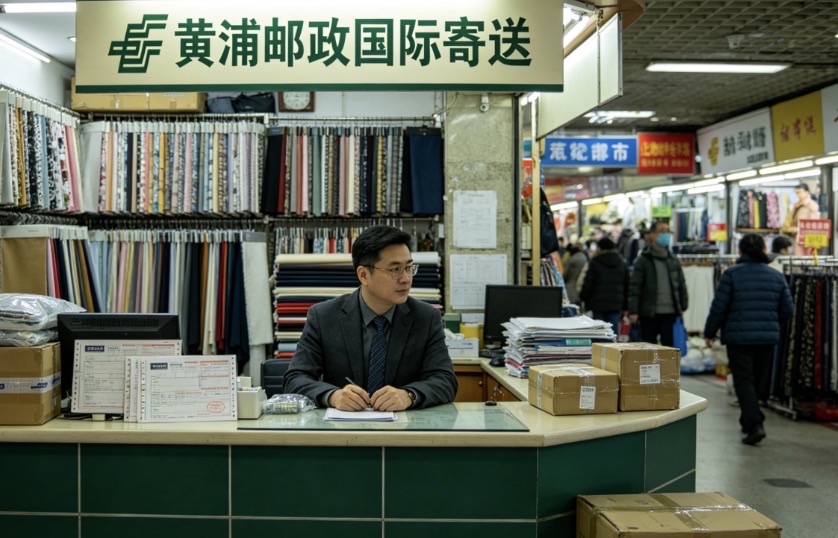
Huangpu Post International Shipping Service Counter

In 2025, Huangpu Post set up a service counter inside the market, handling direct international shipping of finished custom garments, covering over 170 countries and regions worldwide. This service offers overseas visitors an immediate shipping channel once their garments are finished, shortening the logistics cycle from order to delivery.

Inside South Bund Fabric Market (commonly known as "Dongjiadu Fabric Market")

9 stops, in walking order — read top to bottom, no clicking needed.

1 Market Entrance Lobby of 9

Market Entrance Lobby

市场入口大厅

The main entrance lobby of Nanwaitan Light Textile & Fabric Market is the first stop on the journey into this "global bespoke center." Located at the front of the first floor of the main building at 399 Lujiabang Road, the high-ceilinged lobby reflects the "modern marketplace" identity that the market adopted after its 2005 upgrade. Multilingual signage in Chinese, English, Japanese, and Korean guides visitors to the different floors—ready-to-wear leather goods and the Kate & Kevin studio on the first floor, suit tailoring and imported fabric on the second, qipao and traditional textiles on the third, and cashmere and miscellaneous goods on the fourth. A consultation counter staffed by multilingual shop assistants (English, French, German, Italian, and Spanish) assists foreign visitors with measuring, shipping, and alteration questions, while a "Shanghai Bespoke" wall displays stories of NBA players, the US water-polo team, and French flight attendants. During peak hours the lobby doubles as a meeting and bargaining space, with the scent of the Huangpu River mingling with silk—often called Shanghai's most "alive" entry to international fashion.

On-site narration · read it where you stand

Dear friends, where we are standing now is the entrance hall of the South Bund Fabric Market. Welcome to the "Oriental Tailor's Paradise"! This market is located at No. 399 Lujiabang Road, Huangpu District, Shanghai, and officially opened in 2005, but its roots reach back to the Dongjiadu Fabric Market in Shanghai's old town in the 1990s — that was a sacred ground for tailoring in the hearts of the older generation of Shanghainese, where many an old-time gentleman had his very first bespoke suit made.

The market's façade may not look luxurious, but it is a genuine international tourist destination. On TripAdvisor, this four-storey market ranks second among Shanghai attractions, behind only the world-famous historical sites, and is known to visitors from around the world as the "Fabric Market" or the "Oriental Tailor's Paradise." From the pre-game formal wear that NBA stars have made when they come to Shanghai for China games, to the wedding qipao that French visitors fly over specially to have made, this place generates an output value of one billion yuan a year. The 285 tailoring shops cut clothes to measure every day for customers from all over the world, "one person, one pattern" — every garment has its own dedicated paper pattern, a craft no industrial assembly line can match.

Photography tip: the "South Bund Fabric Market" signboard at the entrance is good for a commemorative photo; we especially suggest standing directly beneath it and shooting upward, capturing both the atmosphere of the market and the Chinese shop sign in one frame. But once inside, take care — the shops are densely packed and the aisles fairly narrow, so when you raise your phone to take a photo, be careful not to block other customers' way, and do not point your camera at customers who are trying on clothes. All right, let us now formally enter the first floor and begin today's shopping journey!


1F Ready-to-Wear & Leather Goods Section

一楼-成衣与皮具区

The ready-to-wear and leather goods section occupies the west wing of the market's first floor. With around 40 shops focused on off-the-rack apparel and accessories, it is the fastest-moving part of the market, ideal for visitors who want to buy and wear immediately. Racks and shelves display men's and women's suits, trench coats, leather jackets, blazers, shirts, dresses, evening gowns, and leather goods including cowhide, sheepskin, and crocodile-embossed handbags, briefcases, and belts. Most vendors sell by browsing and bargaining, with on-the-spot fitting and minor alterations; prices range from a few hundred to tens of thousands of RMB. Located next to the Kate & Kevin studio and the lobby consultation counter, the section lets accompanying family or friends pick up a ready garment or a leather accessory while a tailor takes measurements. Many shop assistants can communicate in English about sizing and leather grades and help with packing and international shipping.

On-site narration · read it where you stand

We have now reached the ground floor, the busiest and liveliest floor in the whole market, and the one that catches the eye of many visitors the moment they walk in. The first floor mainly sells ready-made coats, leather jackets, accessories, gloves and eyewear; most are in stock, so if you see something you like, you can take it away on the spot without waiting.

But let me be straight with you — the stalls near the market entrance usually quote higher prices, especially the few prominent ones directly facing the main door. This is a common feature of almost all tourist markets; they know you have just walked in and have not yet compared prices, so they will name a bold figure. The smart move is to walk a full circle first, running the styles and prices through your mind, and then decide where to buy.

Leather jackets are the absolute specialty of the first floor. There are styles of every kind — the classic biker, the bomber, even fusion styles with Chinese frog buttons — so many choices they will dazzle you. But leather quality does vary, and the way to judge it is simple: feel the texture, as good leather is soft and smooth, not stiff; turn over the lining and check the workmanship, whether the stitching is even and the seams clean; and give it a sniff, as a sharp chemical smell means the treatment process was poor. A good leather jacket worn for a few years will fit your figure better and better, while a poor one will start shedding within two years.

The first floor also has accessory and eyewear areas worth a glance. The better-made silk scarves and shawls, some with rather fine silk prints, make suitable souvenirs to bring back for friends. There are also many styles of sunglasses, but keep the lens quality in perspective — do not expect to buy several hundred yuan's worth of quality for a few dozen yuan.

Shopping tip: when you see a style you like, first note the stall number and the quoted price, and come back to negotiate after you have browsed the whole floor; with something to compare against, you will know where you stand. Having taken a rough look at the first floor, let us go and see the shop most worth highlighting on this level.

1F Kate & Kevin Bespoke Studio

一楼-Kate&Kevin定制工坊

The Kate & Kevin bespoke studio sits in the east wing of the first floor, near the entrance lobby, and is one of the earliest studios in the market to operate fully in English with an end-to-end bespoke workflow. Sample gowns hang throughout the room—silk evening dresses, satin qipao, Xiangyunsha outerwear, lace bridal gowns, and cocktail dresses—while the walls display swatch cards of imported fabrics from Italy, the United Kingdom, and Japan. Founders Kate and Kevin follow a "one person, one pattern" draping method, beginning with British-style toile work on the form, then a basted fitting that respects the client's shoulder, neck, bust, waist, and hip proportions, and finishing with hand-stitched hems, pankou knots, and concealed zippers. The studio specializes in evening gowns, qipao, and bridal collections, as well as fusion pieces that combine Chinese standing collars with Western silhouettes. Lead time is usually 7–14 days, and appointments are recommended in peak seasons (March, May, and September–October). In partnership with the Huangpu Post Office counter on the fourth floor, finished garments can be shipped directly to more than 170 countries and regions.

On-site narration · read it where you stand

Round the corner, we arrive at the most recommendable shop on the first floor — Kate & Kevin. They have stalls at numbers 128, 137 and 195, and are one of the very few shops in the market with clearly marked, fixed prices, which is most welcome.

Kate & Kevin focus on business tailoring — suits range from ¥2,000 to ¥5,000, and shirts start at ¥150. This price is highly competitive for bespoke tailoring; in Europe or America, a custom suit of comparable craftsmanship would cost at least five hundred to a thousand US dollars. Even more reassuring, they promise free lifetime alterations, which means that if your figure changes in the future — if you gain or lose weight — you can bring the garment back at any time for them to adjust it, free of charge.

Their tailors are highly experienced and will recommend a cut and fabric according to what you intend to wear it for. Whether it is for an important business meeting, a friend's wedding, or daily commuting, they know what suits, and will not make ill-judged recommendations. For a meeting, for example, they will suggest a dark worsted wool and a more conservative English cut; for a wedding, they might recommend a slightly more luxurious fabric and a lapel with some design flair.

Why do we particularly recommend Kate & Kevin? Fixed pricing means you need not trouble yourself haggling with the owner — especially suitable for foreign visitors who are not good at bargaining or are short on time. Hard bargaining at a fixed-price shop is rather impolite in market culture — their price is already the real price. Of course, if you have plenty of time and enjoy the fun of bargaining, the second floor has more shops to compare and negotiate with at leisure. But if you have only half a day at the market and want a reliable, hard-wearing custom suit, Kate & Kevin is a very efficient choice that avoids the pitfalls. All right, having seen the main highlights of the first floor, let us go up to the second floor, to the core area of suit tailoring.

2F Suit Tailoring Core Zone

二楼-西装定制核心区

The second floor is the heart of Nanwaitan Light Textile & Fabric Market and the densest cluster of shops—more than 60 tailors dedicated to men's suits, shirts, trench coats, and overcoats line both sides of the atrium corridor. It is the area that drives most of the "Shanghai Bespoke" reputation on overseas social media. Most shops follow a "front shop, back factory" model: the front displays wool, cashmere, and blend fabric swatches and sample garments, while the back houses a team of cutters, machinists, and pressers who produce the basted, half-finished, and finished garments. The standard workflow runs from fabric selection to measurement, basted fitting, second fitting, and finished garment, with a 7–14-day lead time that can be compressed to 3–4 days for rush orders. Many shop assistants speak English—and often French, Spanish, or Japanese—and accept remote measurement by photo or video. Stories of international clients such as NBA star Dirk Nowitzki and the US water-polo team are often posted on the walls and on social media, helping first-time visitors identify the silhouette that best suits them.

On-site narration · read it where you stand

Dear friends, we now arrive at the second floor — the bespoke suit core zone. If the first floor is the battlefield of quick shopping, the second floor is where you go deeper into the very essence of the "Oriental Tailor's Paradise." This is the most popular floor with first-time visitors; shops for suits, dresses and other custom clothing cluster here, and the fierce competition means more choice and better service for you.

First, a grand introduction to Dain Design, stall number 278. This shop is known in the market for its "boutique design-grade" positioning — the owner is not an ordinary tailor but a systematically and professionally trained fashion designer. The way she takes measurements is unlike anyone else's, recording 28 data points on your body: the basic figures such as shoulder width, chest and waist, of course, but more crucially the slope of the shoulders, the circumference of the arms, the size of the wrists, the transition curve from waist to hip, and even the subtle lean of your posture. What does 28 data points mean? An ordinary custom suit is measured at about six to eight points, a better one a dozen or so; 28 is nearly the most precise measurement system in the whole market, and the resulting suit fits like a second skin.

Walk a little further to stall 233, whose greatest strength is the widest range of samples. Corduroy suits, peak-collar shirts, Italian narrow lapels, English double-breasted — every style imaginable, and you would be hard pressed to find another shop in the whole market with so many physical samples to handle and try on. If you are still unsure what style suits you, we strongly suggest going first to stall 233 to look and try on plenty, photographing the styles you like, and then ordering elsewhere with a clear idea in mind. A word of caution, though: this shop is about ¥300 more expensive than the neighbouring stalls — a small premium for the wide selection.

The second floor has another treasure — stall 267, Fiona's Shop, specializing in high-end European surplus stock and leftover luxury-brand fabrics. Let us go and take a special look at it next.

2F Imported Fabric Section

二楼-进口面料坊

The imported fabric section sits on the inner side of the 2F east wing, with about 15–20 shops and counters dedicated to premium imported fabrics. It shares foot traffic with the core suit-tailoring area but occupies a higher-end niche. This is where fabric connoisseurs browse: brand-name books from Italy's Loro Piana, Vitale Barberis Canonico, Zegna, and Reda, the UK's Holland & Sherry and Fox Brothers, and Japan's Dormeuil line the shelves, alongside Chinese luxury textiles such as Xiangyunsha, Song brocade, and Zhang velvet. Shop owners typically speak English and Japanese, helping customers understand yarn counts (Super 130s/150s/180s), weave structures (plain, twill, herringbone), cloth weight, and seasonal use, then recommending combinations to match any budget. The section rarely produces garments itself, but it works hand-in-glove with the core tailoring shops and half-finished garment workshops on the same floor—a selection-to-basted-garment turnaround of 3–5 days is common.

On-site narration · read it where you stand

Right next to the suit tailoring area, we now arrive at the imported fabric boutique. The heart of this area is stall 267, Fiona's Shop, a one-of-a-kind presence in the whole market.

Fiona specializes in collecting end-of-season surplus and leftover high-grade fabrics from European luxury brands. These fabrics were originally destined for the production lines of high-end ready-to-wear brands in Italy and France — after the season changes, the brands no longer need them, and through particular channels they end up in Fiona's hands. What is "surplus"? Not seconds, but the few metres or few dozen metres left over after production, of the same quality as the fabric used in garments that sell for tens of thousands of yuan in the boutiques.

Many people come to Fiona's shop, see only the few sample rolls hanging in the display area and leave — and that is a great loss. The real trump cards are hidden behind the counter — you have to take the initiative and ask the owner: "Do you have anything better? May I see the stock?" Only then will Fiona bring out the good things stored away. Fine high-count worsted wool, British Harris tweed, Italian silk blends, French lace — prices range from a few hundred to a few thousand yuan per metre. Some say it is expensive, but bear in mind that the same Italian worsted wool would cost you at least several dozen pounds per metre at a tailor's on Savile Row.

If you know something about fabric, you can simply state the specifications you want, for example: "a four-season worsted wool of 240 to 280 grams, Super 120s or higher," and the owner will know you are a knowledgeable customer and take your requirements seriously. Of course, if you know nothing about fabric, that is perfectly fine too — tell the tailor what season and occasion the garment is for, and let the professional choose for you; the result is usually good. A suit made from good fabric still looks respectable after ten years, while a suit of poor fabric has lost the game before it even leaves the rack. All right, we have seen most of the second floor, so let us go up to the third.

3F Qipao & Chinese Clothing Zone

三楼-旗袍与中式服装区

The central atrium of the third floor is the most distinctively "Eastern" section of the market, gathering around 30 shops that specialize in qipao, changshan, magua, and traditional Chinese wedding attire. Its clientele is strikingly international—French, Singaporean, and Malaysian brides, Chinese-diaspora communities in the US and Canada ordering festival gowns, and Russian and Ukrainian customers ordering bridesmaid qipao all leave their mark here. Fabrics are dominated by silk crepe de Chine, brocade, Xiangyunsha, Song brocade, Zhang velvet, and embroidered cloths, with both fully hand-stitched and hybrid hand-and-machine options available. Mandarin collar height, pankou design, slit position, and sleeve length can all be tailored to the client's figure and taste. Lead time runs 7–14 days, with 3–5-day rush service available; during Chinese New Year and the seventh lunar month, shops often require 1–2 months of advance booking. Finished qipao can be shipped abroad directly from the Huangpu Post Office counter on the fourth floor.

On-site narration · read it where you stand

Everyone, we have reached the qipao and Chinese-style garment zone on the third floor. Foot traffic on the third floor is noticeably lighter than downstairs, so browsing is more relaxed and unhurried, the shop owners have more time to attend to you, and the whole experience is more refined.

First, stall 361, run jointly by two masters, Zhang Fenlin and Hongyun, specializing in hand-tailored silk qipao. The fabric choices are very rich — top-grade yunjin brocade, classic mulberry silk, and easy-care, affordably priced acetate. A single qipao costs between ¥1,000 and ¥1,500. If you are considering two pieces, the package price starts at ¥2,000, which works out noticeably cheaper per piece. From choosing the fabric and taking measurements to the first fitting, the whole process takes about three to four days. The craft is authentic Suzhou-style qipao work, and the piping, the frog buttons and the height of the slits can all be customized to your taste. Many foreign visitors worry that a qipao will be hard to wear out, but a modern qipao can easily be made into an everyday wearable adaptation — a slightly shorter skirt, sleeves removed, a plain fabric with a thin belt, and it looks perfectly at home at a dinner or cocktail party.

Next, stall 379, "Yi Lai Yuan," which has been in the market for twenty years. Its signature product is the double-faced wool coat — wearable on both sides, one side classic camel or black, and turned inside out, the other side wine-red or dark green — so for the price of one coat you get two. The craft is extremely demanding: the entire coat has not a single visible stitch, all hand-sewn and concealed. Besides coats, modern Chinese-style tops, structured waistcoats and quilted custom jackets are also among its strengths.

For value for money, look at stall 180 — a tweed-style suit set for only ¥680, the lowest price in the whole market. If you are short on time but want to take home an outfit with Chinese style, stall 180 has the fastest turnaround, a very practical choice. Having browsed the Chinese-style garments on the third floor, let us walk further in and take a look at the fabric retail zone.

3F Traditional Fabric Retail Area

三楼-传统面料零售区

The traditional fabric retail area runs along the east and south wings of the third floor, with 30–40 counters selling fabric by the metre in a "cut and carry" model. Its main customers are local qipao enthusiasts, independent designers, theatrical costume studios, and DIY buyers. The selection covers everything from basics to niche pieces: silk satin crepe, crepe de chine, organza, chiffon, and habotai; cotton and linen such as washed cotton, ramie, and flax; wool ranging from coarse to worsted fancy tweeds; synthetics and blends suited to school projects or stage costumes; and distinctive textiles including blue calico, batik, tie-dye, ethnic brocade, and Peking opera costume cloth. Counters accept both small cut orders (from 0.5 m) and wholesale volumes, which is convenient for individual buyers. Many can recommend the right fabric width and cutting plan for a client's figure and can arrange shipping or hand-carry packaging. This is the most upstream "raw material window" of the Shanghai bespoke industry chain.

On-site narration · read it where you stand

Walking on from the qipao zone, we come to the traditional fabric retail zone on the third floor. It shares the overall atmosphere of the third floor — few people and quiet, a true treasure trove for fabric lovers, and the most underrated area in the market.

Today I will take you to find a hidden shop — opposite the lift is an unremarkable side lane, and tucked away in it is a brocade shop, very easy to miss if you are not paying attention. But this shop is the one most worth a fabric lover's special trip in the whole market. The owner designs the patterns himself, then works with a factory for exclusive production, which means every roll of fabric in the shop is one of a kind — you cannot buy the same pattern anywhere else in the world.

The main offerings are huailuo gauze and silk damask. Huailuo is one of the most technically complex of traditional Chinese silk weaves, its surface covered with fine, even mesh openings, and these tiny pores make the fabric extremely breathable and gentle on the skin. A shirt or skirt made from huailuo in summer is more comfortable than any high-tech quick-dry fabric. Silk damask, by contrast, has a soft, warm sheen, suited to qipao, evening gowns, or the lining of Chinese-style suits; struck by sunlight, that silken lustre is something synthetic fabric can never imitate.

The fabric here is sold by the metre — silk huailuo is roughly several hundred to over a thousand yuan per metre, and yunjin brocade is dearer still. But compared with European fabric of the same quality, the advantage here is very clear — in a Paris fabric shop, a single metre of Italian silk could set your heart racing.

Shopping tip: if you have had a qipao or Chinese-style top made on the second or third floor, you can come to the fabric retail zone and buy a special length of fabric to take home as a keepsake or to use next time. Many returning customers do exactly this: on their first visit they have a garment made, and on their second they browse the fabric area first to choose the cloth, then go to find a tailor. Fabric takes up no luggage space — roll it up, tuck it in your bag, and off you go — a souvenir of real cultural value and very practical too. All right, having browsed the third floor, let us go up to the fourth for a quick look.

4F Cashmere & Miscellaneous Zone

四楼-羊绒与杂项区

The fourth floor is the top level of the market, with 25–35 shops dedicated to cashmere and complementary accessories; it is at its liveliest during autumn and winter. Visitors can find Inner Mongolia-, Xinjiang-, and Qinghai-sourced pure cashmere yarn, cashmere scarves and shawls, and bespoke-knitted and custom-dyed cashmere sweaters, cardigans, and double-faced cashmere overcoats. The "miscellaneous" range covers sheepskin gloves, belts, silk scarves, buttons, pankou knots, zippers, lining cloth, brooches, tie clips, and cuff links, letting customers put together an entire outfit on the same floor. Many shops offer semi-bespoke service—adjusting collar, sleeve, and body length on ready patterns with a 2–3-day turnaround. The price ladder is clear: from RMB 300 plain cashmere sweaters to over RMB 10,000 premium overcoats. It is the floor that most clearly showcases the value-for-money side of "Shanghai Bespoke."

On-site narration · read it where you stand

We have reached the fourth floor — the cashmere and miscellaneous zone. To be frank with you, the fourth floor is not the core floor of the South Bund Market; it is more of a mixed retail space, with cashmere products, small appliances and all kinds of miscellaneous goods scattered across the stalls, making for fairly casual browsing.

Cashmere scarves and sweaters are what is most worth a careful look on the fourth floor. The prices are usually far lower than the department-store counters — a pure cashmere scarf that might cost over a thousand yuan in a mall can be had here for two or three hundred. But the cashmere market is murky, so you need to learn some basic ways to tell quality. Truly good cashmere feels soft and full, with a natural springiness, completely non-itchy against the skin, like being wrapped in a cloud. If you burn a small tuft of the fibre with a lighter, real cashmere gives off the smell of burnt hair and leaves an ashy-white powder that crumbles when pinched; a synthetic blend gives off a smell of burnt plastic and leaves a hard lump. Of course, you need not do a burn test in the shop, but the feel cannot lie — pinch it, rub it, and good cashmere will speak for itself.

You can give the small-appliance and miscellaneous area a quick scan. There are practical little items such as universal travel adapters, portable fans and phone cases, which you can pick up if you need them, but do not expect the small appliances on the fourth floor to be of any stunning quality — they are not the market's main draw, serving more the everyday needs of nearby residents.

Time-management tip: five to ten minutes to walk around the fourth floor is enough. If your time is limited, save your focus for the tailoring areas on floors one to three — that is where the soul of the South Bund Market lies. Having seen the fourth floor, let us now go down to the first floor to see the last interesting place of the day — the Huangpu Post International Shipping Service Counter.

Huangpu Postal International Shipping Service Desk

黄浦邮政国际寄送服务台

The Huangpu Post Office international shipping counter sits near the escalator on the fourth floor. Established in 2025 under the coordination of the Huangpu District Commerce Commission, it is the temporary service point that completes the "fit on arrival, ship to the world on departure" loop that has become a Nanwaitan signature. The counter offers international EMS, international small packets, registered mail, and air/sea-surface services covering more than 170 countries and regions. On-site workflow: customers present the finished garment, the bespoke order receipt, and valid ID; staff cushion the garment in shockproof paper, reinforce the four corners, weigh and price the parcel, and print the waybill—two bespoke shirts weighing 0.49 kg to Paris, for example, take 5–7 working days at around RMB 260. Beyond shipping, the counter plans a "Nanwaitan Bespoke" themed post office, cultural postcards, and limited-edition philatelic products, making it one of Shanghai's most representative "national-trend meets international courier" experience points.

On-site narration · read it where you stand

Dear friends, we have returned to the first floor, the last stop on our route — the Huangpu Post International Shipping Service Counter. This is a service that only came to the market in 2025, and it may be the most practical of everything I am introducing today!

You have had a whole bagful of custom clothes made — how do you get them back to your own country? In the past this was every visitor's nightmare: cramming them into a suitcase until they were crumpled, being charged for excess weight at the airport, and lugging them around the whole way. Now all these worries are solved: all the clothes you have custom-made or bought in the market you can take straight to the Huangpu Post counter, where within five minutes they will check the address, weigh and price it, seal and pack the box, and then ship it to over 170 countries and regions worldwide. Before you even reach home, your clothes have already arrived.

Let me give you a real example: two custom shirts weigh about 0.49 kilograms, and the shipping cost from Shanghai to Paris is ¥260, delivered in five to seven days. A suit weighs a little over a kilogram, and shipping to New York or London costs between ¥300 and ¥500. Compared with buying an extra suitcase or being fined for excess weight at the airport, this cost is actually a good deal. And the professional packing ensures the clothes do not crease or get crushed out of shape.

The counter has bilingual staff, in both Chinese and English, so filling out the shipping form is no trouble. You need only provide the destination address, the recipient's name and a phone number, and they will handle the rest — the weighing, pricing, sealing and packing.

Practical itinerary tip: if you are staying in Shanghai for more than five days, we recommend this rhythm — come to the market on days one to two for a consultation, measurements, fabric selection and your order; come back on days four to five for the first fitting, when the tailor marks on the spot where adjustments are needed; and on days six to seven, pick up the finished garment and take it straight to the counter to ship. What if your trip is less than five days? Then choose semi-bespoke, or ready-to-wear that can be altered on the spot, which is safer. Semi-bespoke means a finished garment adjusted locally to your figure, usually done in a single day.

All right, our tour of the South Bund Fabric Market ends here. From the entrance hall to Huangpu Post, we have walked through this "Oriental Tailor's Paradise" floor by floor. We hope you all find the very garment that belongs to you here!

Prefer to be shown around?

A local guide walks these 9 stops with you and answers what the page cannot.

Browse tours ↗