Attraction Introduction (For App Listing Page)
Overview
Shijiu Lake sits at the border of Lishui District and Gaochun District in Nanjing, Jiangsu Province, and Dangtu County and Bowang District in Ma'anshan, Anhui Province. It is one of the largest natural freshwater lakes connected to the Yangtze River in the Jiangnan region, covering more than 200 square kilometers. The lake formed through the subsidence and breakup of ancient Danyang Lake, with origins dating back to the early Holocene, roughly 10,000 years ago.
The lake takes its name from its shape: seen from above, the outline resembles a shi jiu — a stone mortar used for husking grain in ancient China. The name first appears in the Northern Song geographical text Taiping Huanyu Ji. In ancient times, the lake was part of the Xuxi Canal waterway. During the Hongwu reign of the Ming dynasty, it was connected to the Qinhuai River via the Tiansheng Bridge Channel (also known as the Yanzhi River), making it a vital water route for transporting grain from Jiangsu and Zhejiang to the imperial capital. The lake's silverfish, hairy crabs, and wild ducks have long been celebrated as its "Three Treasures," earning it the saying: "A peck of gold at dawn, a peck of silver at dusk." The "Shijiu Fishing Song" is counted among the New Forty Scenes of Jinling.
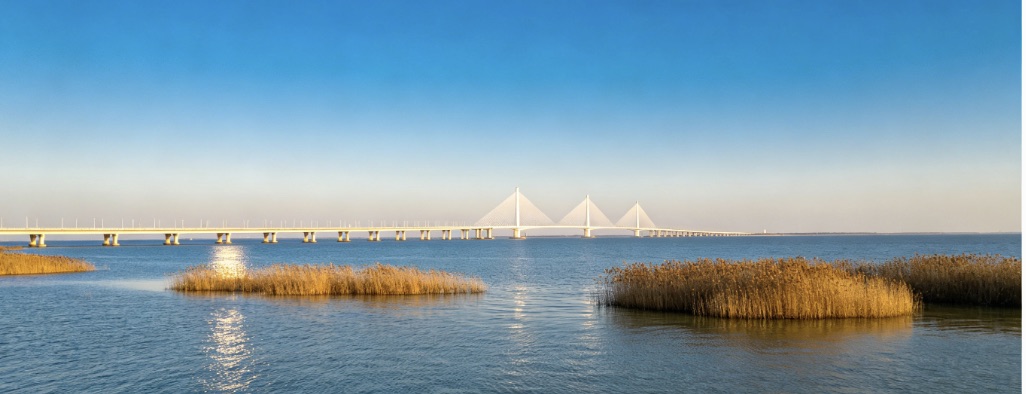
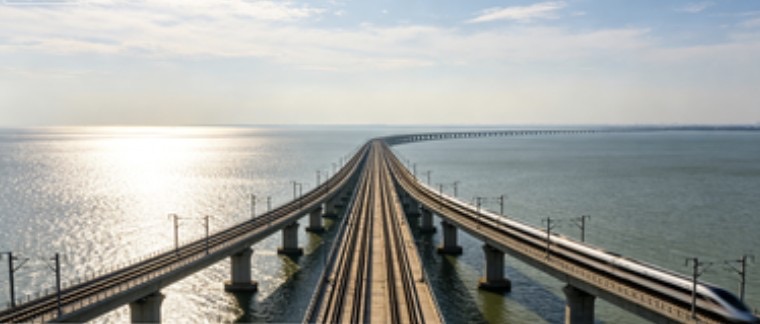
The section of Shijiu Lake within Lishui District is the heart of the scenic area, spanning three townships: Shiqiao, Honglan, and Hefeng. The Shijiu Lake Grand Bridge — a 12.6-kilometer span that arches across the water like a rainbow — carries Nanjing Metro Line S9 over the lake. Where sky meets water, the train appears to glide across the surface, giving rise to the nicknames "Sky Mirror" and "Water Train." The lake lies along the East Asian–Australasian Flyway, one of the world's major bird migration routes. Each winter, thousands of tundra swans make the journey from Siberia to overwinter here, joined by Eurasian spoonbills, Oriental storks, and dozens of other migratory species — earning Shijiu Lake a place among Jiangsu Province's Top Ten Birdwatching Destinations. Along the shoreline, ancient villages, boardwalks, lighthouses, and sweeping reed meadows create a landscape that shifts with every season: wildflowers and birdsong in spring, shimmering haze in summer, golden reed beds in autumn, and flocks of wintering birds in winter.
Attractions
1. Shijiu Lake Grand Bridge
The Shijiu Lake Grand Bridge stretches 12.6 kilometers, the centerpiece of the Ninggaoxin Corridor's lake-crossing project, running from northeast to southwest through the heart of the lake. The bridge deck sits almost level with the water's surface, so from a distance it appears to float — a seamless line where the lake and the sky dissolve into each other. Nanjing Metro Line S9 runs across it, and from the shore you can watch trains move steadily along the horizon, like something out of a Miyazaki film. Beyond its function as infrastructure, the bridge is the most iconic landmark on Shijiu Lake. From the embankment at Xiangyang Village, the bridge, the train, the lake, and the sky merge into the classic "Sky Mirror" image.
2. Shiqiao Sub-district, Xiangyang Village — Embankment Viewing Platform
Xiangyang Village sits at the Lishui end of the Shijiu Lake Grand Bridge. The embankment here offers an unobstructed view across the water and is widely regarded as the best spot to experience the "Sky Mirror" effect. Standing on the dike, you have the 12.6-kilometer bridge and the Metro S9 on one side, and the vast, still lake on the other. On a calm, clear day, the surface becomes a perfect mirror — blue sky and white clouds reflected with startling clarity, the only dividing line a faint ridge of distant hills. The embankment is also the go-to shooting location for the "Water Train": the train's orange-and-white livery moving across the glassy water makes for a minimalist, quietly poetic image.
3. Honglan Sub-district, Xizhao Village — Migratory Bird Observation Point
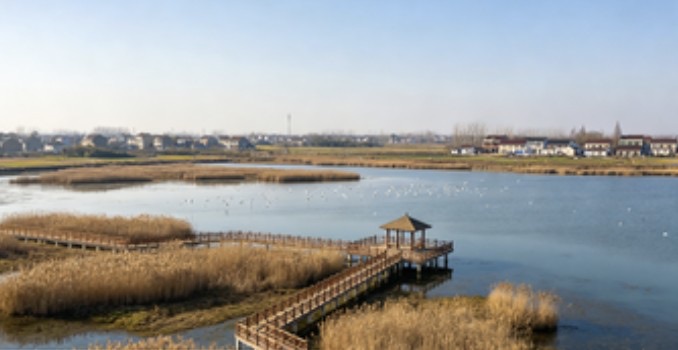
The birdwatching site at Xizhao Village, on the shore of Jiangjiaxizhao Village in Honglan Sub-district, is an important part of the Shijiu Lake wetland system. The lake is wide here, and aquatic vegetation is dense — ideal habitat for the tundra swans that arrive each November and stay through February. Numbers regularly exceed 5,000 birds. Alongside the swans, visitors can spot Oriental storks, black-faced spoonbills, and hooded cranes — all Class I protected species in China — as well as more than 20 Class II protected species including Eurasian spoonbills and greater white-fronted geese. A viewing platform on the shore offers an unobstructed look at the flocks rising and landing at dawn and dusk, their calls carrying across the water. In 2024, the site was named one of Jiangsu Province's inaugural Top Ten Birdwatching Destinations.
4. Yigongqu — Lighthouse
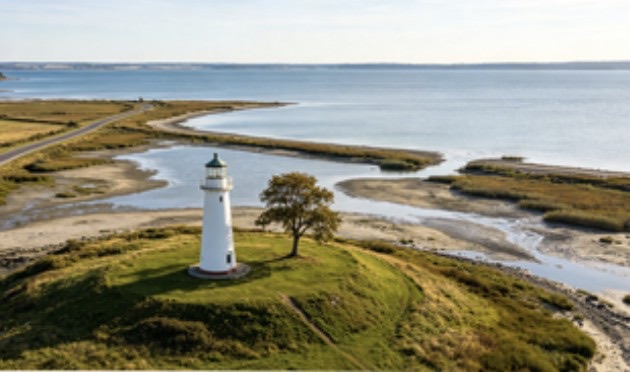
The Yigongqu lighthouse stands on the southeastern shore of Shijiu Lake within Lishui District — a white cylindrical navigation tower rising from the edge of the shoreline grassland. Built to guide boats through the lake at night, it has become one of the most recognizable photo landmarks on Shijiu Lake thanks to its solitary position and clean, simple form. Nearby, a single large tree stands alone on the bank — with no other tall vegetation around it, visitors have taken to calling it "the Lonely Tree." The lighthouse, the lone tree, the lake, and the distant hills compose a scene of spare, austere beauty. At sunrise, when the morning light turns the water red and the lighthouse becomes a silhouette against the glow, the image is at its most striking.
5. Hefeng Town, Zhangxu Village — Sunset Boardwalk
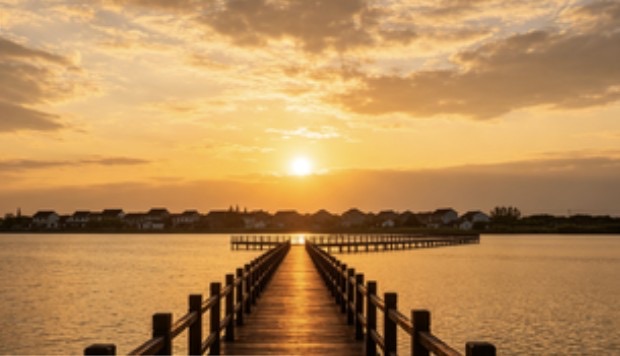
Zhangxu Village sits on the southern shore of Shijiu Lake in Hefeng Town. A concrete boardwalk extends from the village into the lake, ending at a two-story square watchtower. Originally built for fishing operations and flood control, the boardwalk runs roughly 200 meters in a straight line out over the water, with the lake stretching away on both sides — walking it feels like walking on the surface of the lake itself. From the top of the watchtower, the view sweeps across the lake, the wetlands, and the distant hills. This is widely considered the best place on Shijiu Lake to watch the sunset: as the sun drops behind the hills to the west, the sky cycles from deep gold to burnt orange to violet, and the lake mirrors every color below. The silhouettes of the boardwalk and watchtower against the blazing water have earned the spot its reputation as "a lake of molten gold, a sky dyed crimson."
6. Hefeng Town, Zhujia Village — Ancient Village
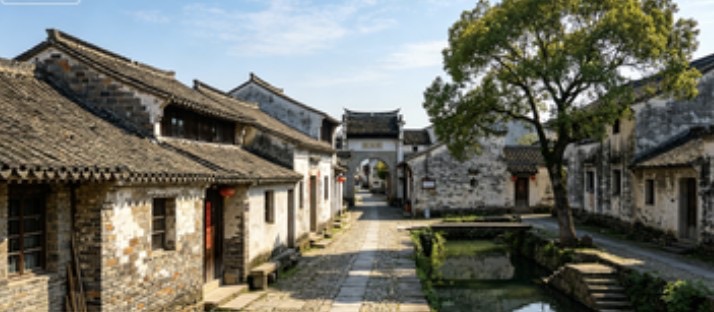
Zhujia Village in Hefeng Town backs up against Fengqi Mountain and faces Shijiu Lake, making it the best-preserved traditional lakeside village in Lishui. At its center is the Zhu Clan Ancestral Hall, built in the late Ming to early Qing dynasty — a two-courtyard, three-bay brick-and-timber structure with intricately carved roof beams and intact brick carvings above the doorway. It stands as a rare physical record of clan society in Lishui during the Ming and Qing periods. The village contains 23 well-preserved old residences, most in the late Qing to early Republican style: gray brick and dark roof tiles, high gable walls, and narrow lanes paved with blue flagstone that follow the slope of the hillside. Ancient trees shade the village entrance, and the lake stretches open beyond the village edge — old village, green hills, and blue water together forming a quietly beautiful Jiangnan tableau.
7. Shijiu Lake Embankment — Lakeside Scenic Corridor
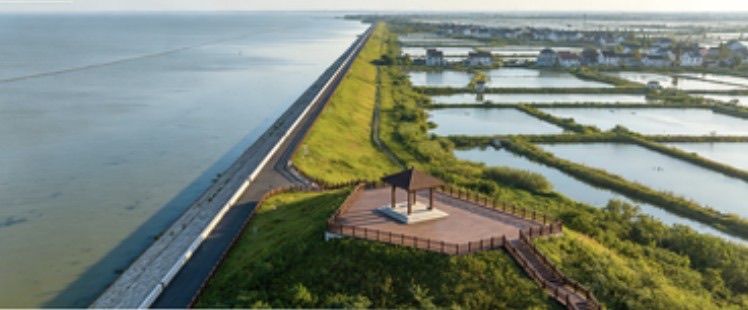
The Shijiu Lake embankment winds along the shore for dozens of kilometers, serving as flood barrier, road, and scenic walkway in one. Raised several meters above the water, the dike offers an unbroken view: lake on one side, wetlands, farmland, and villages on the other. In spring the slopes are covered in wildflowers; summer brings dense reeds and water grasses in every shade of green; autumn turns the reed plumes silver-white; and in winter, the water level drops to reveal broad stretches of lakebed grassland. Observation platforms are scattered along the route, making it easy to pull over and take in the view — the natural backbone of any self-drive or cycling tour of Shijiu Lake.
8. Shijiu Lake Grass Sea
The "Grass Sea" appears each autumn and winter, when falling water levels expose wide stretches of the lakebed, forming an expansive meadow. Dominated by grasses and sedges, the vegetation stands knee-high in its dry season and stretches to the horizon like the steppes of the north. When the wind moves through it, the grass rolls in waves with egrets skimming low overhead, and the cracked, sun-dried lakebed patterns beneath the warm gold of the dry grass create a strikingly raw, open landscape. The Grass Sea is most photogenic in early winter, when low-angle sunlight backlights the grass tips to a glowing fringe and the lake appears as a thin silver line in the distance — the most dramatically different face Shijiu Lake shows across all four seasons.
9. Jingqiao Town, Shuijing Village — Thousands of Acres of Crab Ponds
Shuijing Village in Jingqiao Town, Lishui District, is one of Jiangnan's well-known hairy crab farming areas. Thousands of acres of crab ponds line the lake's edge in an unbroken patchwork. In autumn when the crabs are at their best, the early morning sun catches the surface of each pond in turn, fishermen pole their boats through the narrow channels to feed the crabs, and egrets stand along the dike walls — a harvest scene that distills Jiangnan's lakeside way of life into a single image. Shijiu Lake hairy crabs, raised on the lake's natural water, are prized for their clean, sweet flavor and rank alongside silverfish and wild duck as the lake's "Three Treasures." The ponds connect directly to the open lake, and the outline of the Shijiu Lake Grand Bridge is visible in the distance — productive landscape and natural scenery in the same frame.
6 stops, in walking order — read top to bottom, no clicking needed.

 2
 3
 4
 5
 6