Overview
Ming Xiaoling Mausoleum sits at the southern foot of Purple Mountain (Zijin Shan) in Xuanwu District, Nanjing, nestled beneath the peak known as Dulongfu Wanzhu Feng. It is the joint burial site of Zhu Yuanzhang, the founding emperor of the Ming dynasty, and his empress, Empress Xiaoci. Construction began in 1381 (the 14th year of the Hongwu reign) and was completed in 1413 (the 11th year of the Yongle reign) with the erection of the Spirit Virtue Stele, a project spanning thirty-two years in total. Covering more than 1.7 million square meters, it is one of the largest imperial mausoleums surviving in China. Ming Xiaoling established the "front square, rear round" and "front court, rear burial" layout that defined imperial tomb architecture for over five hundred years across both the Ming and Qing dynasties. Its winding spirit road and magnificent stone sculptures directly influenced the design of the Ming Tombs outside Beijing and the Eastern and Western Qing Tombs. It has long been honored as "the foremost imperial mausoleum of the Ming and Qing era." In 2003, Ming Xiaoling was inscribed on the UNESCO World Heritage List as an extension of the "Imperial Tombs of the Ming and Qing Dynasties."
Site Highlights
Xiamafang Heritage Park
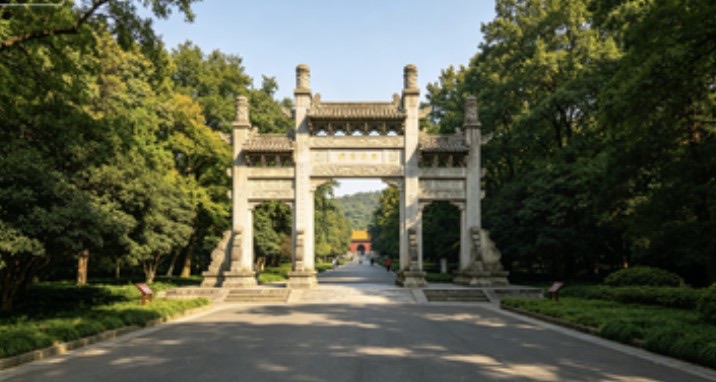
Xiamafang — literally "dismount here" — marks the first stop along Ming Xiaoling's ceremonial approach road. It was the spot where civil and military officials were required to dismount and continue on foot as a sign of reverence. The park has been restored to recreate the full spatial sequence of the original route from Xiamafang to Dajin Gate, including the main entrance plaza, Guanyin Pavilion, the Imperial Stele Pavilion, and the garrison headquarters of the Xiaoling Guard. Within the park, the Ming Xiaoling Museum offers thematic exhibitions on the mausoleum's construction history and early Ming culture.
Dajin Gate
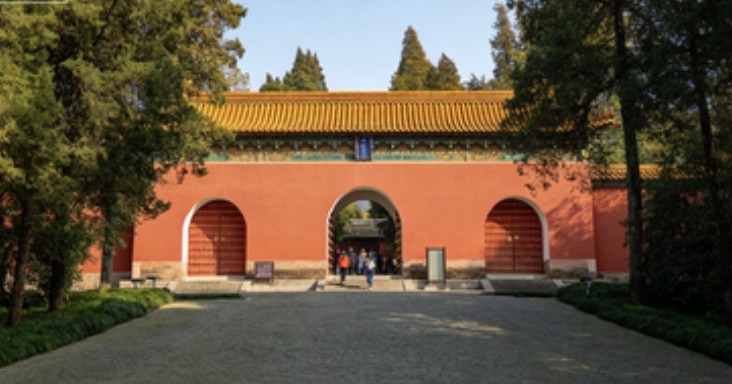
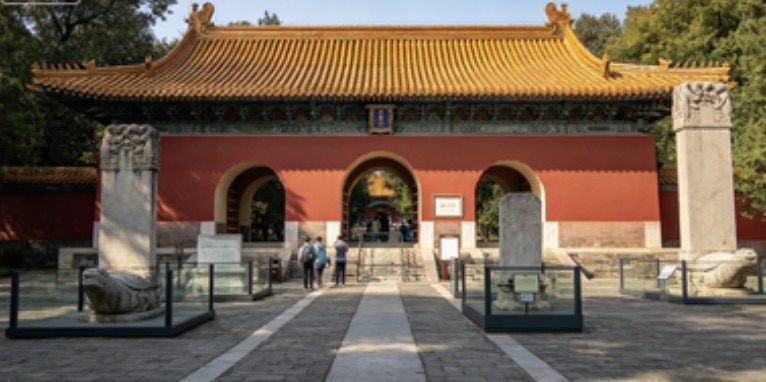
Dajin Gate served as the main gate of Ming Xiaoling's outer enclosure and the first formal entrance to the tomb precinct. The original structure featured a single-eave hip-and-gable roof covered in yellow glazed tiles, with vermilion walls rising from an ornately carved sumeru stone base — an imposing and stately sight. Its wide, tall archways were designed to accommodate the emperor's funeral cortege and ceremonial processions. Roughly seventy meters north of Dajin Gate stands the Square Pavilion (Sifang Cheng), and together the two structures define the southern ceremonial gateway of the mausoleum.
Sifang Cheng (Stele Pavilion of Spirit Virtue)
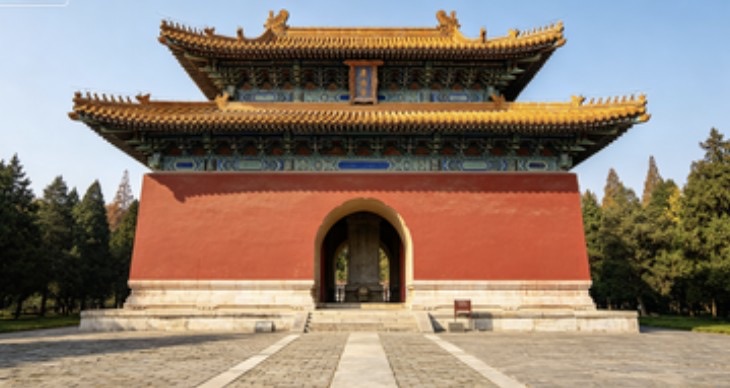
Sifang Cheng, built in 1413 during the Yongle reign, is the pavilion erected by the Yongle Emperor Zhu Di to house a monumental stele honoring his father Zhu Yuanzhang. The pavilion has a square floor plan — hence its popular name Sifang Cheng, meaning "Square City." Inside stands the "Great Ming Xiaoling Stele of Divine Merit and Sacred Virtue," the largest ancient stone stele surviving in the Nanjing region. Its inscription, composed personally by Zhu Di, runs to 2,746 characters and chronicles Zhu Yuanzhang's life from common subject to founding emperor.
Stone Elephant Road (Spirit Road, First Section)
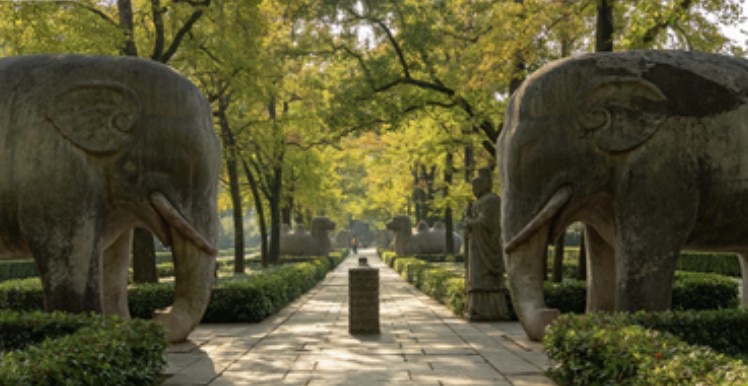
Stone Elephant Road is the first section of Ming Xiaoling's spirit road, stretching 615 meters. Lining both sides are six species of stone animals — lions, xiezhi, camels, elephants, qilin, and horses — with two pairs of each species, one pair kneeling and one pair standing, for a total of twelve pairs and twenty-four sculptures. Every figure was carved from a single piece of stone, the lines clean and commanding. Legend holds that the road does not run straight because Zhu Yuanzhang ordered the path to curve around the tomb of Sun Quan, the great emperor of the ancient kingdom of Wu. In late autumn, golden ginkgo leaves and crimson maples frame the stone animals in a display that has earned the road the title "Nanjing's Most Beautiful 600 Meters."
Wengzhong Road (Spirit Road, Second Section)
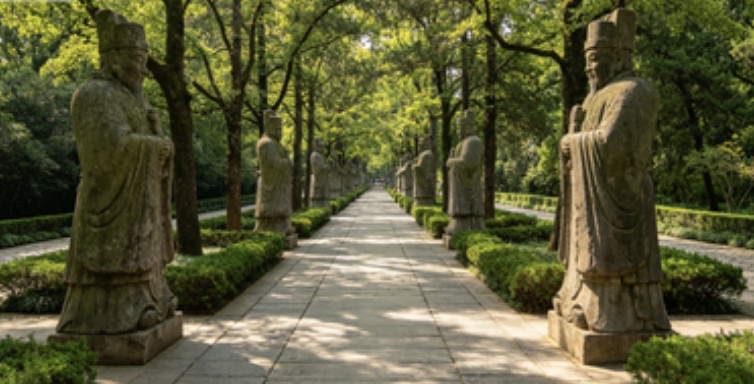
Wengzhong Road is the second section of the spirit road, continuing north from Stone Elephant Road. Along its sides stand two pairs each of civil officials and military generals, all carved to over three meters in height. The civil officials hold court tablets and wear expressions of studied composure; the generals stand in full armor, hands resting on their swords, their equipment rendered in meticulous detail. At the far end of Wengzhong Road, a pair of stone pillars rising to 6.6 meters marks the close of the spirit road and the beginning of the main tomb precinct. The pillars are carved with cloud-and-dragon motifs.
Lingxing Gate and Golden Water Bridge
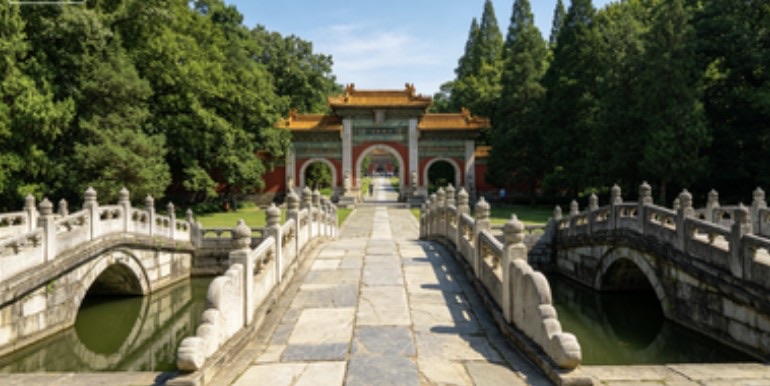
Lingxing Gate is a transitional stone gateway between the spirit road and the tomb precinct, consisting of three archways supported by six pillars capped with stone mythical beasts gazing skyward. Beyond it lies the Golden Water Bridge — five stone bridges spanning the river side by side. The five bridges correspond to rank: the central imperial bridge was reserved for the emperor alone; the next two were for princes; and the outermost pair for officials of the first through third rank. The five bridges also embody the five Confucian virtues — benevolence, righteousness, ritual propriety, wisdom, and faithfulness — making them the most tangible expression of Ming Xiaoling's strict ceremonial hierarchy.
Wenwu Fangmen (Main Palace Gate)
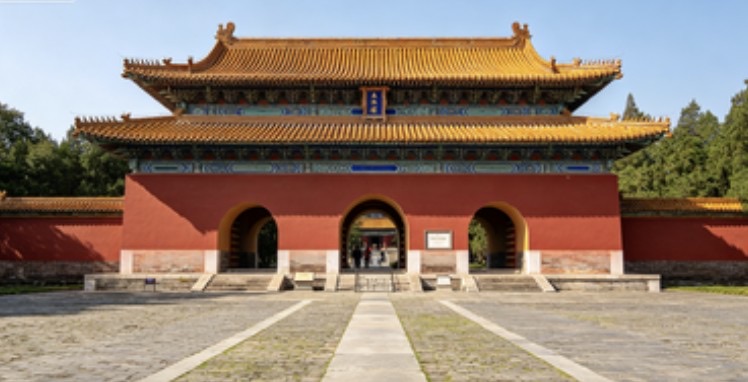
Wenwu Fangmen is the main gate of Ming Xiaoling's palace precinct, originally built with five doorways. It was restored to its full five-door configuration with a tiled roof in 1998, in accordance with Ming dynasty specifications. Set into the eastern wall beside the main gate is a stone stele erected in 1909 (the first year of the Xuantong reign of the Qing dynasty), bearing a "Special Notice" in six languages — Japanese, German, Italian, English, French, and Russian — admonishing foreign visitors to respect the site. It stands as an early testament to modern heritage conservation awareness. Crossing through this gate marks the formal entry into the mausoleum's core area.
Stele Hall (Zhilong Tang Song Stele)
The Stele Hall is a Qing dynasty addition to the precinct. At its center stands the "Zhilong Tang Song" stele, inscribed by the Kangxi Emperor during his third imperial tour south in 1699, when he came to pay his respects at the mausoleum. The inscription declares that Zhu Yuanzhang's governance surpassed that of the great Tang and Song emperors. Kangxi — a Manchu ruler — performed the full three-kneel, nine-prostration ceremony before the tomb of a Han dynasty founder, an act that was simultaneously a political acknowledgment of the previous dynasty's legitimacy and a calculated move to win the loyalty of the scholars and gentry of the Jiangnan region.
Xiang Dian Ruins (Sacrificial Hall)
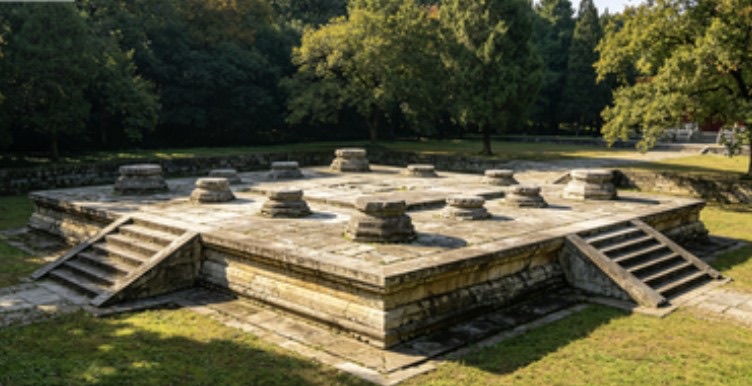
The Xiang Dian was the main ceremonial hall of Ming Xiaoling, built nine bays wide and five bays deep — the imperial "nine-five" configuration symbolizing the Son of Heaven. It was destroyed by fire during the Taiping Heavenly Kingdom period, and all that remains today is a three-tiered sumeru stone platform and fifty-six massive stone column bases. The column bases are arranged according to specific imperial numerical patterns, and their sheer scale still conveys a sense of the hall's original grandeur. A smaller hall rebuilt during the Qing dynasty survives on the eastern side of the ruins.
Fangcheng Minglou (Square Bastion and Bright Tower)
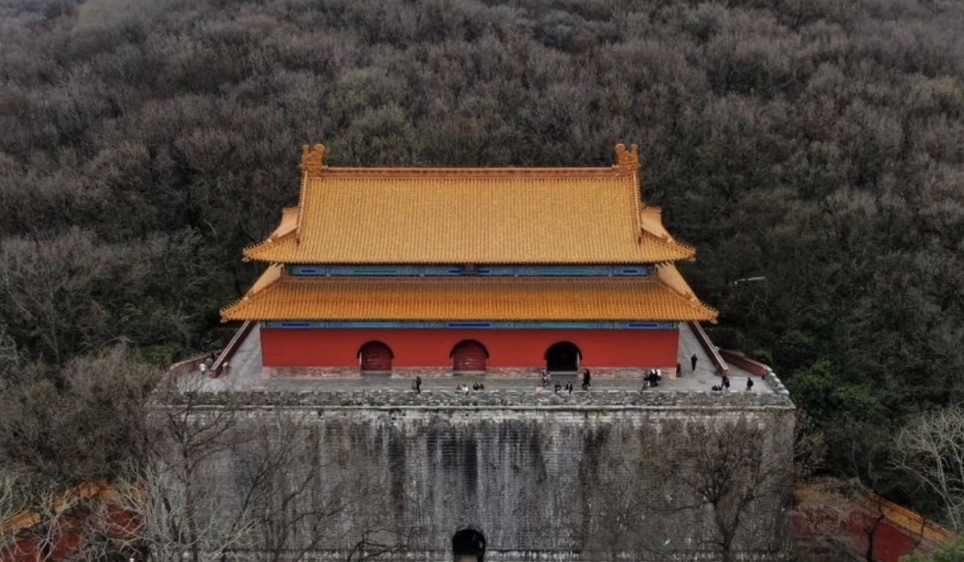
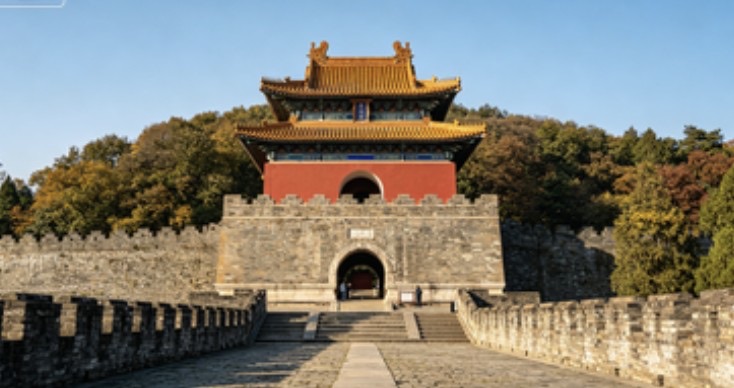
Fangcheng Minglou is a landmark innovation in Ming Xiaoling's design and the highest point in the entire precinct. The square bastion (Fangcheng) is constructed of massive cut-stone blocks, stands sixteen meters tall, and measures seventy-five meters from east to west. A vaulted tunnel runs through its center. Stomping one's feet inside the tunnel produces an echo said to last seven seconds — folk tradition takes this as proof that the underground palace beneath the mausoleum remains intact. The Minglou (Bright Tower) stands atop the bastion; from its summit, the entire tomb precinct spreads out below in a panorama that embodies the classical Chinese ideal of harmony between heaven and humankind.
Baoding (Burial Mound)
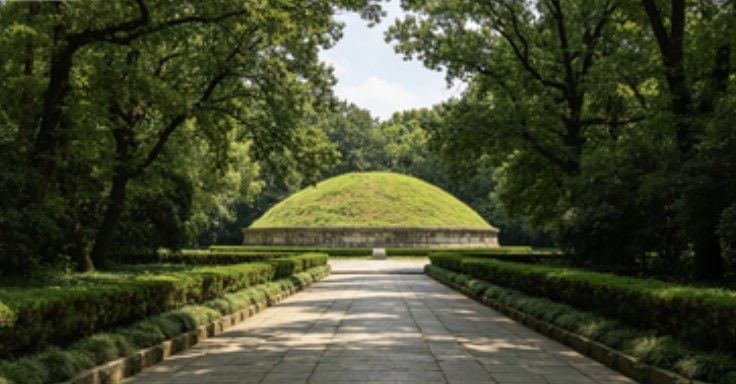
Baoding is the enormous circular earthen mound behind Fangcheng Minglou, roughly four hundred meters in diameter. Beneath it lies the underground palace holding the remains of Zhu Yuanzhang and Empress Ma. No formal archaeological excavation has ever been conducted here in over six hundred years, and the interior remains a mystery. Together with the surrounding Baocheng city wall, Baoding forms the rear "round" half of Ming Xiaoling's "front square, rear round" layout — the circle representing heaven, the rectangular palace precinct representing earth, the two together embodying the ancient Chinese cosmological concept of a round sky over a square earth.
Meihua Shan (Plum Blossom Hill)
Meihua Shan lies within the Ming Xiaoling precinct and is home to roughly 35,000 plum trees spanning more than 360 varieties. By any measure — history, scale, number of trees, or breadth of varieties — it ranks first in China, earning the title "Number One Plum Hill Under Heaven." At the foot of the hill is the tomb site of Sun Quan, the great emperor of the ancient kingdom of Wu. Each year from February through March, when the plum blossoms are in full bloom, the hillside sea of flowers and the stone sculptures along the spirit road create one of Nanjing's most celebrated spring scenes.
11 stops, in walking order — read top to bottom, no clicking needed.

 2
 3
 4
 5
 6
 7
 8
 9
 10
 11