Travel Guide› Nanjing› Nanjing Ming City Wall
Nanjing · Historic wall

Nanjing Ming City Wall 南京明城墙

Nanjing Ming City Wall

I. Attraction Description (for App listing page)

Overview

The Nanjing Ming City Wall was founded in 1366 and completed in 1393 after 28 years of construction, mobilizing 280,000 laborers and consuming 350 million bricks. It was the cornerstone of the Hongwu Emperor Zhu Yuanzhang's strategic directive to "build high walls." The fortification consists of four concentric rings: the Palace City, the Imperial City, the Capital City, and the Outer City. The Capital City wall stretches 35.267 kilometers in total, with 25.091 kilometers still standing today — making it the largest and best-preserved ancient city wall in the world. It was designated a National Key Cultural Relic Protection Unit in 1988 and is the lead city for the "Ming and Qing Dynasty City Walls of China" World Heritage nomination. Built to follow the natural contours of the land rather than conform to classical grid layouts, the wall incorporates rivers such as the Qinhuai and lakes such as Xuanwu into its defensive system, serving simultaneously as a military fortress, a flood-control structure, and a symbol of imperial authority. Zhonghua Gate is the best-preserved and most architecturally complex of all its gates, earning the title "Number One Barbican Under Heaven."

Key Attractions

Zhonghua Gate

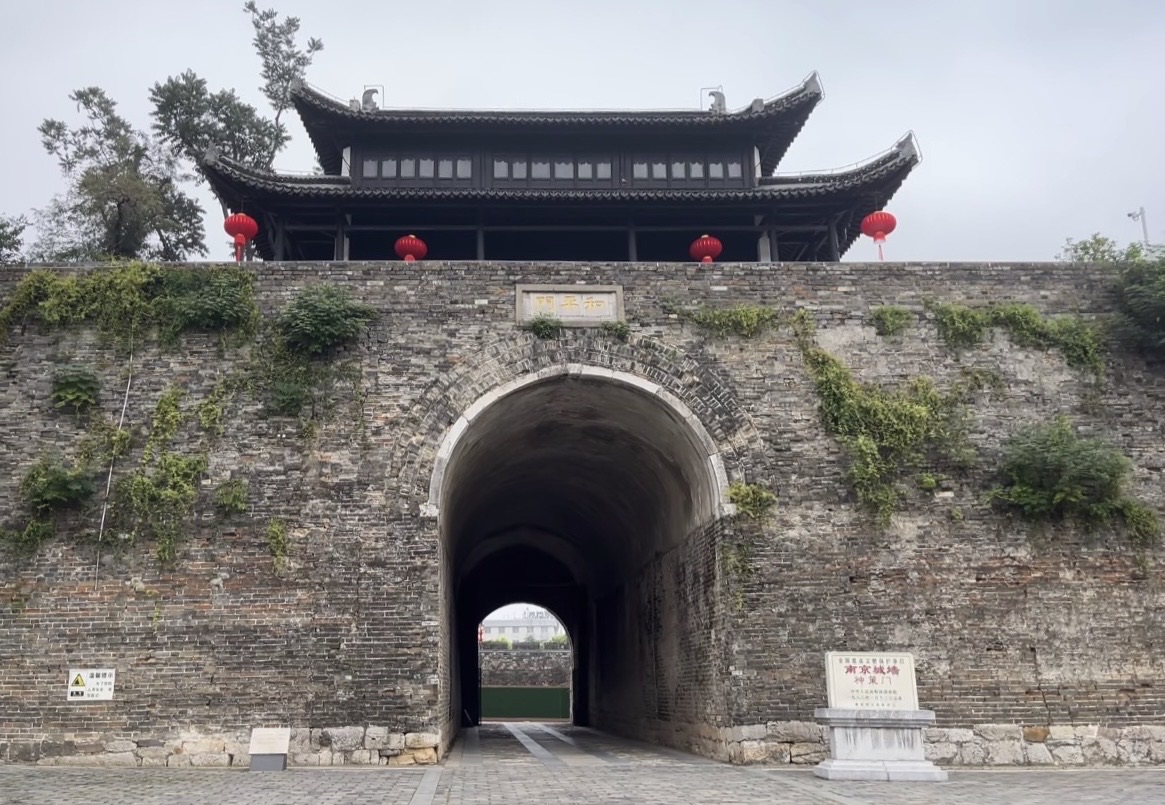
Formerly known as Jubao Gate ("Gate of Accumulated Treasure"), Zhonghua Gate is the largest and most structurally complex ancient city gate surviving in China. Facing south, it measures 118.5 meters wide and 128 meters deep, covering 15,168 square meters. Three successive barbicans and four arched gateways form a defensive layout resembling the Chinese character for "eye." Each gateway was equipped with double iron-clad wooden doors and a portcullis that could be raised or lowered. The foundation is built from massive stone blocks, and the brickwork was mortared with a mixture of glutinous rice paste, lime, and tung oil. The gate rises to a maximum height of 21.45 meters across three levels. The triple-eaved watchtower that once crowned the top was destroyed by Japanese artillery in 1937; only the platform base remains. In 1931, the Nationalist government renamed Jubao Gate "Zhonghua Gate," with the plaque inscribed by Chiang Kai-shek.

The Barbicans and Hidden Soldier Caves

The core defensive system of Zhonghua Gate consists of three inner barbicans. Each enclosed courtyard between gates forms an independent combat zone, designed to divide and trap invaders in segments — the literal origin of the Chinese idiom "catching turtles in a jar." The gate complex contains 27 hidden soldier caves in total: 7 in a row on the inner mid-level of the main gate, 6 flanking the lower passageway on each side, and 14 beneath the ramps on the east and west. Each cave is built with a brick-and-stone barrel vault, stands roughly 2.5 to 3 meters high, and has concealed ventilation shafts that also admit light. Together they could shelter over 3,000 soldiers and stockpile military supplies — an outstanding example of integrated concealed defense in ancient Chinese architecture.

The Portcullises and Gate Ruins

All four gateways of Zhonghua Gate were fitted with double iron-clad wooden doors and a portcullis, creating a two-layer lock. Each portcullis — a heavy wooden panel sheathed in iron — was operated by a windlass mechanism embedded in the masonry above, running in a groove approximately 20 centimeters wide and 18 centimeters deep. Neither the portcullises nor the original wooden doors survive today, but the stone grooves and door pivot sockets remain clearly visible, allowing visitors to understand the mechanical principles behind Ming-era gate operation. Bolt-slot marks on the outer face of the gate arch reveal an additional layer of defense: after the doors were shut, soldiers reinforced them from inside with heavy wooden crossbars.

The Ramps

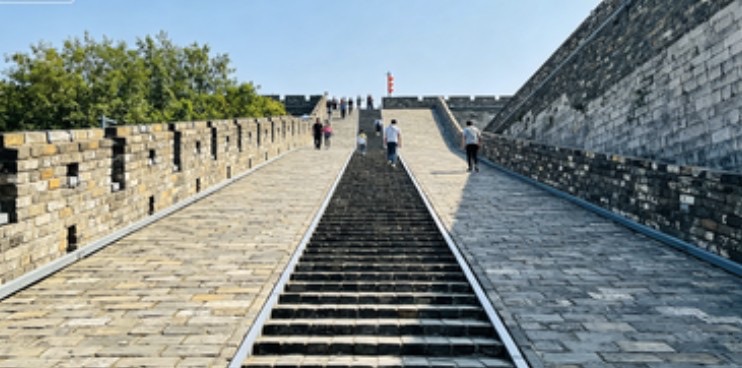
Flanking Zhonghua Gate on the east and west are two ramps, each 11.5 meters wide and 86.1 meters long, paved with large bricks and fitted with transverse ridges to prevent horses from slipping. The grade is steep enough for cavalry to ride directly to the top of the wall. In wartime, commanders could ride up on horseback to direct the battle, while soldiers carried artillery, ammunition, and other supplies to the battlements. These ramps are the best-preserved examples of their kind in any surviving ancient Chinese city gate. Fourteen hidden soldier caves are tucked beneath the two ramps, making full use of the space inside the slope — a testament to the compact, multi-purpose engineering logic of the Ming dynasty.

The Battlements and Brick Inscriptions

The top of the Zhonghua Gate wall ranges from 10 to 18 meters wide, with intact exterior merlons offering views over the Inner and Outer Qinhuai Rivers, the Laomendong historic district, and the ruins of the Dabao'en Temple. The wall's bricks — both inside and out — are stamped or incised with inscriptions recording the kiln location, supervising official, brick-maker, and laborer by name. The bricks came from nearly 200 prefectures, counties, and military garrison units across what are today Jiangsu, Jiangxi, Anhui, Hunan, and Hubei provinces. This is the earliest documented large-scale quality-traceability system in the world. Every brick had to meet the standard of "ringing when struck, showing no voids when broken"; any that failed were smashed on the spot and refired.

Nanjing City Wall Museum

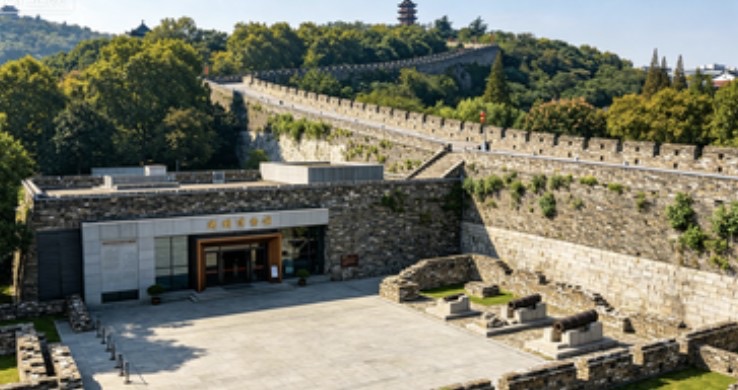
Located just east of the Zhonghua Gate barbican, this museum opened in 2021 and is both a National First-Class Museum and China's only museum dedicated to ancient city walls. The building is semi-subterranean, its glass curtain wall quietly reflecting the face of Zhonghua Gate's arrow tower — a dialogue between the new and the ancient. The total floor area is 12,000 square meters. The permanent exhibition, "The Unparalleled City Wall," displays over 600 varieties of Ming-dynasty bricks, with a brick archive that visitors can access by scanning QR codes to retrieve the full provenance of any piece — where the clay was dug, who fired it, who oversaw the work, and which waterway carried it to Nanjing. Other exhibits include a Ming-era rammed-earth foundation, wooden pile foundations from the Ming Imperial Palace, and ancient siege weapons. AR stations inside the museum can identify and decode brick inscriptions. Admission is free but advance booking is required.

Taicheng Section

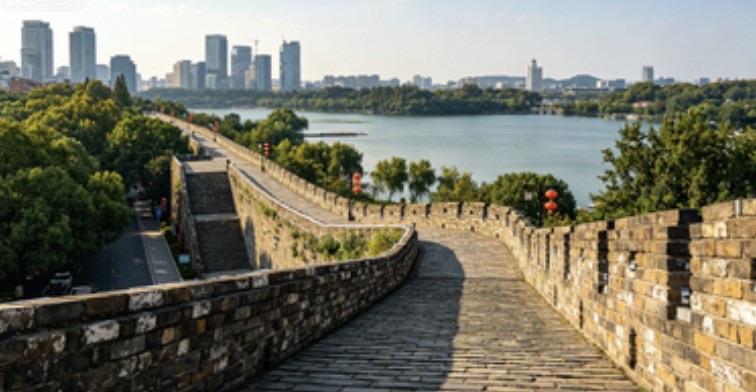
The Taicheng section runs between Jiefang Gate and Taiping Gate on the northern stretch of the Nanjing Ming City Wall and is widely considered its most scenic passage. The wall curves along the southern shore of Xuanwu Lake, and from the top visitors can look east to Purple Mountain, north across Xuanwu Lake, south to the golden roof of Jiming Temple, and west to the Zifeng Tower — a panorama of mountains, water, city, and forest. The name "Taicheng" dates back to the Kingdom of Wu in the Three Kingdoms period, when this area served as the imperial garden district during the Six Dynasties era. The Tang dynasty poet Wei Zhuang immortalized it in the line: "The willows of Taicheng feel nothing at all — they still drape their haze across ten miles of levee." Inside the wall, visitors will find a bookstore and gallery spaces. The Wumiao Sluice ruin at the base of the wall still channels water out of Xuanwu Lake today, making it the longest-serving ancient hydraulic structure in Nanjing.

Shitou Cheng Ruins

Shitou Cheng ("Stone City") sits on the western slope of Qingliang Mountain and is a key section of the western Ming City Wall, built directly into the hillside. Its history stretches back to 211 CE, when Sun Quan of the Eastern Han period relocated to Moling and built a fortress on this site — the founding moment of Nanjing's identity as an ancient capital of six dynasties. When the Ming wall was constructed, it incorporated the ruins of that earlier Three Kingdoms fortification, and portions of the wall rest directly on the natural reddish cliff face, which rises about ten meters. The weathered surface of the rock has eroded into lumpy, hollow-eyed contours that from a distance resemble a menacing face — giving the site its popular nickname, "Ghost Face City." A small pond below the wall reflects the cliff face, creating the famous scene known as "Ghost Face Gazing in the Mirror."

Practical info Opening hours · Ticket · Getting there · Address
Opening hours
  • **Daytime opening hours:** Generally 8:00—17:00 (subject to announcements at each wall entry point)
  • **Night opening hours:** To facilitate citizens and tourists to enjoy the night view of the city wall, Zhonghuamen and Jiefangmen (Taicheng Section) implement evening opening. In peak season (April of the current year to October of the current year), the opening hours are 17:00—22:00 (ticket sales stop at 21:30); off-season opening hours may be adjusted, subject to on-site announcements
  • **Special note:** Some sections may be temporarily closed due to repairs, weather, etc. Please pay attention to official announcements
  • **Recommended visiting time:** 1—2 hours/section
Ticket
  • **Zhonghuamen Wengcheng (Gate Tower):** 50 RMB/person
  • **Taicheng Section (Jiefangmen Section):** 30 RMB/person
  • **Shencemen Section:** Subject to on-site announcements
  • **Some sections (such as Xuanwumen Section, Zhongshanmen Section, etc.):** Free admission
  • **Preferential policies:** Seniors over 60 years old, students, military personnel, etc. enjoy discounts with valid documents; children under 6 years old (inclusive) or under 1.4 meters (inclusive) in height are free
  • **Tip:** Ticket prices vary for different wall entry points, and some sections are open free of charge. It is recommended to check the ticket information of specific wall entry points in advance
Getting there
  • **Zhonghuamen Section:**
    • Metro: Take Metro Line 1 to Zhonghuamen Station, then walk about 5 minutes after exiting the station to reach the site
    • Bus: Take Bus No. 2, 16, 26, 33, 49, 63, 202, 302, Y2, Y20 to "Zhonghuamen Nei" stop or "Zhonghuamen Castle" stop and get off
  • **Taicheng Section (Jiefangmen Section):**
    • Metro: Take Metro Line 3 to Jiming Temple Station, then walk about 10 minutes after exiting the station to reach Jiefangmen
    • Bus: Take Bus No. 2, 3, 20, 31, 44, 48, 52, 67, 70, 201, 304 to "Jiming Temple" stop or "Jiefangmen" stop and get off
  • **Shencemen Section:**
    • Metro: Take Metro Line 1 to Nanjing Station, then walk about 10 minutes after exiting the station to reach Shencemen Park
    • Bus: Take Bus No. 1, 8, 22, 25, 28, 32, 33, 35, 36, 45, 56, 59, 64, 66, 69, 73, 76, 77, 136, 157, 159, 173, 176, Y1, Y9, Y19, and many other routes to "Nanjing Station" or "Shencemen" stop and get off
  • **Tip:** The various sections of the Nanjing Ming City Wall are scattered. It is recommended to plan the visiting route in advance and choose 1—2 sections for focused visiting
Address
  • The Nanjing Ming City Wall is distributed across multiple districts of Nanjing. The addresses of the main wall entry points are as follows:
  • **Zhonghuamen Section:** Zhonghuamen Castle, Qinhuai District, Nanjing, Jiangsu Province
  • **Taicheng Section (Jiefangmen Section):** Jiefangmen (near Jiming Temple), Xuanwu District, Nanjing, Jiangsu Province
  • **Shencemen Section:** Shencemen Park, Xuanwu District, Nanjing, Jiangsu Province
  • **Zhongshanmen Section:** Zhongshanmen, Xuanwu District, Nanjing, Jiangsu Province
  • **Xuanwumen Section:** Xuanwumen, Xuanwu Lake Park, Xuanwu District, Nanjing, Jiangsu Province

Inside Nanjing Ming City Wall

8 stops, in walking order — read top to bottom, no clicking needed.

1 Zhonghua Gate Square (Entrance) of 8

Zhonghua Gate Square (Entrance)

中华门广场(入口)

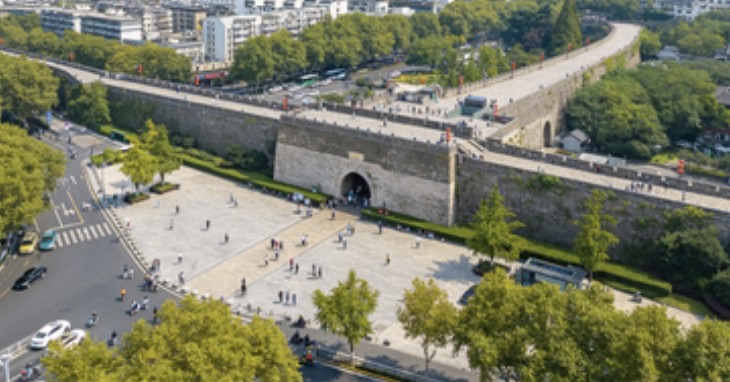
Zhonghua Gate Square is located on the south side of the Nanjing City Wall at Zhonghua Gate, serving as the starting point for visitors entering the barbican scenic area. The square is broad and flat, extending approximately 100 meters from north to south. Looking up, visitors can see the majestic city wall spanning before them, reaching up to 21 meters in height with a commanding presence. A guide stele stands at the center of the square, with ticket booths and a visitor service center on either side. Ginkgo and sycamore trees line the square; in autumn, their golden foliage contrasts beautifully with the grey wall. This is also the best vantage point for photographing the full frontal view of Zhonghua Gate, and many iconic images of Nanjing have been captured here.

On-site narration · read it where you stand

Welcome, everyone! You've arrived at the Nanjing Ming City Wall. Today I'll be guiding you along a route that takes in all the highlights: Zhonghua Gate Plaza, the first gateway, the barbicans and hidden soldier caves, the ramps, the top of the wall, the Nanjing City Wall Museum, and the Taicheng section. Together we'll explore a fortification that has stood for six hundred and fifty years — the greatest ancient city wall in the world.

Let's start with the basics of the Nanjing Ming City Wall. This is no ordinary wall. It is the longest ancient city wall ever built — originally 35.267 kilometers at the time of its Ming-dynasty construction, with 25.091 kilometers still standing today, making it even longer than the Ming city wall in Beijing. The Hongwu Emperor Zhu Yuanzhang took the advice of his strategist Zhu Sheng to "build high walls, stockpile grain, and be slow to claim the throne." Starting in 1366, he mobilized 280,000 laborers and spent 28 years consuming 350 million bricks to create this unmatched feat of military engineering.

What makes the Nanjing City Wall so unusual? Nearly every ancient Chinese capital wall — Xi'an, Pingyao, you name it — is a neat rectangle. Nanjing's is completely different. It follows the natural contours of the landscape, weaving the Qinhuai River, Xuanwu Lake, and Purple Mountain into its defensive system. This was the genius of Zhu Yuanzhang's military strategist Liu Bowen: use the natural terrain as your shield — far more effective than any man-made moat. The wall also consists of four concentric rings — Palace City, Imperial City, Capital City, and Outer City — layered like rings around a core. There is nothing quite like it anywhere else in the history of urban construction.

The magnificent gate in front of us is Zhonghua Gate. Once known as Jubao Gate ("Gate of Accumulated Treasure"), it is the largest and most structurally complex ancient city gate in China, celebrated as the "Number One Barbican Under Heaven." Look up at the plaque above the gateway — those three characters reading "Zhonghua Gate" were inscribed by Chiang Kai-shek in 1931, when the Nationalist government gave the gate its current name. The shift from "Jubao" to "Zhonghua" is itself a piece of history compressed into a name.

First City Gate (Main Gate)

第一道城门(主城门)

The First City Gate is the main south-facing gate of the Zhonghua Gate barbican and the largest gate in the entire defensive system. The gate arch is a vaulted structure approximately 10 meters high and 6 meters wide, accommodating both carriages and horses. Inside the arch, slots for a heavy portcullis are visible, which could be lowered during wartime to seal the passage. The base of the flanking walls is built with massive stone blocks, topped with brick masonry. Inscriptions on the bricks — recording their place of manufacture and the names of the craftsmen — remain clearly legible, serving as important physical evidence for the study of the Ming Dynasty brick production system. Passing through this gate, visitors enter the first barbican and experience the military ingenuity of the "catching turtles in a jar" defensive design.

On-site narration · read it where you stand

Now let's cross Zhonghua Gate Plaza and step up to the base of the first gateway. Take a moment to look up and feel the height — 21.45 meters, roughly equivalent to a seven-story building. In the age of cold weapons, six hundred years ago, that height alone was enough to stop any attacking force in its tracks.

Move closer and look up at the ceiling of the gate tunnel. See those two vertical grooves running from top to bottom? About 20 centimeters wide and 18 centimeters deep — those are the portcullis slots. During the Ming dynasty, every one of the four gateways was fitted with double iron-clad wooden doors and a portcullis: a heavy wooden panel sheathed in iron, raised and lowered by a windlass mechanism set into the masonry above. Picture the scene: enemy soldiers smash through the first wooden door and charge in — then the portcullis crashes down from above, cutting off their retreat. And on the stone walls flanking the tunnel, you can still see the bolt-slot marks — once the gate was shut, soldiers would drive massive wooden crossbars through from the inside, making it nearly impossible to batter open from without.

Now look down at the bricks beneath your feet. On the side face of nearly every brick, you'll find text: the name of the kiln district, the supervising official, and often even the individual brick-maker and laborer. Inscriptions like "Supervising Official of Ji'an Prefecture, Jiangxi Province, So-and-So" or "Kiln master Zhang San" and "Laborer Li Si." Why did Zhu Yuanzhang require every single brick to be named? This was the world's earliest large-scale quality-traceability system — if a brick failed, the name on it led straight back to the person responsible. So craftsmen fired their bricks with extraordinary care. Every brick had to meet the standard of "ringing when struck, showing no voids when broken." Six hundred and fifty years of wind and rain later, these bricks remain as solid as ever — and those ordinary workers' names have, quite unexpectedly, become permanent.

First Barbican

第一道瓮城

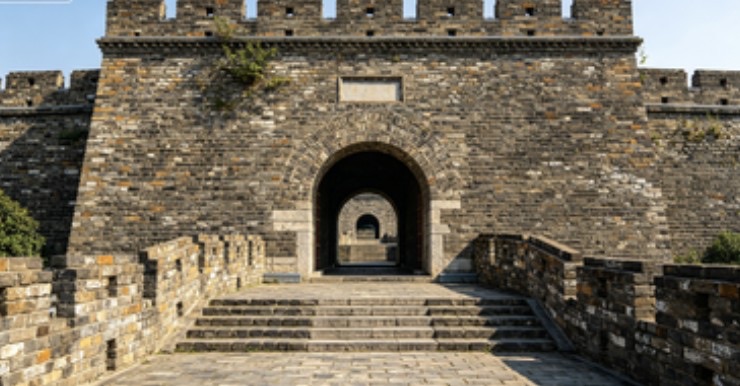
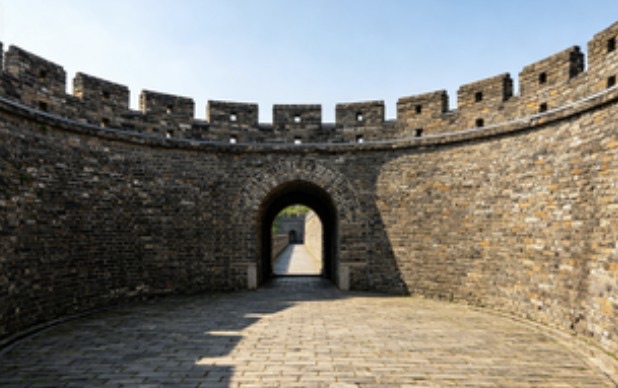
The First Barbican is the outermost of the three barbicans at Zhonghua Gate, covering approximately 3,700 square meters. Visitors enter this space after passing through the main gate. Walls flank it to the east and west, with the second gate to the north, forming a semi-enclosed courtyard on three sides. The core tactical concept of the barbican is to "lure the enemy in deep and catch them like turtles in a jar" — if enemy forces breach the main gate and rush into the barbican, defenders can seal the gates front and rear, then attack from above with arrows, rolling stones, and firearms from all four sides, making escape impossible. The interior is flat and was historically used for stationing troops. Today, multiple exhibition panels introduce the history, construction techniques, and successive renovations of Zhonghua Gate.

On-site narration · read it where you stand

We've passed through the first arched gateway and entered the first barbican. Look ahead — there are three more gateways to go. Zhonghua Gate's defensive system consists of three successive barbicans and four gateways. Seen from above, the entire layout resembles the Chinese character for "eye." What is the core idea behind this design? It is the ancient stratagem of "catching turtles in a jar."

Let me reconstruct the battle scene from six hundred years ago. Suppose the enemy breaches the first gateway and a mass of soldiers floods into this barbican. Behind them, the portcullis drops — no retreat. Ahead, the second gateway stays firmly shut. Defenders in the hidden soldier caves on all sides of the barbican open fire simultaneously: arrows rain down, logs and boulders roll off the walls above. The attackers are trapped in an enclosed space 120 meters long and 118 meters wide, with nowhere to run. And if by some miracle the enemy forces their way past the second gate, they immediately face a third — and then a fourth. Each one is a fresh death trap. This is the most terrifying thing about Zhonghua Gate's military design: it does not try to keep the enemy out. It lets them in — and then tears them apart.

Soldier-Hiding Caverns

藏兵洞

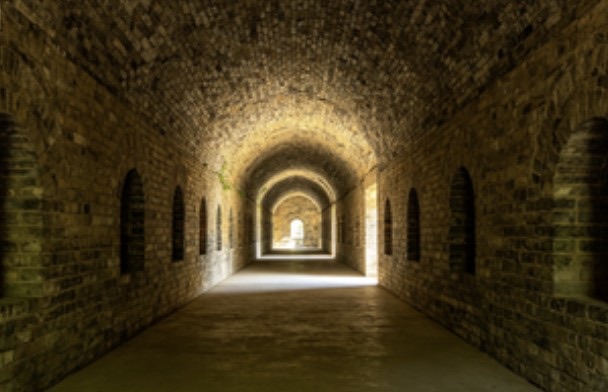
The Soldier-Hiding Caverns are the most distinctive military feature of Zhonghua Gate. Built into the interior of the barbican walls, there are 27 chambers arranged across multiple levels. Each chamber ranges from 20 to 60 square meters in area, with vaulted ceilings, good ventilation, and concealed entrances that are virtually undetectable from outside the wall. According to historical records, the caverns could garrison over 3,000 soldiers in peacetime and accommodate more than 10,000 during wartime, while storing large quantities of grain, weapons, and drinking water sufficient for prolonged defensive operations. The chambers are warm in winter and cool in summer. Today, some have been converted into exhibition spaces displaying Ming Dynasty weapons, inscribed bricks, and reconstructed models of defensive equipment, vividly recreating the military scene from six centuries ago.

On-site narration · read it where you stand

Now turn toward the inner face of the wall — see those arched openings? Those are the hidden soldier caves. Zhonghua Gate contains 27 of them in total: 7 in a row on the inner mid-level of the main gate, 3 on each side of the lower passageway, and 14 beneath the east and west ramps. Each cave is built with a brick-and-stone barrel vault, stands roughly 2.5 to 3 meters high, and has concealed ventilation shafts that also let in light.

How were these caves used in actual combat? At full capacity they could shelter over 3,000 soldiers and stockpile vast quantities of military supplies — grain, arrows, gunpowder, and stone shot. Imagine three thousand fully armed soldiers hidden inside the wall, then pouring out of every cave mouth the moment battle is joined, surrounding the enemy already trapped in the barbican from all directions. Concealing troops inside the fabric of a fortification itself was extremely rare among European castles of the same era. Stand here for a moment and feel it — every inch of ground you're standing on, six hundred and fifty years ago, may well have hidden a soldier ready to charge.

From a modern structural engineering perspective, these caves are remarkable in their own right: not a single timber beam, not a single iron nail — the entire load is transferred through the precise interlocking geometry of the brick vault. The fact that Zhonghua Gate has survived centuries of warfare and natural disaster owes a great deal to this barrel-vault masonry technique.

Horse Ramp

马道

The Horse Ramp is a stone-paved inclined passage built into the interior side of the Zhonghua Gate city wall, approximately 5 meters wide. Paved with stone slabs, it winds from the base of the wall up to the top. During wartime, cavalry could ride directly up the ramp, transporting arrows, rolling stones, grain, and other supplies to defensive positions along the wall crest, greatly enhancing the mobility of the defense. Two ramps are provided on the east and west sides of Zhonghua Gate as backups, ensuring that if one is destroyed, the other remains passable. The ramp has a gradient of approximately 15 to 20 degrees, with low parapet walls on both sides. Walking along it, visitors can appreciate both the practical design of the military architecture and the imposing mass of the wall from a lateral perspective. Today, most visitors use the horse ramp to ascend the wall, making it the best route for experiencing the grandeur of the structure.

On-site narration · read it where you stand

Stepping out of the hidden soldier cave area, notice the two broad sloping corridors on the east and west sides of the wall — those are the ramps. Each is 11.5 meters wide and 86.1 meters long, steeply graded, paved with large bricks, and fitted with transverse ridges to stop horses from sliding.

Pay attention to the grade of the ramp. This is not a staircase — it is a slope designed for horses to gallop up and down at full speed, which was a remarkably refined feature of ancient military engineering. In wartime, commanders could ride their horses straight up to the battlements to direct the battle; supply soldiers could carry heavy cannons, ammunition, rolling logs, and stone shot up to the top in pairs. In the heat of combat, the ramps were the wall's lifeline.

Now look at what's underneath the ramps. The interior space beneath both slopes was cleverly converted into 14 hidden soldier caves, making full use of the void inside the ramp structure. This kind of multi-purpose, space-efficient thinking was remarkably forward-looking for a civil engineering project from over six hundred years ago. The ramps are also a great spot for photography — standing halfway up and looking back at the full breadth of the barbican gives a powerful sense of depth, especially in the late afternoon when the sun comes in low from the west and brings out the texture of the brick in rich layers.

Wall Crest

城墙顶部

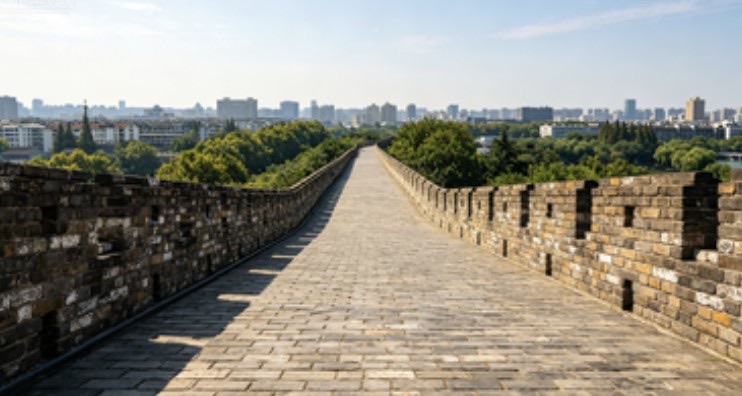
The wall crest is the highest point of the Zhonghua Gate scenic area, approximately 21 meters high, with a top width of 4 to 5 meters paved with smooth bricks, allowing several people to walk abreast. From the top, visitors can gaze northward to see the Qinhuai River meandering through the city and the white-walled, dark-tiled buildings of the Confucius Temple area; southward, the verdant pines and cypresses of Yuhuatai stretch to the horizon; eastward, the Zifeng Tower and Purple Mountain echo each other in a blend of ancient and modern. The wall is topped with crenellations (battlements), with merlons every few steps for soldiers to shoot from and take cover behind. Several reconstructed Ming Dynasty defensive devices and the remains of sentry posts are preserved on the crest. Climbing the wall at dusk, when the setting sun illuminates the ancient bricks, is the golden hour for photographing the Nanjing skyline.

On-site narration · read it where you stand

We've climbed the ramp and reached the top of the wall. Walk to the merlons and look south — the wide river flowing below is the Outer Qinhuai River, and the Changgan Bridge connects this bank to Yuhuatai on the other side. In the Ming dynasty, Yuhuatai was a military high ground just south of the city, and Zhonghua Gate was the first line of defense against any force advancing from that direction. Now look north — the Inner Qinhuai River flows from east to west; on its far bank is the lively Laomendong historic district, and in the distance the glazed tile tower of the Dabao'en Temple catches the sunlight with a golden gleam. Six hundred years ago, when Zhu Yuanzhang stood here, he looked out over the same Qinhuai waterscape, the same merchant boats moving along the same river.

Take a moment to look down at the bricks beneath your feet. The top of the wall ranges from 10 to 18 meters wide — broader than the walls of most European castles of the same era, wide enough for two war chariots side by side. Every single brick carries a name, and every name is a trace of an ordinary person's life.

A photography tip. Walk about fifty meters west along the top of the wall and look back toward the main gate of Zhonghua Gate. From there you can capture all three layers of the barbican's "eye" formation in a single frame, with a dramatic sense of depth and scale. The light in early morning and at dusk hits the brickwork at an angle, and that's when the inscriptions and textures show up most clearly.

Nanjing City Wall Museum

南京城墙博物馆

The Nanjing City Wall Museum, located just east of Zhonghua Gate, is China's only museum dedicated to the theme of city walls. It opened in 2013 with a permanent exhibition titled "A Magnificent Wall," organized into chapters including "Heaven and Earth in Harmony: The Capital of the Great Ming," "Every Brick and Tile: United Will Builds the Wall," and "Six Centuries of Wind and Rain: The Vicissitudes of the Wall." Through artifacts, architectural models, multimedia interactives, and holographic projections, the museum systematically presents the planning, design philosophy, construction techniques, and historical evolution of the Nanjing Ming Dynasty City Wall. The museum houses a large collection of inscribed bricks, each bearing the names of the prefecture, county, and craftsman who produced it — precious evidence of the Ming Dynasty's "inscribe the workman's name" quality accountability system. Admission is free, making it an essential stop for anyone seeking to deeply understand the culture of the Nanjing City Wall.

On-site narration · read it where you stand

Leaving the Zhonghua Gate complex and walking east for less than two minutes, you'll reach the Nanjing City Wall Museum. The building itself is a work of art — it sinks largely underground, its glass curtain wall modestly reflecting the six-hundred-and-fifty-year-old arrow tower of Zhonghua Gate, old and new in quiet conversation through light and shadow. The total floor area is 12,000 square meters. It opened in 2021 as China's first museum dedicated to ancient city walls and holds the status of National First-Class Museum.

Once inside, head straight for the centerpiece of the permanent exhibition "The Unparalleled City Wall" — the Brick Inscription Wall. An entire wall is lined with over 600 varieties of Ming-dynasty bricks, representing nearly 200 production units across the five provinces of Jiangsu, Jiangxi, Anhui, Hunan, and Hubei. Every brick carries text: the supervising official's title, the kiln master's name, the laborer's home district, and even the waterway used during transport. The museum's brick archive lets you scan a code with your phone and pull up the complete provenance of any brick on display — where the clay was dug, who fired it, who oversaw production, and which river route brought it to Nanjing. One brick carries the clear impression of a craftsman's fingerprint — pressed in accidentally during firing, then preserved across six hundred and fifty years. History suddenly feels warm to the touch.

The museum also reconstructs a Ming-era brick quality-inspection station and displays ancient siege and defense weapons along with the wooden pile foundations from the Ming Imperial Palace. Practical note: admission is free, but you must book in advance through the "Nanjing City Wall" WeChat public account at least three days ahead. Flash photography is strictly prohibited inside. If your schedule allows, make your way to the museum's rooftop terrace in the final hour before closing — it's the best vantage point for a sweeping overhead shot of Zhonghua Gate.

Taicheng Section (Premium Segment)

台城段(精华段)

The Taicheng Section is the most representative premium segment of the Nanjing Ming Dynasty City Wall, located on the northeast stretch from Xuanwu Gate to Taiping Gate, approximately 5 kilometers in length. This segment is built along Mount Jilong (Beiji Pavilion), standing on elevated terrain. To the north, it overlooks the vast blue waters of Xuanwu Lake; to the south, it adjoins the millennia-old Jiming Temple. The wall, lake, mountains, and temple pagoda create a dazzling interplay that forms Nanjing's most iconic cityscape. The name "Taicheng" derives from the Palace City of the Six Dynasties period; though not directly related to the Ming wall, this section was named for its proximity to the former Taicheng site. The wall top can be explored on foot or by bicycle, with multiple viewing platforms and rest stations along the way. Ascending Taicheng to gaze at the majestic Purple Mountain and the vast Xuanwu Lake is the ultimate way to experience Nanjing's urban layout of "mountains, water, city, and forest."

On-site narration · read it where you stand

Three things to take away from the Nanjing Ming City Wall.

First: this is the largest ancient city wall in the world — built by Zhu Yuanzhang over 28 years, by 280,000 pairs of hands, using 350 million bricks. The name of a craftsman is stamped into every single one of those bricks. It is the earliest large-scale quality-traceability system ever put into practice, anywhere on earth.

Second: the three barbicans and 27 hidden soldier caves of Zhonghua Gate represent the pinnacle of ancient Chinese military engineering. "Catching turtles in a jar" is not just a figure of speech — it was a fully realized war machine built from real brick and mortar, capable of concealing three thousand soldiers inside a city gate.

Third: when you stand on the Taicheng wall, Purple Mountain's ancient green stretches away on one side, Xuanwu Lake's vast water shimmers on the other, the bell of Jiming Temple carries on the wind behind you, and the city's ten thousand lights glow ahead. Six hundred and fifty years is no more than the blink of an eye — and yet this wall still stands, still holding watch over every last inch of Nanjing.

Before you go, Nanjing has more to offer: the remarkable "Ghost Face Gazing in the Mirror" at Shitou Cheng, the well-preserved Qing-dynasty watchtower at Shence Gate, and several other climbable sections of the wall including Qingliang Gate and Dongshuiguan. Thank you for joining me today — I hope Nanjing leaves you with a journey worth remembering.

Prefer to be shown around?

A local guide walks these 8 stops with you and answers what the page cannot.

Browse tours ↗