Travel Guide› Chongqing› Jiefangbei (Liberation Monument)
Chongqing

Jiefangbei (Liberation Monument) 解放碑

Jiefangbei (Liberation Monument)
Address
Center of Jiefangbei Pedestrian Street, Yuzhong District, Chongqing (intersection of Minquan Road, Minzu Road, and Zourong Road)

Jiefangbei – Bayi Snack Street: Attraction Guide

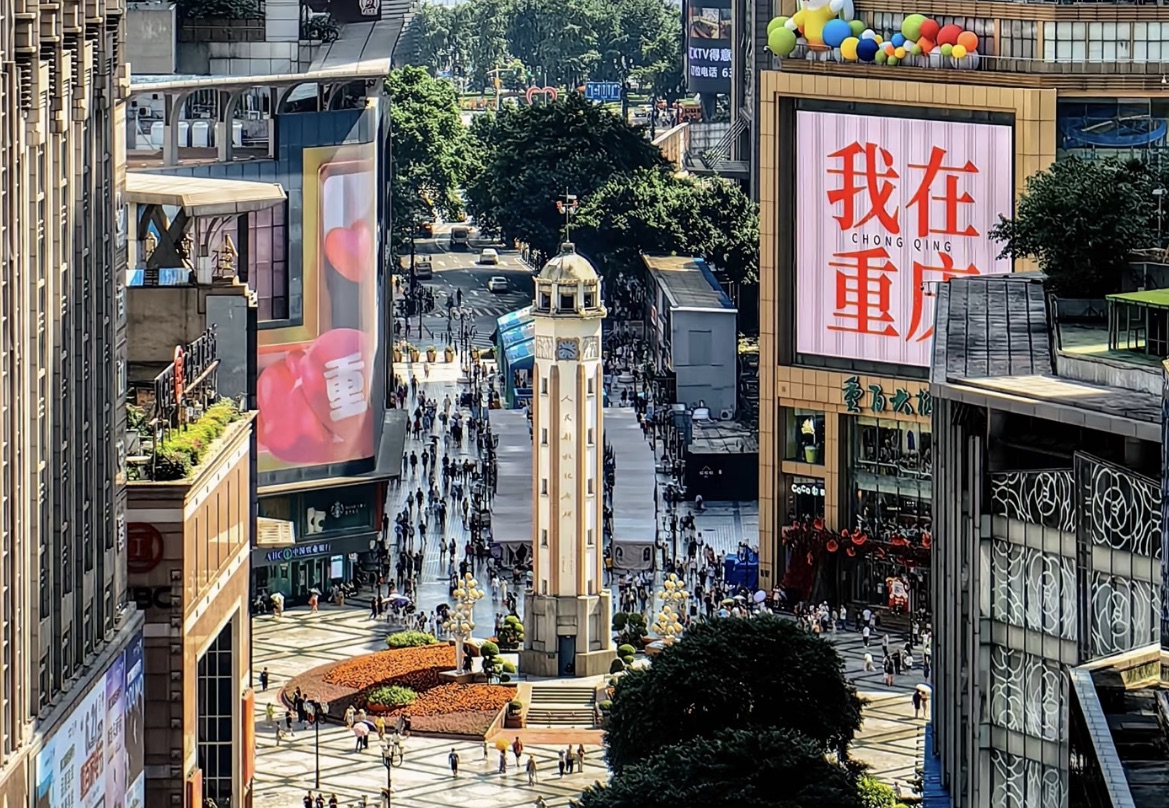
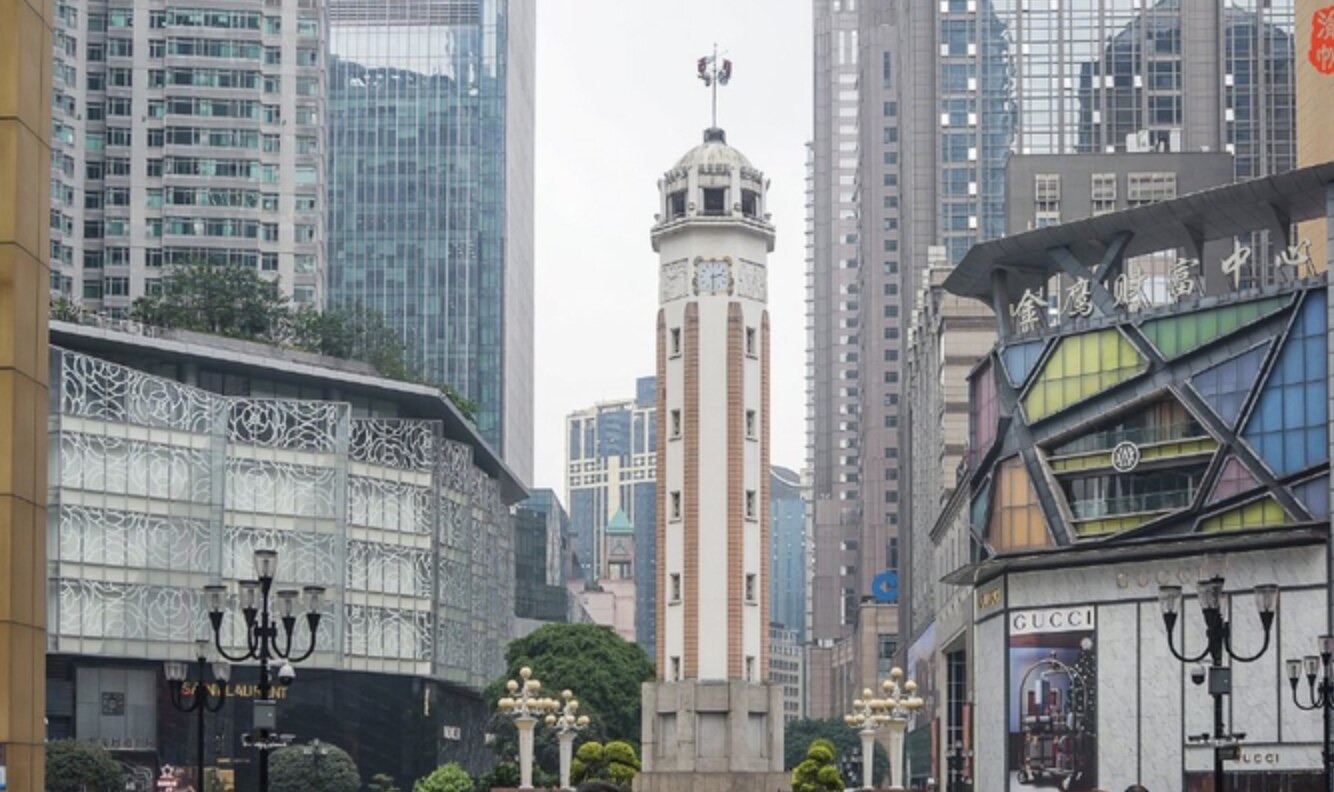
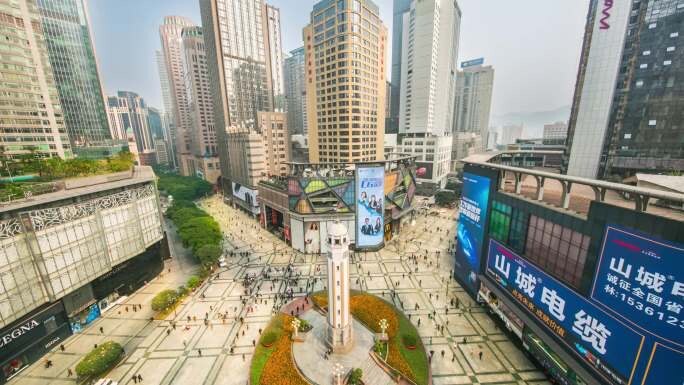
Jiefangbei — full official name "Monument to the Victory of the War of Resistance Against Japan and the Liberation of the People" — stands at the heart of the Jiefangbei commercial pedestrian district in Yuzhong District, Chongqing. It is the city's most celebrated historical and cultural landmark, as well as its commercial centre. Construction began in 1940 under the name "Spirit Fortress," a wooden blockhouse-style tower standing 77 chi (Chinese feet) tall, symbolising the July 7th Incident. In 1947 it was rebuilt in reinforced concrete as the "Monument to the Victory of the War of Resistance Against Japan," and on 1 October 1950 Marshal Liu Bocheng, Chairman of the Southwest Military and Administrative Commission, inscribed the new name: "Monument to the Liberation of the People." The monument thus commemorates both China's victory in the War of Resistance and the nation's liberation. The obelisk has an octagonal prismatic body with a helmet-shaped cap, stands 27.5 metres tall, with each side measuring 2.55 metres. Its interior, including the basement, spans eight floors connected by a spiral staircase leading to four self-chiming clocks at the top. The front face bears the seven characters "Monument to the Liberation of the People," while the base is inscribed with the full text of the Nationalist Government's decree designating Chongqing as the wartime capital. The monument is a National Key Cultural Relic Protection Unit (7th batch) and one of Chongqing's Ten Cultural Icons.

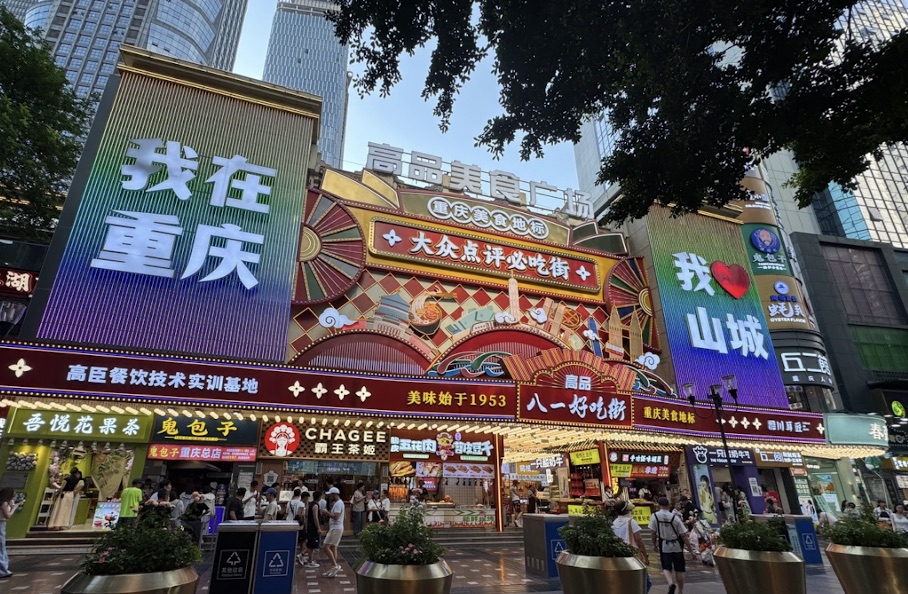
Bayi Road Snack Street (Bayi Lu Haochi Jie) sits adjacent to the Jiefangbei pedestrian zone at the core of the Jiefangbei commercial district, and is one of Chongqing's most representative food-culture streets. Since 1997, when Jiefangbei opened as western China's first commercial pedestrian street, Bayi Road Snack Street has drawn visitors from across the country with its wide variety of Chongqing street food and its lively neighbourhood atmosphere, making it the go-to destination for anyone wanting to experience authentic Chongqing food culture. The street gathers traditional favourites — suanla fen (spicy-sour noodles), Shancheng small tangyuan, deep-fried pork slices, fried skewers, and much more — alongside the historical significance of Jiefangbei and the energy of modern retail, together creating Chongqing's distinctive urban character. Sculptures and architecture line the street, vividly capturing the city's everyday life and food culture, and offering visitors a fully immersive Chongqing experience.

Attractions at the Jiefangbei – Bayi Snack Street Area

  • Monument to the Liberation of the People (Jiefangbei)
  • Jiefangbei Pedestrian Street Sculpture Group
  • Zouronglu Pedestrian Street
  • Bayi Road Snack Street
  • WFC Huixian Tower Observation Deck

Attraction Details

Monument to the Liberation of the People (Jiefangbei)

The Monument to the Liberation of the People, formally the "Monument to the Victory of the War of Resistance Against Japan and the Liberation of the People," occupies the centre of the Jiefangbei commercial pedestrian street in Yuzhong District — Chongqing's most storied historical landmark and commercial hub. Built in 1940 as "Spirit Fortress," the original structure was a wooden blockhouse 77 chi tall, symbolising the July 7th Incident; its base bore the eight virtues "loyalty, filial piety, benevolence, love, trust, righteousness, harmony, and peace," and its exterior was painted black as a blackout measure. After Japan's defeat in 1945, the Chongqing municipal government resolved to rebuild it on the same site. The cornerstone was laid on 31 October 1946 and the monument was completed in August 1947: an octagonal tower with a reinforced-concrete helmet cap, standing 27.5 metres tall, with 140 steps of spiral staircase inside leading to four self-chiming clocks at the top. On 1 October 1950, with the Southwest Military and Administrative Commission's approval and Marshal Liu Bocheng's calligraphy, the monument was renamed "Monument to the Liberation of the People" to mark both the liberation of Chongqing and of the Chinese people. It is China's only national monument commemorating the victory of the War of Resistance Against Japan, a symbol of both the liberation of Chongqing and of the city itself, and a National Key Cultural Relic Protection Unit (7th batch).

Jiefangbei Pedestrian Street Sculpture Group

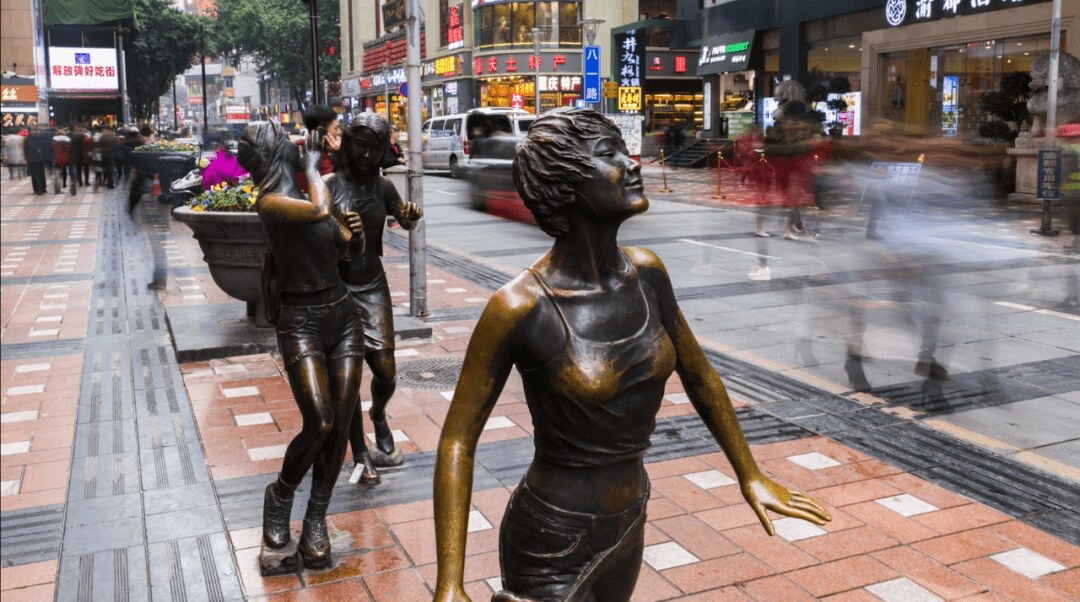
The Jiefangbei Pedestrian Street Sculpture Group is spread throughout the Jiefangbei pedestrian precinct, an artistic landscape that captures Chongqing's urban culture and everyday street life. The group consists of several bronze sculptures — including "Three Girls Out Shopping" and "Old Man Eating Hotpot" — created by professors from Sichuan Fine Arts Institute such as Xu Guangfu and Yu Zhiqiang. The centrepiece is "Three Girls Out Shopping," located in the Bayi Road Snack Street area: its core element is a pair of giant silver chopsticks, 11 metres tall, adorned with a gaiwan tea cup, Sichuan peppercorns, and small forks — symbols of Chongqing's food culture and city spirit. The sculptures' design concept fuses the bold, fiery flavours of Chongqing cuisine with the passionate character of its people, while conveying the modernity and dynamism of the Jiefangbei central business district. They stand as a direct window onto Chongqing's urban culture for every visitor.

Zouronglu Pedestrian Street

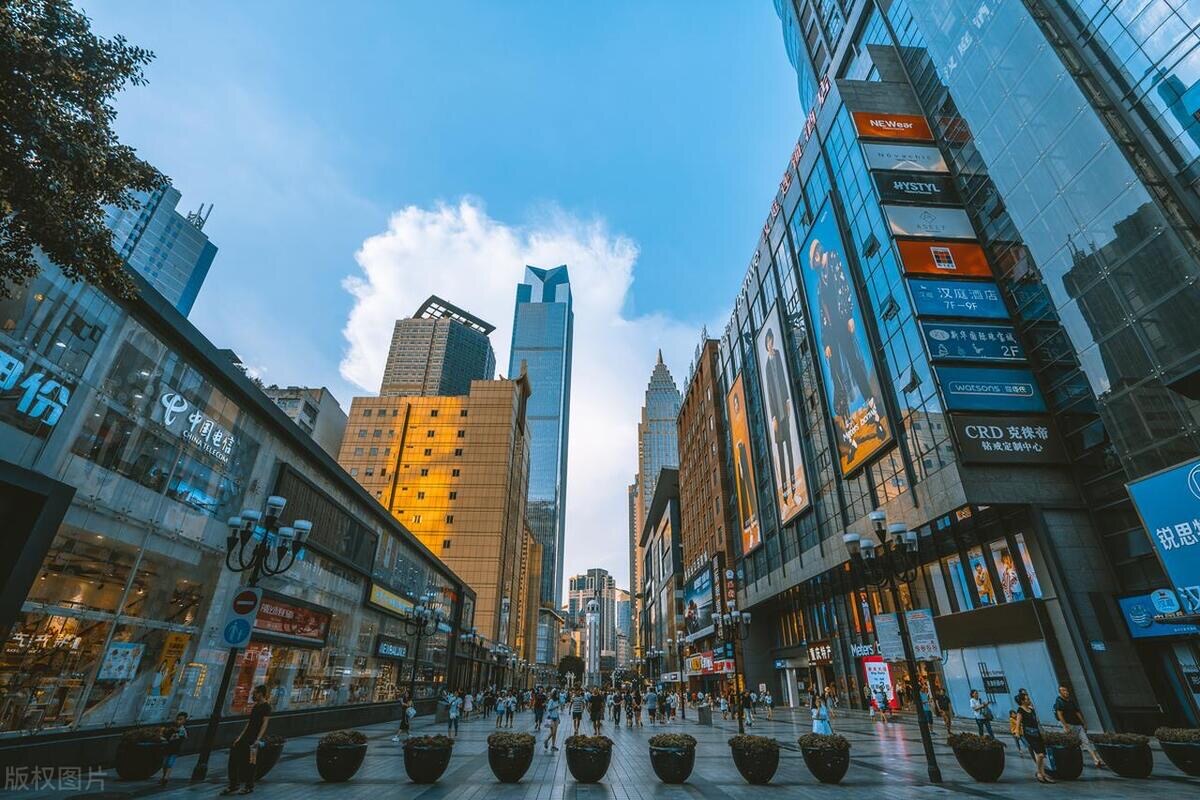
Zouronglu Pedestrian Street runs through the heart of the Jiefangbei district, linking the monument with Bayi Road Snack Street. The road was laid in 1939 under the name "Xinsheng Road" (New Life Road); on 25 December 1943 the municipal government renamed it "Zouronglu" in honour of Zou Rong, a martyr of the 1911 Revolution. Paved with rust-coloured Huagang granite tiles and flanked by green belts and benches, the street is a pleasant route for anyone exploring the Jiefangbei district on foot. Stretching from the Gongyuan Road intersection northward to Linjiangmen, the street passes landmarks such as Chongqing World Trade Centre and Metropolitan Plaza — modern commercial towers that stand in vivid contrast to the historic monument and speak to Chongqing's blend of tradition and modernity. A five-minute walk along Zouronglu brings you from Jiefangbei to Bayi Road Snack Street.

Bayi Road Snack Street

Bayi Road Snack Street is located at 181 Bayi Road, Yuzhong District, Chongqing, immediately adjacent to the Jiefangbei pedestrian zone, and is one of the city's most representative food-culture streets. Since 1997, when Jiefangbei opened as western China's first commercial pedestrian street, Bayi Road Snack Street has been the top destination for visitors wanting to experience Chongqing food culture, thanks to its rich selection of local snacks and its lively, neighbourhood-market atmosphere. The street runs for roughly 100 metres and brings together traditional Chongqing staples — suanla fen, Shancheng small tangyuan, deep-fried pork slices, fried skewers, spiced tofu and sweet-potato noodles — at wallet-friendly prices that keep visitors coming back. High-rises line both sides, neon signs light up the night, and the modern commercial energy of the district sits alongside bluestone-paved ground decorated with bas-reliefs and sculptures evoking old Chongqing. After dark, the pedestrian street blazes with light, the monument stands tall in the background, and the aromas of street-food stalls fill the air — a uniquely Chongqing scene where sightseeing and eating happen in the same breath, giving visitors both a taste of the city's contemporary energy and a feel for its older, neighbourhood soul.

WFC Huixian Tower Observation Deck

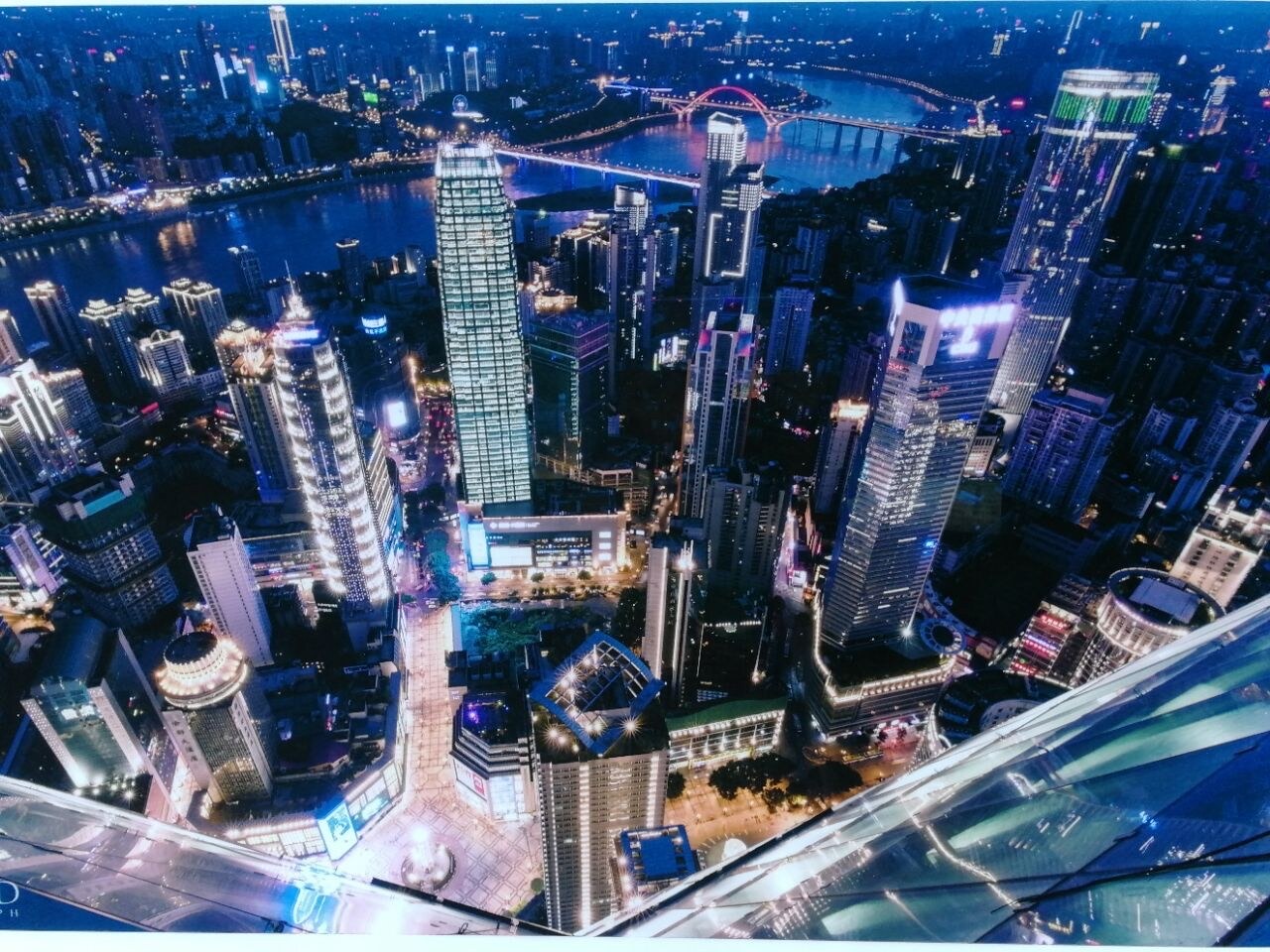
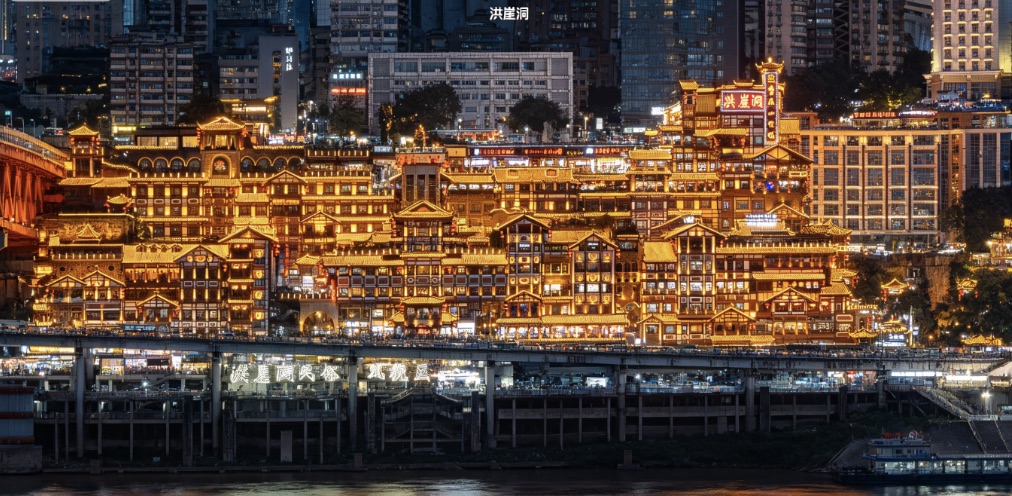
The WFC Huixian Tower Observation Deck is located at 188 Minzu Road, Yuzhong District — one of the finest vantage points in the entire Jiefangbei district. The observation deck occupies floors 73–75 of the World Financial Centre (WFC), a tower built on the site of Huixian Lou, which dates to the 1980s and was Chongqing's first building to surpass the Jiefangbei monument in height, as well as the birthplace of Chongqing's fashion industry. At an elevation of 590 metres, the deck is nicknamed the "Rooftop of Chongqing." From here, visitors can take in a panoramic view of the confluence of the Yangtze and Jialing rivers and the full sweep of the Yuzhong Peninsula — by day, the spectacle of two rivers converging; by night, the neon glow of the Jiefangbei district and the golden splendour of Hongya Cave. Floor 73 displays a large collection of historic Chongqing photographs, old maps, and archival documents that trace the city's transformation across time, making it an essential stop for anyone wanting to understand how Chongqing became what it is today.

Practical info Opening hours · Ticket · Getting there
Opening hours
  • Public Areas Around the Monument: Open 24/7
  • Best Visit Time: Nighttime, when the area around Jiefangbei is neon-lit and brilliant, you can enjoy both the monument light show and the business district nightscape
  • Note: Jiefangbei Business District has extremely high visitor traffic, especially during holidays; please take care of personal belongings
Ticket
  • Free admission (no ticket required for public areas around Jiefangbei Monument; shopping malls and restaurants in the vicinity are charged separately)
Getting there
  • Rail Transit: Take Chongqing Rail Transit Line 1, 2, or 6, get off at Xiaoshizi Station, walk about 3 minutes from Exit D to arrive
  • Bus: Take buses 105, 111, 112, 114, 135, 151, 181, 261, 462, 465, 601, 603, 868, etc., get off at Jiefangbei Station
  • Taxi/Ride-hailing: Directly tell the driver "Jiefangbei" or "Jiefangbei Pedestrian Street"; you will arrive right at the destination
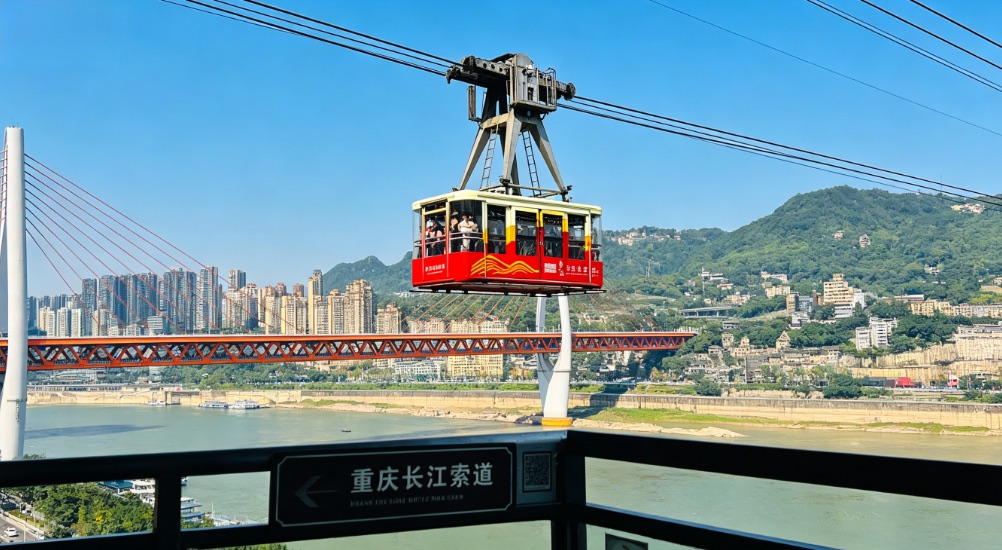
  • Yangtze River Cableway: Take the cableway from Nanan District to Yuzhong District, walk about 10 minutes after exiting the station to arrive

Inside Jiefangbei (Liberation Monument)

6 stops, in walking order — read top to bottom, no clicking needed.

1 Jiefangbei Square of 6

Jiefangbei Square

解放碑广场

Jiefangbei Square is located at the core of the pedestrian commercial district in Yuzhong District, centered on the People's Liberation Monument and radiating outward in a circle roughly 200 meters in diameter. It is both the spiritual symbol and commercial heart of Chongqing. The site originated in 1940 as the "Spirit Fortress" commemorating the War of Resistance; the Anti-Japanese War Victory Monument was built here in 1946 and renamed "People's Liberation Monument" by Liu Bocheng in 1950. Surrounded by WFC, Metropolitan Plaza and Pacific Department Store, the square draws over 300,000 visitors daily — the foremost commercial district in western China.

On-site narration · read it where you stand

Welcome, everyone! Welcome to the Jiefangbei commercial district of Chongqing. Today we'll follow the route from Jiefangbei Square to Zouronglu Pedestrian Street, then on to Bayi Road Snack Street, and finally up to the WFC Huixian Tower Observation Deck — taking in a landmark that brings together history, commerce, and food culture at the very heart of the city.

We're standing right now in Jiefangbei Square, the centre of the Jiefangbei district and our first stop today. The square sits at the junction of Zouronglu, Minzu Road, and Minquan Road in Yuzhong District, covering a total area of approximately 24,400 square metres — 400 metres from east to west and 350 metres from north to south. At its centre stands the Jiefangbei monument, China's only national monument commemorating the victory of the War of Resistance Against Japan, and a symbol of Chongqing's liberation and of the city itself. It is a National Key Cultural Relic Protection Unit (7th batch). The square is paved with rust-coloured Huagang granite tiles, clean and bright — a perfect spot to rest and take photos.

People's Liberation Monument

解放碑纪念碑

The People's Liberation Monument, standing 27.5 meters tall at the intersection of Minzu, Minquan and Zourong Roads, is an octagonal reinforced-concrete tower clad in reddish-brown granite, topped with a clock, wind vane and alarm bell. Originally named the "Anti-Japanese War Victory Monument" and laid in October 1946, it was renamed by Liu Bocheng in 1950. Designated a national-level protected cultural heritage site in 2013, it is the only monument in China commemorating the victory of both the Anti-Japanese War and the World Anti-Fascist War.

On-site narration · read it where you stand

We're now at the very centre of Jiefangbei Square — standing before the Monument to the Liberation of the People. Construction on this monument began in 1940. The original structure was called "Spirit Fortress": a wooden blockhouse-style tower standing 77 chi tall, symbolising the July 7th Incident. Its base bore the inscription of eight virtues — loyalty, filial piety, benevolence, love, trust, righteousness, harmony, and peace — and its exterior was painted black as a blackout measure against air raids. After Japan's surrender in 1945, the Chongqing municipal government decided to rebuild it on the same site under a new name: "Monument to the Victory of the War of Resistance Against Japan." The cornerstone was laid on 31 October 1946, and the monument was completed in August 1947. The new structure is an octagonal prismatic tower with a reinforced-concrete helmet cap, standing 27.5 metres tall, with 140 steps of spiral staircase inside leading up to four self-chiming clocks at the very top.

On 1 October 1950, with approval from the Southwest Military and Administrative Commission, the monument was renamed "Monument to the Liberation of the People" to mark both the liberation of Chongqing and of the Chinese people. The name was written by Marshal Liu Bocheng. The front face of the shaft bears those seven characters, while the base carries the full text of the Nationalist Government's decree designating Chongqing as the wartime capital. It is one of Chongqing's Ten Cultural Icons and a National Key Cultural Relic Protection Unit. The four self-chiming clocks at the top have gone through five generations of upgrades — from hand-wound French mechanical movements to today's Swiss Tian Jun timepieces — each one witnessing another chapter in Chongqing's story. The monument faces north-northeast; its eight-sided prismatic form stands solemn and commanding, serving as the city's defining image and spiritual reference point.

Jiefangbei Pedestrian Street Sculpture Group

解放碑步行街雕塑群

Scattered along the pedestrian zones radiating from the monument along Zourong, Minzu and Minquan Roads, this group of over a dozen bronze and stone sculptures was created between 1997 and the 2010s. Highlights include the "Century Chongqing" relief wall (depicting the city from treaty-port era to wartime capital), the "Bang-Bang Army" group (portraying porters), the "Down-River Migrants" figures (wartime evacuees), and a hotpot scene sculpture. Designed jointly by the Chongqing Sculptors Association and the Sichuan Fine Arts Institute, they form a touchable, photogenic three-dimensional memory of the city.

On-site narration · read it where you stand

If you look around from the monument, you'll spot the Jiefangbei Pedestrian Street Sculpture Group scattered throughout the precinct. These sculptures are an artistic celebration of Chongqing's urban culture and everyday street life. The group consists of several bronze works — including "Three Girls Out Shopping" and "Old Man Eating Hotpot" — created by professors from Sichuan Fine Arts Institute such as Xu Guangfu and Yu Zhiqiang. The most eye-catching of them all is "Three Girls Out Shopping," located in the Bayi Road Snack Street area. Its centrepiece is a pair of giant silver chopsticks, 11 metres tall, with a gaiwan tea cup, Sichuan peppercorns, and small forks clinging to them — all symbols of Chongqing's food culture and city spirit.

The design concept fuses the bold, fiery flavours of Chongqing cuisine with the passionate character of its people, while also conveying the modernity and energy of the Jiefangbei central business district. These were among the earliest urban sculptures to appear on a commercial pedestrian street in Chongqing, and they have become iconic to Bayi Road Snack Street. Feel free to get up close — they make for a great photo and a real sense of the city's culture and street-level life.

Zourong Road Pedestrian Street

邹容路步行街

Stretching about 1.2 km from Xiaoshizi in the east to Minsheng Road in the west, Zourong Road Pedestrian Street is named after Zou Rong (1885–1905), the Qing-dynasty revolutionary who wrote "The Revolutionary Army." Pedestrianized in 1997 — Chongqing's earliest — it is flanked by veteran department stores (Chongqing Department Store, New Century) and modern complexes (Metropolitan Plaza, Yingli International). With over 500,000 daily visitors and over one million on holidays, it boasts the highest commercial sales efficiency in western China.

On-site narration · read it where you stand

We're now leaving the monument and heading north along Zouronglu Pedestrian Street. This road was first laid in 1939 under the name "Xinsheng Road" (New Life Road). On 25 December 1943, the municipal government renamed it "Zouronglu" in honour of Zou Rong, a martyr of the 1911 Revolution. Zou Rong was a native of Ba County, Chongqing — celebrated as the "vanguard of the revolutionary army" — a prominent democratic revolutionary propagandist and thinker who gave his life for national liberation at just 20 years old. The street is paved with rust-coloured Huagang granite tiles and lined on both sides with green plantings and benches, making it one of the most pleasant walking routes through the Jiefangbei district.

Zouronglu runs from the Gongyuan Road intersection northward all the way to Linjiangmen, passing landmarks including Chongqing World Trade Centre and Metropolitan Plaza. These modern towers stand in vivid contrast to the historic monument, capturing Chongqing's distinctive quality of old and new existing side by side. Zouronglu is also the main corridor connecting the monument to Bayi Road Snack Street — a walk of about five minutes, with Chongqing's urban scenery and street life to enjoy along the way.

Bayi Road Good Food Street

八一路好吃街

Located on Bayi Road adjacent to the Jiefangbei pedestrian zone and stretching about 500 meters, this is one of the oldest and best-known food streets in central Chongqing. Over 200 stalls and shops line both sides, offering dozens of authentic Bayu snacks — sour-spicy noodles, Chongqing small noodles, grilled pig brain, skewered chicken, iced jelly, and mountain-city glutinous-rice balls — alongside viral spots like Zhou Shixiong Hotpot and Hao You Lai noodles. Originating as a spontaneous 1990s night market and formalized in 2008, it draws over 100,000 visitors daily.

On-site narration · read it where you stand

We've arrived at Bayi Road Snack Street — the highlight of today's tour. Located at 181 Bayi Road, Yuzhong District, right next to the Jiefangbei pedestrian zone, this is one of Chongqing's most representative food-culture streets. Since 1997, when Jiefangbei opened as western China's first commercial pedestrian street, Bayi Road Snack Street has drawn visitors from across the country, winning its place as the top spot to experience authentic Chongqing food culture — a combination of extraordinary variety and a lively, neighbourhood-market atmosphere.

The street runs for roughly 100 metres and packs in a full spread of Chongqing favourites: suanla fen (spicy-sour noodles), Shancheng small tangyuan, deep-fried pork slices, fried skewers, spiced tofu and sweet-potato noodles — all at prices that won't stretch the budget. High-rises line both sides, neon lights blaze overhead, and the energy is unmistakably urban; underfoot, bluestone paving decorated with bas-reliefs and sculptures recalls old Chongqing. After dark, the street lights up completely, the monument stands tall in the background, and the aroma of street food drifts through the air — a scene that perfectly sums up Chongqing: you walk, you eat, you sightsee, all at once.

The entrance is at 181 Bayi Road, about 100 metres from the monument — roughly five minutes on foot from Zouronglu. Inside you'll find stalls and shops of every kind, and the best way to enjoy it is simply to wander and graze. The sculptures and storefronts along the way are a vivid, street-level introduction to Chongqing culture.

WFC Huixianlou Observation Deck

环球金融中心会仙楼观景台

(WFC)73,339,。2000,360,、、、、。,。、,,。

Perched on the 73rd floor of the Chongqing World Financial Center (WFC) in the Jiefangbei district, the Huixianlou Observation Deck sits 339 meters above sea level — among the highest viewing platforms in Chongqing. Its roughly 2,000 m², 360-degree glass curtain wall offers sweeping views of the Yuzhong Peninsula, the Yangtze–Jialing confluence, Hongyadong, Qiansimen Bridge, Raffles City and the Nan'an skyline. Operating in daytime and night sessions, the deck features a sky café, a souvenir shop and a "cloud mailbox" — one of the best vantage points for Chongqing's cyber-punk skyline, nicknamed "the Summit of the West."

On-site narration · read it where you stand

From Bayi Road Snack Street we continue on to our final stop: the WFC Huixian Tower Observation Deck. Located at 188 Minzu Road, Yuzhong District, it is one of the finest vantage points in the entire Jiefangbei district. From Bayi Road Snack Street, head along Minzu Road or Minquan Road — about five minutes on foot and you're there.

The observation deck grew out of Huixian Lou, a tower built in the 1980s that was the first building in Chongqing to surpass the monument in height and the birthplace of Chongqing's fashion industry. Today the deck occupies floors 73–75 of the World Financial Centre (WFC), at an elevation of 590 metres — nicknamed the "Rooftop of Chongqing." From here you can take in a sweeping panorama of the Yangtze and Jialing rivers converging and the full spread of the Yuzhong Peninsula. By day, watch the two rivers merge in the spectacle locals call "Jiama Shui" (the Horse-Bridled Waters); by night, the neon glow of the Jiefangbei district and the golden blaze of Hongya Cave put on a show of their own.

Floor 73 displays a large collection of historic Chongqing photographs, old maps, and archival documents, tracing the city's transformation across time and making this an essential stop for anyone wanting to understand how Chongqing has evolved. Opening hours are 10:00–22:00 (last entry 21:30). Adult tickets are 118 yuan; children under 1.2 metres enter free; visitors aged 22 and under (students) or 70 and over are eligible for a discounted ticket at 100 yuan. Take the lift directly to floor 73, then walk up to the open-air observation deck on floor 75 for a full panoramic view of Chongqing.

Prefer to be shown around?

A local guide walks these 6 stops with you and answers what the page cannot.

Browse tours ↗