Travel Guide› Hangzhou› Hefang Street (Qinghefang Historical Block)
Hangzhou · Market & old street

Hefang Street (Qinghefang Historical Block) 河坊街(清河坊历史街区)

Hefang Street (Qinghefang Historical Block)
Address
Hefang Street, Shangcheng District, Hangzhou, Zhejiang Province (from Zhonghe Road east to Wushan Square west)

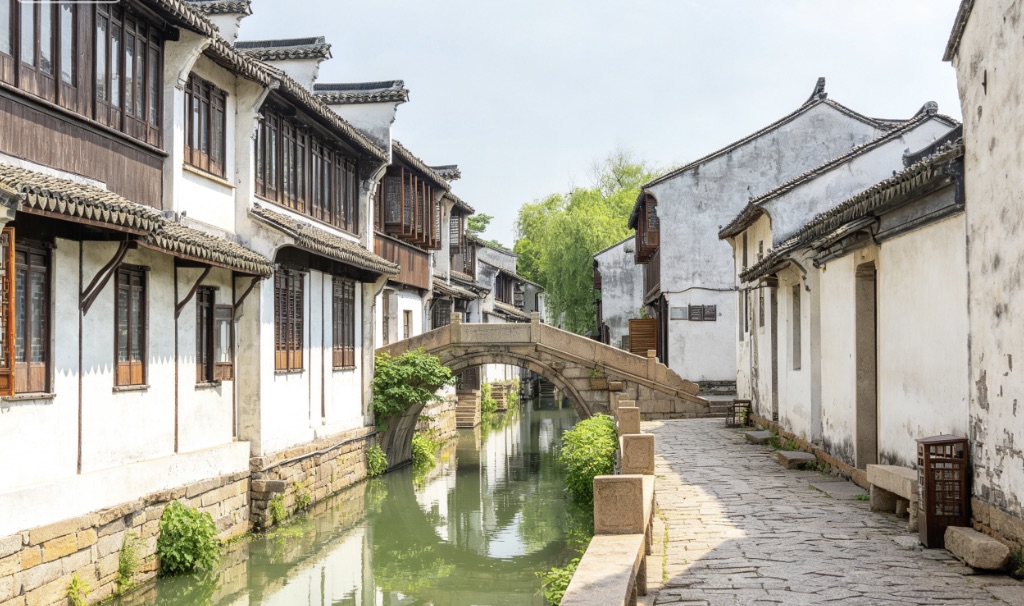
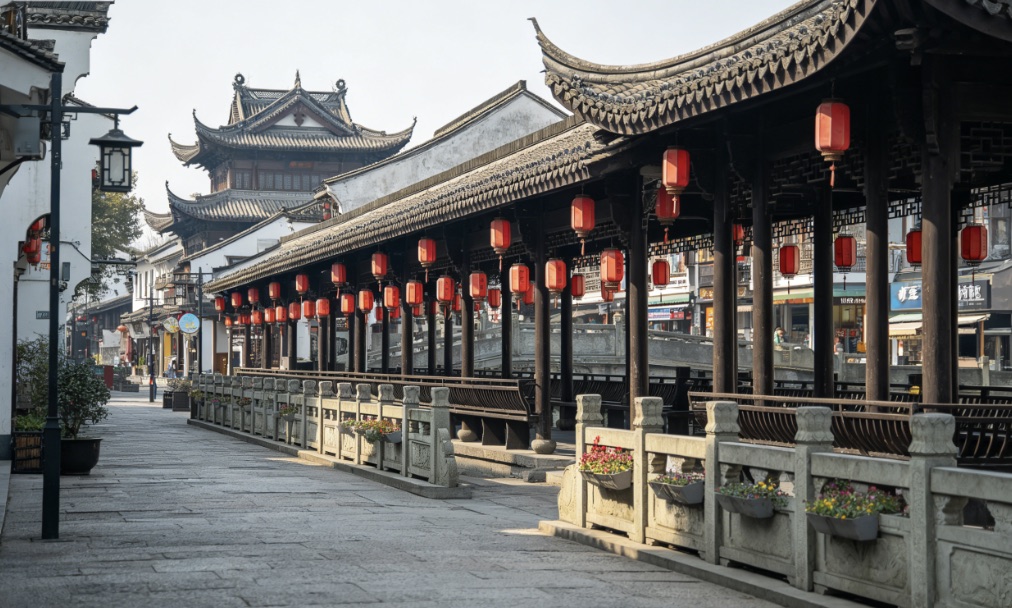
Hefang Street is located in Shangcheng District, Hangzhou, in the eastern province of Zhejiang. It runs east from Jiangcheng Road to Nanshan Road in the west, with Wushan Mountain rising to its south and West Lake stretching to its north. It is one of Hangzhou's most celebrated historic commercial districts, with a history that goes back to Lin'an, the capital of the Southern Song Dynasty, when it formed the beating heart of the city's trade — over 800 years ago. The district preserves the architectural character of the late Qing Dynasty and early Republican era: rows of traditional Jiangnan buildings line the stone-paved lanes, with medicine halls, teahouses, silk shops, and time-honored restaurants standing shoulder to shoulder. It has been described as "a living fossil of Hangzhou's traditional commercial culture." Today, Hefang Street serves as a window into the folk customs and traditional crafts that have flourished here since the Southern Song, and is one of the most evocative places for visitors from around the world to experience the atmosphere of old Hangzhou.

East Entrance of Hefang Street

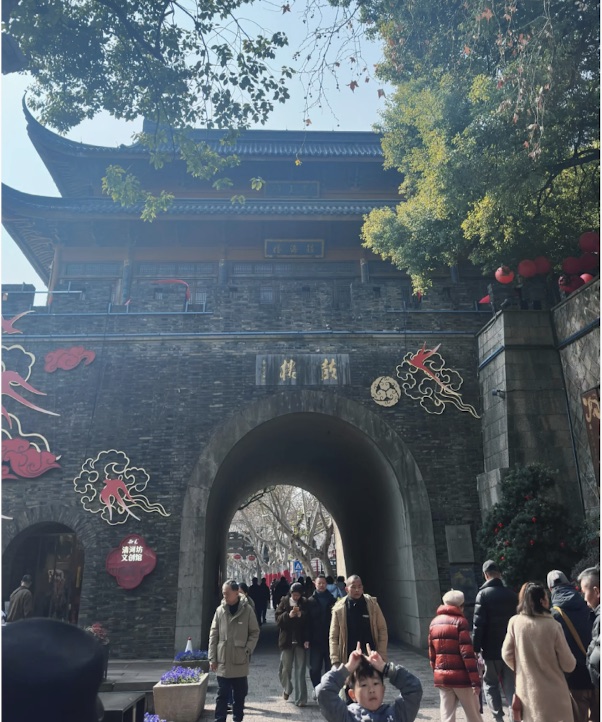
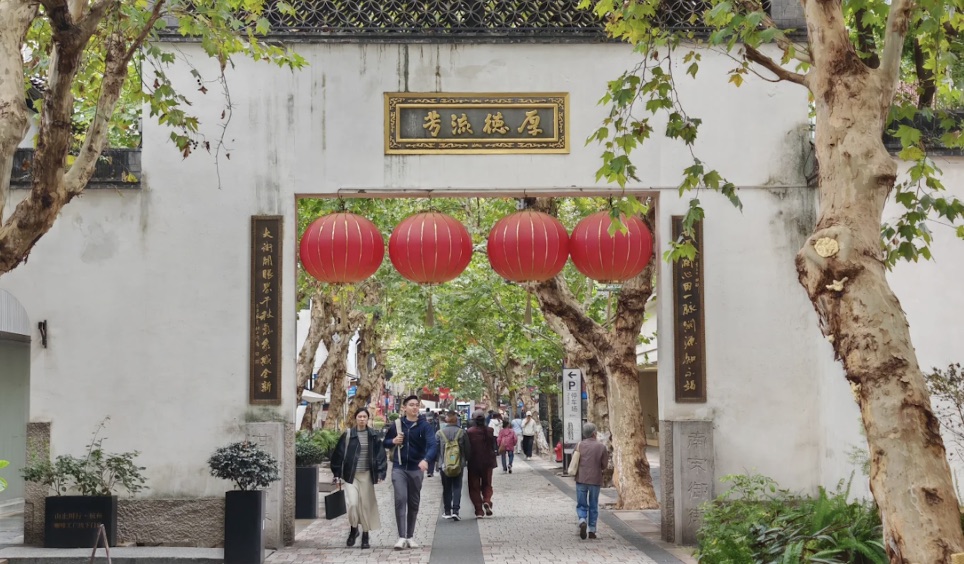
The east entrance is marked by a traditional pailou gate arch — grey brick, dark tiles, upturned eaves and carved beams — that stands in vivid contrast to the rush of the modern city behind it. This is the starting point for a walking tour of the street, and the first portal through which visitors sense Hangzhou's layering of ancient and contemporary.

Drum Tower

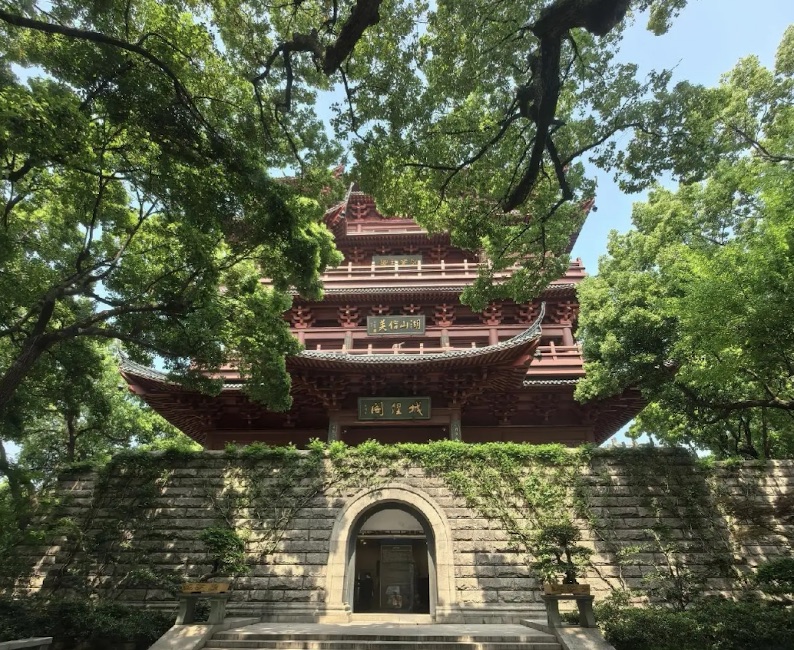
The Drum Tower was first built during the Five Dynasties period of the Wuyue Kingdom, serving as the city's timekeeping post and military watchtower. The current structure was rebuilt in 2002 following the design of its Southern Song predecessor: three stories tall, with double-eaved hipped rooflines. From the top, visitors can look out over the Qiantang River and the forested hills surrounding West Lake. It is the defining historic landmark of the Hefang Street district.

Wangxian Pavilion

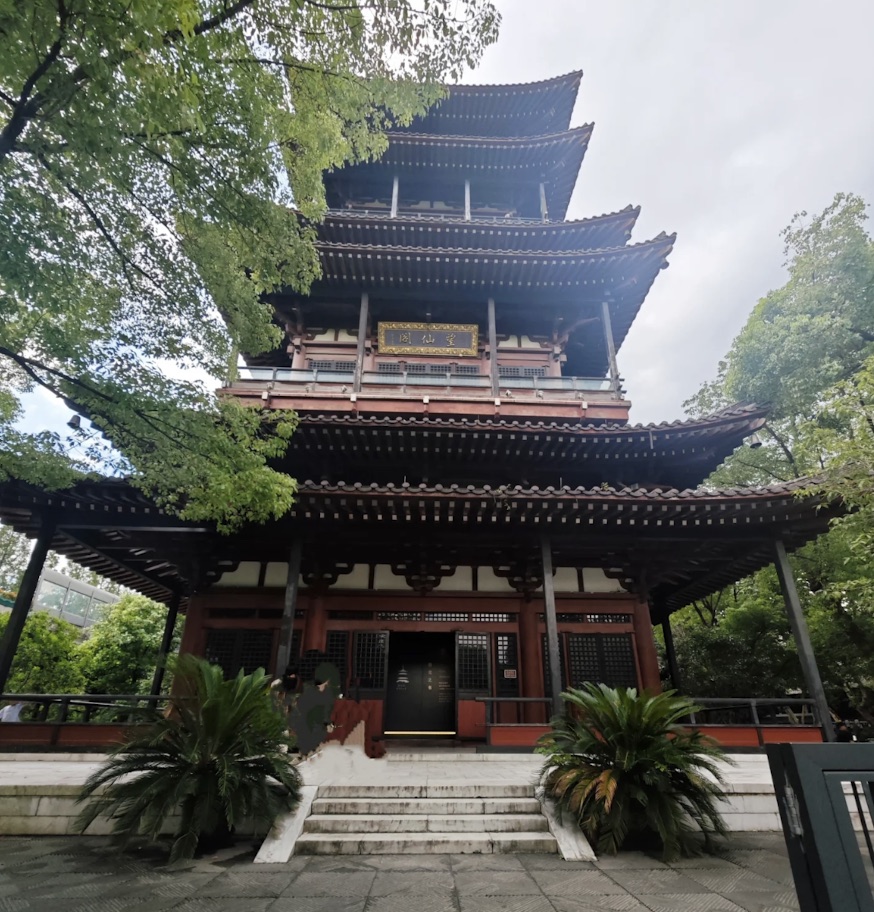
Wangxian Pavilion stands to the east of the Drum Tower — a three-story reconstruction built in Southern Song architectural style. Its name is borrowed from an old Hangzhou bridge called Wangxian, meaning "Gazing Toward the Immortals," that once stood nearby. From the pavilion's upper floors, visitors can look down on the junction of Hefang Street and the Southern Song Imperial Street, making it one of the finest spots for taking in the district in full and photographing the city skyline.

Hu Qing Yu Tang Chinese Medicine Museum

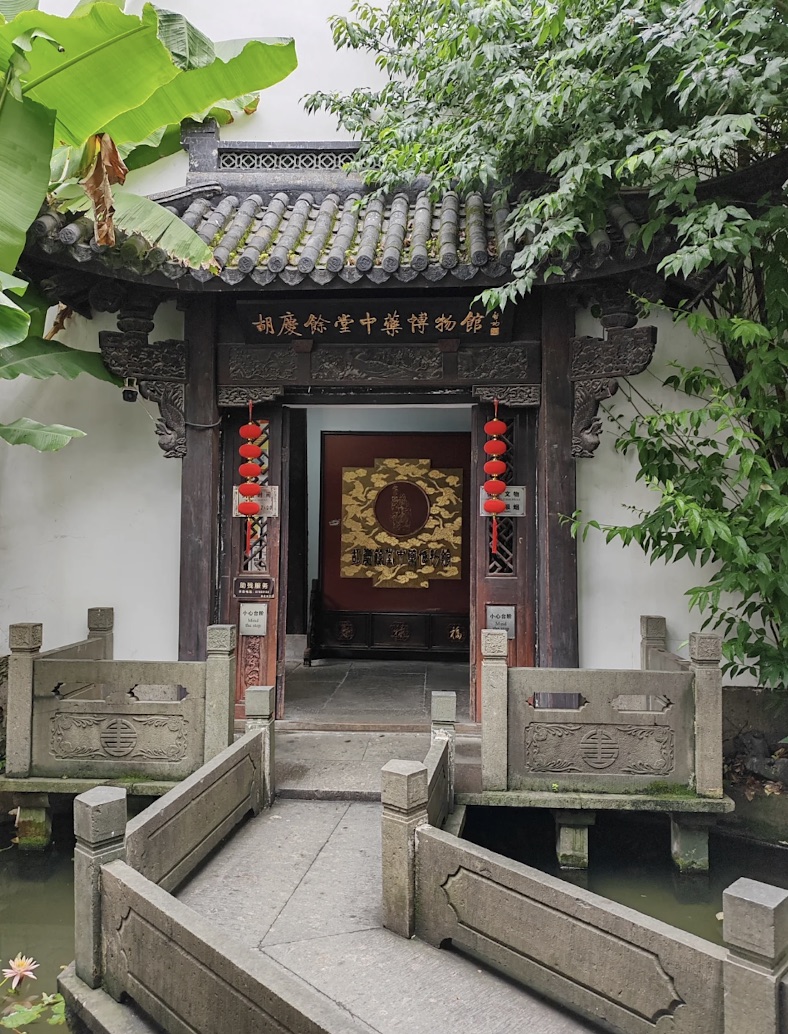
Hu Qing Yu Tang was founded in 1874 by Hu Xueyan, the celebrated late-Qing merchant official. It is one of the largest and best-preserved late-Qing commercial medicine halls in China. The complex blends Jiangnan domestic architecture with the atmosphere of a working pharmacy, and its lacquered signboards, gilded plaques, and traditional dispensing instruments together form a priceless record of China's modern traditional medicine culture.

Fang Hui Chun Tang

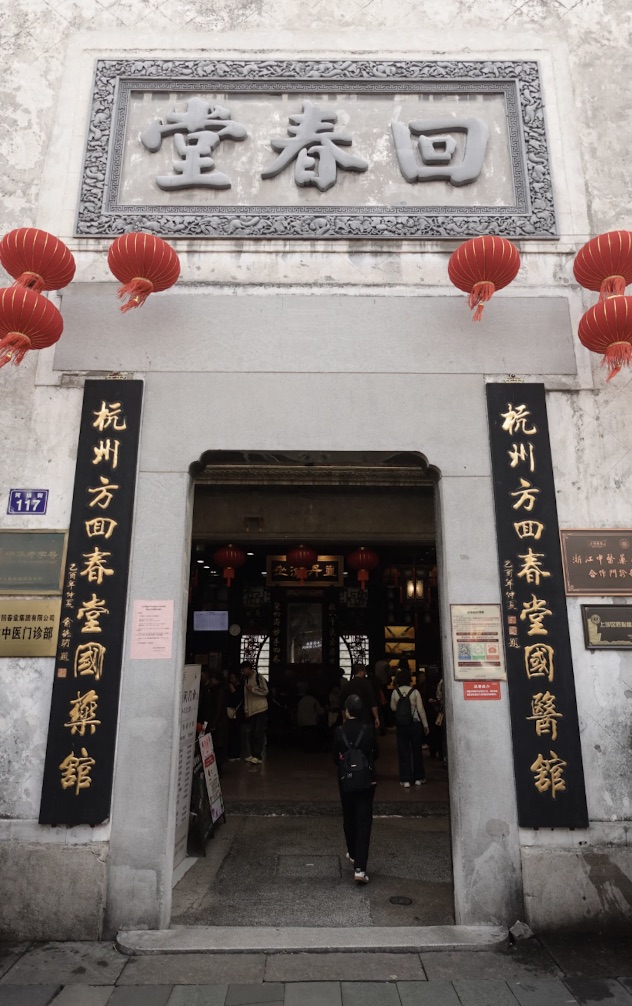
Fang Hui Chun Tang was established in 1649, the sixth year of the Shunzhi reign of the Qing Dynasty, making it one of Hangzhou's oldest traditional medicine houses. Inside, original medicine cabinets and the scene of a resident physician taking pulses at a carved consultation desk have been kept intact, carrying on the Jiangnan pharmacy tradition: "a physician's heart is one of benevolence, and the preparation of medicines, however laborious, must never cut corners."

Zhu Bingren Copper Art Museum

Founded by Zhu Bingren, a National Master of Arts and Crafts, this is China's first museum dedicated entirely to copper sculpture. The collection spans molten-copper works, copper murals, and architectural elements in copper, presenting a dialogue between fire and metal that pushes contemporary metalworking to its expressive limits.

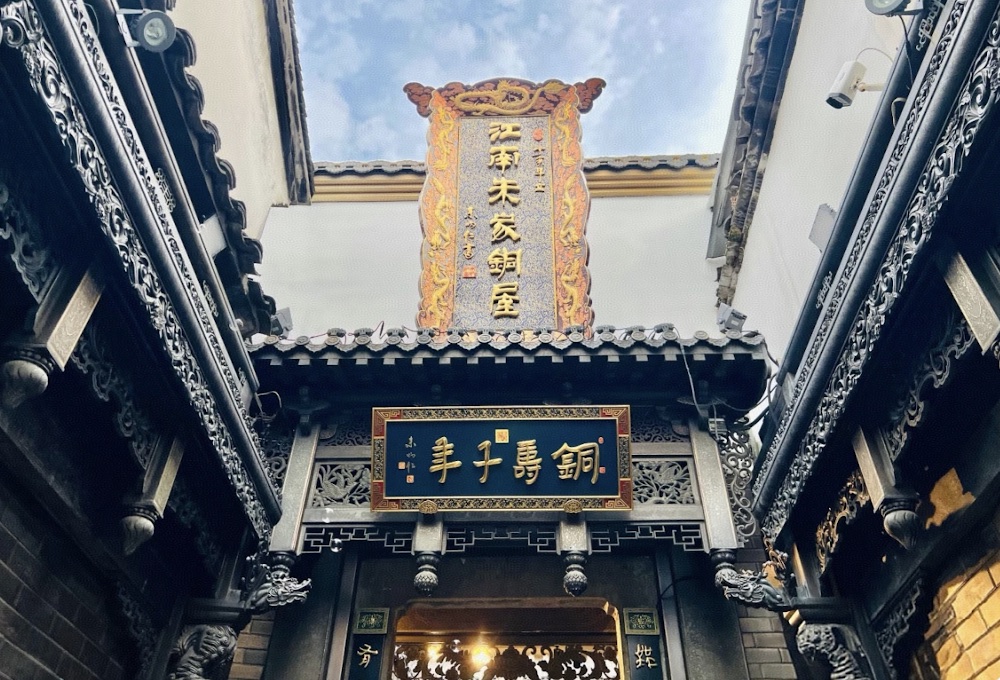
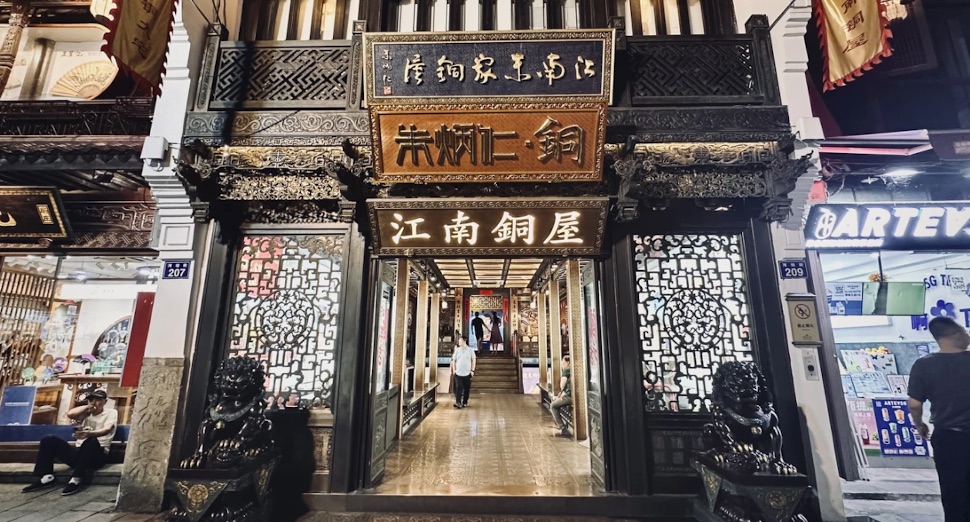
Jiangnan Copper House

The Jiangnan Copper House is the centrepiece exhibition hall of the Zhu Bingren Copper Art Museum. Copper covers the building inside and out — doors, windows, roof, floors, and even furniture — earning it the description "a copper sculpture you can live in."

Southern Song Imperial Street

The Southern Song Imperial Street was the central axis of Lin'an, the Southern Song capital, laid out as a ceremonial route for the emperor's processions to the suburban altars. Today, archaeological remains and a pedestrian street are combined: glass-covered sections in the pavement reveal foundations, drainage channels, and building bases from 800 years ago, recreating the grandeur of the Song capital — a Ten-Mile Imperial Street lined with traders of every kind.

Dajing Lane

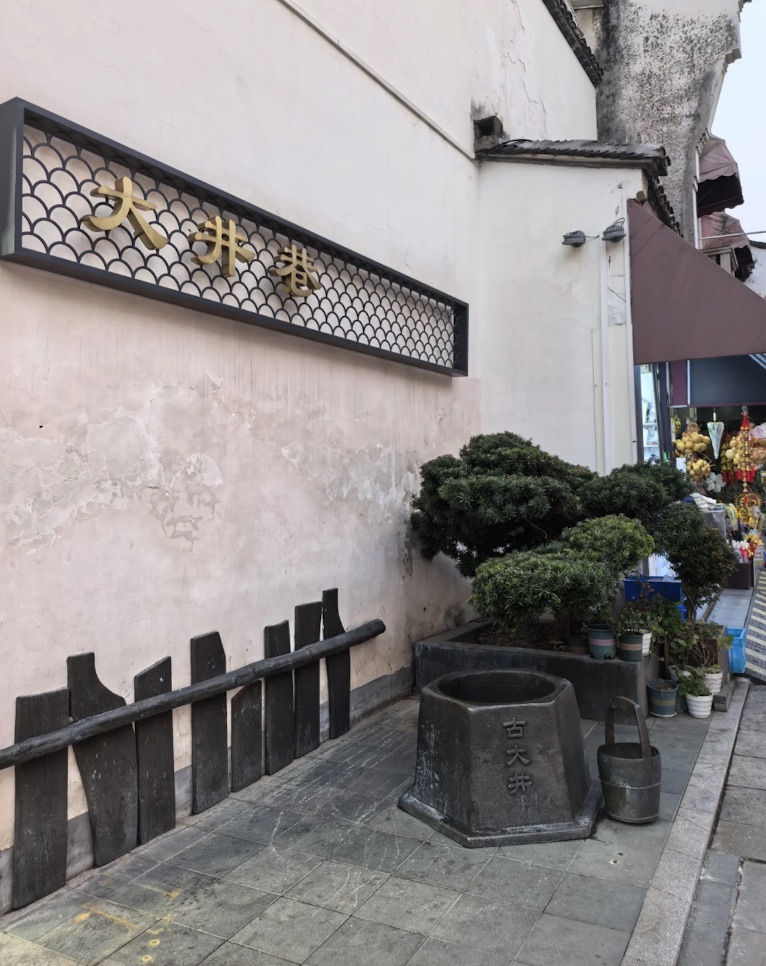
Dajing Lane takes its name from a well inside it that dates back to the Tang and Song dynasties. It is one of the better-preserved traditional alleyways on the western side of Hefang Street, retaining old gateway courtyards, shikumen stone-frame doorways, and early modern shopfronts. Its quiet, shaded character makes a composed counterpoint to the commercial bustle of the main street.

Wushan Square and Chenghuang Pavilion

Wushan Square sits at the southern end of Hefang Street and is the main open space at the heart of Hangzhou's old city. Climbing the hill to the south brings you to Chenghuang Pavilion, first built in the Ming Dynasty. The current structure, rebuilt in 1998, is a seven-story Song-style tower standing 41.6 metres tall. From the top, the full panorama of West Lake, the Qiantang River, and old Hangzhou spreads out below — a view traditionally celebrated as "the Heavenly Wind of Wushan."

Practical info Opening hours · Ticket · Getting there
Opening hours
  • Street: open 24/7 year-round. Shop hours generally 9:00–22:00, varying by individual store.
Ticket
  • Free. The street is open to all with no admission fee. Some venues inside (e.g., Hu Qing Yu Tang Chinese Medicine Museum) may charge separately.
Getting there
  • **Metro:** Line 1 to Ding'an Road Station Exit C (10-min walk); Line 7 to Wushan Square Station.
  • **Bus:** Routes 8, 25, 35, 38 to Wushan Square or Qinghefang Station.
  • **By Car:** Navigate to "Wushan Square Parking" or "Gaoyin Street Parking" (approx. 10 RMB/hour).

Inside Hefang Street (Qinghefang Historical Block)

10 stops, in walking order — read top to bottom, no clicking needed.

1 Hefang Street East Entrance (Dongrukou) of 10

Hefang Street East Entrance (Dongrukou)

河坊街东入口
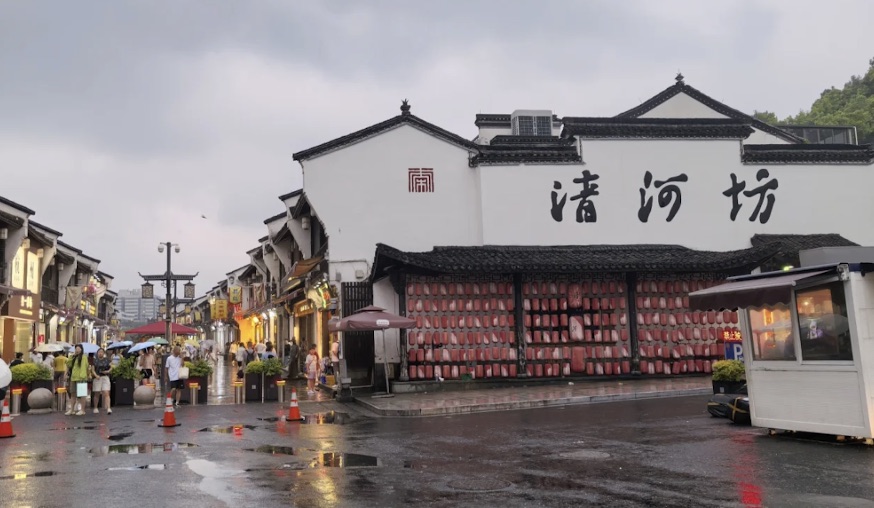
The East Entrance of Hefang Street is located at the intersection of Zhongshan Middle Road and Hefang Street in Shangcheng District, Hangzhou. It is the eastern starting point of the Hefang Street pedestrian zone. The entrance is paved with neat bluestone slabs, and both sides of the street feature restored architectural complexes in Ming-Qing style, with black tiles, white walls, and carved wood windows——the rich ancient atmosphere greets visitors instantly. Nearby the entrance are various Hangzhou time-honored brand shops, including Wang Xingji Fan Studio, Zhang Xiaoquan Scissors, and Hu Qingyutang Traditional Chinese Medicine, among others. Once visitors step in from this entrance, they formally enter the core area of Hangzhou's millennial civilian culture. Hefang Street has a total length of about 1,800 meters, of which the Qinghefang section (from the East Entrance to Nanshan Road) is a pedestrian street——one of the most completely preserved and representative historical and cultural blocks in Hangzhou. Every weekend and holiday, the area in front of the East Entrance teems with crowds.

On-site narration · read it where you stand

Friends, welcome to the east entrance of Hefang Street. Look up — that imposing arch gate of grey brick and dark tile, with its curving eaves and carved beams, is the iconic entrance to the street. The three bold characters above it are every visitor's first introduction to this ancient thoroughfare.

Standing here, you can feel a striking contrast: behind you is the noise and pace of the modern city; in front of you is a cobbled old street lined with shops. That layering of old and new is one of the most captivating things about Hangzhou — a city that moves fast in the internet age yet holds on to eight centuries of memory since the Southern Song.

As you step onto Hefang Street through the east entrance, notice the flagstones beneath your feet. Don't underestimate these stones — they were laid to traditional lane standards, slightly uneven, with a texture underfoot that makes every step feel like a conversation with over 800 years of history. The buildings on both sides are mostly in the style of the late Qing Dynasty and early Republic: white walls, dark-tiled roofs, wooden doors and windows, with shops on the ground floor and living quarters or storage above — the classic Jiangnan "shopfront and home" arrangement.

Look around on both sides: there is Longjing tea for sale, silk scarves, Hangzhou fans, oiled-paper umbrellas, and all manner of local snacks. No rush to buy anything just yet — we will wander at our leisure. For now, let me suggest a great photo spot: stand directly under the pailou arch and shoot upward to frame the gateway against the blue sky and white clouds. It captures the character of Hefang Street beautifully. In the evening, when the lanterns on the arch light up and their warm amber glow falls on the grey brickwork, the atmosphere becomes something else entirely.

Right, let us walk in and begin today's cultural journey.
Drum Tower (Gulou)

鼓楼

The Drum Tower is located at the east end of Hefang Street, at the intersection of Zhongshan Middle Road and Wangjiang Road. It is an important historical and cultural site and landmark building in Hangzhou. The Drum Tower was first built during the Five Dynasties period in the Wuyue Kingdom (approx. 907 CE) and originally served as the south gate of Lin'an City's inner citadel——Chaotian Gate——in the Southern Song Dynasty, being the south gate of ancient Hangzhou and holding a prominent status. Historically, the Drum Tower was destroyed by war and fire multiple times and rebuilt repeatedly. The existing building was reconstructed in 2002 according to the Ming Dynasty Drum Tower form. The Drum Tower is a three-story wooden tower-style building with a double-eave xieshan roof, red walls, and black tiles, about 20 meters in height, presenting a majestic bearing. The first floor houses the "Southern Song Lin'an City Historical Relics Exhibition," recreating the prosperous scene of Lin'an, the Southern Song capital, through texts, models, and multimedia. The second floor is a tea culture exhibition space where visitors can taste tea and rest.

On-site narration · read it where you stand

Walking west along Hefang Street, you will soon see an imposing historic structure ahead — the Drum Tower. Take a look: three stories tall, with double-eaved hipped rooflines, red walls and dark tiles, and a massive bronze bell hanging under the eaves. It is quite a commanding sight.

The Drum Tower's history goes back to the Five Dynasties period of the Wuyue Kingdom, over a thousand years ago. In ancient cities, there were no clocks — the drum tower and bell tower told time. Each morning and evening, when the drums sounded, people in the city knew when the markets should open and when they should close. Beyond timekeeping, the tower also served as a military watchtower, giving guards a view of everything moving inside and outside the city walls.

The tower you see now was rebuilt in 2002 based on its Southern Song design. Though a reconstruction, the craftsmanship is meticulous: the bracket sets, beams, and doors all preserve the clean, dignified lines of Song architecture. If you like, go up to the second or third floor. Looking east, you get a full view of Hefang Street; looking west, you can see the hills in the direction of West Lake, and on a clear day, the Qiantang River glitters in the distance. In the late afternoon, as the sun drops and the whole old city is bathed in golden light, it is an especially photogenic moment.

Look at the main facade of the Drum Tower — a large plaque bears its name in flowing running-script calligraphy, the fluid brushwork making an interesting contrast with the weight of the architecture below. The ground-floor archway is open to pass through, and there is something nicely symbolic about it: on one side, a lively commercial street; on the other, the direction leading toward the Southern Song Imperial Street.

One more thing — there are plenty of specialty shops and teahouses around the Drum Tower. If your feet need a rest, find a teahouse nearby, order a cup of Longjing, and watch the world pass by below. That is the Hangzhou slow life in its natural habitat.

Wangxian Pavilion (Wangxiange)

望仙阁

Wangxian Pavilion is located in the middle section of Hefang Street, adjacent to the Southern Song Imperial Street ruins. It is a three-story tower-style building in Ming-Qing style and the best high vantage point within Hefang Street for viewing the surroundings. The pavilion's name originates from a touching Southern Song legend: when Emperor Gaozong of Song (Zhao Gou) crossed south and stationed in Hangzhou, he once gazed into the distance from this spot and suddenly saw immortal figures appearing in auspicious clouds. A pavilion was subsequently built to commemorate this event, hence the name "Wangxian" (Gazing at Immortals) Pavilion. The pavilion is about 16 meters high, with a double-eave pyramidal roof, vermilion pillars, and surrounding corridors——elegant and exquisite in architectural style. The first floor houses a Hangzhou old photographs exhibition, displaying precious old photos of Hangzhou's city walls, streets, and canal from the late Qing and early Republican period. The second floor is a Southern Song culture exhibition space. The third floor is an open viewing terrace. Wangxian Pavilion is also one of the best photography spots on Hefang Street.

On-site narration · read it where you stand

Passing through the Drum Tower and continuing east, you will see Wangxian Pavilion. It stands on the east side of the Drum Tower — a three-story reconstruction built in Southern Song architectural style, with upturned eaves, red pillars, and grey-green tiles. It captures the spirit of Song-dynasty building rather well.

The name Wangxian Pavilion comes from an old Hangzhou bridge called Wangxian — "Gazing Toward the Immortals." In earlier times, people standing on that bridge and looking east could see the tower-pavilions and monasteries of Fenghuang Hill wreathed in mist, looking for all the world like a realm where immortals might dwell. When this pavilion was built here, it inherited that poetic name.

The ground floor is open — go inside and look up at the beautifully carved ceiling panels and bracket sets. The upper floors require climbing a rather steep staircase, so take care on the way up and down. From the top, the view opens up dramatically: to the north, the crowds of Hefang Street; to the south, the green wooded slopes of Wushan; to the west, the silhouette of the Drum Tower and the distant outline of West Lake; to the east, the lanes of Hangzhou's old city spreading outward. This is one of the best positions for photographing the full sweep of the district.

Particularly recommended: try a shot here that places one of the pavilion's curved eaves in the foreground with the tower blocks of the modern city rising in the background. That kind of frame captures Hangzhou's character as a city where history and modernity genuinely coexist.

Also worth knowing: this part of the street comes alive at night, when the pavilion is lit up and its glow spills onto the flagstones below. If your schedule allows, come back after dark for a sense of what the Song poets meant by "a thousand lanterns lighting the night market beneath blue clouds."

Hu Qingyutang Traditional Chinese Medicine Museum

胡庆余堂中药博物馆

The Hu Qingyutang Traditional Chinese Medicine Museum is located within Da Jing Lane on Hefang Street and was converted from the original site of the Hu Qingyutang pharmaceutical workshop. It officially opened to the public in 1989 and is the only national-level traditional Chinese medicine specialized museum in China. Hu Qingyutang was founded in 1874 by Hu Xueyan, a renowned Anhui merchant in the late Qing Dynasty, and is hailed as the "Jiangnan Medicine King," standing alongside Beijing Tongrentang as the "Two Great Pharmacies of North and South." The museum covers an area of about 3,000 square meters and completely preserves the "front shop, back workshop" architectural layout of the Qing Dynasty pharmacy——the front hall serving as the sales and exhibition area, and the back hall as the pharmaceutical workshop and medicinal material storage area. The museum houses over ten thousand pieces of traditional Chinese medicinal material specimens, pharmaceutical tools, and precious medical books. Visitors can closely observe pharmaceutical workers demonstrating traditional Chinese medicine production processes such as slicing herbs, grinding powder, and making pills on-site.

On-site narration · read it where you stand

Friends, we have arrived at one of Hefang Street's most celebrated old establishments — Hu Qing Yu Tang. Look at that imposing entrance: black lacquer, gold lettering, the four characters of the name gleaming above the gate. This is the medicine hall founded in 1874 by Hu Xueyan, one of the most remarkable merchant officials of the late Qing Dynasty.

Hu Xueyan was a towering figure in his era — a Huizhou merchant who built a fortune in banking and silk, and who turned to medicine out of a genuine desire to provide ordinary people with quality, authentic traditional Chinese remedies. For over a century, Hu Qing Yu Tang has held to its founding motto: "Sourcing must be genuine; preparation must be meticulous." Those eight characters still hang in the main hall — have a look when you go inside.

The building itself is a work of art. It follows the classic Jiangnan layout of "shopfront facing the street, workshop behind," with the dispensary at the front and the storage rooms and preparation workshops further back. Throughout the complex, the carved woodwork, brickwork, and stonework draw on motifs of plum blossoms, orchids, bamboo, chrysanthemums, and symbols of fortune and longevity — beautiful and meaningful in equal measure. The original counters and medicine cabinets are still in use, with hundreds of small drawers each labelled with the name of an individual herb, lined up in perfect order. It is quite a sight.

We are now entering the Hu Qing Yu Tang Chinese Medicine Museum, where admission is around ten yuan. The museum traces the history of Chinese medicine, displays specimens of raw herbs, and shows the ancient tools of the trade — pill crushers, precision scales, ceramic dispensing vessels. You will quickly appreciate just how elaborate the preparation of traditional Chinese medicine can be: some herbs are steamed, some dry-roasted, some treated with honey or wine, some sun-dried — each step carried out without exception.

Hu Qing Yu Tang still offers resident physician consultations today. If you are curious, you can experience a traditional pulse reading here. The pharmacy also sells a selection of prepared medicines and wellness drinks, including tortoise jelly and loquat syrup — worth picking up as souvenirs. That said, when it comes to buying herbal medicines, please consult a professional rather than choosing at random.

Fang Huichun Tang (Fang Huichuntang)

方回春堂

Fang Huichun Tang is located at 117 Hefang Street and was founded in 1649 (the sixth year of the Shunzhi reign of the Qing Dynasty) by the Fang family of Qiantang. It is the oldest surviving traditional Chinese medicine time-honored brand in Hangzhou, predating Hu Qingyutang by 225 years. The name "Huichun" (Returning Spring) is derived from the meaning of "rejuvenating the elderly and restoring health with miraculous skills," and the hall has long been renowned for its "authentic medicinal materials, meticulous processing, and renowned physicians practicing on-site." The medicine hall is a late Qing residential building with three courtyards and two skywells, featuring black tiles, white walls, and carved gate towers, preserving the complete layout of ancient TCM halls. Currently, Fang Huichun Tang offers comprehensive TCM diagnosis and treatment services including internal medicine, gynecology, pediatrics, and acupuncture and tuina massage, with over ten renowned veteran TCM doctors stationed there. The hall also regularly holds public welfare activities such as "National TCM Day," "Herbal Paste Festival," and "Parent-Child Paste Experience." During the winter paste festival period, free clinic services and constitution identification are also provided.

On-site narration · read it where you stand

Continuing along Hefang Street, you will come to another establishment with very deep roots: Fang Hui Chun Tang. Founded in 1649 — the sixth year of the Shunzhi reign of the Qing Dynasty — it predates Hu Qing Yu Tang by more than two hundred years, making it one of Hangzhou's oldest traditional medicine houses.

The name "Hui Chun" — "restoring spring" — carries the meaning of "a physician's healing touch brings life back," expressing the hope that medicine can relieve suffering and restore health. Over the centuries, Fang Hui Chun Tang has held to its own guiding principle: "We may earn a profit, but we will never sell a counterfeit." That ethic sits alongside Hu Qing Yu Tang's motto as twin pillars of Hangzhou's tradition of honesty in the medicine trade.

Look at the facade: deep red doors, a gold-character signboard, latticed wooden windows, red lanterns hanging at the entrance. It has all the ceremonial weight of a great old institution. Step inside and the first thing you see is the towering medicine cabinet — rows upon rows of drawers, each labelled with a herb name. At the centre of the hall, a traditional consultation desk is usually occupied by a senior physician quietly taking a patient's pulse and writing out a prescription. That scene has almost disappeared from modern urban life, but here at Fang Hui Chun Tang it plays out every single day.

One of the hall's specialities is its paste medicine culture. These concentrated herbal preparations are traditionally taken in autumn and winter as a tonic. Each year around the Start of Winter solar term, Fang Hui Chun Tang holds a paste medicine festival, drawing many longtime Hangzhou residents who come specifically to have a personal formula made up. If you happen to be visiting in autumn or winter, it is well worth a look.

The hall also carries a range of wellness products suited to visitors looking for something to take home: sour plum drink, luo han guo herbal tea, black sesame balls — all palatable, all rooted in traditional health thinking, and all reasonably priced. They make thoughtful gifts for family and friends.

For photos, stand at the entrance and frame the gold signboard and red lanterns together — it is a richly atmospheric shot. If you happen to catch a physician mid-consultation inside, ask politely before taking a picture. It is a rare and meaningful image to bring home.

Zhu Bingren Copper Sculpture Art Museum (Jiangnan Copper House)

朱炳仁铜雕艺术博物馆(江南铜屋)

The Zhu Bingren Copper Sculpture Art Museum is also known as the "Jiangnan Copper House" and is located at 207 Hefang Street. It was founded in 2007 by Mr. Zhu Bingren, a national-level arts and crafts master and the fourth-generation inheritor of "Zhu Family Copper Art." It is the only thematic museum in China dedicated to copper sculpture art. The entire museum building is constructed with copper walls, copper roof, and copper pillars——from the roof and walls to the floor and doors/windows——consuming about 150 tons of pure copper in total, presenting a magnificent and spectacular sight, hailed as an "epic written in copper." The museum is divided into four major exhibition sections: "Copper History Corridor," "Zhu Bingren Copper Sculpture Masterpieces Exhibition," "Copper and Life," and "Copper Architecture Art," displaying over a thousand exquisite works by Zhu Bingren and three generations of copper art inheritors from his family. Among these, the 5-meter-high purple copper "Leifeng Pagoda" model, the 3-ton "Copper Bridge," and the "Copper Calligraphy" series are all crown jewels of the museum. The museum also has a copper sculpture interactive experience zone.

On-site narration · read it where you stand

Friends, we have arrived at one of the most distinctive stops on Hefang Street — the Zhu Bingren Copper Art Museum. This is no ordinary museum: it is China's first museum dedicated entirely to the art of copper sculpture, founded by Zhu Bingren, a National Master of Arts and Crafts.

Zhu Bingren is a Hangzhou native who grew up in a family of copper craftsmen. The technique he pioneered — "molten copper art" — is considered a revolution in the history of copper sculpture. In traditional copper casting, the form is predetermined by a mould. What Zhu Bingren discovered was that when copper is heated until molten and allowed to flow and cool freely, it creates lines and textures of extraordinary natural grace — not unlike the expressive ink-wash landscapes of Chinese painting. This free-flowing approach breaks completely from the constraints of traditional casting, giving rigid metal the spontaneous energy of brushwork on paper.

Inside the museum, the range of works is remarkable: murals several metres tall, finely detailed tabletop pieces, works that echo the forms of ancient bronzeware, and copper furniture, screens, and architectural elements. Some pieces gleam gold; others have been allowed to oxidise into deep, weathered greens and browns. Every one of them carries the particular warmth and weight of metal.

Make sure to spend time in front of the large molten copper murals. From a distance they read as landscape paintings; up close, you can see the natural grain of the solidified copper — cliff faces rendered in textured strokes, water in flowing patterns, mist in airy diffusion, all expressed through the behaviour of the metal itself. Zhu Bingren calls this "the calligraphy of copper," meaning he lets the copper write its own artistic language.

The museum is free to enter, so take your time. If you would like a memento, the shop carries small copper pieces — copper gourds, ruyi sceptre charms, bookmarks — that are beautifully made and carry auspicious meanings. These objects will change colour gradually as they oxidise over the years, making each one a unique artwork of time.

Photography tip: use side lighting to bring out the surface texture of the copper and the three-dimensional quality of the molten patterns. Avoid flash — strong artificial light washes out the natural metallic lustre.

Jiangnan Copper House (Jiangnan Tongwu)

江南铜屋

The Jiangnan Copper House is the alternative name for the Zhu Bingren Copper Sculpture Art Museum and also the most stunning core landscape of the museum. The entire building is strictly constructed according to the "front hall, back main hall, with side wings" layout of Ming-Qing Jiangnan residential buildings, with three courtyards, two skywells, and a column-and-tie wooden (copper) structure. Everything from the exterior to the interior decorations is made of copper——the doors and windows are copper, the pillars are copper, the handrails are copper, and even the floor paving and ceiling decorations are copper, totaling over 150 tons of pure copper consumed, with a cost of tens of millions of yuan. The Copper House appears with "black tiles" (copper tiles) and "white walls" (copper walls), with upturned eaves and carved beams——under sunlight it glitters with golden light, presenting a magnificent sight. Inside the copper house, thematic exhibition areas such as "Copper Study," "Copper Tea Room," "Copper Buddha Hall," and "Copper Garden" are set up. The Copper House itself is also a rare giant copper sculpture artwork.

On-site narration · read it where you stand

Friends, right next to the Zhu Bingren Copper Art Museum is the celebrated Jiangnan Copper House. If the museum was about looking at copper sculpture, the Copper House is about stepping inside one — the building itself is a massive work of copper art.

Built by Zhu Bingren and his team over many years, the Copper House uses copper throughout: exterior walls, doors and windows, roof, and floors. Look at the outer walls — copper panels have been worked into intricate patterns. The window frames catch the light with a warm metallic glow. The copper roof tiles overlap in layers, shimmering with an antique bronze hue in the sun. The entire structure is said to have used well over a hundred tonnes of copper, making it one of the most unusual all-copper buildings in China or anywhere in the world.

Step inside and you have the sensation of entering a metal palace. The floor is copper. The columns are copper-clad. Even the hanging lights overhead are copper. But it does not feel cold or harsh — the copper surfaces, treated and aged to show both warm antique browns and patches of green patina, create an atmosphere that is warm and quietly mysterious, especially under the building's interior lighting.

Throughout the interior, smaller copper works are on display — copper furniture, vessels, Buddhist figures, animal sculptures. Looking at all of this, you begin to feel how central copper has been to Chinese art across the centuries: from the ritual bronzeware of the Shang and Zhou periods to the censers and incense burners of the Ming and Qing dynasties, to the molten-copper work being made today.

One more thing worth knowing: the Copper House changes in appearance with the seasons and the weather. On sunny days it catches the light and seems to glow; on overcast or rainy days, the damp air deepens the patina; at night, the play of light across the copper surfaces makes the building look positively opulent. Come at different times and you will see a different building.

Photography tips: the entrance and the copper staircase inside are both extremely photogenic. Try a wide-angle lens to capture the full interior space — the texture of the copper, the quality of the light, and the architectural structure all in one frame. Skip the flash; let the copper show its natural colour in ambient light.

Southern Song Imperial Street (NanSong Yujie)

南宋御街

The Southern Song Imperial Street is located on Zhongshan Middle Road in Shangcheng District, Hangzhou, extending from the Drum Tower in the south to Zhongbei Bridge in the north, with a total length of about 4,000 meters. It was the central axis of Lin'an City (the Southern Song capital) and the exclusive ancient road where emperors passed on their way to offer sacrifices to heaven at the Jingling Palace. The Imperial Road ruins were discovered in 2008 at the Yangguan Lane section of Zhongshan Middle Road. Subsequently, Hangzhou launched the comprehensive conservation project for the Imperial Street, transforming the areas along the street into an open pedestrian block according to the principle of "restoring the old to its original form." Today's Southern Song Imperial Street retains bluestone slab pavement and underground imperial road ruin display windows——visitors can view the crushed stone cushion layer, drainage ditches, and floor tile ruins of the Southern Song Imperial Road through specially-made glass flooring. The Southern Song Imperial Street and Hefang Street intersect in a cross pattern, together forming the "Qinghefang-Southern Song Imperial Street" historical and cultural block.

On-site narration · read it where you stand

Friends, we have now arrived at the place in this district that carries the most historical weight — the Southern Song Imperial Street. The road beneath your feet was, over 800 years ago, the central axis of Lin'an, the capital of the Southern Song Dynasty. It was a road reserved for the emperor's processions and great ceremonial occasions.

The Imperial Street once ran from the north gate of the imperial palace all the way to Wulin Gate in the north — a stretch of roughly five kilometres. Along both sides stood government offices, commercial establishments, restaurants and wine houses, temples and Taoist shrines standing side by side, making it the most bustling and prosperous part of the entire capital. The Southern Song poet Fan Chengda described Lin'an as a place where "buying and selling on the great avenue never ceased, day or night" — which gives you some sense of what the Imperial Street must have been like, crowded with people and traffic at all hours.

What you see today is the result of archaeological excavation and a carefully considered restoration. Most strikingly, certain sections of the street have glass panels set into the pavement, beneath which you can look down at Song-dynasty foundations, drainage channels, and building remains from over 800 years ago. This design — a walking street above, a museum below — means you can stroll while stepping across the centuries.

The buildings along both sides have been thoughtfully designed: some reference the Southern Song architectural style, others reflect the arcade-front architecture of the Republican period, together capturing multiple layers of Hangzhou's history. Down the centre of the street runs a water feature that follows the length of the Imperial Street, recalling the ancient canal network that once ran through Lin'an. Beyond its visual appeal, it brings a welcome coolness in summer.

Take a look at the shops lining the Imperial Street — many are Hangzhou's established names and specialist brands: silk, tea, porcelain, restaurants. Traditional craftsmanship sits alongside contemporary creative goods. Old and new genuinely coexist here.

Slow down, take your time. If you can, come back in the evening. By then the paper lanterns and ground lights along the street will be lit, the water feature will mirror the glow, and warm amber light will pour from the shopfronts on both sides. Walking through it all, you really will feel something like a journey back to the Song.

For photos, the water feature and period-style pavilions at the middle section of the Imperial Street make a wonderful backdrop. If you have a drone, an aerial shot looking straight down the central axis gives a real sense of the grand civic planning of an ancient capital — though do check the local regulations on unmanned flight in this historic urban area before going up.

Dajing Lane (Dajing Xiang)

大井巷

Dajing Lane is located on the south side of Hefang Street, at the foot of Wu Mountain. It connects Zhongshan South Road on the east and links to Hefang Street on the west. It is a quiet historical lane about 300 meters long. The lane's name originates from a five-eye ancient well——Dajing (Big Well)——built during the Five Dynasties period in the Wuyue Kingdom, inside the lane. The well mouth has five water drawing holes, allowing five households to draw water simultaneously. It was one of the important public water sources in ancient Hangzhou, and nearby residents still draw water for drinking from it to this day. Both sides of the lane retain a large number of Hangzhou-style residential houses from the late Qing and early Republican period, with black tiles, white walls, wooden doors, and stone steps. Dajing Lane is also one of the convenient paths to the Wu Mountain scenic area and Chenghuang Pavilion. Because the lane is relatively narrow and has not undergone excessive commercial development, it is one of the few "living old Hangzhou" blocks in the vicinity of Hefang Street.

On-site narration · read it where you stand

Friends, after the lively main street and the Imperial Street, we are turning into a quieter alley — Dajing Lane. It is not as busy as the main drag, but it preserves more of the unfiltered texture of everyday life in old Hangzhou.

The lane takes its name from an ancient well inside it, whose history goes back to the Tang and Song dynasties. For generations it was a vital water source for the people living nearby. Every household has running water now, of course, but the old well has been kept, standing as a witness to the lane's long past. If you are curious, go and find it — the well mouth is usually covered with a stone slab or wooden lid, with an information panel alongside.

Compared to the main street of Hefang, Dajing Lane is decidedly calmer. The alley is narrow, with old white-walled, dark-tiled buildings on both sides — some tall gateway compounds, some compact shikumen stone-framed residences. Climbing plants cover the walls, and sunlight filtering through the leaves makes dappled patterns on the stone flags below. It has the particular feel of old Hangzhou at its most unhurried.

In recent years, some independent boutiques, small coffee shops, and tearooms have moved into the lane, generally keeping the old buildings' exteriors and renovating inside. Sitting in one of these spaces with a cup of tea or coffee, looking through a wooden window frame at the old street outside, is a very pleasant way to spend half an hour.

If you want to step away from the crowds and find somewhere quiet to rest, Dajing Lane is a good choice. It is also excellent for documentary-style photography: old walls, weathered doors, flagstone paths, moss-covered corners — all good material. A longer focal length works well for picking out details — a carved wooden door, a faded old lantern, an elderly resident sitting in the sun in a doorway. These images say more about the human warmth of the old city than any landmark.

One practical note: there are several local Hangzhou snack shops near Dajing Lane, selling things like cong bao gui, ding sheng gao rice cakes, and Zhiwei steamed dumplings, at prices more reasonable than the main street and flavours just as good. Worth stopping for a refuel.

Wushan Square and Chenghuang Pavilion (Wushan Guangchang yu Chenghuang Ge)

吴山广场与城隍阁

Wushan Square is located at the foot of Wushan Hill, on the south side of Hefang Street in Shangcheng District, Hangzhou. It is a landmark open urban square at the southern end of old Hangzhou's urban area and a comprehensive public space for citizens' fitness, leisure, and large-scale events. The square covers an area of about 5 hectares, paved with granite floor tiles, with a large musical fountain and a sunken performance stage in the center. Every weekend and holiday, intangible cultural heritage markets, folk performance exhibitions, and open-air concerts are held here. From the southern end of the square, follow the stone-step mountain path winding upward——it takes about 20-30 minutes to reach the summit of Wushan, where the landmark Chenghuang Pavilion stands. Chenghuang Pavilion is a seven-story antique-style building, about 40 meters high, with upturned eaves and vermilion walls. Ascending the pavilion offers a 360-degree overlook of Hangzhou's cityscape. Wushan itself is also an important cultural famous mountain in Hangzhou, with many scenic spots such as the "Twelve Zodiac Rocks," "River and Lake Convergence Viewing Pavilion," and "Medicine King Temple" on the mountain.

On-site narration · read it where you stand

Friends, our final stop on the Hefang Street tour is Wushan Square and Chenghuang Pavilion, at the southern end of the district. If Hefang Street is Hangzhou's memory of city life, then Wushan is Hangzhou's mountain at its back, and Chenghuang Pavilion is the finest high point for taking in the whole old city spread out below.

Wushan Square is the largest open space at the heart of Hangzhou's old city, an important gathering place for locals and visitors alike. The square is generously landscaped with greenery and walking paths, and surrounded by the Wushan flower and bird market, the Hefang Street commercial area, and all kinds of restaurants. If you need a rest after wandering Hefang Street, find a bench here and watch Hangzhou's daily life unfold in front of you.

Heading south from Wushan Square and climbing up the hillside path brings you to Chenghuang Pavilion. Originally built in the Ming Dynasty, the structure you see today was rebuilt in 1998 in Song architectural style. It has seven floors and stands 41.6 metres tall, making it the defining landmark of the Wushan summit. The Chenghuang — City God — is the divine guardian of a city in Chinese folk tradition, and every city has its own temple or pavilion dedicated to this protective deity. The Chenghuang Pavilion in Hangzhou is dedicated to Zhou Xin, a Zhejiang judicial official of the Ming dynasty.

Climb to the top and the panorama is extraordinary. To the north, West Lake opens up in full: the Su Causeway, Bai Causeway, Broken Bridge, and Leifeng Pagoda all visible at once. To the east, the Qiantang River glitters, and beyond it the modern skyline of Qianjiang New City rises in the distance. To the west, the mountain ranges roll on. And directly below, the street and square you just walked through. The ancients honoured this viewpoint as "the Heavenly Wind of Wushan" — one of the Eighteen Views of West Lake in the Qing Dynasty — meaning that up here, on the summit, you feel the boundless wind moving between heaven and earth.

The interior of Chenghuang Pavilion is worth exploring too: exhibits on Hangzhou's history, folk customs, and city god culture, alongside fine woodcarving, stone carving, and painted murals. The observation platform at the very top has unobstructed views on all sides — it is the best position for photographing the Hangzhou cityscape in full. Spend some time up here and find the right angle to bring West Lake, the old city, and the modern skyline all into one frame.

If time allows, I particularly recommend making the climb in the late afternoon. As the sun descends, its golden light spreads across the surface of West Lake; Leifeng Pagoda and Chenghuang Pavilion cast long shadows toward each other; the whole city of Hangzhou settles into a warm evening haze. Standing there, you will truly understand why the old saying goes: "Above is paradise; below are Suzhou and Hangzhou."

That brings our Hefang Street tour to a close. I hope you are leaving with more than photographs and souvenirs — I hope you are taking away a real feel for the history and culture of this extraordinary city. Thank you all, and enjoy the rest of your time in Hangzhou.

Prefer to be shown around?

A local guide walks these 10 stops with you and answers what the page cannot.

Browse tours ↗