I. Attraction Description (App Listing Page)
Overview
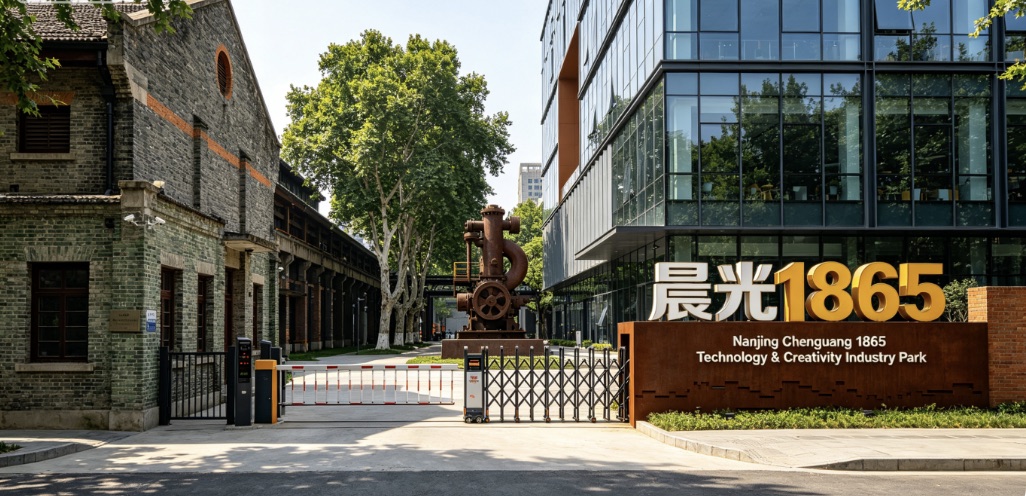
Nanjing 1865 Creative Industry Park sits at 388 Yingtian Avenue, Qinhuai District, beside the Qinhuai River and just outside the Ming city wall. The site was originally the Jinling Arsenal, founded in 1865 by Li Hongzhang, the Viceroy of Liangjiang — one of the earliest modern military-industrial facilities in China, long known as the "cradle of China's national defense industry." The park covers roughly 50,000 square meters and retains 9 Qing-dynasty buildings, 23 Republican-era buildings, and more than 20 industrial structures from the People's Republic period, making it the largest and best-preserved complex of modern industrial architecture in China. As one of the country's four major arsenals, the site produced China's first wheeled Krusen-type breech-loading cannon and its first Maxim single-barrel machine gun. During the War of Resistance Against Japan, the factory relocated to Chongqing and at its peak accounted for 60 percent of national munitions output. After 1949, the factory pivoted to aerospace manufacturing and later gained international renown for casting monumental bronze Buddhist statues — including the Tian Tan Buddha in Hong Kong, the Lingshan Grand Buddha in Wuxi, and the Nanshan Guanyin in Hainan. In 2007, the Chenguang Group transformed the old factory complex into a science and creative industry park, now home to more than 200 companies. The park is a seventh-batch National Key Cultural Relic, a founding member of China's Industrial Heritage list, and a second-batch 20th Century Architectural Heritage of China. It also features on the "New Forty-Eight Scenic Spots of Jinling" list.
Attractions
Qing-Dynasty Industrial Heritage: Jinling Arsenal Exhibition Hall (Main Machine Shop) | Right Machine Shop | Left Machine Shop | Copper Smelting and Rolling Shop | Timber Workshop Building | Heavy Machine Shop
Republican-Era Architecture: Republican-Period Office Building | Sawtooth-Roof Workshop | Old Main Gate
Cultural Landmarks: Anti-War Sculpture | Buddha's Hand Bronze | Central Square and 1865 Steel Numeral Sculpture
Jinling Arsenal Exhibition Hall (Main Machine Shop)
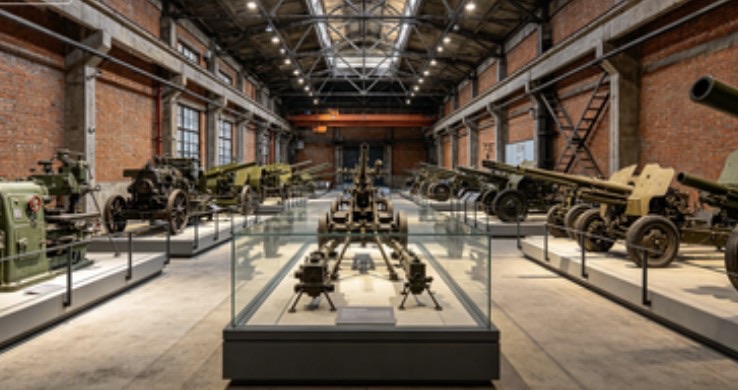
The Jinling Arsenal Exhibition Hall occupies the site of the original Main Machine Shop, built in 1866 — the oldest surviving industrial building in Nanjing. The two-story brick-and-mortar structure features a gabled roof with triangular trusses and exposed brick walls, with a floor area of 912 square meters. It is a rare example of 19th-century British industrial architecture transplanted to China. Inside, the hall presents the full history of the Jinling Arsenal from its founding in 1865: illustrated timelines, a bronze cannon from the 1870s, a reproduction of the 37mm wheeled Krusen-type breech-loader made in 1888, Maxim heavy machine guns, and documents tracing the factory's wartime relocation to Chongqing and its postwar transformation into an aerospace manufacturer. Taken together, the exhibits chart a century in which the fate of a single factory was inseparable from that of the nation.
Right Machine Shop
The Right Machine Shop was built in 1873, making it one of the earliest surviving Qing-dynasty workshops on the grounds, on par with the Main Machine Shop. The two-story brick-and-mortar building has a gabled roof with triangular trusses and a floor area of 919 square meters. Its exterior walls retain the original exposed Qing brickwork, and the semicircular arched windows with brick voussoirs are hallmarks of late-Qing industrial architecture. In 1934, Li Chenggan — then director of the Jinling Arsenal — oversaw an expansion that relocated and faithfully reconstructed the workshop on its current footprint. Today the interior houses a creative design studio; the juxtaposition of a Qing-era structural frame with a contemporary workspace captures the park's guiding philosophy of old and new in dialogue.
Left Machine Shop
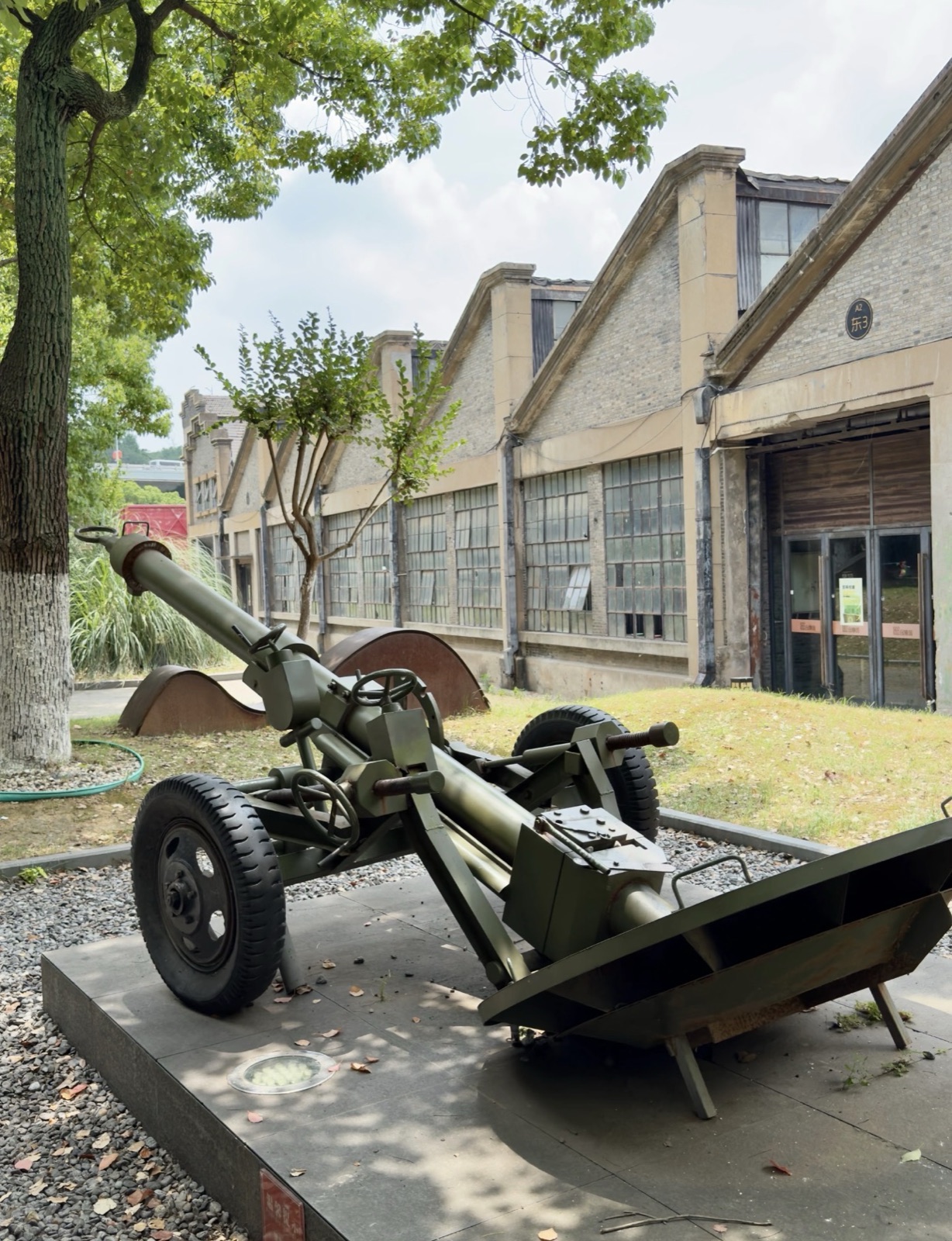
The Left Machine Shop dates to 1879 and shares the same two-story brick-and-mortar construction and 914-square-meter footprint as its neighbors. Together with the Main Shop and Right Shop, it formed the "separate-workshop, interconnected" production layout of the Qing arsenal. Rebuilt on its original plan in 1934 and restored again in 2005, the interior still carries traces of the iron furnace room and sand-casting pits. The building now serves as a creative exhibition space displaying artifacts such as an 82mm mortar produced during the Second World War and a 120mm heavy mortar successfully prototype-tested in 1944. The original Qing structural frame and the modern military-industrial relics side by side trace a hundred years of weapons technology evolution.
Copper Smelting and Rolling Shop
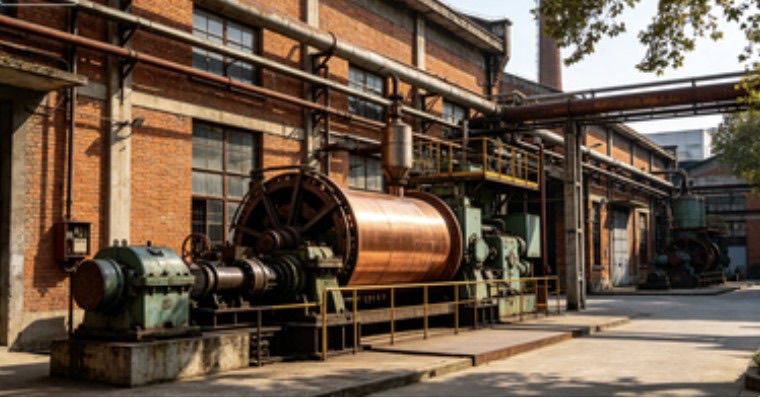
Built in 1881, this building is the most complete and visually striking single structure among the park's Qing-dynasty ensemble. It measures 40.2 meters long by 13.2 meters wide and features a grey-tile hipped roof with a central ventilation ridge that addresses both light and airflow. The exterior walls are exposed red brick, every window and door opening finished with a semicircular arch and ornamental brick voussoir — a superb example of 19th-century British industrial design fused with Chinese brickwork traditions. The arched windows and the historic murals of shell-production processes still visible on the walls have made this the park's most photographed backdrop. In the slanted light of a mid-afternoon sun pouring through the arches, the interplay of shadow and warm brick is at its most photogenic.
Timber Workshop Building
Built in 1886, originally called the Woodwork Factory, the Timber Workshop Building covers 846 square meters. It pairs a square pyramidal-roofed wing on the east with a hipped-roof wing on the west — a purpose-built shop for crafting the wooden components of weapons: gunstocks, gun carriages, and artillery frames. The original exposed brick walls survive, and the building's silhouette stands out among the park's structures: the combination of a pyramidal and a hipped roof breaks the monotony of standard industrial sheds and illustrates how even late-Qing military-industrial architecture could balance function with a degree of architectural character.
Heavy Machine Shop
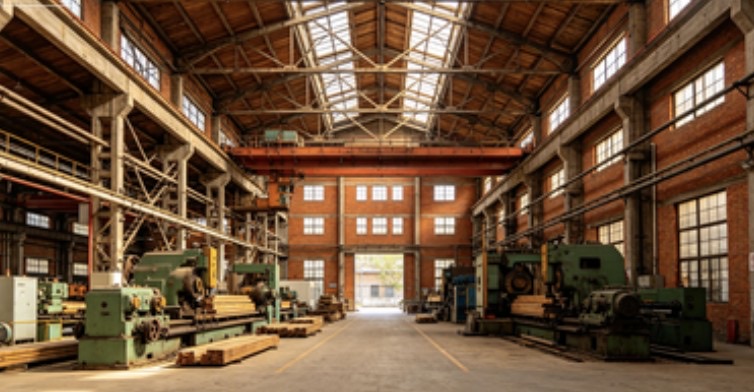
Also dating to 1886, the Heavy Machine Shop is the largest of the park's Qing-dynasty workshops. The two-story timber-and-brick hybrid structure is 47.74 meters long, 16.14 meters wide, and 8.97 meters to the eaves, with a floor area of 1,584 square meters. An 18-meter-span gabled timber roof frame rests on brick walls nearly 80 centimeters thick; the truss joints use metal connectors laced with iron tension rods, representing the most advanced timber-structure technology in Chinese industrial construction of the late 19th century. The corner stones at each of the four corners stand over one meter high — a defensive design feature — and the second-floor timber planks, each 30 centimeters wide and 8 centimeters thick, remain perfectly intact after 160 years. They are a tangible measure of the quality standards Li Hongzhang imposed when he specified that his factories be built "in the Western manner."
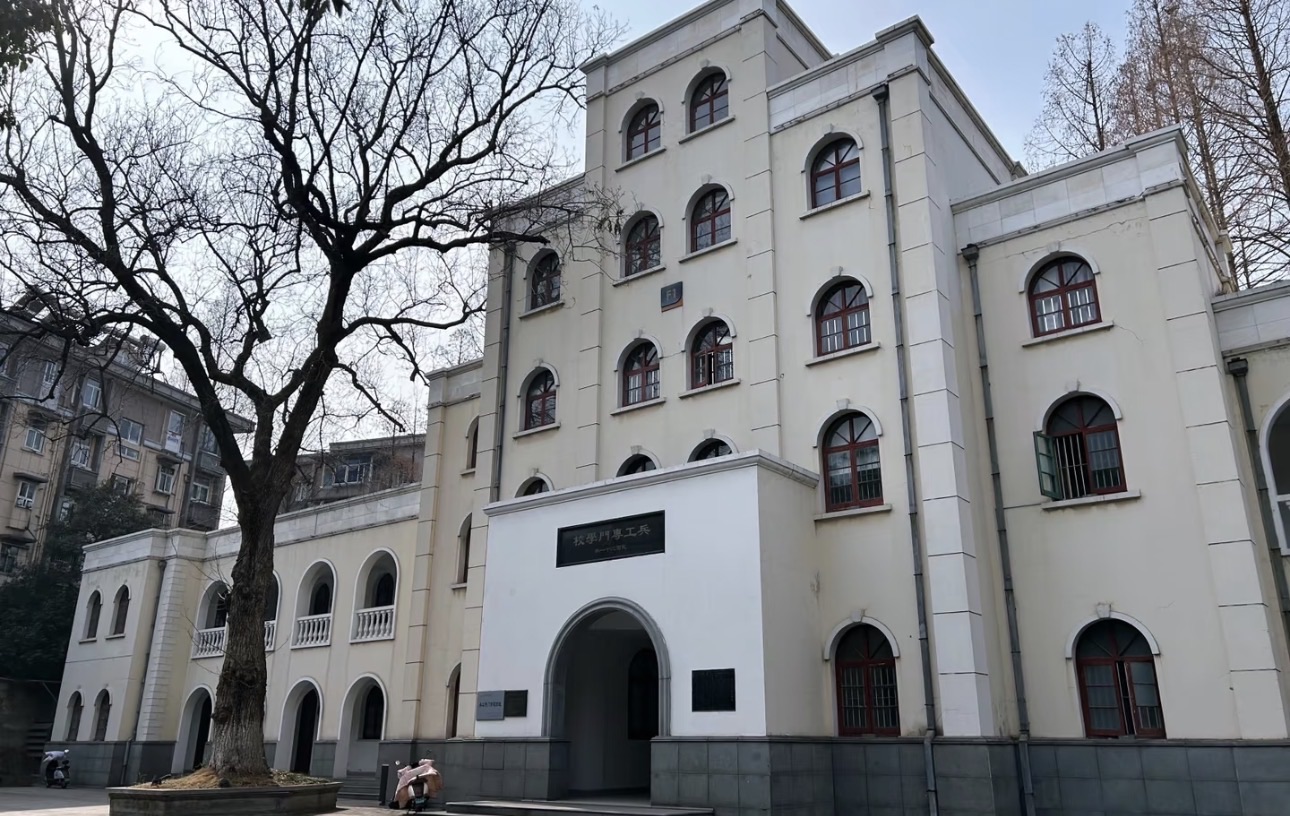
Republican-Period Office Building
Built in 1934 during Director Li Chenggan's expansion of the Jinling Arsenal, this two-story building served as the administrative nerve center of the factory. Its pseudo-European brick-and-mortar construction features light-plastered exterior walls and a plain entrance portico. The original wooden staircase is still in daily use; every creak of the treads feels like a record of the footsteps of factory managers who climbed them decades ago. Li Chenggan was a Japan-educated engineer-administrator who during his tenure added more than 50,000 square meters of workshop space and introduced standardized production, lifting the Jinling Arsenal to the front rank of national munitions manufacturers. The building now houses technology firms and stands as a model of the park's principle that preservation and productive use go hand in hand.
Sawtooth-Roof Workshop
Built in 1936, this workshop is the most architecturally inventive industrial legacy of Li Chenggan's directorship. Its defining feature is the roofline: a continuous series of sawtooth ridges, each vertical face glazed with a strip of skylights that channel natural light deep into the interior without allowing direct sunlight to fall on precision machining surfaces. The solution drew on early-20th-century European industrial optical research and was exceptionally rare in modern Chinese industrial architecture. The workshop is now occupied by the Jinling Smart Manufacturing Research Institute; the inspection robots developed here — some of which contributed to quality control during the manufacture of the C919 commercial aircraft — roll slowly along tracks once worn by machine tools. The century-old building and cutting-edge technology share the same floor, forming the park's most eloquent temporal cross-section.
Old Main Gate
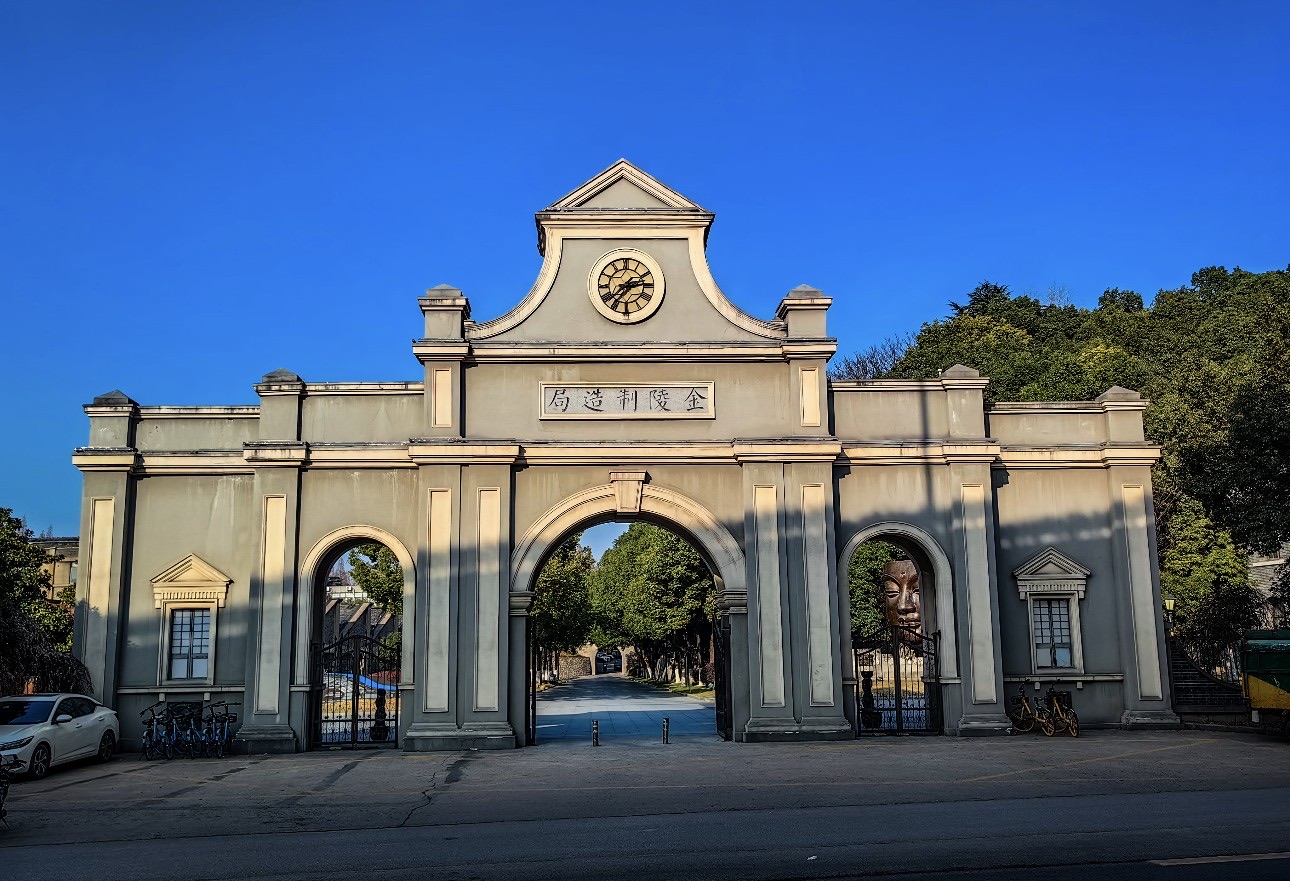
The Old Main Gate stands at the southern Chenguang Road entrance, on the original site of the front gate of the Jinling Arsenal. The stone lintel bears the carved inscription "Jinling Zhizao Ju" (Jinling Manufacturing Bureau), and the grey-brick pillars on either side preserve their original masonry. In front of the gate, a bronze sculpture vividly recreates a scene from a century ago: two workers bent forward, pushing a cart loaded with artillery shells along a rail track — a freeze-frame of the arsenal's daily rhythm. The Old Main Gate is the starting point of the park's timeline; passing through it, Qing-dynasty workshops, Republican-era office buildings, and the sawtooth-roofed machineshop unfold in sequence, forming an architectural corridor that spans three centuries.
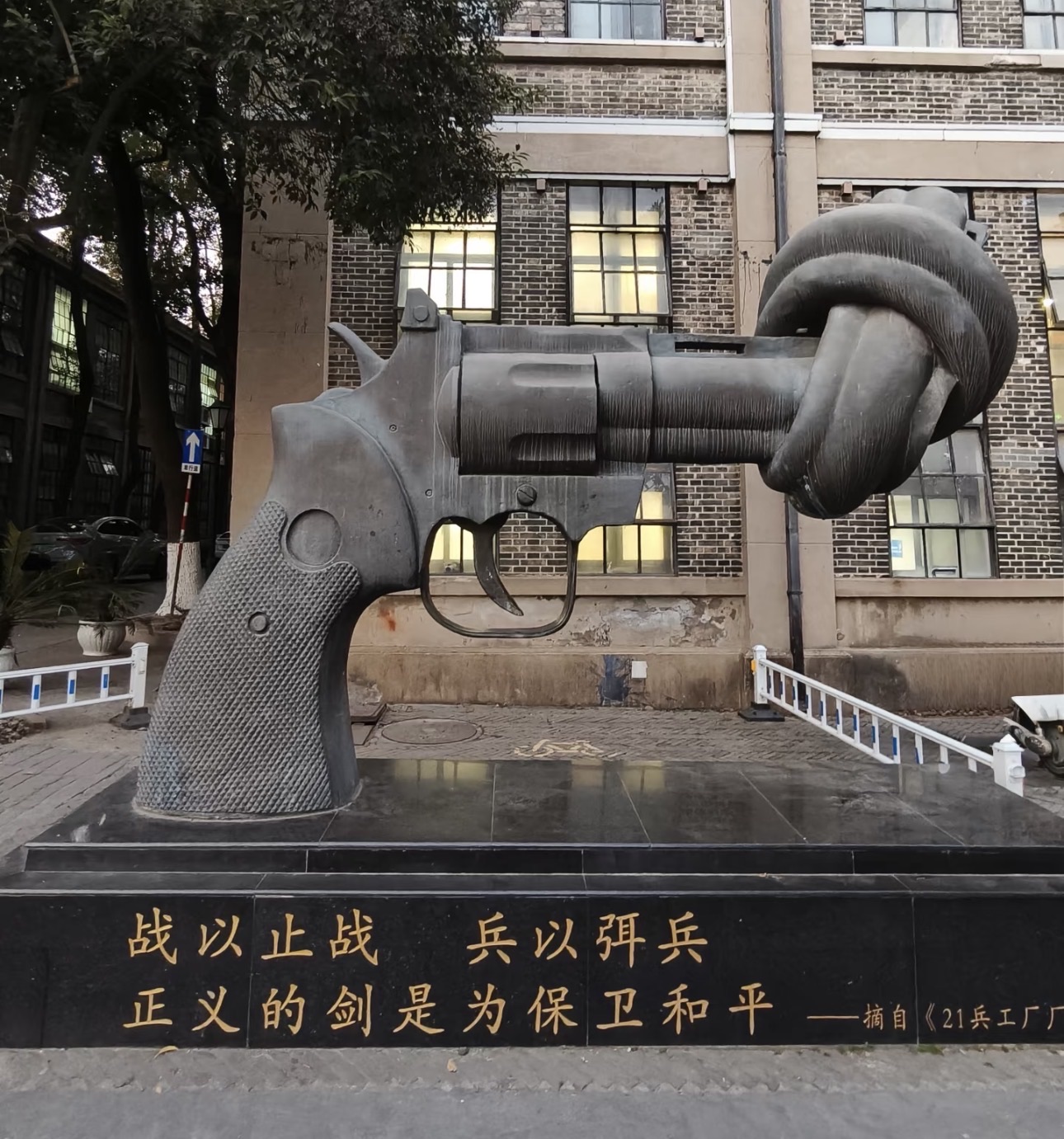
Anti-War Sculpture
In the park's northwest corner stands a sculpture of a pistol with its barrel tied in a knot — a motif that echoes the "Non-Violence" knotted-gun sculpture gifted by Luxembourg to the United Nations garden in New York in 1988. This one, however, carries its own inscription on the base: "War to end war, weapons to silence weapons — the sword of righteousness exists to defend peace." Those words come from the factory anthem of the Jinling Arsenal, with lyrics by Guo Moruo and music by He Lvting, two giants of modern Chinese literature and music. The song was written in the fire of the War of Resistance: the same people who manufactured the weapons that held the front lines also sang of the peace those weapons were meant to protect. That the factory which cast cannons later cast Buddhas, and that the factory which made guns now stands an anti-war sculpture on its own grounds — this arc of transformation gives the park a human depth that goes well beyond industrial heritage.
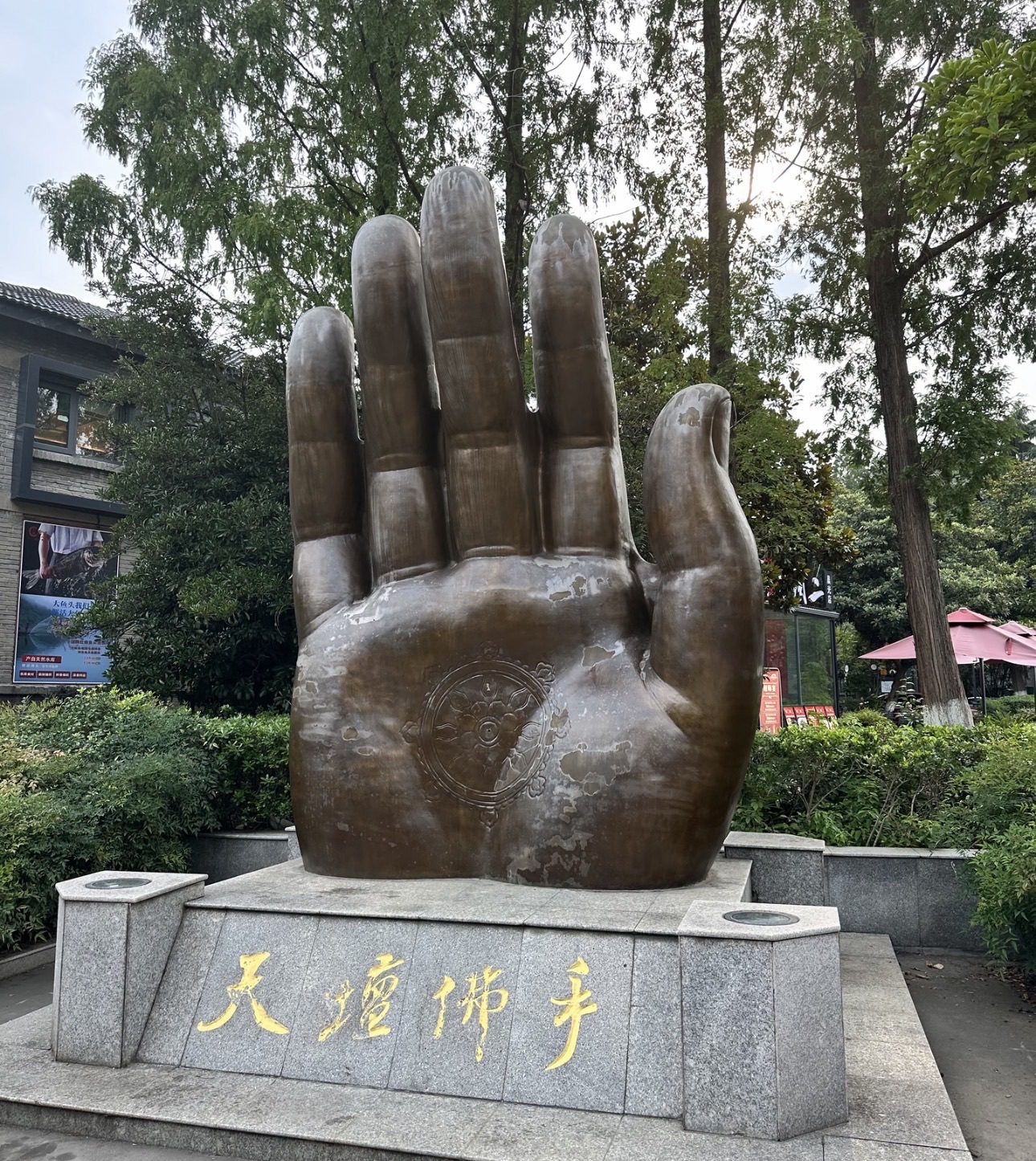
Buddha's Hand Bronze
At the western end of the park, beside Yanghu Lane, a monumental bronze hand rises from the ground. It is not a standalone artwork but a casting-trial twin of the Tian Tan Buddha in Hong Kong, produced in 1989 using identical materials and techniques to test the foundry process before the main statue was cast. The Tian Tan Buddha stands 34 meters tall and weighs 250 tons — the world's tallest outdoor bronze seated Buddha — and was manufactured by the Nanjing Chenguang Machinery Factory. The same precision casting expertise that had once produced artillery barrels proved equally suited to producing monumental religious art. The factory went on to cast the 88-meter Lingshan Grand Buddha in Wuxi and the 108-meter Nanshan Guanyin statue in Hainan, earning it the title of "China's foremost foundry of bronze Buddhist statues." The Buddha's Hand is the concentrated symbol of that legend of transformation: from manufacturing destruction to casting devotion, within the walls of a single factory.
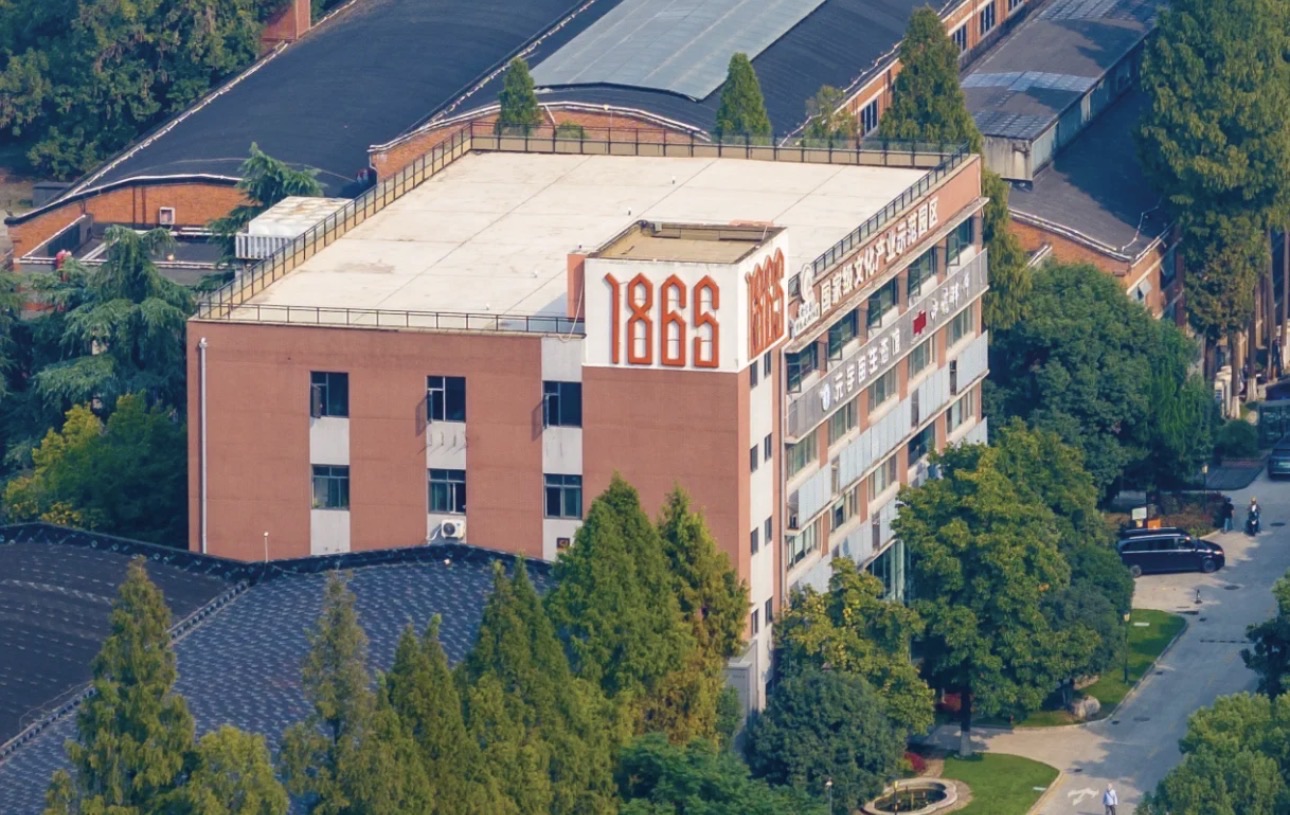
Central Square and the 1865 Steel Numeral Sculpture
The Central Square is the park's main public gathering space. Weekends bring creative markets to the square — handcrafted leather goods, original illustrations, independent-designed clothing. On one side towers the giant "1865" numeral sculpture, fabricated from weathering steel whose rusted surface is a deliberate celebration of industrial texture. Scattered around the square are steam-punk pipe installations and mural walls, where the raw weight of century-old red brick meets the vivid colors of contemporary street art in a charged visual conversation. The E12 exhibition hall hosts rotating shows on industrial-themed art year-round, one of the park's most representative spaces for contemporary art practice within a historic shell.
9 stops, in walking order — read top to bottom, no clicking needed.

 2
 3
 4
 5
 6
 7
 8
 9