Travel Guide› Chongqing› Dazu Rock Carvings
Chongqing · Temple & shrine

Dazu Rock Carvings 大足石刻

Dazu Rock Carvings
Address
Baoding Town, Dazu District, Chongqing (Baodingshan Rock Carvings); Longgang Street, Dazu District, Chongqing (Beishan Rock Carvings)

Overview of Dazu Rock Carvings

The Dazu Rock Carvings are located in Dazu District, Chongqing, and refer collectively to a group of cliff sculptures centered on Buddhist themes. Construction began in the first year of the Yonghui era of the early Tang dynasty (650 AD) and continued through the late Tang, the Five Dynasties, and into its peak during the Northern and Southern Song dynasties, with later work extending through the Ming and Qing periods — a span of more than a thousand years. Rooted in the rich cultural soil of the Ba-Shu region, the Dazu Rock Carvings absorbed and refined the artistic achievements of earlier cave temples, then pushed beyond them to open entirely new ground. Their distinctively national, secular, and everyday character established them as the defining model of cave art with a Chinese identity, representing the highest level of rock-carving art in the world between the 9th and 13th centuries.

The Dazu Rock Carvings illuminate, from multiple angles, the significant developments and shifts in cave art style and popular religious belief during the Tang and Song periods. They contributed fundamentally to the innovation and evolution of Chinese cave art, and hold irreplaceable historical, artistic, scientific, and aesthetic value that no earlier period of cave carving can match. As the final great monument in the history of Chinese cave art, Dazu stands alongside Dunhuang, Yungang, and Longmen to form a complete history of that tradition. On May 8, 2007, the Dazu Rock Carvings scenic area was designated a National 5A Tourist Attraction by China's National Tourism Administration. In 2025, all five mountains of the Dazu Rock Carvings — Baoding Mountain, Beishan, Nanshan, Shimenshan, and Shizhuanshan — were opened to visitors for the first time simultaneously, offering a richer and more varied experience of the stone-carving art.

Sub-attractions Within the Scenic Area

The Dazu Rock Carvings scenic area includes the following sites:

  • Baoding Mountain Scenic Area
  • Beishan Scenic Area
  • Nanshan Scenic Area
  • Shimenshan Scenic Area
  • Shizhuanshan Scenic Area
  • Dazu Rock Carvings Museum

Attraction Descriptions

Baoding Mountain Scenic Area

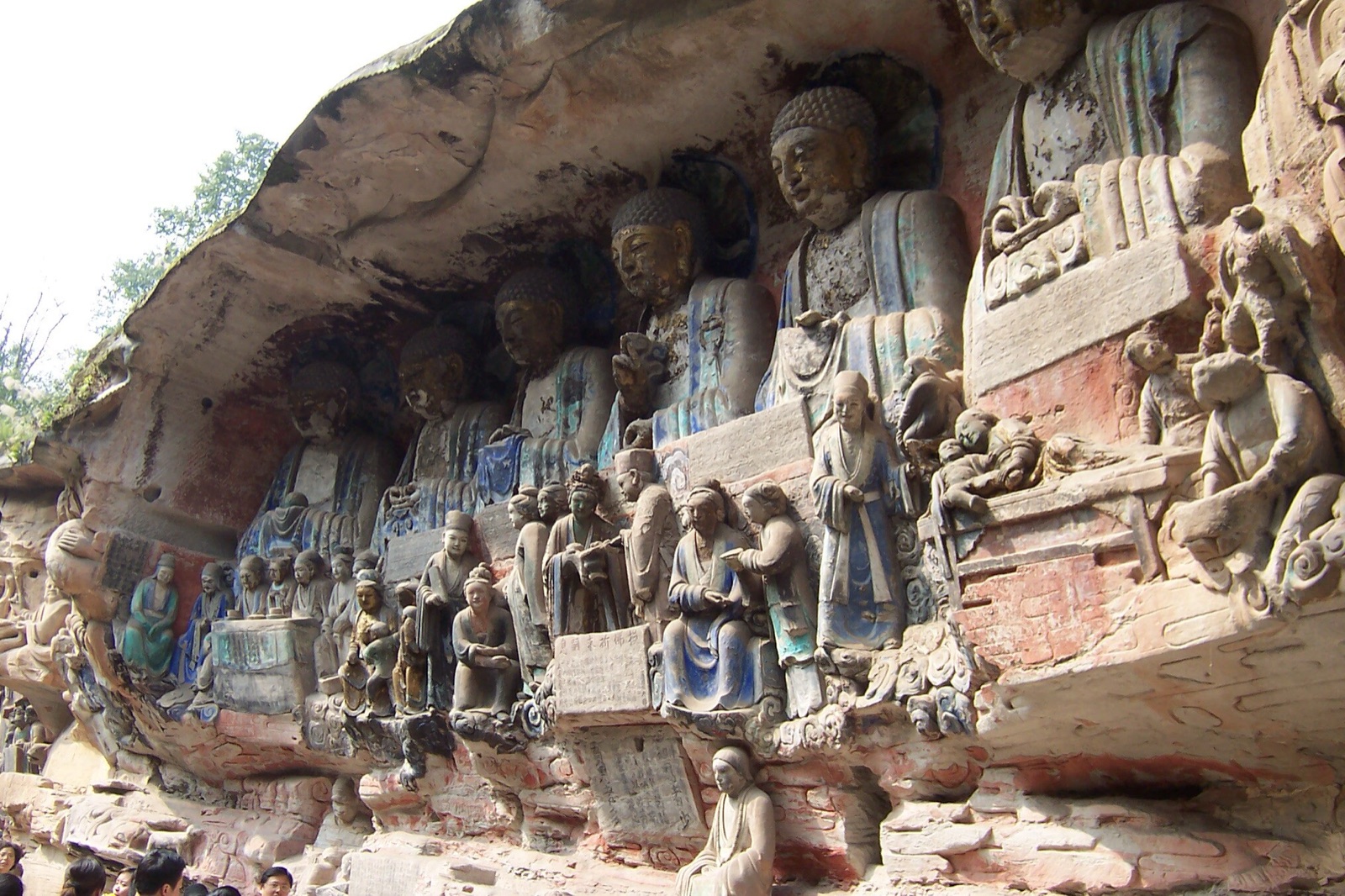
The Baoding Mountain rock carvings are centered on Dafo Bay and form a large-scale Esoteric Buddhist cave complex commissioned by the Southern Song dynasty monk Zhao Zhifeng during the Chunxi to Chunyou reign periods (1174–1252 AD). The cliff sculptures at Baoding Mountain were conceived and executed as a unified whole; the site is immense, with nearly ten thousand individual figures, and stands as one of the representative masterworks of late Chinese cave art.

The cliff face at Dafo Bay stretches roughly 500 meters long and 8 to 25 meters high, shaped like a U-form valley with carvings cut into three cliff walls — east, south, and north — grouped into 31 numbered sections. Every sculpture is accompanied by inscribed texts; most of these inscriptions diverge from standard canonical editions, and many are Buddhist documents never included in any edition of the Tripitaka, giving them exceptional scholarly value. The subjects at Baoding Mountain are never repeated: each niche is both doctrinally linked to its neighbors and formally connected to the next, forming an organic whole that reads like a sweeping historical panorama.

Beishan Scenic Area

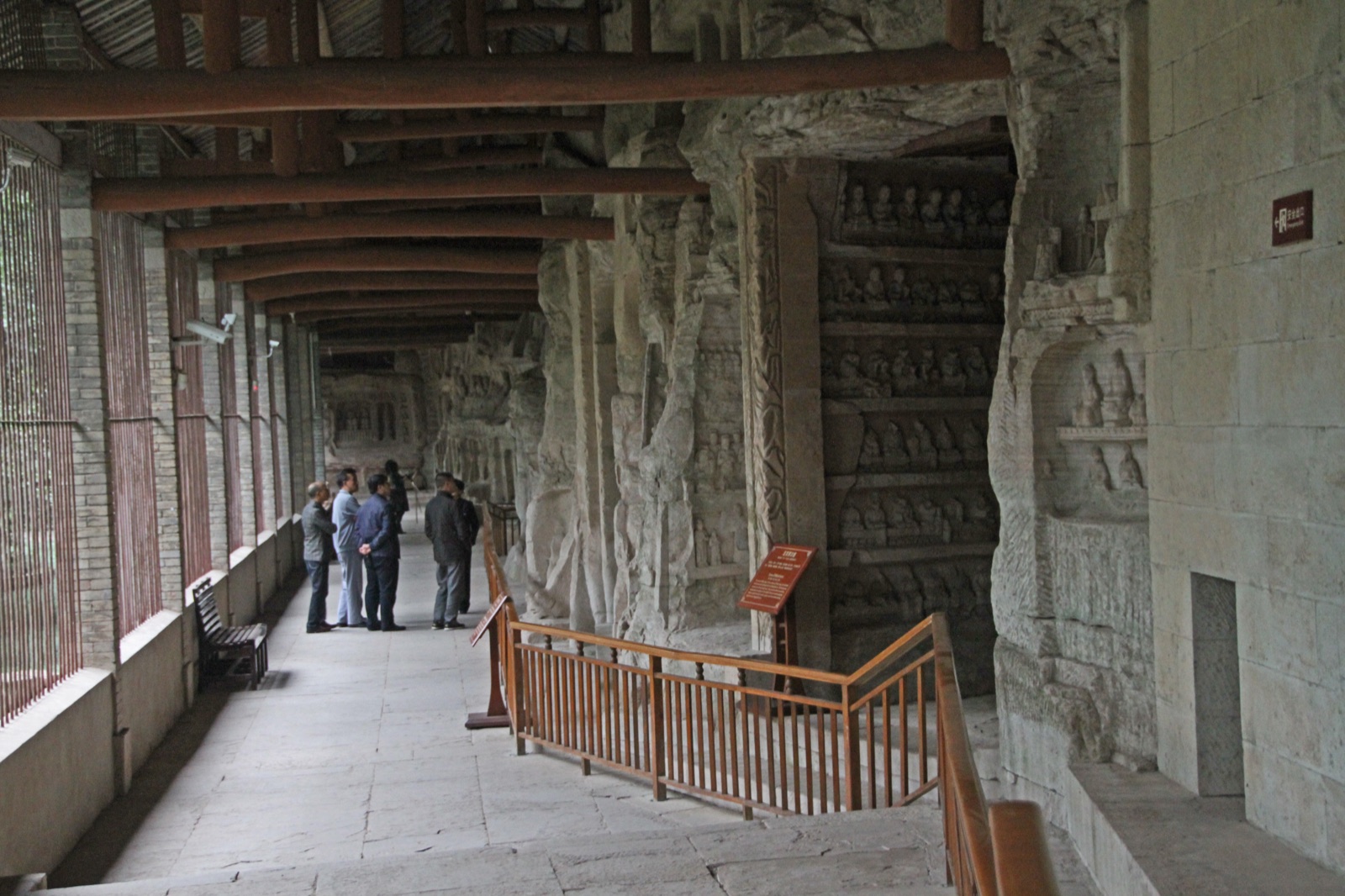
The Beishan rock carvings stand on the summit of Beishan, about 2 kilometers north of Dazu's urban center. Carving began in the first year of the Jingfu era of the Tang dynasty and continued through the Shaoxing reign of the Southern Song (892–1162 AD), spanning nearly 300 years. The carved cliff face runs roughly 300 meters long and 7 to 10 meters high; nearly ten thousand figures survive, drawn from 51 subjects, with Esoteric Buddhism predominating — a character quite different from China's earlier cave sites.

Beishan is celebrated worldwide for the refinement and elegance of its carvings, the clarity of their period style, the delicacy of the workmanship, the supreme technical skill, and the exceptional state of preservation. It has been called "a pearl on the crown of Chinese cave art." Niche 136, the Revolving Sutra Repository Cave, is the jewel and exemplar of Song-dynasty stone carving: the cave is 4 meters high, 4.7 meters wide, and 7 meters deep, and its figures — Manjushri, Samantabhadra, Jade-Seal Guanyin, Sun-and-Moon Guanyin, Wish-Granting Guanyin, and Rosary Guanyin, among others — display willowy grace, exquisitely rendered garments, lovely features, and an air of quiet dignity that is universally acknowledged as among the finest and most elegant sculpture in all of Chinese cave art.

Nanshan Scenic Area

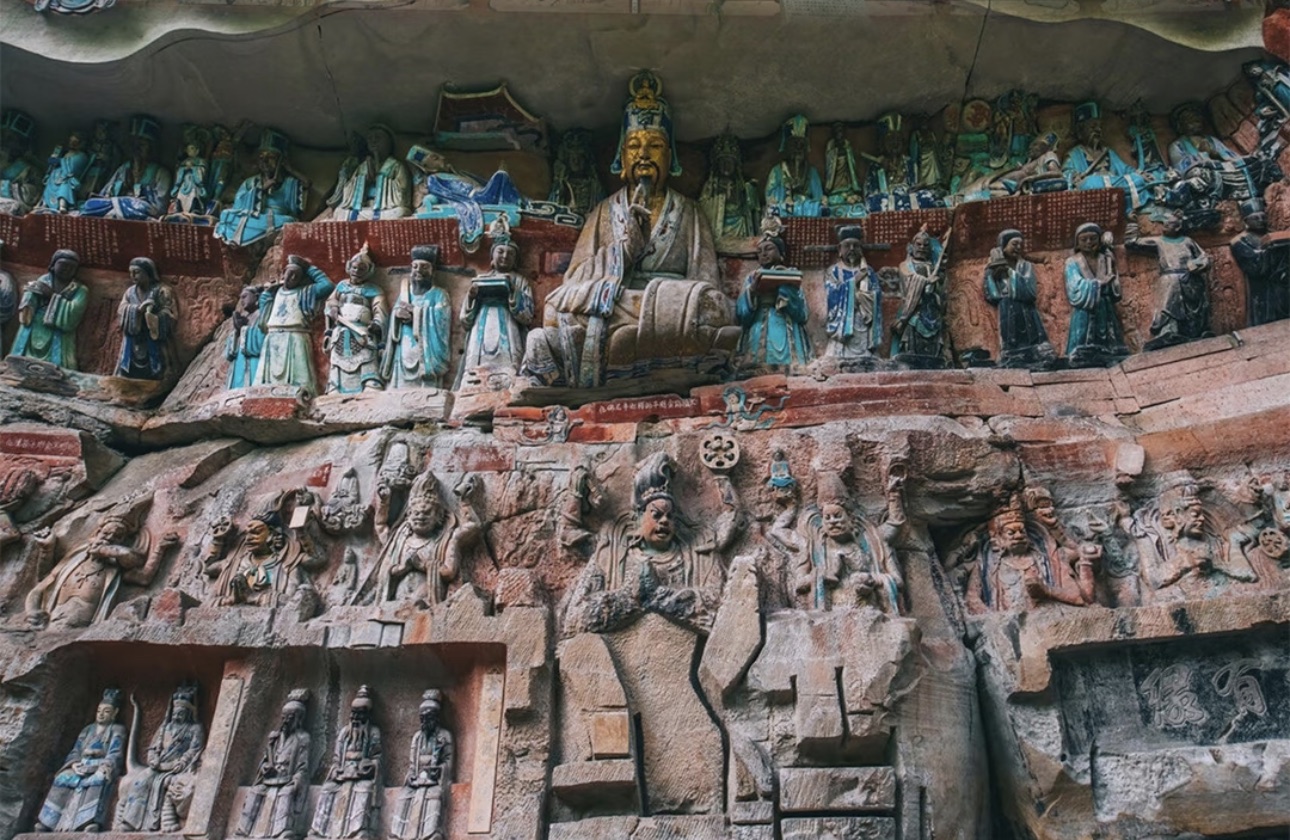
The Nanshan rock carvings, once known as Guanghua Mountain, sit on the summit of Nanshan about 2 kilometers south of Dazu's urban center. They were carved during the Shaoxing reign of the Southern Song (1131–1162 AD) and constitute the most finely carved and most complete Daoist sculptural complex from that period in China.

The carved cliff at Nanshan runs more than 80 meters long and 3 to 10 meters high, grouped into 15 numbered sections. The principal subjects are Daoist: the Shrine of Zhenwu the Supreme Emperor of the Dark Heaven, the Shrine of Houtu the Sacred Mother of Earth, the Cave of the Three Purities, the Dragon Cave, and others. The Cave of the Three Purities alone contains 421 figures, arraying the full hierarchy of the Daoist pantheon from the Three Purities and Four Sovereigns down to the 360 Heavenly Worthies — a vivid record of how, by the 12th century, Daoism had evolved from early veneration of Laojun and the Three Officials into a systematically ranked faith centered on the Three Purities and Four Sovereigns.

Nanshan's footprint is modest, but the richness of its imagery and its scholarly character are remarkable: it holds 5 Song stelae, 7 inscriptions, 15 Qing stelae, and one set of couplets each from the Qing and Republican periods. Its sculptural style is distinctive — finely carved, true to life, blending the solemn authority of divinity with the vitality of human expression — and occupies a singular place in Chinese stone-carving art.

Shimenshan Scenic Area

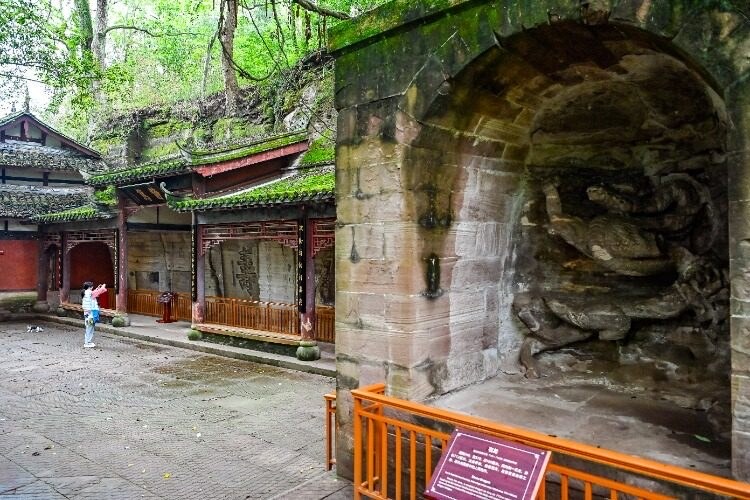
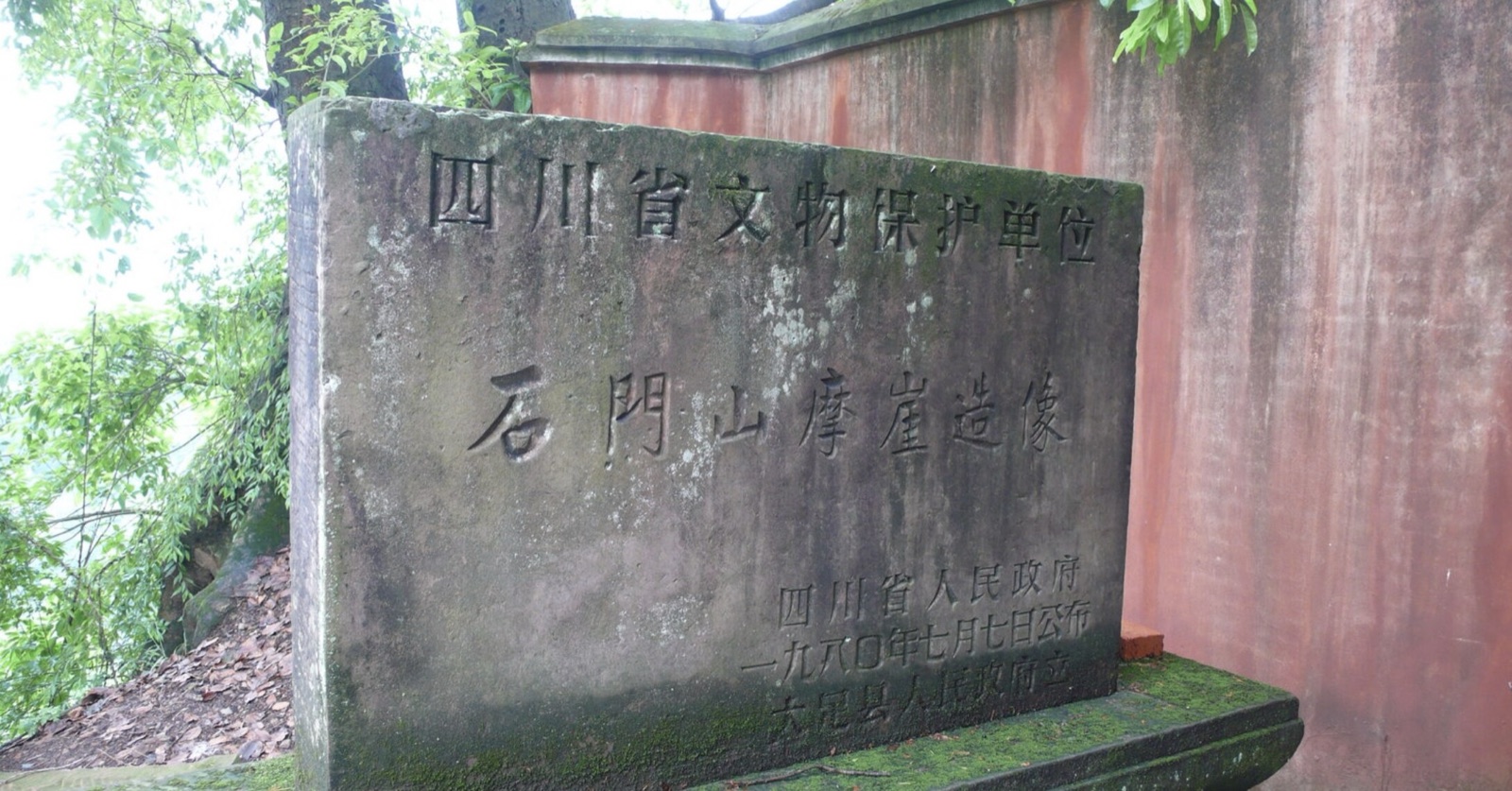
The Shimenshan rock carvings are located in Shimen Village, Shima Town, 20 kilometers east of Dazu District. The site takes its name from the two massive stone faces that rise opposite each other like a pair of great stone gates. Carving spanned from the first year of the Shaosheng era of the Northern Song to the twenty-first year of the Shaoxing era of the Southern Song (1094–1151 AD). The site is a rare example in Chinese stone-carving art of Buddhist and Daoist imagery coexisting within a single space, and the Daoist figures are its most distinctive feature.

The carved cliff at Shimenshan runs 71.8 meters in total length and stands 3.4 to 5 meters high, grouped into 16 numbered sections with 12 niches and caves containing 268 individual figures. Outside Niche 2, the shrine of the Jade Emperor, stand figures of Thousand-League Eye and Wind-Receiving Ear with powerful, muscular bodies, prominent veins, and boldly exaggerated forms that project an unstoppable force. Niche 7, the one-legged Wutong Dadi, stands on a single foot atop a wind-and-fire wheel — broad forehead, deep-set eyes, wide mouth and thick lips, robes and sashes billowing — every inch the image of a god who comes and goes like the wind.

The sculptural style at Shimenshan is strikingly varied: no two figures are alike, the subjects range widely, and the site as a whole provides rich physical evidence for the study of the intellectual history, philosophical history, and popular religious beliefs of Song-dynasty China — particularly the fusion of Buddhism and Daoism.

Shizhuanshan Scenic Area

Shizhuanshan lies in Fohui Village, Sanqu Town, 25 kilometers southwest of Dazu District. Carving ran from the fifth year of Yuanfeng to the third year of Shaosheng in the Northern Song (1082–1096 AD); the mountain stands at an elevation of 444.6 meters. Shizhuanshan is the earliest site in China where Confucian, Buddhist, and Daoist sculptures were brought together in a single space — an extraordinarily rare phenomenon in the history of cave art.

The carved cliff at Shizhuanshan stretches roughly 130 meters, and the surviving figures number in the several thousands. Among the well-preserved niches are the Earth Treasury Bodhisattva figure, the Cave of Laojun, the Three-Age Buddha Cave, the Cave of Wenzuan Wang, the Manjushri Cave, and the Lu Ban Cave. Niche 6 is the Shrine of Confucius and the Ten Wise Disciples: the central wall bears a seated figure of Confucius, the great Chinese thinker and founder of Confucianism, flanked on both side walls by his ten most celebrated disciples — an exceptionally rare subject in all of China's cave-carving tradition.

The Shizhuanshan carvings are grouped into 10 numbered sections, rich in content and diverse in subject. From one angle they record the crucial historical reality of mutual tolerance and convergence among Song-dynasty religious cultures. They are a singular flowering in the garden of Chinese cave art, carrying exceptional historical, artistic, and philosophical value.

Dazu Rock Carvings Museum

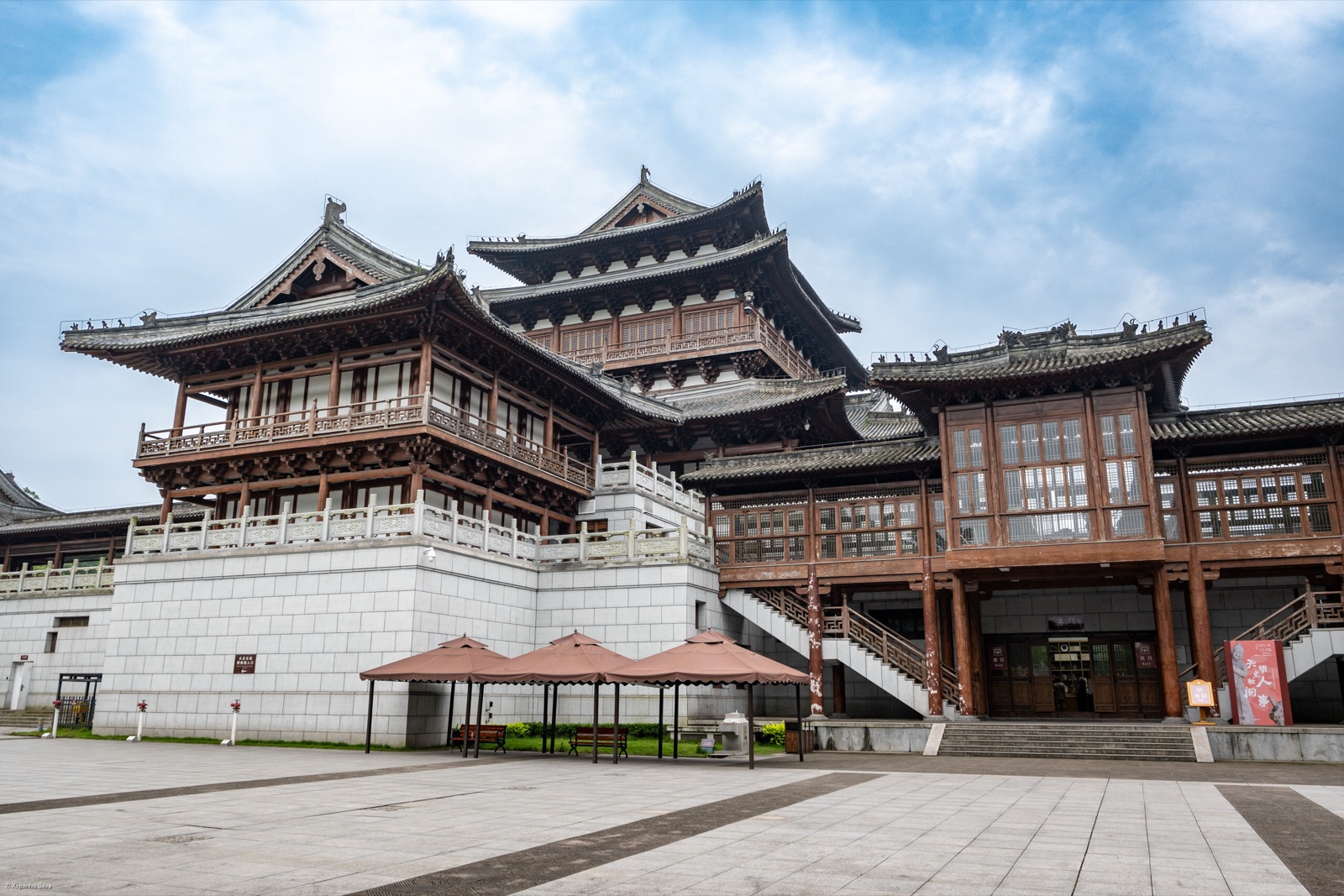
The Dazu Rock Carvings Museum is housed within the visitor center of the Dazu Rock Carvings scenic area. It is a major showcase for Chinese cave art and an essential window onto the history, artistry, and cultural significance of the Dazu carvings.

The museum's galleries display precious artifacts, high-fidelity replica sculptures, and documentary materials, offering a systematic introduction to the history of the carvings' creation, their artistic character, and their cultural value. The museum also houses a digital cinema showing the 4K film "Tianxia Dazu" and the 8K dome film "Dazu Rock Carvings," which use modern digital technology to let visitors experience the cave sculptures, mountain landscapes, and starry skies from multiple angles and in full panorama — conveying the artistic power of carvings scattered across remote hills that are rarely accessible in person.

The museum additionally features the "One Grain of Sand, One World" creative video installation, which uses point-cloud data from three-dimensional models of the cave sculptures and projects them from multiple angles, giving the art an entirely new mode of presentation and vitality. Through large-scale digital scanning and true-to-life 3D modeling, visitors can experience a one-to-one recreation of the site and appreciate the unique charm of a thousand years of cave art from every direction.

Practical info Opening hours · Allow · Ticket · Getting there
Opening hours
  • Baodingshan Rock Carvings: 08:30-18:00 (last entry at 17:00)
  • Beishan Rock Carvings: 08:30-17:30 (last entry at 16:30)
  • Note: Allow 3-4 hours for Baodingshan Rock Carvings; 1.5-2 hours for Beishan Rock Carvings
Allow
  • Note: Allow 3-4 hours for Baodingshan Rock Carvings; 1.5-2 hours for Beishan Rock Carvings
Ticket
  • Baodingshan Rock Carvings: Peak season (March-November) 115 RMB/person; Off season (December-February next year) 100 RMB/person
  • Beishan Rock Carvings: Peak season (March-November) 70 RMB/person; Off season (December-February next year) 50 RMB/person
  • Combo Ticket (Baodingshan + Beishan + Baodingshan Museum): Peak season 140 RMB/person; Off season 120 RMB/person
  • Discounted Tickets: Students, seniors, military personnel, etc. can enjoy half-price or free admission with valid ID
  • Note: It is recommended to purchase a combo ticket to visit both Baodingshan and Beishan core scenic areas at once
Getting there
  • From Chongqing urban area:
    • Bus: Take a bus from Chongqing Caiyuanba Bus Station or Chenjiaping Bus Station to Dazu District, about 2.5 hours, fare about 45 RMB; after arriving in Dazu, transfer to bus or taxi to the scenic area
    • High-speed Rail: Take the Chengdu-Chongqing High-speed Railway to Dazu South Station, about 1 hour; after arrival, transfer to bus or taxi to the scenic area (about 30 minutes)
    • Driving: Drive along the Chongqing-Chengdu Expressway (G5013) to the Dazu exit, follow signs to the scenic area, about 2 hours
  • Within the scenic area: The distance between Baodingshan and Beishan is about 15 kilometers; you can take the scenic area shuttle bus (about 20 RMB/person)

Inside Dazu Rock Carvings

6 stops, in walking order — read top to bottom, no clicking needed.

1 Baoding Mountain of 6

Baoding Mountain

宝顶山

: / Baoding Village, Baoding Town, Dazu District, Chongqing

:() 145 /(2024 );60—64 ,65 ;1.2 ; / Baoding Mountain ticket (incl. Dazu Rock Carvings Museum) CNY 145 (joint ticket since 2024); seniors 60–64 half price, 65+ free; children under 1.2 m free; students with ID half price

: 08:30—18:00(17:30 ,18:00 ); / Daily 08:30–18:00 (last ticket 17:30, last entry 18:00); closed on Lunar New Year's Day

:①——:/, 205 ;②——:, 30 ;③: / (1) Coach from Caiyuanba/Chenjiaping Bus Station to Dazu, then bus 205 to Baoding; (2) Chengdu–Chongqing HSR to Dazu South Station, then 30-min shuttle or taxi; (3) From Chengdu: same HSR route

On-site narration · read it where you stand

Welcome, everyone! You have arrived at the Dazu Rock Carvings — a UNESCO World Heritage Site and National 5A Tourist Attraction. Today I'll be guiding you along a route that takes us from the visitor center to the digital cinema, the museum, Dafo Bay, and finally Shengshuo Temple, as we explore the final great monument in the history of Chinese cave art.

The Dazu Rock Carvings date back to the early Tang dynasty and span more than a thousand years of history, representing the highest level of cave art in the world between the 9th and 13th centuries. This is a monumental complex that brings together Confucian, Buddhist, and Daoist imagery, centered on Dafo Bay at Baoding Mountain and created under the direction of the Southern Song dynasty monk Zhao Zhifeng. The Dazu Rock Carvings are celebrated for their distinctively national, secular, and everyday character — the defining model of cave art in a Chinese style. Before we set off, I recommend catching one of the digital films shown at the cinema inside the scenic area — it will give you a strong sense of the historical context and artistic significance of what you're about to see.

We're now at the digital cinema, where two films are showing: the 4K film "Tianxia Dazu" and the 8K dome film "Dazu Rock Carvings." Both combine live footage with CG animation to bring the artistic world of the carvings to life. Lean back in the reclining seats with your field of vision wide open, and let the play of light and imagery carry you into the cultural depths behind the Dazu Rock Carvings.

The films feature cave sculptures rarely accessible in person — works tucked away in remote hills, including the Thousand-Hand Guanyin and the Reclining Buddha in Dafo Bay at Baoding Mountain. These productions represent a fresh approach to sharing the Dazu heritage with a wider audience and a creative experiment in smart tourism. As you watch, pay particular attention to how the films introduce key pieces like the Thousand-Hand Guanyin and the Reclining Buddha — it will enrich your visit to the actual sites that follow.

We've arrived at the Dazu Rock Carvings Museum, an essential window onto the history, artistry, and cultural significance of the carvings. The galleries display precious artifacts, high-fidelity replica sculptures, and documentary materials, offering a systematic introduction to the creation history, artistic character, and cultural value of the site.

Please note that the museum is closed on Mondays. During your visit you'll see faithful reproductions of landmark figures from the Dazu collection, including the Thousand-Hand Guanyin and the Reclining Buddha. These replicas are made using high-precision technology and are designed to be assembled, disassembled, and transported with ease. You'll also encounter reproductions of carvings that are normally inaccessible, tucked away in remote mountain locations.

Inside the museum, look for the "One Grain of Sand, One World" creative video installation, which uses point-cloud data from three-dimensional models of the cave sculptures and projects them from multiple angles, giving the art an entirely new kind of presence and vitality. Take a little extra time here — there's a lot to absorb.

We're about to enter the heart of the Dazu Rock Carvings — Dafo Bay at Baoding Mountain. This is a large-scale Esoteric Buddhist cave complex commissioned by the Southern Song dynasty monk Zhao Zhifeng during the Chunxi to Chunyou reign periods (1174–1252 AD). The cliff face at Dafo Bay stretches roughly 500 meters long and 8 to 25 meters high, shaped like a U-form valley with carvings cut into three cliff walls — east, south, and north — grouped into 31 numbered sections.

The sculptures of Dafo Bay illuminate, from multiple angles, the major developments and shifts in cave art style during the Tang and Song periods. Every figure is accompanied by inscribed texts; most of these inscriptions diverge from standard canonical editions, and many are Buddhist documents never included in any edition of the Tripitaka, making them invaluable for Buddhist textual scholarship. The subjects at Baoding Mountain are never repeated: each niche is doctrinally linked to its neighbors while connecting to the next in form, creating an organic whole that reads like a sweeping historical panorama.

Before you enter Dafo Bay, a few important reminders: flash photography is strictly prohibited inside, to protect these precious carvings. The sculptures are densely arranged throughout the bay, so please follow the directional signs and work through the major highlights in order.

In front of you is Niche 1 of Dafo Bay — the Acts of Liu Benzun. Liu Benzun was a patriarch of Esoteric Buddhism who practiced here. This is the opening passage of the entire Dafo Bay sequence and Zhao Zhifeng's first statement of intent in spreading the Buddhist dharma.

The Acts of Liu Benzun carves out the story of how Liu Benzun practiced and taught throughout the Ba-Shu region. Taking Liu Benzun as his model, Zhao Zhifeng merged Esoteric Buddhist practice with the rhythms of ordinary life and forged a distinctive style of Buddhist culture in the process. The carvings use high-relief technique; the figures are vivid and true to life, the scenes varied and rich, and the ensemble paints a picture of how Esoteric Buddhism developed in China during the Southern Song period.

As you look at this niche, pay attention to Liu Benzun's robes and posture — both reflect the style of a Song-dynasty master in practice. You'll also notice scenes of disciples traveling alongside him, capturing the communal and lineage-based nature of Buddhist cultivation.

We're now at Niche 4 of Dafo Bay — the Scenes of Hell. This is a group of carvings illustrating the Buddhist principle of karmic retribution, rendered across 132 scenes that show the different fates awaiting people after death according to the good or evil they did in life.

The Scenes of Hell formed a key part of Zhao Zhifeng's program for spreading Buddhist teaching at Baoding Mountain. The aim was to use visually arresting imagery to warn people to live morally and accumulate merit. Through vivid depictions, these carvings convey the Buddhist concept of karma — the idea that one's actions in this life determine one's circumstances in the next.

As you walk through, take note of the scenes of punishment — hungry ghosts gnawing at skulls, horse-faced demons dragging people into cauldrons of oil — which carry both artistic force and deep philosophical weight. Look equally at the scenes of reward, such as heavenly beings enjoying the blessings of their merit, which express the Buddhist conviction that virtue and transgression alike find their reckoning.

We've arrived at Niche 9 of Dafo Bay — the Illustrated Scripture on Parental Kindness. This group of carvings expresses the Buddhist ideal of filial piety through 24 sequential panels depicting the hardships parents endure in raising their children.

The Illustrated Scripture on Parental Kindness is one of the clearest expressions of how Zhao Zhifeng wove Buddhist thought together with traditional Chinese culture, blending Buddhist ideas of reincarnation with the Confucian virtue of filial devotion. Through vivid imagery, these carvings convey the importance of filial piety and the responsibility children bear to repay their parents for the gift of life and upbringing.

Look carefully at the scenes of parents nurturing their children — the suffering of pregnancy, the difficulty of nursing — which carry both artistic beauty and deep cultural meaning. And notice the scenes of children repaying their parents, such as praying for parental longevity, which reveal how highly filial piety was prized in Buddhist teaching.

Before you stands Niche 8 of Dafo Bay — the Thousand-Hand Guanyin. This is the largest cliff sculpture in China that combines carving, gold leaf, and polychrome painting in a single work, and it is one of the most iconic sights in the entire Dazu Rock Carvings.

The Thousand-Hand Guanyin stands 7.7 meters high and 12.5 meters wide. Across 88 square meters of cliff face, 830 hands are carved — each palm bearing an eye, and most hands holding a ritual implement — every one distinct in pose, together symbolizing Guanyin's boundless compassion and wisdom. This sculpture underwent a major conservation project from 2008 to 2015, an eight-year effort designated the nation's "Priority Project No. 1" for the protection of stone cultural relics.

Look closely at the hands — each implement and gesture carries its own specific meaning. Then turn to Guanyin's face: that expression of serene, solemn compassion represents the highest aspiration in Buddhism.

This is Niche 15 of Dafo Bay — the Three Sages of Huayan. These are three standing figures each about 7 meters tall: Vairocana Buddha at the center, flanked by Manjushri on the left and Samantabhadra on the right.

The Three Sages of Huayan are the central figures of the Huayan school of Buddhism, embodying wisdom, compassion, and power. Of particular note is the seven-tiered jeweled pagoda held in Manjushri's hand — standing roughly 1.8 meters tall and weighing over 800 jin (approximately 400 kilograms), it has remained suspended without falling for more than 800 years, a feat achieved by the ancient craftsmen through a masterful application of architectural mechanics.

Study the robes and postures of the Three Sages, which reflect the extraordinary skill of Song-dynasty Buddhist art. Don't miss the pagoda in Manjushri's hand, a testament to the ingenuity of the craftsmen who made it. Samantabhadra, graceful and serene in expression and figure, is often called the "Venus of the East" — well worth a long look.

You're looking at Niche 18 of Dafo Bay — the Nine Dragons Bathing the Prince. The carving shows a young man standing in a pool encircled by nine dragons, evoking the sacred scene of the Shakya prince's birth.

The Nine Dragons Bathing the Prince is a remarkable marriage of nature and art: the craftsmen channeled a natural mountain spring into the pool and directed the water out through a channel, achieving a perfect harmony between the landscape and the sculpture. This reflects the ingenuity and creativity of the ancient artisans, who were as attentive to the living environment as they were to artistic expression.

As you look at the nine dragons in the pool, notice the variety of their forms and the animation of their poses — this is Song-dynasty Buddhist sculpture at its finest. Then look at the young prince's face and bearing, which typify the realistic style and humanizing tendency of Song-dynasty carving.

We've come to Niche 2 of Dafo Bay — the Sacred Traces of Shakyamuni's Nirvana, known to most visitors simply as the Reclining Buddha. This is a stone-carved half-figure of a reclining Buddha stretching 31 meters in length, making it the largest stone-carved half-reclining Buddha in the world.

The Buddha's eyes are lightly closed in an expression of serene wisdom; he lies on his right side; his right shoulder sinks below ground level, and the lower half of his body disappears into the base of the southern cliff — the visible half alone measuring 31 meters. This technique — stopping the brush before the thought runs out — lends the Reclining Buddha an air of even greater solemnity and mystery. The disciples carved around him are each distinct in character, reflecting the heights of Song-dynasty Buddhist art.

Study the expression on the Buddha's face and the gesture of his hand, which embody the Buddhist understanding of the nirvana state. And look at the surrounding disciples and bodhisattvas — each one individual, reflecting the rich cultural convergence of Buddhist tradition.

We've arrived at Shengshuo Temple on Baoding Mountain. This Esoteric Buddhist monastery was first built in the fourth year of the Chunxi reign (1178 AD) by the Southern Song monk Zhao Zhifeng, and it is the birthplace of the Baoding Mountain rock carvings.

The temple climbs the hillside in a commanding arrangement, with a floor area of 1,631.68 square meters. Its main surviving halls — the Mountain Gate, the Hall of Heavenly Kings, the Hall of Indra, the Mahavira Hall, the Hall of the Three-Age Buddhas, the Hall of the Burning Lamp, and the Hall of Vimalakirti — seven halls in all — were rebuilt during the Qing dynasty.

Shengshuo Temple is the center and origin point of the Baoding Mountain rock carvings; it was here that Zhao Zhifeng practiced and directed the entire carving project. As you explore the temple, pay attention to its architectural style and sculptural ornamentation, which bear the marks of both Song-dynasty Esoteric Buddhism and the Qing-dynasty reconstruction. The temple also preserves important stone carvings and stelae, including a reclining figure of Vimalakirti, all worth a careful look. Shengshuo Temple has been a place of worship for centuries — the folk saying "Pray at Emei on the way up, pray at Baoding on the way down" speaks to its standing in Buddhist devotion.

We've reached the Boyong Fangong exit of the Baoding Mountain scenic area. Boyong Fangong is an iconic structure at Baoding Mountain; its name draws on the image of "surging waves" from Buddhist scripture, evoking the vastness and sanctity of the dharma.

Before you leave the Baoding Mountain area, take a moment to look back on the carvings you've seen and let their Buddhist wisdom and artistic power settle with you. The Dazu Rock Carvings are celebrated for their distinctively national, secular, and everyday character — the defining model of cave art in a Chinese style. We hope today's visit has given you a richer and more personal understanding of this World Heritage Site.

We're now in Baoding Old Street, an important part of the Baoding Mountain scenic area and a place to rest and experience the local culture.

Baoding Old Street preserves the architectural character and commercial atmosphere of the Song dynasty, with specialty shops lining both sides offering local produce and handcrafted goods. You're welcome to try authentic Chongqing food here — dishes like Dingjiapo roasted potatoes and Zhong Daye hand-pulled noodles — and get a taste of the culinary culture of the Ba-Shu region.

As you stroll through, notice the architectural style and the layout of the street, which give a sense of what urban life looked like in the Song dynasty. This is also a good place to pick up creative products inspired by the Dazu Rock Carvings as a memento of your visit.

You're about to leave the Baoding Mountain section of the Dazu Rock Carvings. Before you go, please make sure you haven't missed any of the highlights — the Thousand-Hand Guanyin, the Reclining Buddha, and Shengshuo Temple, among others.

The Baoding Mountain rock carvings are the final great monument in the history of Chinese cave art and a cornerstone of the World Heritage. Their distinctive artistic vision and cultural depth have drawn visitors from across China and around the world. We hope today's journey has given you a deeper appreciation of this thousand-year treasury of stone-carving art.

Before you leave, please return your audio guide so that other visitors can use it. And please respect the rules of the scenic area — do not touch or mark the carvings in any way. Together we can protect this irreplaceable cultural legacy.

Beishan (North Mountain) Scenic Area

北山景区

: 1 / No.1 Beishan Road, Longgang Sub-district, Dazu District, Chongqing

: 70 /; 145 /;,65 / Beishan ticket CNY 70; joint ticket with Baoding CNY 145; students with ID half price, seniors 65+ free

: 08:30—18:00(17:30 ); / Daily 08:30–18:00 (last ticket 17:30); closed on Lunar New Year's Day

:①—, 104 201 ;②() 102 ;③ 5—10 / (1) Coach to Dazu, then bus 104/201; (2) HSR to Dazu South, then bus 102; (3) Walking or 5–10 min taxi from Dazu downtown

On-site narration · read it where you stand

Welcome, everyone! You have arrived at the Beishan Scenic Area of the Dazu Rock Carvings. Today I'll guide you along the route from the visitor center to the museum, then on to the Beishan rock carvings themselves, as we explore the final great monument in the history of Chinese cave art.

The Beishan rock carvings trace their origins to the first year of the Jingfu era of the Tang dynasty (892 AD) and continued through the late Tang, the Five Dynasties, and into their peak during the Northern and Southern Song dynasties, with later work extending through the Ming and Qing periods — a span of more than a thousand years. The Beishan carvings are dominated by Buddhist imagery, with Guanyin figures the most celebrated of all; the site has been called "a gallery of Guanyin sculpture in China." Here you can follow the evolution of Chinese cave art style from the late Tang through the Song dynasties, preserved in a single, intact sequence.

I recommend starting with the museum before heading into the rock carvings. Once inside Beishan, we'll focus on some of the most representative figures, including Samantabhadra and Manjushri.

We're now at the Dazu Rock Carvings Museum, an essential window onto the history, artistry, and cultural significance of the carvings. The galleries display precious artifacts, high-fidelity replica sculptures, and documentary materials, offering a systematic introduction to the creation history, artistic character, and cultural value of the Dazu Rock Carvings.

Please note that the museum is closed on Mondays. During your visit you'll encounter faithful reproductions of landmark figures from the Beishan collection, including Samantabhadra and Manjushri. These replicas are made using high-precision technology and are designed to be assembled, disassembled, and transported with ease.

Inside the museum, look for the "One Grain of Sand, One World" creative video installation, which uses point-cloud data from three-dimensional models of the cave sculptures and projects them from multiple angles, giving the art an entirely new kind of presence and vitality. Take a little extra time here — there's a lot to take in.

We're about to enter the Beishan rock carvings. The Beishan carvings stand on the summit of Beishan, about 2 kilometers north of Dazu's urban center. Carving spanned from the first year of the Jingfu era of the Tang dynasty to the Shaoxing reign of the Southern Song (892–1162 AD), a period of nearly 300 years.

The carved cliff runs roughly 300 meters long and 7 to 10 meters high. Nearly ten thousand figures survive, drawn from 51 subjects, with Esoteric Buddhism predominating — a character quite different from China's earlier cave sites. The figures here are strikingly individual in personality, graceful in bearing, well-proportioned, elaborately dressed, and laden with jewelry, pendants, flower clusters, and pearl strings — all rendered with an extraordinary delicacy of detail.

Before entering the carvings area, a reminder: flash photography is strictly prohibited inside, to protect these precious sculptures. Beishan also has an evening light show open from 19:30 to 23:00 — if you're interested, you're welcome to return after dark and see the carvings in a completely different light.

We've arrived at Niche 136 of Beishan — the Revolving Sutra Repository Cave. This is the jewel and exemplar of Song-dynasty stone carving. The cave stands 4 meters high, 4.7 meters wide, and 7 meters deep, and its principal figures include Manjushri, Samantabhadra, Jade-Seal Guanyin, Sun-and-Moon Guanyin, Wish-Granting Guanyin, and Rosary Guanyin.

The Revolving Sutra Repository Cave was praised by the internationally renowned author Han Suyin as "a pearl on the crown of Chinese cave art." The figures here display willowy grace, exquisitely rendered garments, lovely features, and an air of quiet dignity that is universally acknowledged as among the finest and most elegant sculpture in all of Chinese cave art.

Study the sutra scroll in Manjushri's hand and the expression on Samantabhadra's face — both speak to the extraordinary level of Song-dynasty Buddhist art. And look at the jade seal in Jade-Seal Guanyin's hand and the sun-and-moon discs in Sun-and-Moon Guanyin's hands: these details reflect the decorative richness and symbolic depth of Song Buddhist sculptural tradition.

In front of you is the figure of Samantabhadra from the Beishan rock carvings. Samantabhadra has been called the "Venus of the East" for the refinement and nobility of her features and bearing.

Samantabhadra sits cross-legged on a lotus throne carried on an elephant's back, crowned and jeweled, her face round and beautiful, her robes flowing. Her figure is graceful and slender, her gaze gentle, her lips slightly pursed as though about to smile — every inch the embodiment of gentle Eastern feminine elegance. Beneath the throne, the elephant handler stands firm and powerfully built, creating a striking contrast with the serene bodhisattva above and throwing her idealized character into even sharper relief.

Look carefully at Samantabhadra's expression and hand gestures, which embody the Buddhist understanding of the bodhisattva. Then take in the elephant and its handler — their vitality and strength frame the whole composition.

Before you is the figure of Manjushri from the Beishan rock carvings. In Buddhism, Manjushri is celebrated as the "First in Wisdom," and in Buddhist iconography he is commonly paired with Samantabhadra, the "First in Virtue," flanking Shakyamuni Buddha on either side.

Manjushri's face is square and resolute, his bearing upright and commanding. He holds a sutra scroll in his left hand and forms a mudra with his right; his eyes are slightly open and his lips gently closed, as though absorbed in deep thought — the very image of vast learning and keen intelligence. The ancient craftsmen used their finest chisels to capture, with full conviction, the image of Manjushri as erudite, wise, and full of vitality.

Study Manjushri's expression and hand gestures, which convey the Buddhist ideal of wisdom. Then look at the blue lion beneath the lotus throne — a symbol of Manjushri's wisdom and strength. The figure leading the lion by a rope is known as the Kunlun attendant: powerfully built, armored, stepping forward with vigor as he strains to hold the reins — a wonderfully alive piece of carving.

We're now looking at the Jade-Seal Guanyin of the Beishan rock carvings. This Guanyin figure is full and graceful, holding a jade seal in hand and seated cross-legged on a square platform, eyelids lowered, gaze cast downward, with a straight nose, small mouth, and the hint of a smile — approachable and serene.

Jade-Seal Guanyin's cape drapes forward from the seat and falls loosely in front — light and natural. What really catches the eye is the flower crown: it is decorated with extraordinary intricacy, carved in an open, translucent style. The strings of beads, each bead no larger than a bean, have survived intact for more than 800 years without a single piece lost — a sight that never fails to astonish.

As you look at this figure, take note of the expression and hand gesture, which reflect the high achievement of Song-dynasty Buddhist art. And look at the flower crown and the bead strings that cover the figure — these details speak to the decorative refinement and sheer precision of Song Buddhist sculpture.

In front of you is the Rosary Guanyin from the Beishan rock carvings, known colloquially as the "Coquettish Guanyin." This figure is beautifully alluring and utterly approachable — a goddess who seems to have stepped down from the altar to walk among us.

Rosary Guanyin wears a jeweled crown, her body adorned with necklaces and pendants, her sashes catching the breeze — gentle, restrained, warm, and elegant. Inside the niche, the Western Trinity sit cross-legged on lotus thrones beneath a splendid canopy above. On either side of the lotus thrones, numerous bodhisattva figures are carved in relief, signifying the flourishing of the dharma and proclaiming the magnificence of the Pure Land.

Pay attention to the expression and hand gesture of this Guanyin, which captures the humanizing tendency of Song-dynasty Buddhist art so clearly. And study the surrounding bodhisattvas and the carved canopy above — these details bring the full artistic style and religious vision of Song Buddhist sculpture into focus.

We're now at the "Record of He Guangzhen's Farewell Banquet for Prefect Wang Mengying" stele in the Beishan rock carvings. This Song-dynasty inscription dates to 1250 AD and records aspects of the social and political history of eastern Sichuan in the aftermath of Mongol raids.

This stele carries significant value as a document that corroborates, supplements, and helps date the historical record. The text is well preserved and the calligraphy is fine, making it a precious source for the study of Song-dynasty history and culture.

Take a moment to read the text and appreciate the calligraphic style, which exemplifies the achievement of Song-dynasty stele art. And notice the condition of the inscription — it reflects the care China has devoted to the protection of its cultural heritage.

You're about to leave the Beishan Scenic Area. Before you go, please make sure you haven't missed any of the highlights — the Revolving Sutra Repository Cave, Samantabhadra, Manjushri, Jade-Seal Guanyin, and Rosary Guanyin, among others.

The Beishan rock carvings are a masterwork of late Chinese cave art, celebrated worldwide for their refinement and elegance, the clarity of their period style, the delicacy of the workmanship, the supreme technical skill, and the exceptional state of preservation. Together with the Baoding Mountain rock carvings, they form the finest core of the Dazu Rock Carvings as a whole, tracing the arc of Chinese cave art from the Tang through the Song dynasties.

Before you leave, please return your audio guide so that other visitors can use it. And please respect the rules of the scenic area — do not touch or mark the carvings in any way. Together we can protect this irreplaceable cultural legacy.

Dazu Rock Carvings Museum

大足石刻博物馆

: / Dazu Rock Carvings Museum, Baoding Village, Baoding Town, Dazu District, Chongqing

:();、 / Free admission (ID/passport reservation required)

: 09:00—17:00(16:30 );(); / Tue–Sun 09:00–17:00 (last entry 16:30); closed Mondays except public holidays; closed on Lunar New Year's Day

:①();②—();③ 25 / (1) Same as Baoding Mountain (museum sits just inside the entrance); (2) HSR to Dazu South, then shuttle; (3) ~25 min taxi from Dazu downtown

On-site narration · read it where you stand

Welcome, everyone! You have arrived at the Dazu Rock Carvings Museum. Today I'll guide you from the visitor center through the museum and on to the Baoding Mountain rock carvings, as we explore the final great monument in the history of Chinese cave art.

The Dazu Rock Carvings Museum is housed within the visitor center of the Dazu Rock Carvings scenic area. It is a major showcase for Chinese cave art and an essential window onto the history, artistry, and cultural significance of the Dazu carvings. The museum's galleries display precious artifacts, high-fidelity replica sculptures, and documentary materials, offering a systematic introduction to the creation history, artistic character, and cultural value of the Dazu Rock Carvings.

Please note that the museum is closed on Mondays. The museum also houses a digital cinema showing the 4K film "Tianxia Dazu" and the 8K dome film "Dazu Rock Carvings" — we recommend watching before heading out to the carvings, as the films will give you a strong foundation for what you're about to see.

We're about to enter the Dazu Rock Carvings Museum. The museum is organized into several main gallery zones: World Cave Art Overview, History and Art of the Dazu Rock Carvings, Conservation and Heritage of the Dazu Rock Carvings, and Digital Showcase of the Dazu Rock Carvings.

As you move through the galleries, please pay close attention to the precious artifacts and replica sculptures in the display cases — they will help you understand the historical context and artistic significance of the Dazu Rock Carvings. Also take a moment to look at the documentary materials and photographs on the walls, which trace the history and current state of the carvings' conservation.

Before entering, one reminder: the museum is closed on Mondays. Audio guides are available for rent at the entrance — we recommend picking one up for a more detailed commentary throughout your visit.

We've arrived at the first gallery zone — the World Cave Art Overview. This section introduces the development and artistic characteristics of the world's major cave art traditions, including Dunhuang's Mogao Caves, the Yungang Grottoes, and the Longmen Grottoes.

This gallery traces the historical journey of cave art as it traveled from India into China and spread to different parts of the country. You'll also have the opportunity to appreciate the artistic styles and carving techniques of these sites, building a knowledge base that will enrich your visit to the Dazu Rock Carvings ahead.

As you move through the gallery, pay attention to the maps and timelines, which will help you understand the transmission routes and historical background of cave art. And look at the representative replica sculptures on display — they illustrate the distinctive character of cave art traditions from different regions.

We've arrived at the second gallery zone — the History and Art of the Dazu Rock Carvings. This section covers the history of the carvings' creation, their artistic character, and their cultural value, as well as the place the Dazu Rock Carvings occupy within the world of cave art.

The Dazu Rock Carvings date back to the early Tang dynasty and span more than a thousand years of history, passing through the late Tang, the Five Dynasties, and reaching their peak during the Northern and Southern Song dynasties, with later work extending through the Ming and Qing periods. They are a monumental complex that brings together Confucian, Buddhist, and Daoist imagery, and their distinctively national, secular, and everyday character established them as the defining model of cave art in a Chinese style.

As you explore this gallery, pay attention to the historical timeline and the comparisons of artistic styles across different periods — these will help you understand what sets the Dazu Rock Carvings apart from, and in relation to, other cave sites. And take note of the key figures introduced here, particularly the Southern Song monk Zhao Zhifeng, the principal creator of the Baoding Mountain carvings.

We've arrived at the third gallery zone — the Conservation and Heritage of the Dazu Rock Carvings. This section covers the history of the carvings' protection, the technologies used in their restoration, and how they are being carried forward.

The conservation of the Dazu Rock Carvings has evolved from emergency rescue interventions to proactive preventive care. In recent years, Dazu District has used digital technology to power a "smart tourism" approach that brings these thousand-year-old carvings to life for new audiences. At the same time, the Dazu Rock Carvings Research Institute has deepened the academic field of Dazu Studies, building a research network that crosses regional and disciplinary boundaries to provide scholarly support for the carvings' protection and transmission.

As you look through this gallery, pay attention to the displays of conservation techniques and restoration case studies — they will give you a real sense of how difficult and how important this work is. And look at the scholarly achievements on display, including the Complete Collection of the Dazu Rock Carvings, which speaks to the depth and breadth of research that has been devoted to this site.

We've arrived at the museum's digital cinema, where two films are showing: the 4K film "Tianxia Dazu" and the 8K dome film "Dazu Rock Carvings." Both combine live footage with CG animation to bring the artistic world of the Dazu Rock Carvings to life.

The 8K dome film "Dazu Rock Carvings" uses the live-footage-plus-CG format to transform physical space into digital space. Lean back in the reclining seats with your field of vision wide open, and let the play of light and imagery carry you into the cultural depths behind the Dazu Rock Carvings. The film features cave sculptures rarely accessible in person — works tucked away in remote hills, including the Thousand-Hand Guanyin and the Reclining Buddha in Dafo Bay at Baoding Mountain.

As you watch, pay particular attention to how the film introduces key pieces like the Thousand-Hand Guanyin and the Reclining Buddha — it will enrich your visit to the actual sites that follow. And take in the film's introduction to the historical background of the Dazu Rock Carvings — it will help you understand the cultural depth that underpins what you're about to see.

You're about to leave the Dazu Rock Carvings Museum. Before you go, please make sure you haven't missed any of the major gallery zones — the World Cave Art Overview, the History and Art of the Dazu Rock Carvings, the Conservation and Heritage of the Dazu Rock Carvings, and the Digital Cinema.

The Dazu Rock Carvings Museum is an essential window onto the history, artistry, and cultural significance of these carvings. Through its exhibitions and digital presentations, you can build a comprehensive understanding of the Dazu Rock Carvings before heading out to the sites themselves.

Before you leave, please return your audio guide so that other visitors can use it. And inside the museum, please respect the rule against using flash photography near the exhibits — together we can protect this irreplaceable cultural legacy.

Nanshan (South Mountain) Scenic Area

南山景区

: / Nanshan Community, Tangxiang Sub-district, Dazu District, Chongqing

: 5 /(, 5 );/ / CNY 5 maintenance fee in peak season; free in low season; covered by joint ticket

: 08:30—18:00(17:30 ); / Daily 08:30–18:00 (last entry 17:30); closed on Lunar New Year's Day

:①—, 102 ;②() 102 ;③ 20 / (1) Coach to Dazu, then bus 102; (2) HSR to Dazu South, then bus 102; (3) ~20 min walk from Dazu downtown

On-site narration · read it where you stand

Welcome, everyone! You have arrived at the Nanshan Scenic Area of the Dazu Rock Carvings. Today I'll guide you from the visitor center through the Nanshan rock carvings, as we explore this milestone in the history of Chinese cave art.

The Nanshan rock carvings sit on the summit of Nanshan, about 2 kilometers south of Dazu's urban center. They were carved during the Shaoxing reign of the Southern Song dynasty (1131–1162 AD) and constitute the most finely carved and most complete Daoist sculptural complex from that period in China. Nanshan's centerpiece is the Cave of the Three Purities, which alone contains 421 figures arraying the full hierarchy of the Daoist pantheon from the Three Purities and Four Sovereigns down to the 360 Heavenly Worthies.

Please note that Nanshan is one of the five mountains of the Dazu Rock Carvings. Admission is free with a ticket from Baoding Mountain or Beishan. Opening hours are 9:00 to 17:30 daily; ticket sales close at 16:00 and the gates close to new visitors at 16:30.

We're about to enter the Nanshan rock carvings. Nanshan's footprint is modest, but the richness of its imagery and its scholarly character are remarkable: it holds 5 Song stelae, 7 inscriptions, 15 Qing stelae, and one set of couplets each from the Qing and Republican periods.

The sculptural style at Nanshan is distinctive — finely carved, true to life, blending the solemn authority of divinity with the vitality of human expression — and occupies a singular place in Chinese stone-carving art. The Daoist carvings here reflect many characteristic features of Song-dynasty Daoist culture, including a reverence for the dragon so profound that an entire cave was given over to the dragon as its sole subject — something extremely rare in Chinese cave art.

Before you enter, a reminder: flash photography is strictly prohibited inside, to protect these precious carvings. The trail through Nanshan is relatively straightforward, but the sculptures are densely arranged; please follow the directional signs and work through the highlights in order.

We've arrived at the centerpiece of the Nanshan rock carvings — the Cave of the Three Purities. This is a central-pillar cave: a square pillar rises in the middle of the space, with a corridor running around all four sides. In total, 421 figures are carved within.

The Cave of the Three Purities is one of the rare central-pillar caves at Dazu and the most complete and systematic physical record of Song-dynasty Daoist hierarchies surviving anywhere in China. The cave contains figures of the Three Purities of Daoism — the Heavenly Worthy of Primordial Beginning, the Heavenly Worthy of Numinous Treasure, and the Supreme Elder Lord — along with the Four Sovereigns: the Most Honored Jade Emperor of the Golden Que of the Supreme Heaven, the Great Emperor of the Purple Tenuity of the Northern Pole of the Central Heaven, the Great Emperor of the Heaven of the Curling Chen, and the Earth Deity That Responds to Heaven and Enacts Its Law. These and many more fill the walls in full divine order.

As you move through the cave, pay attention to the layout and the carving details, which speak to the remarkable level of Song-dynasty Daoist art. Also look for the Zodiac diagram on the cave wall — a row of small circular niches carved in relief, each depicting a zodiac image such as a centaur, crab, lion, and scales. These overlap with the twelve Western astrological signs as we know them today, and the Daoist understanding of the celestial zodiac actually predates Western astrology by several centuries.

In front of you is the Shrine of Zhenwu the Supreme Emperor of the Dark Heaven from the Nanshan rock carvings. Zhenwu is the guardian of the north in Daoism, also known as Xuanwu. The carving shows Zhenwu enthroned, one foot planted on a tortoise, the other on a serpent, with attendants on either side bearing a seal and a sword.

The carving of Zhenwu reflects the reverence for dragons and divine animals in Song-dynasty Daoist culture. The ability to make the dragon the sole subject of an entire cave shrine is extraordinarily rare in Chinese cave art. The image of Zhenwu is solemn and commanding, expressing the Daoist veneration of the northern guardian deity.

Study the expression and hand position of Zhenwu, which convey the Daoist understanding of divine authority. And look at the postures of the attendants and the ritual objects in their hands — these details illuminate the artistic style and religious significance of Song Daoist sculpture.

We've arrived at the Shrine of Houtu the Sacred Mother in the Nanshan rock carvings. Houtu is the goddess of the earth in Daoism, presiding over yin-yang balance, fertility, and the beauty of all living things. The carving shows the three manifestations of Houtu the Sacred Mother seated in state, with the Nine-Heaven Great God of Birth Watch and the Nine-Heaven Lady of Birth Delivery carved on either side.

The Shrine of Houtu the Sacred Mother reflects the Daoist reverence for fertility and the natural world, and records the important place of female divinities in Song-dynasty Daoist belief. The image of Houtu the Sacred Mother is dignified and serene, capturing the Song period's ideal of feminine beauty.

Study the expression and posture of Houtu the Sacred Mother, which convey the Daoist understanding of the goddess. And take note of the carvings of the Nine-Heaven Great God of Birth Watch and the Nine-Heaven Lady of Birth Delivery — these details illuminate the artistic style and religious significance of Song Daoist sculpture.

We've come to the Dragon Cave in the Nanshan rock carvings. Inside, a stone dragon coils and twists, its head rearing upward toward the sky — a figure of tremendous energy and dynamism, one of the finest dragon images in all of stone-carving art.

The Dragon Cave reflects the deep reverence for dragons in Song-dynasty Daoist culture. Making the dragon the sole subject of an entire cave shrine is extraordinarily rare in Chinese cave art. The dragon's image is at once commanding and alive, a testament to the remarkable skill of the Song-dynasty craftsmen.

As you look at the stone dragon, study the form and energy of its movement — this is Song stone-carving art at the peak of its powers. And take note of the layout of the cave and the finer details of the carving, which reveal the character and style of Song Daoist art.

We're now in the Stele Gallery of the Nanshan rock carvings, which preserves 28 inscribed stelae and records. Of particular importance is the "Record of He Guangzhen's Farewell Banquet for Prefect Wang Mengying," dated to 1250 AD.

This inscription records aspects of the social and political history of eastern Sichuan in the mid-13th century in the aftermath of Mongol raids, preserving a great deal of precious firsthand material. The stele carries significant value as a document that corroborates, supplements, and helps date the historical record — it is an important physical source for the study of Song-dynasty history and culture.

Study the text and the calligraphic style of the inscriptions, which reflect the achievement of Song-dynasty stele art. And take note of the condition of the stelae, which speaks to China's commitment to the protection of its cultural heritage.

You're about to leave the Nanshan Scenic Area. Before you go, please make sure you haven't missed any of the highlights — the Cave of the Three Purities, the Shrine of Zhenwu, the Shrine of Houtu the Sacred Mother, the Dragon Cave, and the Stele Gallery.

The Nanshan rock carvings are a rare example, in Chinese cave art, of a purely Daoist sculptural program with a fully developed divine hierarchy. They vividly record the historical reality that, by the 12th century, Daoism had evolved from early veneration of Laojun and the Three Officials into a systematically ranked faith centered on the Three Purities and Four Sovereigns. From one angle they also record the broader Song-dynasty story of mutual tolerance and convergence among religious cultures.

Before you leave, please return your audio guide so that other visitors can use it. And please respect the rules of the scenic area — do not touch or mark the carvings in any way. Together we can protect this irreplaceable cultural legacy.

Shimenshan (Stone-Gate Mountain) Scenic Area

石门山景区

: / Shimen Village, Shima Town, Dazu District, Chongqing

: 5 /(, 5 );/ / CNY 5 maintenance fee in peak season; free in low season; covered by joint ticket

: 08:30—18:00(17:30 ); / Daily 08:30–18:00 (last entry 17:30); closed on Lunar New Year's Day

:①, 15 ;②;③ 35 / (1) Rural bus to Shima Town, then 15-min walk; (2) Drive via Longtong Road; (3) ~35 min taxi from Dazu South HSR Station

On-site narration · read it where you stand

Welcome, everyone! You have arrived at the Shimenshan Scenic Area of the Dazu Rock Carvings. Today I'll guide you from the visitor center through the Shimenshan rock carvings, as we explore this milestone in the history of Chinese cave art.

Shimenshan is located in Shimen Village, Shima Town, 20 kilometers east of Dazu District, at an elevation of 374.1 meters. The site takes its name from the two massive stone faces that rise opposite each other like a pair of great stone gates. Carving spanned from the first year of the Shaosheng era of the Northern Song to the twenty-first year of the Shaoxing era of the Southern Song (1094–1151 AD). The Shimenshan rock carvings are a rare example in Chinese stone-carving art of Buddhist and Daoist imagery coexisting within a single space, and the Daoist figures are its most distinctive feature.

Please note that Shimenshan is one of the five mountains of the Dazu Rock Carvings and requires a real-name advance reservation. Once you've completed your purchase, no printed ticket is needed — your national ID card used at registration will get you through the gates. Opening hours are 9:00 to 17:30 daily; ticket sales close at 16:00 and the gates close to new visitors at 16:30.

We're about to enter the Shimenshan rock carvings. The carved cliff runs 71.8 meters in total length and stands 3.4 to 5 meters high, grouped into 16 numbered sections with 12 niches and caves containing 268 individual figures. The site also preserves 20 carving records, 8 stelae and inscriptions, 8 restoration records, and the names of craftsmen including Wen Weiji, Wen Judao, and Jian Zhongjin.

Shimenshan is the largest combined Buddhist-Daoist carving complex in the Dazu Rock Carvings scenic area as a whole, and the Daoist niches are artistically the most distinctive of all. The figures are full and powerful in form, true to life in expression, blending the solemn authority of divinity with the vitality of human character — occupying a singular place in Chinese stone-carving art.

Before you enter, a reminder: flash photography is strictly prohibited inside, to protect these precious carvings. The trail is relatively straightforward, but the sculptures are densely arranged; please follow the directional signs and work through the highlights in order.

In front of you is Niche 2 at Shimenshan — the Shrine of the Jade Emperor. The carving shows the Jade Emperor together with two of his attendants: Thousand-League Eye and Wind-Receiving Ear.

Thousand-League Eye has eyes like bronze bells, seemingly able to see for a thousand leagues; Wind-Receiving Ear has a grotesque face, one ear tilted up in close attention. Both figures are powerfully muscular, their veins standing out in relief, the forms boldly exaggerated. This exaggeration not only heightens the visual impact but also expresses the Daoist imagination of divine power.

Study the expressions and postures of Thousand-League Eye and Wind-Receiving Ear, which showcase the achievement of Song-dynasty Daoist art. Then take in the figure of the Jade Emperor — the details of his form and bearing illuminate the artistic style and religious significance of Song Daoist sculpture.

We've arrived at Niche 7 at Shimenshan — the figure of Wutong Dadi, the Five-Passage Great Emperor. The carving shows Wutong Dadi standing on a single foot atop a wind-and-fire wheel — broad forehead, deep-set eyes, wide mouth and thick lips, robes and sashes billowing — every inch the image of a god who comes and goes like the wind.

Wutong Dadi is a rare deity in Ba-Shu cave art, reflecting the folk elements within Song-dynasty Daoist belief. His image is at once commanding and alive, a testament to the remarkable skill of the Song-dynasty craftsmen.

Study the expression and posture of Wutong Dadi, as well as the wind-and-fire wheel beneath his foot, which together convey the Daoist imagination of divine power. And take note of the surrounding carved details, which illuminate the artistic style of Song Daoist sculpture.

We're now at Niche 12 at Shimenshan — the Dongyue Dadi Precious Penitential Tableau. The niche contains 98 figures, with Dongyue Dadi, the Great Emperor of the Eastern Peak, and his consort Shuming Empress enthroned at the center, reflecting the prominent place of the Dongyue lineage within the Daoist divine hierarchy during the 10th to 13th centuries (the Song period).

Dongyue Dadi is the lord of the underworld in Daoism, and Shuming Empress is his consort. Together with the surrounding figures, this ensemble expresses the Song-dynasty Daoist conception of the afterlife and the structure of the divine hierarchy below ground, reflecting how Song society understood the world after death.

Study the expressions and postures of Dongyue Dadi and Shuming Empress, and the array of divine figures around them — all of these details illuminate the artistic style and religious significance of Song Daoist sculpture.

We've arrived at Niche 6 at Shimenshan — the Western Trinity and Ten-Saint Guanyin Cave, the finest example of what the word "exquisite" means in the context of the Dazu Rock Carvings.

The central wall holds the Western Trinity: three large, dignified, and compassionate figures seated in state. On the left and right walls, five bodhisattvas each are carved in relief — ten figures in all, collectively called the Ten-Saint Guanyin. Each wears a tall flower crown, a face of gentle elegance, a slender and well-proportioned body, jewelry draped over robes and sashes wound about the figure, a circular flaming nimbus and a boat-shaped aureole behind the head. Every Guanyin stands barefoot on a lotus flower — serene, pure, and untouched by the world.

Study the expressions and hand gestures of the Western Trinity and the Ten-Saint Guanyin, which convey the Buddhist understanding of the bodhisattva realm. And look closely at the ornamentation and postures of each figure — these details bring the full artistic style and religious vision of Song Buddhist sculpture into focus.

You're about to leave the Shimenshan Scenic Area. Before you go, please make sure you haven't missed any of the highlights — the Shrine of the Jade Emperor, Wutong Dadi, the Dongyue Dadi Precious Penitential Tableau, and the Western Trinity and Ten-Saint Guanyin Cave.

The Shimenshan rock carvings are a rare example in Chinese stone-carving art of Buddhist and Daoist imagery coexisting within a single space. Endlessly varied in style, with no two figures carved the same, rich in subject matter and diverse in form, the site provides abundant physical evidence for the study of Song-dynasty intellectual history, philosophical history, and popular religious belief — particularly the fusion of Buddhism and Daoism.

Before you leave, please return your audio guide so that other visitors can use it. And please respect the rules of the scenic area — do not touch or mark the carvings in any way. Together we can protect this irreplaceable cultural legacy.

Shizhuanshan (Stone-Seal Mountain) Scenic Area

石篆山景区

: / Shizhuan Village, Sanqu Town, Dazu District, Chongqing

: 5 /(, 5 );/ / CNY 5 maintenance fee in peak season; free in low season; covered by joint ticket

: 08:30—18:00(17:30 ); / Daily 08:30–18:00 (last entry 17:30); closed on Lunar New Year's Day

:①, 20 ;②;③ 40 / (1) Rural bus to Sanqu Town, then 20-min walk; (2) Drive via Darong Road; (3) ~40 min taxi from Dazu South HSR Station

On-site narration · read it where you stand

Welcome, everyone! You have arrived at the Shizhuanshan Scenic Area of the Dazu Rock Carvings. Today I'll guide you from the visitor center through the Shizhuanshan rock carvings, as we explore this milestone in the history of Chinese cave art.

Shizhuanshan lies in Fohui Village, Sanqu Town, 25 kilometers southwest of Dazu District. Carving ran from the fifth year of Yuanfeng to the third year of Shaosheng in the Northern Song (1082–1096 AD); the mountain stands at an elevation of 444.6 meters. The Shizhuanshan rock carvings are the earliest site in China where Confucian, Buddhist, and Daoist sculptures were brought together in a single space — an extraordinarily rare phenomenon in the history of cave art.

Please note that Shizhuanshan is one of the five mountains of the Dazu Rock Carvings and requires a real-name advance reservation. Once you've completed your purchase, no printed ticket is needed — your national ID card used at registration will get you through the gates. Opening hours are 9:00 to 17:30 daily; ticket sales close at 16:00 and the gates close to new visitors at 16:30.

We're about to enter the Shizhuanshan rock carvings. The carved cliff stretches roughly 130 meters long and 3 to 8 meters high, grouped into 10 numbered sections, with surviving figures numbering in the several thousands. The well-preserved niches include the Earth Treasury Bodhisattva figure, the Cave of Laojun, the Three-Age Buddha Cave, the Cave of Wenzuan Wang, the Manjushri Cave, and the Lu Ban Cave; the remaining niches have become too worn to make out clearly.

The Shizhuanshan carvings were financed by Northern Song estate owner Yan Xun and executed by craftsmen including Wen Weijian. The complex includes the Shrine of Confucius and the Ten Wise Disciples, the Shrine of the Supreme Elder Lord, and other carvings that bring Confucianism, Buddhism, and Daoism together in one place — a key piece of physical evidence for the study of how Song-dynasty religious cultures tolerated and converged with one another.

Before you enter, a reminder: flash photography is strictly prohibited inside, to protect these precious carvings. The trail is relatively straightforward, but the sculptures are densely arranged; please follow the directional signs and work through the highlights in order.

We've arrived at Cave 6 at Shizhuanshan — the Shrine of Confucius and the Ten Wise Disciples. This is an exceptionally rare example of Confucian iconography in cave art, virtually without parallel anywhere in China.

Confucian imagery in cave carving is extremely uncommon. The patron Yan Xun wanted his descendants to be learned and intelligent; in the minds of Song-dynasty people, or in their ideals, Confucius was the embodiment of wisdom. Confucius sits upright in formal posture, his head wrapped in a soft kerchief, his forehead prominent, his right hand holding a fan. On his left stand five disciples in a row, and on his right stand five more. According to the inscriptions, the five on the left are Yan Hui, Min Sun, Ran You, Duanmu, and Yan Yan; the five on the right are Zhong You, Ran Geng, Zai Wo, Ran Qiu, and Bu Shang. These ten, the most celebrated among Confucius's seventy-two disciples, are collectively known as the Ten Wise Disciples.

Study the expression and posture of Confucius and the bearing and individuality of each of the ten disciples — these details reflect the character and style of Song-dynasty Confucian art. And look at the finer carved details throughout, which speak to the achievement of Song stone-carving at its height.

We're now at Cave 8 at Shizhuanshan — the Cave of Laojun. The central figure is a seated image of Laozi, the founder of Daoism in China; seven figures of Daoist adepts and masters stand on his left, and seven more on his right.

The Cave of Laojun reflects the character of Song-dynasty Daoist art. The figure of Laozi is solemn and dignified, expressing the deep reverence Daoism holds for its founder. The adepts and masters on either side are each distinctive in character, reflecting the hierarchy of immortals within Song-dynasty Daoist belief.

Study the expression and posture of Laozi, and the forms and bearing of the surrounding adepts and masters — these details illuminate the character and style of Song Daoist art. And look at the finer carved details throughout, which speak to the achievement of Song stone-carving at its height.

In front of you is the figure of Lu Ban at the Shizhuanshan rock carvings — the only depiction of Lu Ban in any cave complex in China, carved high up on the cliff face.

Lu Ban in this carving wears a broad smile. He is dressed in a wide-sleeved long robe, his belly round and full, his feet in straw sandals. In his left hand he holds a carpenter's square, a metal shear hanging from his wrist; his right hand is raised and pointing with a laugh toward his apprentice standing behind him. The apprentice also wears a knotted belt and straw sandals, carrying a square measure, a steelyard, and its weight, standing still and listening to the master's teaching.

As you look at this carving, pay attention to Lu Ban's expression and posture and the tools in his hand — these details reflect Song-dynasty popular craft veneration and the secular tendency in artistic expression. And take note of the apprentice's posture and his tools, which paint a vivid picture of craftsmen at work and at learning in the Song period.

We've arrived at the figure of Hariti in the Shizhuanshan rock carvings. Hariti is a protective deity in Buddhism, known in Chinese folk tradition as the "Bodhisattva Who Sends Children."

Hariti wears a phoenix crown and formal ceremonial robes; her ceremonial ribbons hang down to her shoulders; her face is beautiful and refined; she wears a necklace at her throat; her body is clothed in a wide-sleeved long robe with sashes pressed against her shoulders and arms, falling along either side. She sits in the auspicious posture on a carved altar throne, her left hand cradling a small child seated on her left knee, her right hand held at chest level holding an auspicious fruit; both feet wear boots resting on a square stool with two holes.

On either side of the main figure stands a lady-in-waiting, each with hair dressed in twin buns tilted down toward the ears, wearing a paired-front long skirt with a sash at the waist. To the right of the right attendant, a wet nurse and two small children are carved: the nurse wears hair in two buns, earrings hanging from both ears, a wide-lapeled long robe with wide sleeves, her chest and breast exposed, both arms cradling a small child to nurse, while a second child is utterly alive — sound asleep, or playing and frolicking — wonderfully endearing.

Study the expression and posture of Hariti, the child in her arms, and the auspicious fruit in her hand — these details reflect the image of a Buddhist protective deity and the merging of that image with popular belief. And look at the surrounding attendants and the wet nurse, which give a vivid window onto Song-dynasty social life and family relationships.

You're about to leave the Shizhuanshan Scenic Area. Before you go, please make sure you haven't missed any of the highlights — the Shrine of Confucius and the Ten Wise Disciples, the Cave of Laojun, the figure of Lu Ban, and Hariti.

The Shizhuanshan rock carvings are the earliest site in China where Confucian, Buddhist, and Daoist sculptures were brought together in a single space, and they record from one angle the crucial historical reality of mutual tolerance and convergence among Song-dynasty religious cultures. Their distinctive artistic vision and cultural depth attract visitors from across China and around the world.

Before you leave, please return your audio guide so that other visitors can use it. And please respect the rules of the scenic area — do not touch or mark the carvings in any way. Together we can protect this irreplaceable cultural legacy.

Prefer to be shown around?

A local guide walks these 6 stops with you and answers what the page cannot.

Browse tours ↗