Free admission (residential area, no ticket required)
Address
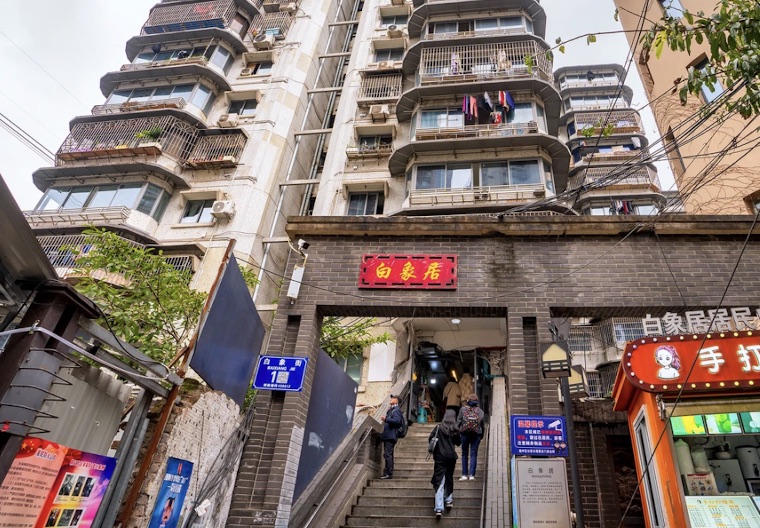
No. 1 Baixiang Street, Yuzhong District, Chongqing (by the Yangtze River, near Chaotianmen)
Intro Copy (App Attraction Listing Page)
Overview
Bai Xiang Ju stands on Jiefang East Road in Yuzhong District, Chongqing. Built in the early 1990s, it is a celebrated masterpiece of modern mountain-city residential architecture, recognized both at home and abroad. The complex is constructed directly against the sheer cliffs above Changbin Road, formed by multiple high-rise residential towers joined together. What makes Bai Xiang Ju truly extraordinary is the building wisdom embedded in how it works with the mountain's natural elevation: the entire structure rises 24 floors yet was never fitted with a single elevator. Instead, three separate ground-level entrances — each at a different height — connect the building to different layers of the city. Regarded as the pinnacle of Bayu mountain-city geometric aesthetics, Bai Xiang Ju carries the everyday memory of hillside neighborhood life unique to Chongqing. Its sky corridors overlooking the Yangtze River and the crisscrossing cable car create a scene of such singular strangeness that the complex has become one of the defining windows into Chongqing's three-dimensional, otherworldly urban character and its ongoing story of urban renewal.
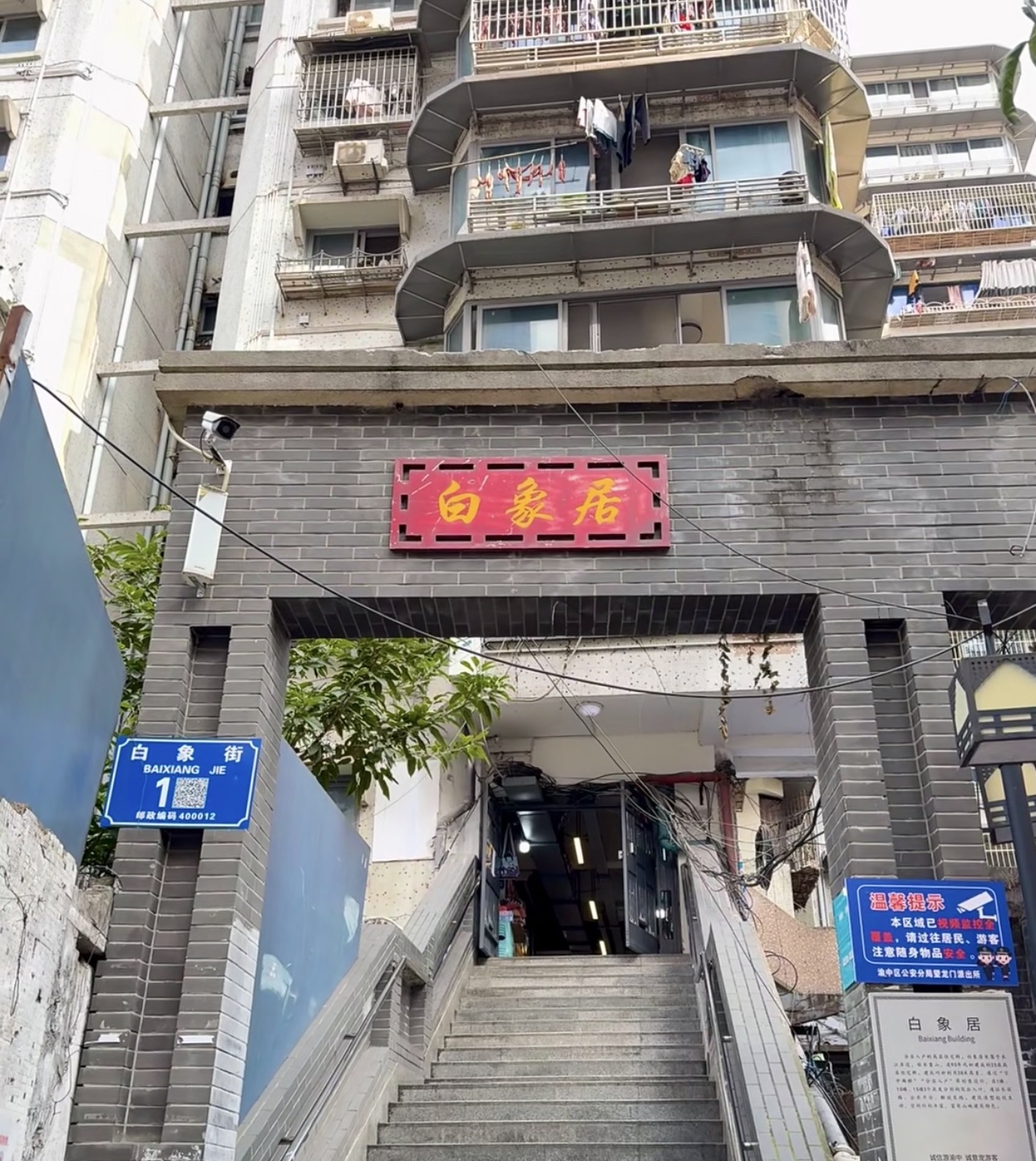
The ground-level riverside entrance sits at the very base of the complex, right beside Changbin Road, and marks the physical starting point of Bai Xiang Ju's vertical journey. The entrance connects raw cast-concrete facades to stone steps below, giving the base a solid, grounded quality characteristic of mountain-city architecture. This transitional space — where the riverside boulevard gives way to the interior of a hillside building — captures the site's defining logic of "perching above the great river," and offers the best vantage point from which to crane your neck upward and feel the full 24-floor mass rising straight from the rock.
Floor 10 — Sky Public Corridor
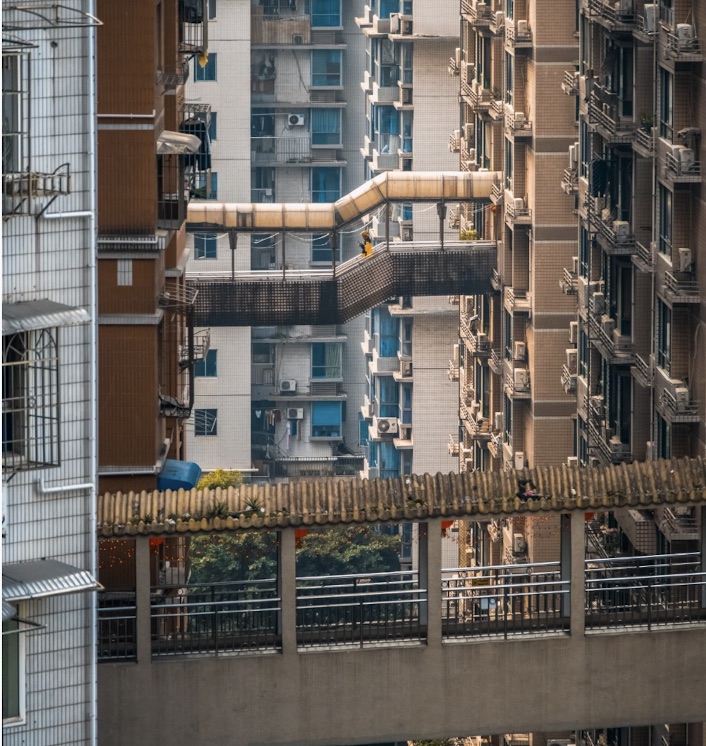
The sky public corridor on the 10th floor is the most iconic space in the entire complex. It is a semi-open suspended walkway running horizontally through multiple towers, stretching several hundred meters in total, functioning as the building's central public street. On one side, the doors and windows of dense residential apartments line the corridor; on the other, the Yangtze River opens up without obstruction. This space is both a perfect expression of the communal ingenuity Chongqing's mountain-dwellers have built into limited space and one of the most visually arresting three-dimensional urban scenes in the city.
Yangtze Cable Car Frame Window
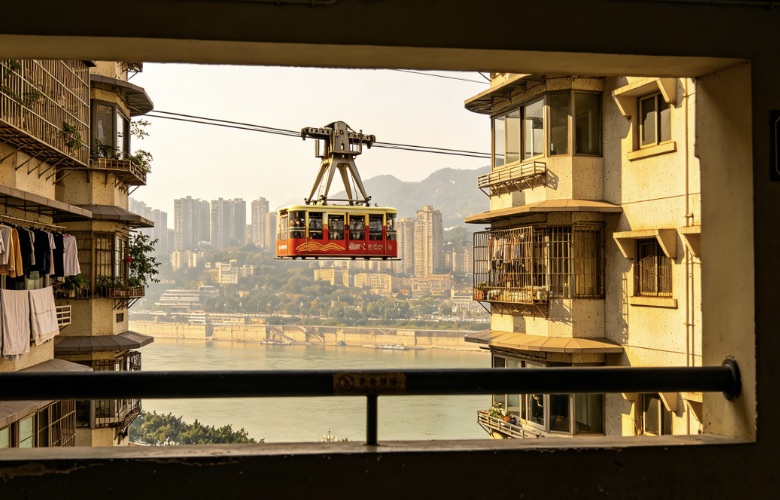
The Yangtze Cable Car framing window sits at the midpoint of the sky corridor and is Bai Xiang Ju's most famous convergence of urban scenery. The space is formed by the building's tall concrete structural frame and an unglazed open balcony beyond, which naturally frames a view of the rushing Yangtze and the Dongshui Gate Bridge spanning it. When a gondola of the Yangtze Cable Car drifts slowly past the opening, the retro transit system and the late-20th-century residential block lock into the same frame, creating a visual resonance across time — a layered, three-dimensional composition unlike anything else in the city.
Floor 15 — Jiefang East Road Exit (Upper-City Connection Point)
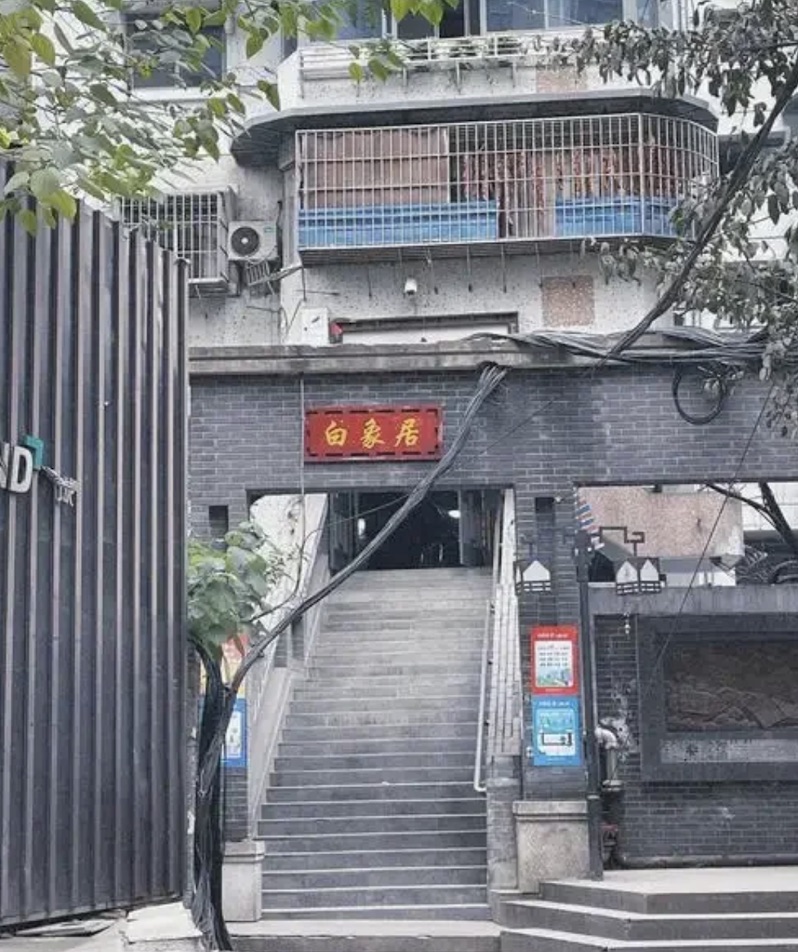
The 15th-floor Jiefang East Road exit is where Bai Xiang Ju's mountain-topography logic reaches its most astonishing expression. A reinforced-concrete flat bridge spans the air and connects the building's internal corridor — at the 15th floor — directly to street level on Jiefang East Road above. This design breaks completely with the convention of a single ground floor and integrates the entire tower into Chongqing's "3D transport network." It is a living textbook for understanding the city's legendary terrain, where buildings double as bridges and streets float in the sky.
Practical infoOpening hours · Getting there
Opening hours
Open 24/7 (residential area, accessible anytime; daytime visits recommended)
Getting there
Rail Transit: Take Chongqing Rail Transit Line 1 or 6, get off at Xiaoshizi Station, walk about 15 minutes
Bus: Take buses 112, 120, 141, etc., get off at Chaotianmen Station, walk about 10 minutes
Taxi/Ride-hailing: Navigate to "Baixiangju" or "Baixiang Street," walk uphill about 5 minutes after getting off
Note: Baixiangju is located on a steep slope; comfortable shoes are recommended
Inside Baixiangju Residential Complex
4 stops, in walking order — read top to bottom, no clicking needed.
The riverside entrance on the ground floor of Baixiangju is the starting point of the vertical tour. It features two 2-meter stone elephants, a 1990s residential block hugging the Yangtze and the famous air-raid-shelter-turned-café that has become a viral photo spot for the Chongqing skyline and cable car.
On-site narration · read it where you stand
Welcome, everyone! You've arrived at Bai Xiang Ju — often called Chongqing's "3D mountain-city residential miracle." Today we'll follow the official route: Floor 1 Riverside Entrance $\rightarrow$ Floor 10 Sky Public Corridor $\rightarrow$ Yangtze Cable Car Frame Window $\rightarrow$ Floor 15 Jiefang East Road Exit — climbing upward layer by layer to experience this legendary 24-floor building that has never needed an elevator, and to feel firsthand the mountain-city spatial ingenuity at its most raw.
We're standing right now at our starting point: the Floor 1 Riverside Entrance on Changbin Road. If this is your first time in Chongqing, the building in front of you is about to rewrite everything you thought a residential block could be. Bai Xiang Ju was built in 1992 and is formed by several towers joined into a single structure. Tilt your head back and look straight up — the building rises a full 24 floors above you. In almost any other city in the world, a residential building of this height with no elevator would be unthinkable. Here in Chongqing, it is simply the solution a designer found by working with the mountain rather than against it. Now follow me up these broad stone steps and into the building. Our vertical adventure begins.
10th-Floor Sky Corridor
10层空中公共连廊
Built in 1996, this 24-floor residential block has no elevator. The 10th-floor corridor links the three towers of the complex, offering unobstructed views of the Yangtze, the cable car, the Raffles City skyline and the Yangtze River Bridge—an iconic filming and viral-photography location famous for Chongqing's "8D magic."
On-site narration · read it where you stand
Great effort, everyone! After climbing through the dense residential stairwells, we've reached the heart of the entire building — the Floor 10 Sky Public Corridor.
Take a moment here. Catch your breath and look around. For international visitors, this walkway is genuinely hard to believe. It is a semi-open suspended passageway stretching several hundred meters through multiple towers. On your left, you'll see the front doors and daily life of ordinary apartment homes. On your right, the Yangtze River rolls past without a single thing blocking the view. In Chongqing, a corridor like this isn't just a passageway — it's the neighborhood's "street in the sky." You may spot elderly residents playing chess here, fanning themselves and chatting, with laundry drifting in the river breeze. This place is a perfect illustration of how the close-knit street culture of southern China has floated up into the air and taken root. Please keep your voices low and be mindful not to disturb the people who actually live here.
Cable-Car Frame Window
长江索道同框观景窗
This framed cable-car shot, captured from the 10th-floor corridor's east end with a 2–3x telephoto lens, places the Yangtze Cable Car and Baixiangju's 24-story walk-up in the same frame. The result—an "8D" composition of building, cable car and river—has become a must-shoot for photographers worldwide.
On-site narration · read it where you stand
Continue along the 10th-floor sky corridor deeper into the building until you reach this wide-open, unglazed window. This is the famous Yangtze Cable Car Frame Window.
Of everything in Bai Xiang Ju, this spot has the most cinematic pull — and is the sharpest collision between Chongqing's cyberpunk present and its nostalgic past. There are three visual layers worth pointing out to you. In the far background: the Dongshui Gate Bridge, its clean modern lines arching across the Yangtze in orange-red steel. In the middle distance: the river itself, wide and relentless. And in the foreground — this is the one that requires patience — the Yangtze Cable Car. When the retro double-deck gondola glides slowly across your window frame, the rumble of the cable mechanism mixing with the horn of a passing river ferry, a working piece of modern infrastructure and a late-20th-century apartment block share the same image at the same moment. This is Chongqing's three-dimensional spatial aesthetic in its purest form. Get your camera ready and wait for that gondola to fly across the river.
15th-Floor Jiefang East Road Exit (Ending Point)
15层解放东路出口(终点)
This 15th-floor exit connects Baixiangju to Jiefang East Road and the Luohan Temple area via a 30-step descent. The platform offers a striking 3D-traffic view of Jiefang East Road, Minzu Road, Cangbai Road, the cable car and double-decker buses, marking the official end of the Baixiangju vertical tour.
On-site narration · read it where you stand
After taking in the cable car view, we leave the 10th-floor corridor and climb five more floors up through the residential stairwells. We've now arrived at today's final stop — the Floor 15 Jiefang East Road Exit.
Pay close attention to what happens next. We've been climbing stairwells inside a residential building — and yet the moment you step through this door and cross a flat concrete bridge of just ten or so meters, you'll find yourself standing directly on a busy, full-traffic city road. That is Bai Xiang Ju's greatest architectural sleight of hand. Chongqing sits on a massive mountain, and the designers worked with a vertical drop of tens of meters to connect the building's 1st floor to Changbin Road at the base of the hill, and then bridge the 10th and 15th floors through separate walkways and exits to other roads higher up the slope. For visitors from abroad, this is the magic-realist daily life of old Chongqing residents: open the door and you're facing a cliff, step outside and you're on a road, climb to the rooftop and there's another road waiting. This building, where architectural history and mountain geometry meet as one, is where our tour of Bai Xiang Ju comes to a close. We hope this climb has given you a real feel for what makes Chongqing such a singular city. Enjoy the rest of your journey.

 2
 3
 4